
The Cinematography of "Solidarity" with DP Mark Mannschreck

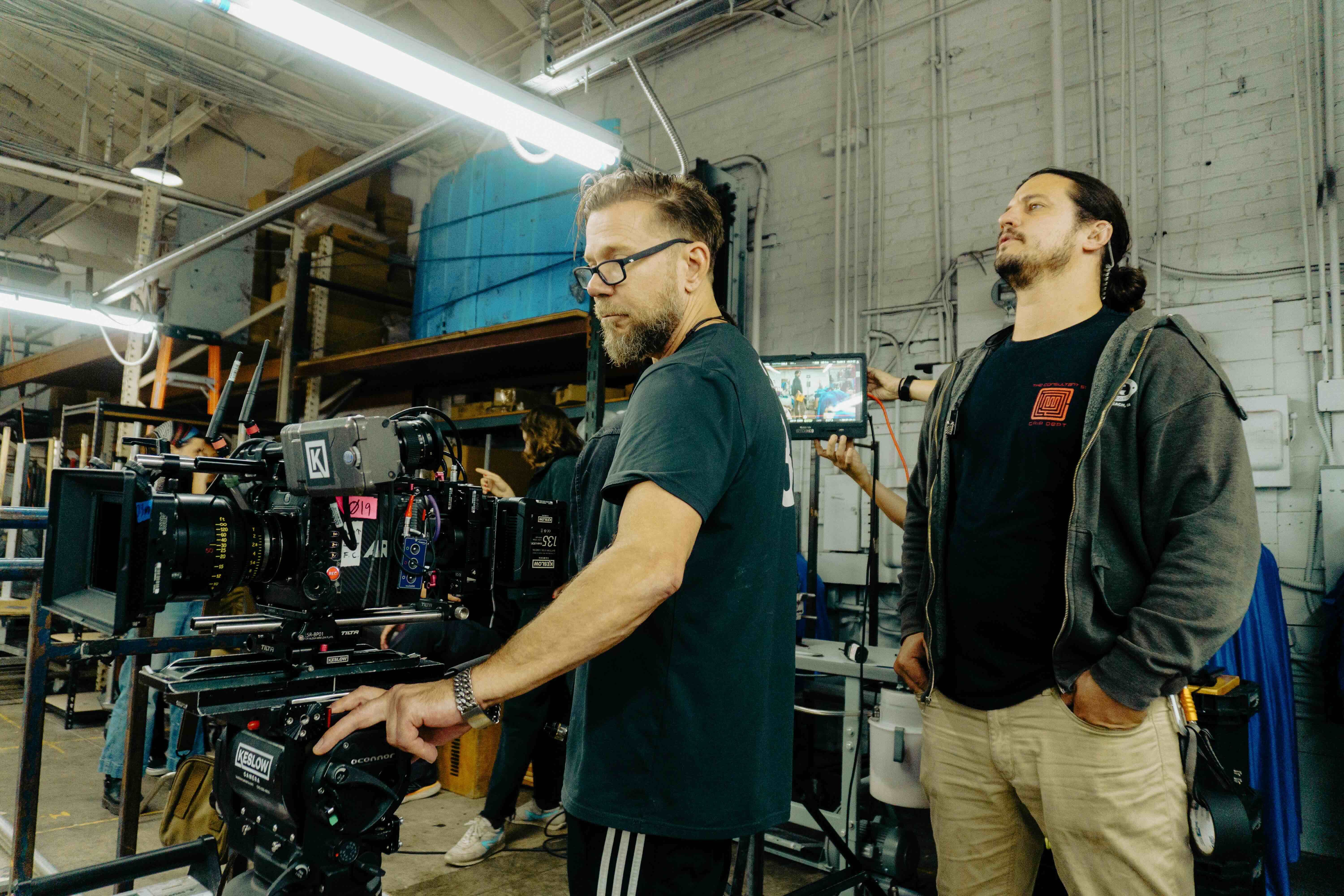
DP Mark Mannschreck behind the scenes of "SOLIDARITY." Image courtesy of Dustin Brown.
When cinematographer Mark Mannschreck began shooting SOLIDARITY in Los Angeles in June 2021, two things started at the same time: a film, and a relationship with the production designer, Clarisa Garcia-Fresco. Nearly five years later, both arrived at the same moment - the film premiering at Dances With Films in June 2026 as the two of them were getting married.
Written and directed by Dustin Brown, SOLIDARITY follows a Mexican seamstress and a Lithuanian butcher struggling to survive as immigrants in LA's Fashion District, their parallel lives marked by loss, labor, and unexpected connection. Shot across four phases on an ARRI Alexa Mini with a Cooke S4/i prime and anamorphic lens package provided by Keslow Camera, the film had its world premiere at Dances With Films on June 19, 2026.
What camera platforms did you test for this project? What qualities were you seeking in your camera choices? What led you to the cameras you settled on?
We tested a handful of camera and lens combinations before we landed on the ARRI Alexa Mini. I wasn’t chasing the newest or most cutting-edge gear — I was after the sensor-and-glass combination that rendered the story in the way that told it best. The Mini’s sensor gave me the latitude and the color response I wanted, and from there it was about pairing it with the right glass.
The Mini is a workhorse. It’s reliable, it has the look we were after, and it’s small enough to get into the kinds of places we were shooting — a run-down apartment in Pomona, a working garment factory, a real butcher shop, the streets of LA at night. In those situations you need a package that can move fast and just keep going.
A big part of why we chose it was how easily it morphs to whatever support the scene needs. The same body could go from handheld to Steadicam to a locked-off head to a slider without becoming a different rig each time. That flexibility mattered to us — we could change the way the camera moved scene to scene without slowing the day down or rebuilding the package around it.
On the technical side, we recorded ProRes 4444 in Log-C at 24 fps with a 180-degree shutter, and rated the Mini at its native 800. I worked between a T2.8 and a T4 — shallow enough to keep the focus where I wanted it, and still able to hold detail down in the shadows without the image falling apart.
There was a lot of night work, and the Mini’s latitude in Log-C let us hold the shadows without the image falling apart and still move quickly when conditions weren’t on our side. On the bright exteriors it was the opposite problem, and the Mini’s built-in ND let me pull my stop back down where I wanted it without stopping to swap filters.
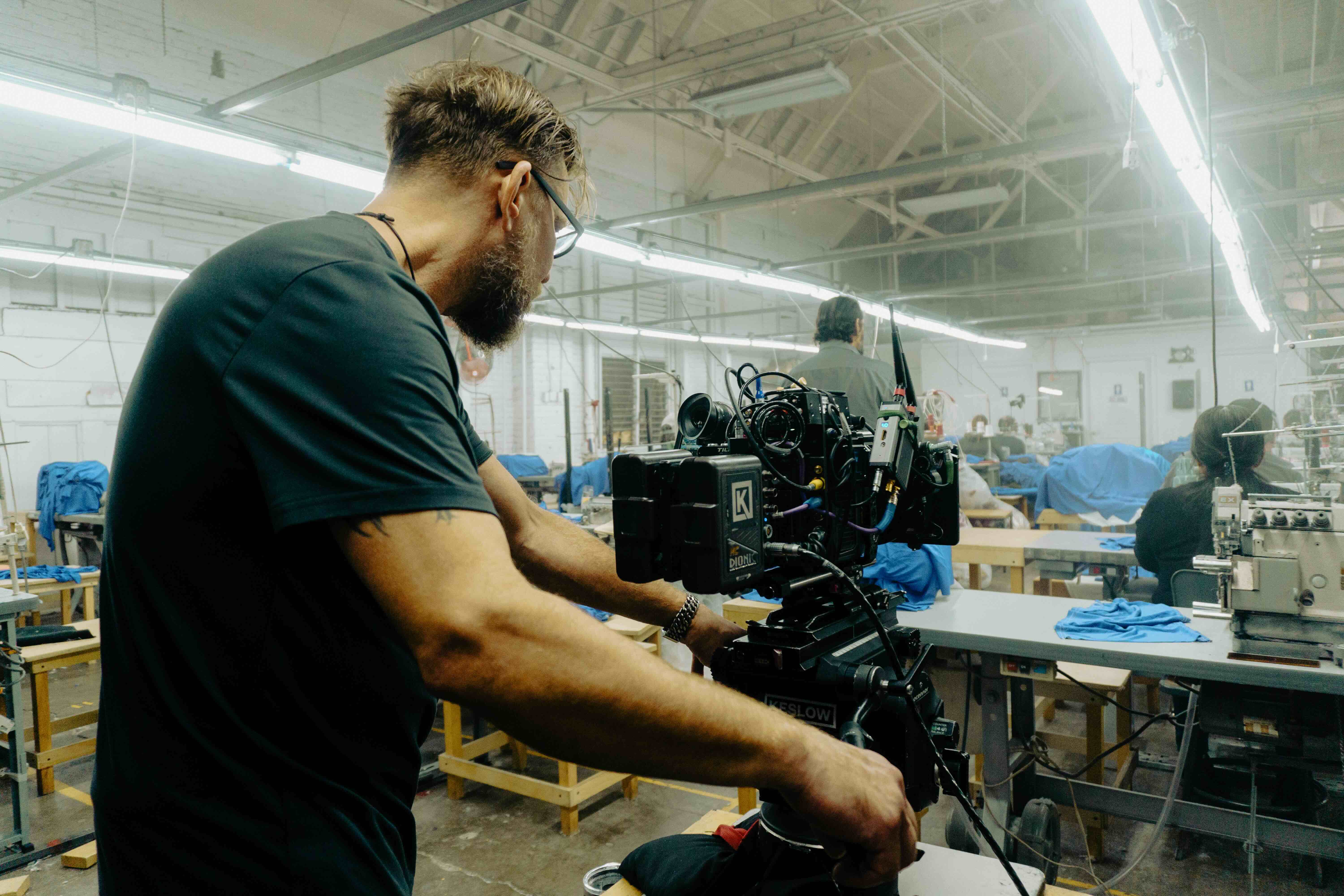
DP Mark Mannschreck behind the scenes of "SOLIDARITY." Image courtesy of Dustin Brown.
What drew you to this story? Were there any specific moments or visuals in the script that stood out to you upon your first read?
For me it always came back to the short. Dustin and I made the original Solidarity together in 2013 at Santa Monica College, and it had a run none of us really expected: Clermont-Ferrand, the Cannes Emerging Filmmaker Showcase, a BAFTA Student Film finalist, Best Dramatic Short at the San Diego Film Festival, and a stack of other festival awards along the way.
So when Dustin went through AFI and wrote the feature, it didn’t feel like starting something new. It felt like picking up something we’d already begun. We knew these characters and we knew this world. We’d been living with it for years, so there was no cold first read — it was more like coming back to old ground and seeing it again.
What lenses did you shoot with? Were you seeking certain optical characteristics?
The lenses are where the look really splits in two. For the grounded, real-world part of the film we shot Cooke S4/i primes — 18, 25, 35, 40, 50, and 135mm — plus a set of the compact miniS4/i in 18, 50, and 75mm for the tighter spots where the full-size glass wouldn’t fit. I’ve always liked what the Cookes do with faces. There’s a humanness to them, and they don’t call attention to themselves. The 40 is the one I keep coming back to, with the 35 and 50 in steady rotation, a 25 when we needed to open the frame up, and a 135 on the rare occasion we needed to reach in.
For the surreal sequences we went anamorphic. Early on that meant Kowa anamorphics — that was what Keslow had available for us in the first leg — and when the Hawk V-Lites opened up later, we moved over to those. Either way, the effect is the same — the second you put an anamorphic on, the whole image changes — the distortion, the flares, the way it compresses — and that helped set those sequences apart from the grounded material.
For a film like this, our working stop of T2.8 to T4 felt the best for most scenes. Dustin and I had a few friendly arguments about that. Focus is one of the strongest tools we have for telling the audience where to look, and I didn’t want to give that up.
My favorite focal length in Super 35 is a 40mm. A 35 feels a hair too wide to me, and a 50 often feels too tight once the camera’s moving. The 40 just sits right.
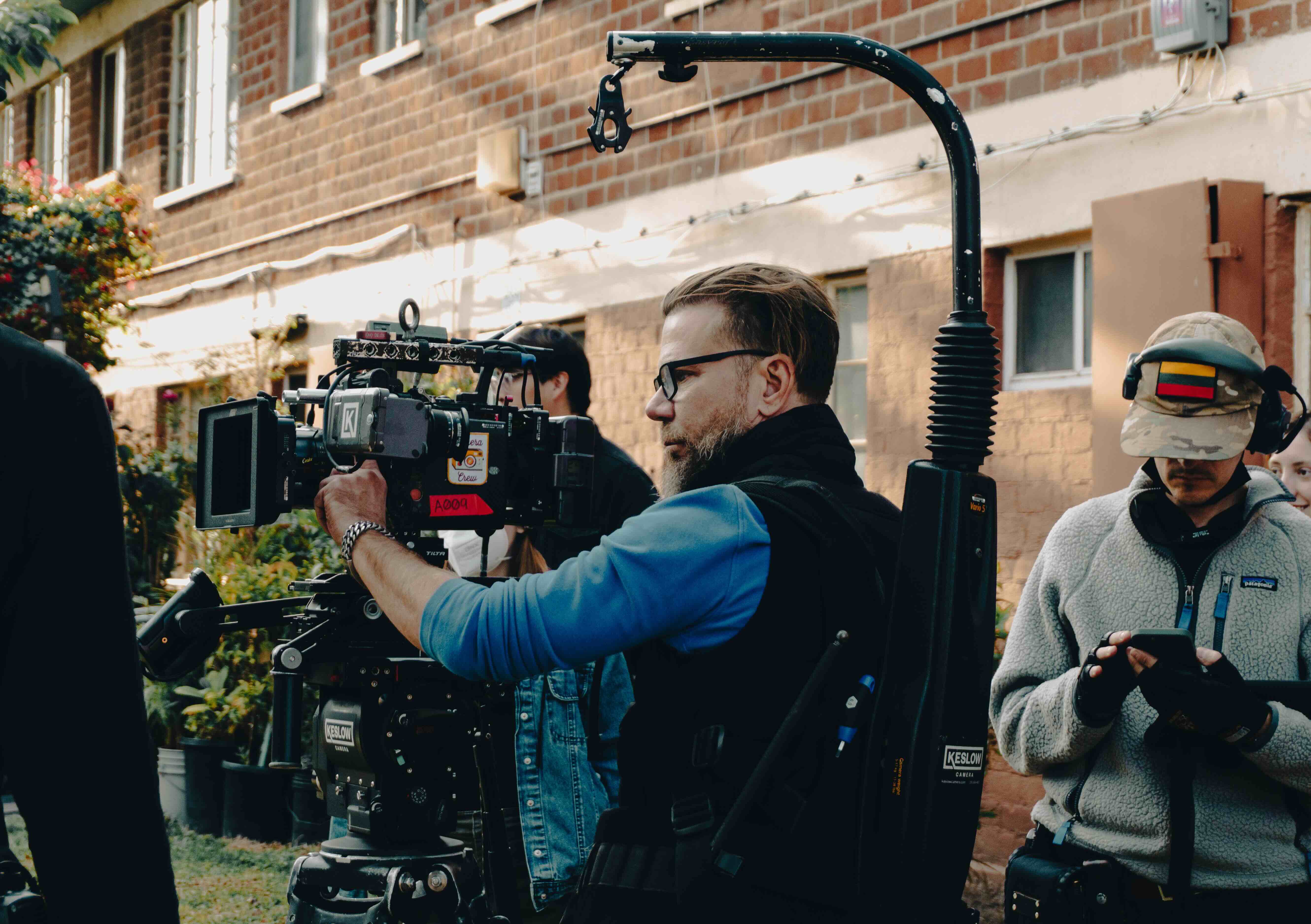
DP Mark Mannschreck behind the scenes of "SOLIDARITY." Image courtesy of Dustin Brown.
How would you describe your visual approach to the project?
Composition is something I have to find in the viewfinder, and I can’t get that on a monitor. That’s why I need to operate. The more I analyze a frame, the worse the composition always seems to get. I think it comes down to the weight of the frame. We short-sided people a lot — pushed them out toward the edge of the frame — because we wanted the world around them to feel big, sometimes a little too big. I’m also fine letting part of the frame fall off into black. Not everything has to be lit.
The locations were the real challenge, especially at night. We couldn’t just flood everything with even light and move on — it had to feel like it was coming from the place itself. So we leaned on practicals, soft color-tunable LED, and big overhead diffusion and bounce, with negative fill to carve it back down. A lot of the package was battery RGB, Astera tubes especially. We needed lights that were color-tunable and battery-powered, so we could dial in a color without running power to it — and in tight locations that paid off over and over. When we needed a bigger soft source, we’d bring in Creamsource Space units.
Camera movement we worked out scene by scene, and most of it came through a few kinds of support — handheld, Steadicam, a Ronin Pro gimbal, a Dana Dolly slider on speedrail, and locked-off. Each one carries its own pace, and a lot of the job is matching the support to the timing a scene wants. A lock-off lets a moment sit and makes the audience wait on it. The slider gives you a slow, deliberate push that builds without anyone really noticing. Steadicam floats alongside a character. The Ronin Pro gimbal gave us a smooth, floating move we could take anywhere — sometimes on an Easyrig Vario 5 to carry the weight, and sometimes on my own Exhauss exoskeleton for the longer takes, or when I needed to boom above my head. And handheld puts you right in the middle of it. How long a move runs, when it starts, when it settles — that timing is as much a part of the cut as anything in the frame.
I come at this partly as an editor, and I think a DP has to understand how the shots are going to edit together. You’re not just making nice frames in isolation — you’re shooting pieces that have to assemble into a scene. If you’re not thinking about the cut while you’re on set, you’ll come up short in post. None of it was movement for its own sake — it came out of what the scene needed.
I love handheld. It’s also the most grueling, and the hardest to master, I think. The mechanics you can pick up fast, but operating handheld well isn’t really a mechanical thing — it’s instinct. Knowing when to drift and when to hold, when to let the frame breathe with an actor instead of chasing them. You can’t get that out of a manual. It lives in your hands, and it only comes from doing it for years.
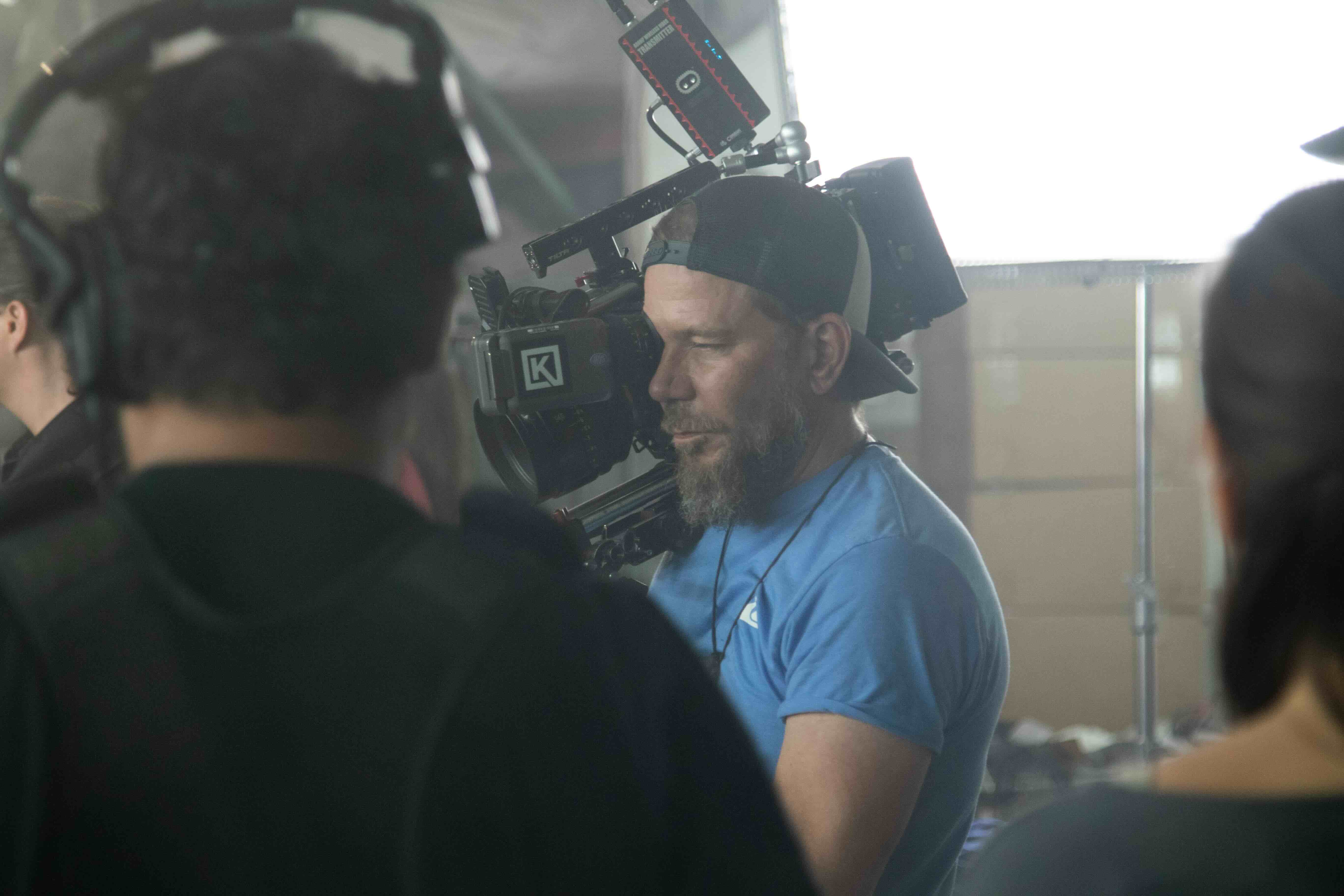
DP Mark Mannschreck behind the scenes of "SOLIDARITY." Image courtesy of Dustin Brown.
When it comes to your experience making this project in particular, how did working with Keslow Camera help bring the film to life? Were there any challenges during the production that Keslow was able to alleviate?
We shot the film in four phases over a long stretch of time. The first phase was 14 days back in June of 2021, and the work ran all the way through the later Lithuanian Days material. Over a timeline like that, consistency becomes a real problem to solve.
Keslow was part of this from early on — our camera and lens package and the dolly all came through them, and they stood behind the production across every phase. On an independent film carried over this many years, that kind of support is a lot of what makes it possible at all.
The other tricky part was holding continuity while the package itself kept evolving. We switched from the Kowas to the Hawk V-Lites mid-production, and Keslow made that transition painless. What I value most, though, is reliability. Across all the years we spent on Solidarity, I can’t really remember losing meaningful time to an equipment problem. On an independent film, that is enormous.
Is there anything about the experience of making this project that has impacted your creative process going forward?
This one was personal in a way most jobs aren’t. I met Clarisa Garcia-Fresco Mannschreck on this film, where she was the production designer, while we were scouting and shooting. We started the film and our relationship at the same time, back in June 2021 — and now, almost five years later, the film is finally finished and premiering in June 2026, right as we’re getting married. The two have run side by side from the very beginning.
Working alongside her changed the way I think about the relationship between production design and camera. When those two departments are talking from day one, the whole image gets better. The best work I’ve been a part of has come out of exactly that kind of collaboration.
It also reaffirmed something Dustin and I have always held onto: real locations matter. A working garment factory, an actual butcher shop, real streets at night — those places carry a history you can’t build on a stage.
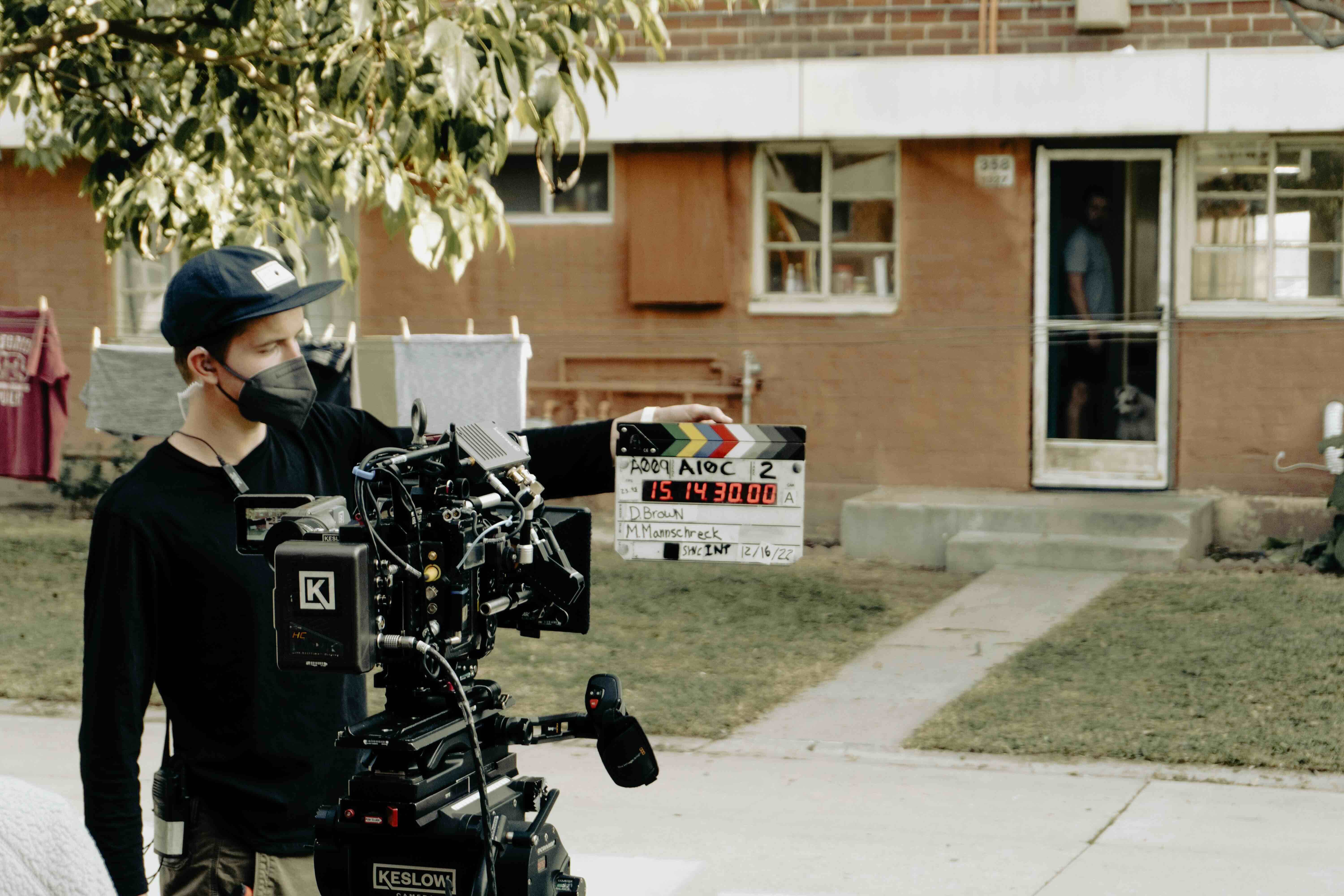
Behind the scenes of "SOLIDARITY." Image courtesy of Dustin Brown.
What was your journey to becoming a DP?
I’ve been doing this for more than thirty years now — shooting, directing, editing. I never sat down and decided to “become a cinematographer.” It happened one project at a time. A lot of the job is figuring out what actually matters and learning to tune out the rest.
I feel the best directors want a DP who pushes back when something isn’t working rather than waste precious time on set — to an extent, of course.
What advice would you give to aspiring cinematographers who are inspired by your work?
People get too wrapped up in the gear — cameras, lenses, LUTs, whatever the internet is excited about that week. Before you make a choice, know why you’re making it. Why this lens? Why this frame? Why this move?
The gear matters, but the story matters more. And find people you trust and keep working with them. This job is hard, and the right collaborators make all the difference.
How do you stay inspired as a creative?
A lot of what feeds me comes from outside of film. I started in music videos, so rhythm and music are baked into the way I see composition. My mom was an artist, and she inspired me from an early age.
I shoot a lot of stills too. After the Eaton Fire, we were living in temporary housing for four or five months in DTLA, and I got back into street photography. Walking around reacting to whatever’s in front of you is a good reminder that not everything has to be planned.
DP Mark Mannschreck behind the scenes of "SOLIDARITY." Image courtesy of Dustin Brown.
Are there any members of the camera department or production team in general you’d like to acknowledge for their contributions to the project?
Dustin Brown. We’ve worked together a long time — the original short, the feature, a run of Last Chance for Animals campaigns — and by now we have a shorthand that makes the work go faster.
Clarisa designed the film. The whole physical world of it is hers, and a lot of what holds up in the frame holds up because of what she put there.
On the crew side, the gaffers kept the look consistent across every phase — Jeff Peters got us started, then Saulius Lukosevicius and Arthur Garcia took it through the rest, including the night street work. My 1st AC, David Bostrom, has to be given credit for nailing focus at those wide stops through complicated moves — at a T2.8 there’s no room for error, and he kept it sharp on the night exteriors and the run-and-gun days.
Frederik Bokkenheuser colored the film at Picture Shop in Burbank. Freddy is a pro and truly understands the DP’s intent. He doesn’t step on the shots — he really helps plus them out. He also grounded the scenes and let the anamorphic material go its own way, which is a big part of why the two worlds feel so different.
Are there any members of the Keslow Camera team you’d like to acknowledge for their support of the project?
The whole Keslow LA team, really. Mel Mathis (SVP, Marketing) is the one who made it all possible — she got us set up and kept the support coming across every phase. Zachary Patino (Former Marketing Agent, Los Angeles) helped get our gear sorted from the very first phase, and the wider LA crew has backed this project through every stage, and plenty of my other productions over the years. They understand what we’re trying to do, and they make sure we’ve got what we need to do it. [x]
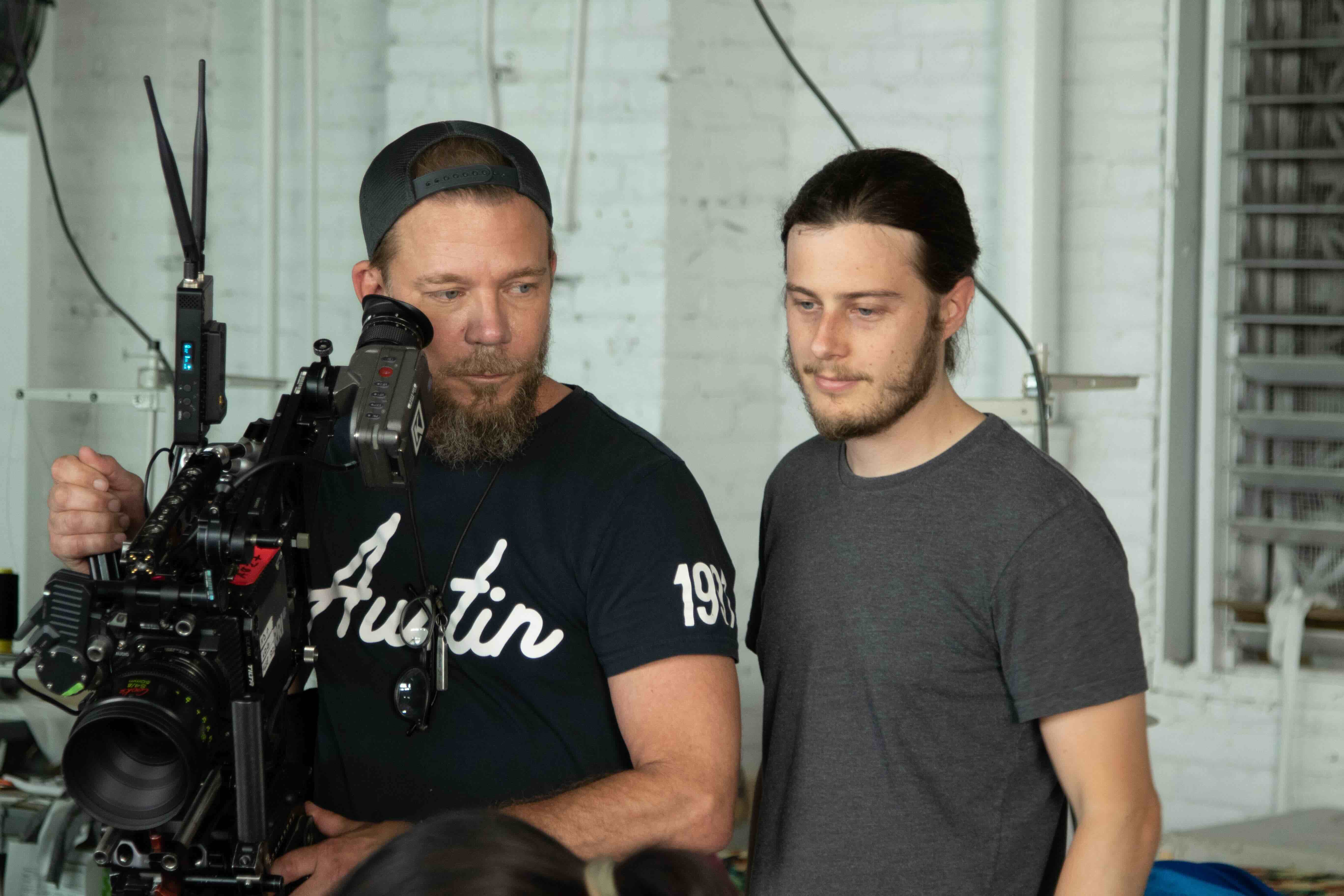
DP Mark Mannschreck with director Dustin Brown behind the scenes of "SOLIDARITY." Image courtesy of Dustin Brown.