
The Cinematography of "40 Acres" with DP Jeremy Benning, ASC, CSC

DP Jeremy Benning, ASC, CSC, on set of 40 ACRES, a Magnolia Pictures/Mongrel Media release. Photo by Rafy. Image courtesy of Jeremy Benning, ASC, CSC.
In 40 ACRES, the feature debut from director R.T. Thorne, Hailey (Danielle Deadwyler,) the matriarch of a family of farmers in post-apocalyptic Canada, is forced to defend their land and the ones she loves from violent, cannibalistic marauders who have decimated the local community of survivors.
Nominated for “Theatrical Feature Cinematography” at the 2025 Canadian Society of Cinematographers Awards, Keslow Camera connected with DP Jeremy Benning, ASC, CSC, to discuss all things 40 ACRES, from working in the unpredictable elements on a functional farm, to seamlessly blending practical and visual effects to make the film’s not-too-distant, post-apocalyptic future a reality.
The film has a very earthy color palette. How much of that look was determined on set versus in grading, and how much of it was accomplished using filters? How did you hone in on the approach and the look generally?
Our director, R.T., had prepared a lookbook for the film that he shared with both myself and Peter Cosco, the Production Designer, and that was our road map to begin with. All of the colors you see in the sets were selected with Peter. Peter, R.T., and myself worked together to choose paint finishes and set decoration pieces, costumes, that kind of thing. All were tied together in that way, even down to the vehicles that they drove, because a lot of what we were doing was being created.
A lot of it was about choosing the right locations, because the film relies on the real places on the farm itself, the exteriors of the farm. There's a couple different exterior properties, and we chose places based on look and tone, and also just logistically, how they would serve us in terms of the scope of the work we have to do. And then there were some set builds. The basement bunker, or “the boot” as they call it in the film, was a set piece. And then there's the bedroom. The bedrooms were set pieces, and the dungeon holding cell that the bandit characters have, that's also a set. Everything was built to tie into real locations.
I didn't use filters in the camera. All I was doing really was adjusting the color balance of the camera and the LUT that we created in advance of the film, which was just a subtle contrast LUT really. It wasn't anything too extreme. I would say that the bulk of the look visually was in the final color grade. R.T. and I looked at some examples, we played around with it a bit, and he really wanted to avoid it being your stereotypical desaturated, bleak, post-apocalyptic look. He wanted it to have more saturation and more richness and earthiness to lean into that, as opposed to going for your typical clichéd desaturated look. We actually looked at a more desaturated grade, and R.T. was like, “No. This is too on the nose for this world.” So, yeah, we figured that out in the final stages of the grade.
On the lenses specifically, there's a lot of really beautiful bokeh in the film. There are really prominent flares that come through in multiple scenes that complement that sense that we're in nature, or on the farm. What qualities were you looking for when you were testing your lenses, and why did you settle on the lenses that you went with?
We did a pretty extensive test. And our team, lead by 1st AC Craig Morgan, was involved with that with me all the way along. As part of the lens testing, we were also comparing cameras. So we wanted to compare the ARRI ALEXA 35 to the Sony VENICE 2, which I’d never used before, and do a side by side comparison.
We spent a day at Black Creek Pioneer Village in Toronto, which is a historic farm property, and we did our testing there, knowing it'd be similar tones of old barns and that kind of thing. We did a comparison of spherical versus anamorphic, with two or three different kinds of spherical primes. It was an all day test of evaluating multiple sets of lenses on both cameras. We did that in various day, interior and exterior settings with people with darker skin tones, just to see the real look of the cast, male and female.
We then did a night exterior, a simple lighting shot of a barn in the background, and we compared both cameras and their high ISO modes. And, so after all that testing, we ended up landing on the ALEXA 35 and the MasterBuilt Soft Flare primes. When R.T. and I both looked at the lenses, we liked the slightly vintage look. They were still pretty sharp, but they had softer edges. It was a slightly older feel. It's a good sense of grittiness of the world, without too much character or too dirty looking, but also not too sharp and clean. So it was that sweet spot in those lenses.

A fully outfitted ARRI ALEXA 35 with MasterBuilt Soft Flare Primes, on set of 40 ACRES, a Magnolia Pictures/Mongrel Media release. Photo by Jeremy Benning, ASC, CSC. Image courtesy of Jeremy Benning, ASC, CSC.
When we looked at the test, we went to Urban Post. We saw the footage projected. And the Alexa had just that extra bit of detail in the very bottom end of shadow that, especially with our contrasty day interiors, night exteriors, that kind of thing, and knowing that we had a cast of a lot of different skin tones, but a lot of darker skin tones, that having that extra bit of detail to pull up in the grade if we ever wanted to lift someone's face a tiny little bit here and there, that would give us the most flexibility given the nature of our schedule.
So that's why we ended up going with the ALEXA 35, but my hope was that we'd actually would love the VENICE 2 because the ND system obviously is more advanced. It has more ND stop range from 0.3 to, I think it's 2.4, but in one stop jumps, which knowing the nature of an indie feature and a lot of day exterior shifting conditions, that quick filter changing ability is huge. But I ultimately realized that, from a post standpoint, that having that extra shadow detail would beat out the concept of the ND system.
As far as the two cameras, the high ISO, which we used occasionally, the ES mode in the ALEXA 35 and the dual ISO in the VENICE 2 - I thought that they were basically almost exactly the same in terms of noise level. I couldn't tell the difference between the two, so it was really the shadow detail that won us over with the ALEXA.
It's definitely a unique approach to testing to actually go on to a location and have lighting conditions and scenarios similar to what you’ll be shooting, which I feel is probably much more useful than doing camera tests in a sterile environment where you're just looking at a lens chart or something like that.
Yeah. And we talked about that. It's like, why don't we go out into the world in a similar looking place with real daylight and real textures and dark interiors with natural light through windows. Let's just go as close to the real places we can, because Sudbury is too far away for a test. I think that was a good decision to make.
It added a little bit of extra cost and logistics to the production, but I think it allowed R.T. and I to really pick the right tools. That's how we created our LUT as well. Based on those tests, we went to Urban Post and worked with our colorist, Jim Fleming, and our DIT, Kent McCormick, and we came up with a LUT based on those tests because we knew this was very close to what the real place would be like. So that helped a lot.
On the note of the lighting, you touched on doing a lot of day and night exteriors in these large spaces with great scope. You're in nature, and so you don't have a lot of opportunities to necessarily be hiding units out of frame. What was your general approach to lighting, especially in some of these sequences, when you're in the barn and you have all of this sunlight pouring in through these slats of wood, or perhaps in the third act where we've got this moonlit haze across the cornfields?
Well, I guess there's three approaches. One was just straight up day exterior. Two is day interior, but with a lot of natural and augmented light coming into the day interior, and then third, you've got night exteriors. The straight up day exteriors, where it's just the family in the fields or that kind of thing, was largely driven by just time of day. We chose our angles and scheduled around the best time of day for that light knowing that we're not gonna be really lighting anything, and we have to embrace the sun as it's playing because I can't afford the time or the logistics to control a huge area with an overhead fly swatter.
That was literally just 12x12 Ultrabounces and bleached muslins and some negative fills on frames that we would play in and around those big wide shots just to catch people's skin and eyes a little bit. Then that barn sequence inside, where he's holding the girl captive, that was the real barn of that location that you see. The owner of the farm, Connie, she was super sweet and cooperative, and she'd lived there since she was a child. It had been in her family since the twenties, so she grew up working that farm. We asked if we could cut some holes in the side of the barn where there's some window openings, which she let us do. And then, you can see the slats of light through the barn in those openings, and we were able to hide some 4Ks on some tall Long John Silvers, those big tall stands outside, and we were able to get it in the right angles that they could come through and make some pools of light in the barn and not be seen through the slats.

A look at a night exterior lighting setup for 40 ACRES, a Magnolia Pictures/Mongrel Media release. Photo by Jeremy Benning, ASC, CSC. Image courtesy of Jeremy Benning, ASC, CSC.
For the night exterior work, we have this massive area to cover, between the house and the barn. There's a lot of action that happens in between that area that's a fairly wide span. So we had this plan. My gaffer, Nigel Hartwell, and my key grip, Wayne St. George, we went to the location, a few weeks in advance, just the three of us, and walked around. And I had an idea of, “I think we need to put a lift here.” We needed three lifts that we can put behind each major structure so that at night, we can hide them behind the structures. And that way, no matter which way we look, we've always got a fill, a key, and a backlight if we want it, and we can adjust the level. So we scoped out spots where we thought we could get them into, which potentially could be pretty problematic because this is a working, very old farm property where there's lots of junk laying around. The ground's super uneven. If it gets wet, it's gonna turn into a mud pit. How do you get a multi-thousand ton lift into these positions? But they were confident that with the right amount of prep, we could do it. So we managed to figure that out so we could get these lifts in place.
And then the plan was that in the daytime, the lifts will be fully lowered down, shrunken up, and then we would cover them in areas where we couldn't avoid seeing them, behind the barn, for example. We would just cover them with huge aged tarps. And that way, they just look like big pieces of farm equipment. There’s a couple shots when we’re in the cornfield near the barn, and you look back towards the barn, you can see this green machine thing covered in fabric. That's actually one of our night lifts just hidden away, because we realized we wouldn't be able to bring the lifts in and out. Logistically, manpower budget, all those things. Once the lifts came, they'd have to just stay there for the three weeks that we were at that property.

A look at the exterior lighting setup for 40 ACRES, a Magnolia Pictures/Mongrel Media release. Photo by Jeremy Benning, ASC, CSC. Image courtesy of Jeremy Benning, ASC, CSC.
At night, we had an LRX Single HMI on each lift, and we had two Cineo Quantum IIs, which are Cineo’s version of a ARRI S360. We had two of those on each lift with the Vulture mounts from LRX. You can pan and tilt them and their egg crates, which at night was great because we could pan them around, create pools of light, control their color and intensity, all that. We used the LRX Singles on each lift to fire light super deep across the cornfield. So if you're looking from the barn or anywhere, and you see between the buildings and you see that night horizon way out there, we would use one of those lifts to just pan the LRX head around towards the horizon, just full spot it, and find a little detail of the horizon, which is the forest that was a couple kilometers away. So, everywhere we looked, we used a combination of all three lifts to create fill, backlight, and a distant horizon look, and we could do it relatively quickly, because we didn't have a lot of time to turn around, and the scenes are really big and huge. We had to be lit super fast all the time, and so that was our night approach. We wanted to make sure the distant perimeter was present.
Even that cornfield work where you mentioned the fog. There's a sequence where you see them coming across the field, returning back to the farm at night, and it's a procession of all our heroes. They're silhouetted in the fog. That was actually real fog, by total fluke. We had the lifts I just mentioned on the farm, but then we also had an LRX truck parked on the next road over from the farm. The idea was to light the cornfield with that at night because we were gonna shoot the sequence of them coming back in the cornfield and across the hills at night. So we were just gonna park the LRX truck a kilometer away. We're gonna focus all six heads towards us and fan them out to create this super weak edge light. And it just so happened that that night, a crazy fog rolled in. It was just a total serendipitous thing, and it lasted all night. Then, the shootout in the cornfield, it was a combination of real fog, and VFX fog, which was a great match to the real fog. So we got super lucky that way.

An LRX Truck a kilometer away backlights real fog behind star Danielle Deadwyler in 40 ACRES, a Magnolia Pictures release.
With the day exteriors, it was September into October in Sudbury, when normally the weather is pretty tumultuous. We got so lucky with consistent sun. We had perfect sun with a bit of cloud every day, that for the most part, allowed us to stick to our plan of, “By this time of day, we should be looking in this direction. And this time of day, we should be over here.” So we had good luck from the sun gods and a little bit of the fog gods, I guess. (Laughs)
The plan of those multiple lifts was a bit of a logistical burden for the production. It was expensive, but Cinelease gave us an amazing deal. Shout out to those guys. They were very supportive of the project, and they really helped us have that gear. We couldn't have done it without those lifts to get that look and the scope of what you see. That allowed us to have that huge scope at night looking in any direction. So, I'm really thankful that they did that for us.
Extremely fortuitous that that was natural fog, because watching the film, it's such a striking visual. I immediately thought watching it, “Wow. They must have had some very powerful hazers out there in the cornfields to accomplish that.”
Yeah. I mean, it's crazy because when R.T. wrote the last part of the film, that whole night sequence was written to be dense fog. We basically had to acknowledge that we're gonna have to do some of this with VFX, because there's no way we can fog areas that are that huge. So the sequence you see in the with the shootout in the cornfield, when they first get back, that was VFX fog.
We shot that clean. But we had done some tests as part of our camera test day to have our VFX vendors show us some tests of what they could do with fog. So we did some night work on our test day, and they added some test fog. There was supposed to be more of it, but just from a budget standpoint, the scope of it got shrunken down to that one VFX fog sequence. But then what's great is that the biggest, widest landscape, night fog work, that was real fog. So we got lucky with a good hybrid of the biggest stuff that was real fog, and then the smaller scope was VFX.

Kataem O’Connor and Milcania Diaz-Rojas in 40 ACRES, a Magnolia Pictures release. Photo courtesy of Magnolia Pictures.
Regarding the visual effects and special effects realm, what challenges came along with having so many visual effects in a project like this? Particularly, there's a lot of muzzle flares and gunfights. Were you using actual blank firing weapons, or was that accomplished in post? There's this fantastic climactic fight scene when the lights are shut off in the house, and it's all illuminated by the muzzle flares. How do you approach a sequence like that and make it feel natural and organic?
First, I think the most challenging thing overall VFX-wise was the cornfield. Because the cornfield that we see at the family's farm, that farm didn't actually have a cornfield. And, again, Connie was very cooperative with the film, wanted to help out. They were willing to clear a section of the hayfield for us so we could make our own cornfield. We worked with a local farmer that was in a nearby town, where they had a real cornfield, that was the right sun direction. It was the right scope. It didn't have houses or anything on the edges that were problematic. The main beginning sequence when all the bad guys are coming through the cornfield, that was the real cornfield.
We shot that there, with the idea that we would then connect to them approaching the family farm. As they're getting right up close to the actual house and the barn itself, that was basically a real cornfield that we planted. We transplanted corn from the real cornfield to the location farm. I think we planted a 60x60 square area. We did some testing with a drone and Artemis viewfinder, checking if it was enough. “How much do we need for the number of people to come through? What's the smallest amount of corn we can plant that still works knowing that we're gonna have to do some VFX extension?” But then it's like, where does that VFX extension begin, and how much can we afford seeing that? We didn't really know upfront, how many of these VFX shots can we actually afford. So we have to shoot in a way that there might be very few VFX shots - we can't rely on it entirely.
So we had this 60x60 patch, and I think it was a couple thousand corn plants, full grown stalks of corn that were hand transplanted. I can’t recall the number exactly, but it was in that ballpark. So that was a huge challenge of, how are we gonna do that? We didn't really have a VFX supervisor at the time. So it was between R.T. and I knowing our own experiences working with VFX, how to shoot that because we didn't have anyone with us, advising us.
There's some drone shots you see where the VFX team added the cornfield in the distance, or they expanded it as the guys are approaching it. So there is some VFX work in the drone shots, and we knew from our own planning and concept drawings, where the cornfield would be. So when we were framing it with the drone and the guys walking, we knew, “Okay, the cornfield will be roughly here in the frame.” So we knew how to frame for it, and when they would approach the edge of it, and how long it will take them to get through the cornfield before they get to the actual hero house. That was tricky because also, after the corn was transplanted, it started to die.
We wanted it to be not fully green, and we wanted it to look sickly because that's a story point. But it got too sickly in some places where it's like, “Oh, wow. It's really yellowing after a week of being transplanted.” So we had to figure out, story-wise, a way of saying, in VFX, we'll treat it that there's patches of yellow in amongst the big corn fields so that we can make it a story point that the corn isn't doing well, parts of the crop are dying.
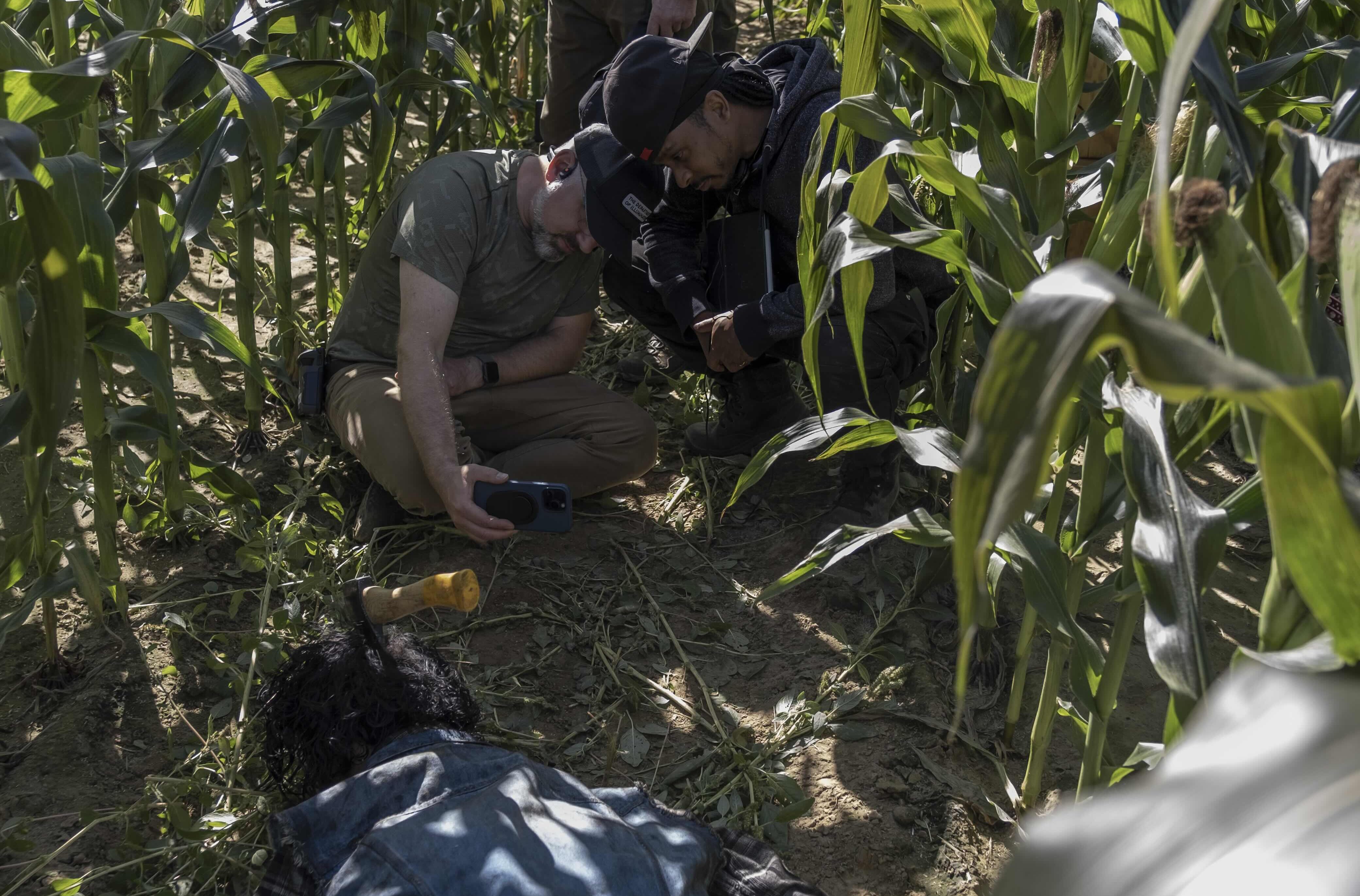
(L-R) DP Jeremy Benning, ASC, CSC, and director R.T. Thorne, line up a shot in the cornfields on the set of 40 ACRES, a Magnolia Pictures/Mongrel Media release. Photo by Rafy. Image courtesy of Jeremy Benning, ASC, CSC.
On the muzzle flashes, we had a combination of fully VFX muzzle flash where there's no blanks at all, and then there's a couple sequences where we knew we needed to use blanks; one is the finale when they come back through the fog at night, and she's shooting at the bad guys in the cornfield and running from them to the barn. That was real muzzle flash. We knew it would be the best effect for that night sequence. Real muzzle flash, real blanks, which obviously everyone was concerned about the safety of that. So we really wanted to limit it to just those moments.
The sequence you mentioned in the house when the lights go off, R.T. had written that in. That was designed that way from the start, and we looked at references from ‘The Batman’ in particular. There’s a sequence in a dark set where there's all this muzzle flash, and it's all lit by that. So we were like, “Okay. That's the benchmark of how to achieve that.” We studied that, and that was because from what we had read, that they used real muzzle fire. We talked about doing it that way, and we had a safe way of doing it, but we just didn't have the time. We just knew that there's no way we're gonna have time on the day to do it. Because every time, with a real gun with blanks, the process of checking the gun, and safety and all that, for every single piece would have tripled the amount of time, if not quadrupled the amount of time it would have taken to shoot the sequence.
VFX muzzle flashes are something I had sort of done before on The Boys and The Expanse. We had sequences where we wanted interactive muzzle flash, but we didn't want blanks. So we came up with a way of creating an LED ribbon that wraps around the muzzle of the gun that can be triggered with a flash effect to look like muzzle flash. And then, of course, VFX adds their muzzle flash over top of that. You get the interactive light, and you get the real look of a muzzle flash with post. Jeff Moss at MossLED and I had done this a couple times in the past, and we came up with this. Because the thing about the muzzle flash is that it has to have the right decay so that it looks like real muzzle flash. Real muzzle flash has a half frame of ramp up or so, and a frame and a half of ramp down, and a full frame of bright. You need that subtle little attention to detail. Otherwise, it's just a blip. Oftentimes, the camera doesn't even capture it properly because it's too short of a burst. You get that split frame thing. So we did a lot of testing to design a chip that was programmed to have the right flash effect. So we figured out a way with our props and gun wrangler to fit this LED tech onto the prop guns we were gonna use.
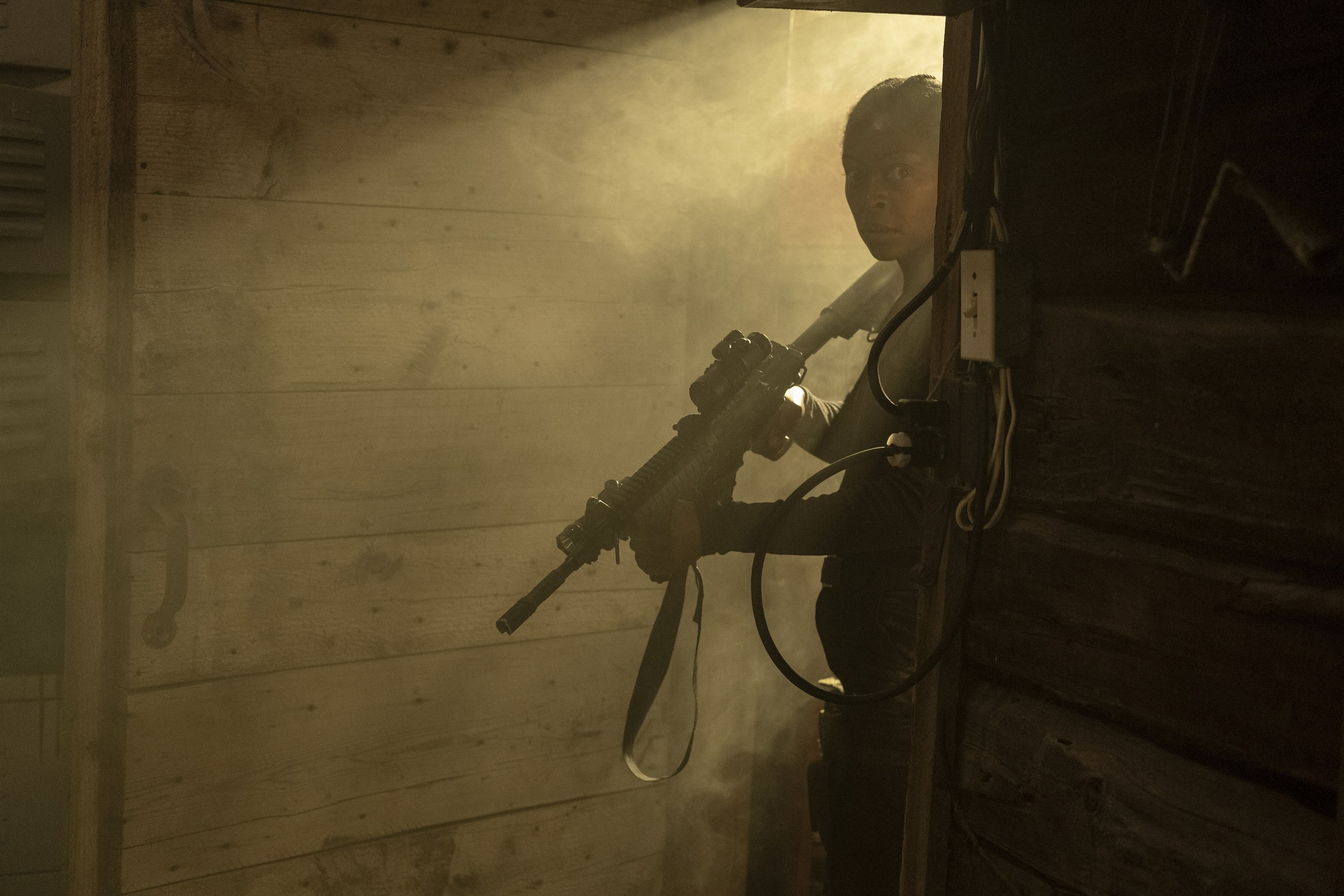
Danielle Deadwyler in 40 ACRES, a Magnolia Pictures release. Photo courtesy of Magnolia Pictures.
There was a battery pack that went into the gun, and the trigger of the guns were modified so that the actor could actually pull the trigger. All the stunt guys, they could pull the trigger and the guns would flash with their own command, basically. There is a way of doing this, where it's triggered remotely by the board operator. But, obviously, with a sequence like that, it's so choreographed. It has to be perfect. It was designed so that the stunt performers and the actor could trigger the muzzle themselves by pulling the trigger. The whole thing was very carefully choreographed so that every moment of the sequence, the gun had to be in the right place so that when the trigger gets pulled, it lights someone's face up, and it has to look natural. And knowing that we're only gonna see any action the moment a gun is fired.
R.T. and I talked about that upfront, and he said, “No. I really want it to be pitch black, but there's no light. It's not, ‘movie dark,’ it's literally pitch black when there's no gunfire.” So we did a bunch of tests with that as well to see, “Okay, how much can you see?” Angelica Lisk-Hann, our stunt coordinator, and her stunt team designed a fight sequence around that, which we could break up into pieces. We knew that because the camera doesn't move, and R.T. was specific, “I want the camera just to be planted like a wide shot. Everything has to take place in that one shot in the kitchen.” The camera can't pan, but that also meant that when we shot it, we could stop and start. We could do each of those bursts as its own piece, and then cut, and then move on to the next one. Do it a bunch of times till we know the timing is good, and then move on to the next one because you can basically cut to black to the next piece. That helped us, but it was still hard to get right because if someone's hand was six inches the wrong direction, forwards or backwards, it wouldn't light someone's face, and then you'd have to do it over again. It was a lot of just keep trying each piece until we got all the little flashes that we needed in each section.
I think this was the last sequence of the day at this and that was a real location. That wasn't a set. It was the last scene of the day. I think we had an hour and a half to get it. So we had very little time to get everything, and it all just had to work. We tested the crap out of those guns leading up to it. The stunt people had rehearsed with them. We really only had one chance to get this because we were leaving that location the next day. It was a whole big tent build that we did there. It was a major setup, we can't come back to this. We have one chance at this at this location. And I think it actually worked pretty well.
I can understand stress running a little bit high in a moment like that. I feel, especially whenever you're doing something with stunts, it does take a little bit longer. There are more safety considerations. I can definitely understand wanting to minimize the variables at play when you really just need to nail it quickly. It worked out and matches perfectly to the scenes that do have the actual blanks.
I'm glad you think that, because I think overall, the consistency of the gunfire is good between the real muzzle flashes, the VFX flashes, and the LED gag. I think it's pretty good overall, because it is a fairly important part of the story, and you don't see a lot of it, but when you do, it's super impactful. So it's nice that it's consistent.
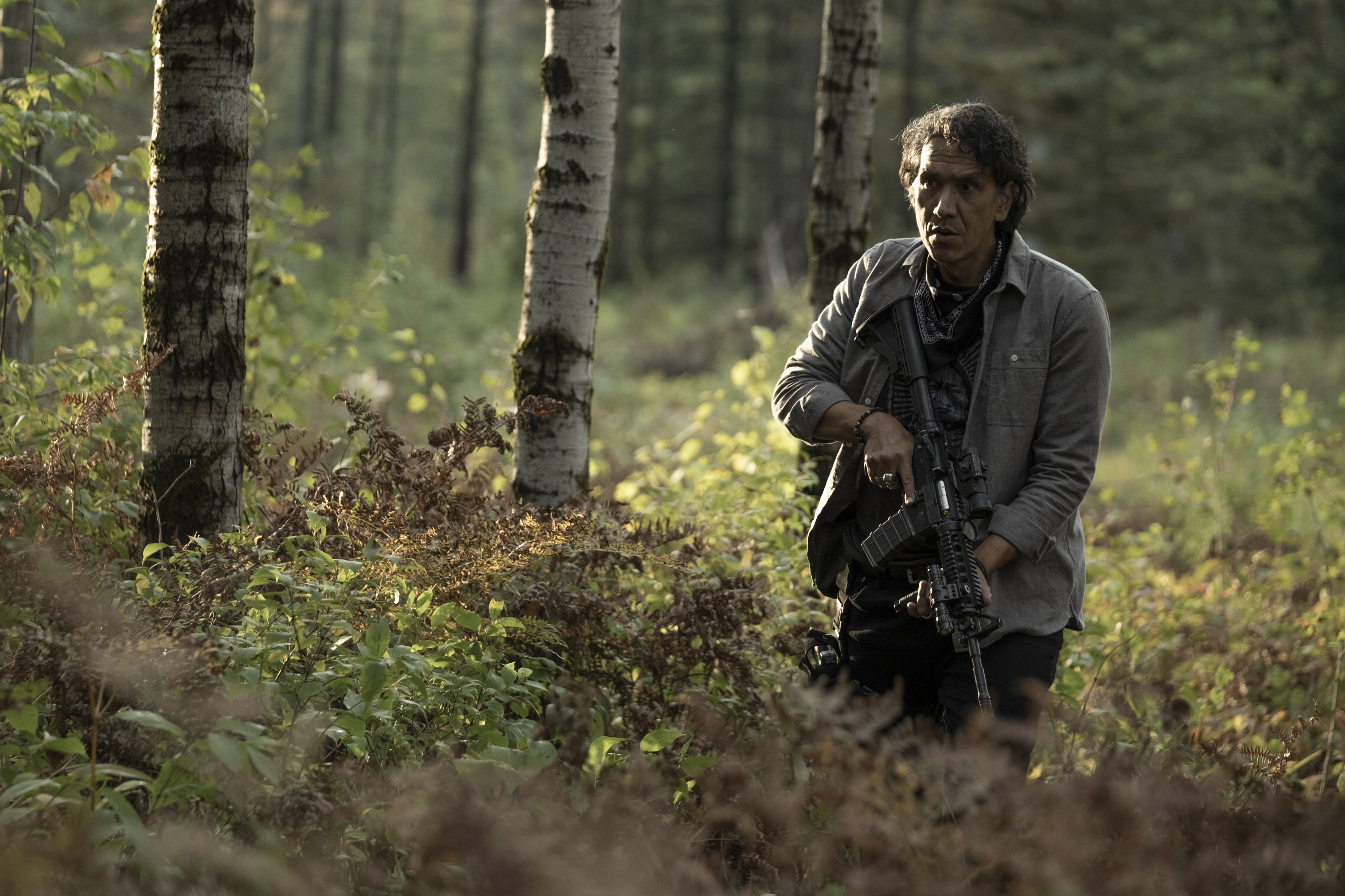
Michael Greyeyes in 40 ACRES, a Magnolia Pictures release. Photo courtesy of Magnolia Pictures.
Another scene that stood out to me is when there's the ceremonial bonfire. What was that process like? Because watching it, as a viewer, you might not even think that it’s a visual effect.
Oh, yes. Well, it was a combination of real fire on set, and visual effects. Actually, my brother, Luc Benning, he's a Special Effects Coordinator, so it was great for us to work together on this. He came up with a rig between him and the Production Designer and the Set Dec team. We had to figure out a way to build a frame for the fire. Luc and his team and the art team, they constructed a metal frame, a wireframe kind of bonfire shape that could have flame bars attached all over it so that we could, on the night of, turn it all on, and it's basically a bunch of propane tanks firing this triangular shaped frame that was filled with flames so that we could turn it on and off.
We added additional light sources, lying on the ground around it that were pointing light towards the cast. They would just extend the power of the firelight, which knowing again that it would all be covered up by VFX. It would also light the ground a little more. So it did work as a bit of real interactive light on the cast. When we turn around and look at the cast, I'd say it’s 60% film lighting fire effect, with a little bit of the real fire mixed in with it.
But, again, that was a super rushed sequence. We didn't have a VFX supervisor with us. We didn't have anyone there to take plates or anything. It was literally, what we were able to get on the night. We had so little time that night. We were right up against it. We almost didn't even get the real fire because we were so rushed to get it set up. But, thankfully, we did get it, and we had enough of the real fire that I think it helps sell the VFX version of it.
I think rather than just totally relying on cinema lighting with a flicker effect or whatever you might be tempted to do, that actually implementing real fire, you can't really replace or replicate that perfectly. It seems like so much of this project came down to nailing that cohesion between the organic, practical elements, and the visual effects accomplished in post. It comes together beautifully.
Yes. It goes back to the muzzle flash. It's a time thing. We know this just has to work, and we have so little time to shoot this that we need the reliable thing, which is the human controlled version, then we wanna try and meld it with the natural organic version, but we have to lean into the predictable, efficient one as well.

Kataem O’Connor beside the ceremonial bonfire in 40 ACRES, a Magnolia Pictures release.
I know you mentioned drones a couple of times. The film has a lot of beautiful camera movement throughout. Beyond just the drones, there's some of what appears to be Steadicam where we've got these sweeping movements. We're circling the table in the basement, or we're following this cast of characters. Or, on the other end of things, when they're on their ATVs and we're ripping across the fields, and we're just keeping right up with them. What unique approaches were there to how you flew the camera and how did you determine these moments where you wanted to feature this really dynamic camera movement?
R.T. and I worked together to block that out as much as we could in advance. We really tried to go through each location and work out exactly more or less, what the main beats would be camera move wise. So for the most part, we had a good plan going in to make sure we had the right tools for it. So the drone work, we very carefully plotted that out. I have my own mini DJI drone that I use for scouting purposes. So it allowed us to work together, R.T. and I, to look at the locations from above and figure out, “Okay, what's the best path in the forest here? How does it look?” So that when the drone team came, which is Chris Bacik, when he came up, we already had laid out some of the stuff that we could show him. “Here's the angle that we got that we like from the drone,” so he at least he wasn't searching for it on the day because, again, time.
So he had very clear instruction of, “Hey, this is the shot.” And oftentimes, some of that stuff, we would send him off to go shoot it with, either the real cast or doubles, and a second AD or whatever while we were shooting a unit with the main crew, or setting up somewhere else. I wasn't with him for the most part, because it just it allowed us to be more autonomous. I'd show him my references of this is the shots we like. These are the angles. So that for the most part, that's how I worked with them. I wasn't with them a lot. There was a few sequences that I was with them, but I would say half of it, they worked on their own.
They used the Inspire 3 with the Zenmuse X9 camera, which I think is very impressive. I almost don't see a reason to fly a bigger camera than that because it flies really fast. It's more stable in the wind. It can move more dynamically, and those guys are great with it. Hats off to them for that. Sasha Moric was my A Camera operator, and Sasha's a very talented gimbal operator with the Ronin. He does a combination of Steadicam, he does handheld Ronin with the anti-gravity harness, and also Ronin on a jib. So we used those three tools. I would say that Ronin as a remote head was, 80% of the time or 70%, and then the other more mobile in the field stuff was a lot of handheld Ronin. He was basically controlling it all himself. With that anti-gravity harness, it's very smooth and allows some booming action.
We used the Aerocrane with the Ronin on it for crane moves and very classical composed movement around the family, around the vehicles and the farm, and out in the field, cutting down crops and stuff. So those were our three main tools for movement.

(L-R) Kataem O’Connor, director R.T. Thorne, and DP Jeremy Benning, ASC, CSC, on the set of 40 ACRES, a Magnolia Pictures/Mongrel Media release. Photo by Rafy. Image courtesy of Jeremy Benning, ASC, CSC.
For the most part, we knew what the sequences that we're gonna be doing next, and had fleshed out ideas and approach. “We're gonna do a oner through the bunker, in the basement, and we're gonna follow this character from this room and into this room. And we're gonna pivot at this point.” That made it so that set had to be lit pretty much practically because we knew the camera's gonna be moving around everywhere, all the lighting has to be built in for the most part. That took some planning with the Production Design and Set Dec teams, and then, of course, timing wise, we were so crunched to get that lighting installed and addressed.
I was like, “Look, we have to have this lighting in before the first day of shooting. Because if it's not in by the first day of shooting, you're waiting for us to program everything, and it needs to be on a lighting console so we can work quickly.” We managed to work that out with the whole team, with construction to have that time to get in there and get all the lighting installed. That goes back to the camera movement. It was because we knew the camera had to move through that space, really dynamically and see everything.

Danielle Deadwyler in 40 ACRES, a Magnolia Pictures release. Photo courtesy of Magnolia Pictures.
When photographing the action scenes in particular, were you working with pre-visualized sequences from the stunt team, or was it more discovering those moments on-set as you worked with them directly?
It was more of us discovering as we worked with them directly, just by the nature of time and budget, and the amount of prep resources we had available to us. R.T. and I did talk through a bunch of it together and with stunts, some location scouting work, and we figured out a lot of it together. But there wasn't really a lot of time to pre-vis. Angelica shot some pre-vis for a few of the major sequences. But even with those, it was still would be adapted on the day. The blocking might have changed. For example, the big climactic sequence in the Quonset hut at the end with Danielle, and all the bad guys. That got transformed on the night of.
Because of weather, we'd already moved that fight sequence, which is the climax of the film. We actually took a rain date on the day we were supposed to originally shoot it, because it was exterior. It was written to be out in the field right near the barn. And, so we postponed it to the end of the schedule, and then it ended up that by chance that of the two worst days we had for weather, that ended up being another terrible night - rain, cold. The whole grounds of the property turning in to mud. The trucks were getting stuck in the mud. It was a disaster happening, and we had to think on our feet. This has to now move inside. So this big scene, with a lot of movement, taking up a big space, fight sequence with multiple performers had to now be moved inside that Quonset hut that we'd shot in previously.

Danielle Deadwyler & DP Jeremy Benning, ASC, CSC, filming the climatic fight scene of 40 ACRES, a Magnolia Pictures/Mongrel Media release. Photo by Rafy. Image courtesy of Jeremy Benning, ASC, CSC.
We’d done other work in there, but we really didn't have a plan until the morning of, that this whole sequence is gonna be now inside this Quonset hut. We really didn't have a lighting plan in place. It was made up on the spot, like, “Okay. We have to light this place for night, and we have to look in every direction with a fight that we're now gonna have to improvise how to make it work in this space within two hours.” And that's basically what that ended up being. Which I think actually, in some ways, worked out even better, because it made it more claustrophobic and tight and vicious. So sometimes these sorts of, acts of God or whatever, actually end up forcing you into doing something more unique.
Sometimes when you're up against the wall is when it really forces you to be creative and think on your feet to come up with something that you wouldn't have thought of if you had infinite options.
That's exactly right. So, I mean, that was a blessing in a way, because that was our last night of filming, actually. That was what we shot on the very last night. Literally, the trucks were stuck in the mud outside that barn. We were supposed to shoot a whole sequence outside of the barn that night, and we couldn't because all of our trucks that dropped the gear off that night couldn't leave. So we're like, well, we have to rethink how we're gonna shoot this because the trucks are literally stuck in our shot.
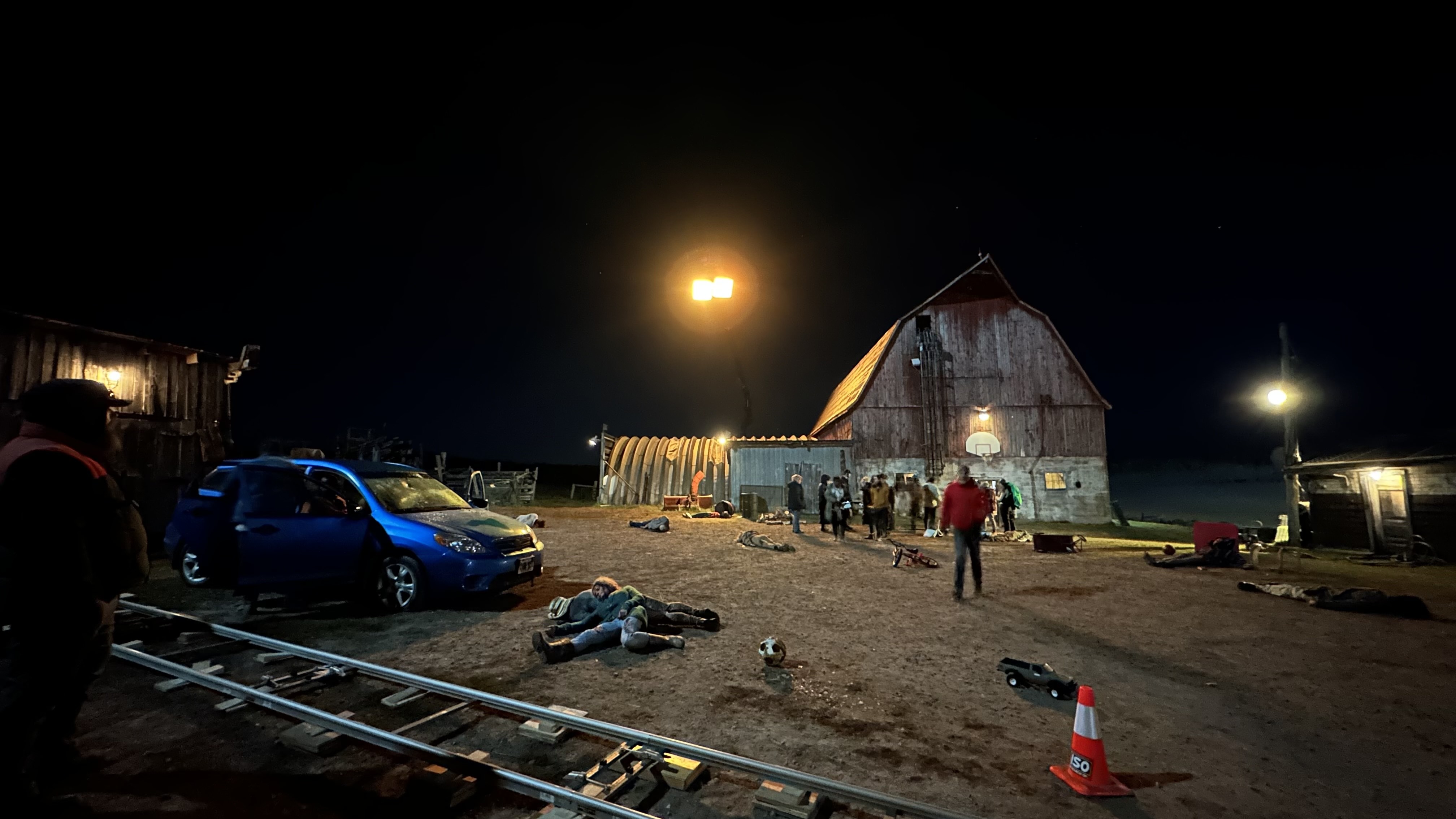
A look at the filming of the third act climax for 40 ACRES, a Magnolia Pictures/Mongrel Media release. Photo by Jeremy Benning, ASC, CSC. Image courtesy of Jeremy Benning, ASC, CSC.
Jumping forward a little bit, there's a few moments that stand out where we step into a higher frame rate realm, and we've got some slow motion. Particularly when Dawn (Milcania Diaz-Rojas) is dancing around in that barn that we were discussing earlier, with the beautiful light pouring in through the slats of wood, and then, obviously, the final image of the film where it's all of our heroes coming together and enjoying this beautiful meal. We're slowing things down and really being present with the characters. What was that approach for those high frame rate sequences? And I'm sure that had some impact on the choice between the VENICE 2 and the Alexa 35 as well.
If I remember correctly, I think those sequences were shot at 60 frames per second. They're either 60FPS or 72FPS. R.T. had laid those out in advance that he wanted high frame rate. So we knew that at some point in the sequence, we were gonna go slow mo. That barn sequence was one of them, because we knew there was gonna be this track playing. We actually had music playing on the day when we shot it, for everyone to get into it. That was actually a good double purpose thing, where our the lifts that we had for the night work, it worked out that that lift, one of them was parked behind that barn in a way that we could use the LRX signal to fire through the openings that were at the top of the loft space there. So that scene, that big that bright backlight that's coming in, hitting her, was actually one of our night lifts working as a as a daylight for that sequence.
There's a shot of Emanuel where we’re looking at him, and you can see that he's in a slit of light. R.T. had shown me this reference image and said, “I really wanna have this moment where he's just him in a shadow with a slice of light. He's watching her dance.” So I thought, if we angle everything to be this way in the room, we can do that because the LRX is right behind the barn here. Create that little stripe of light on his face from those slots.
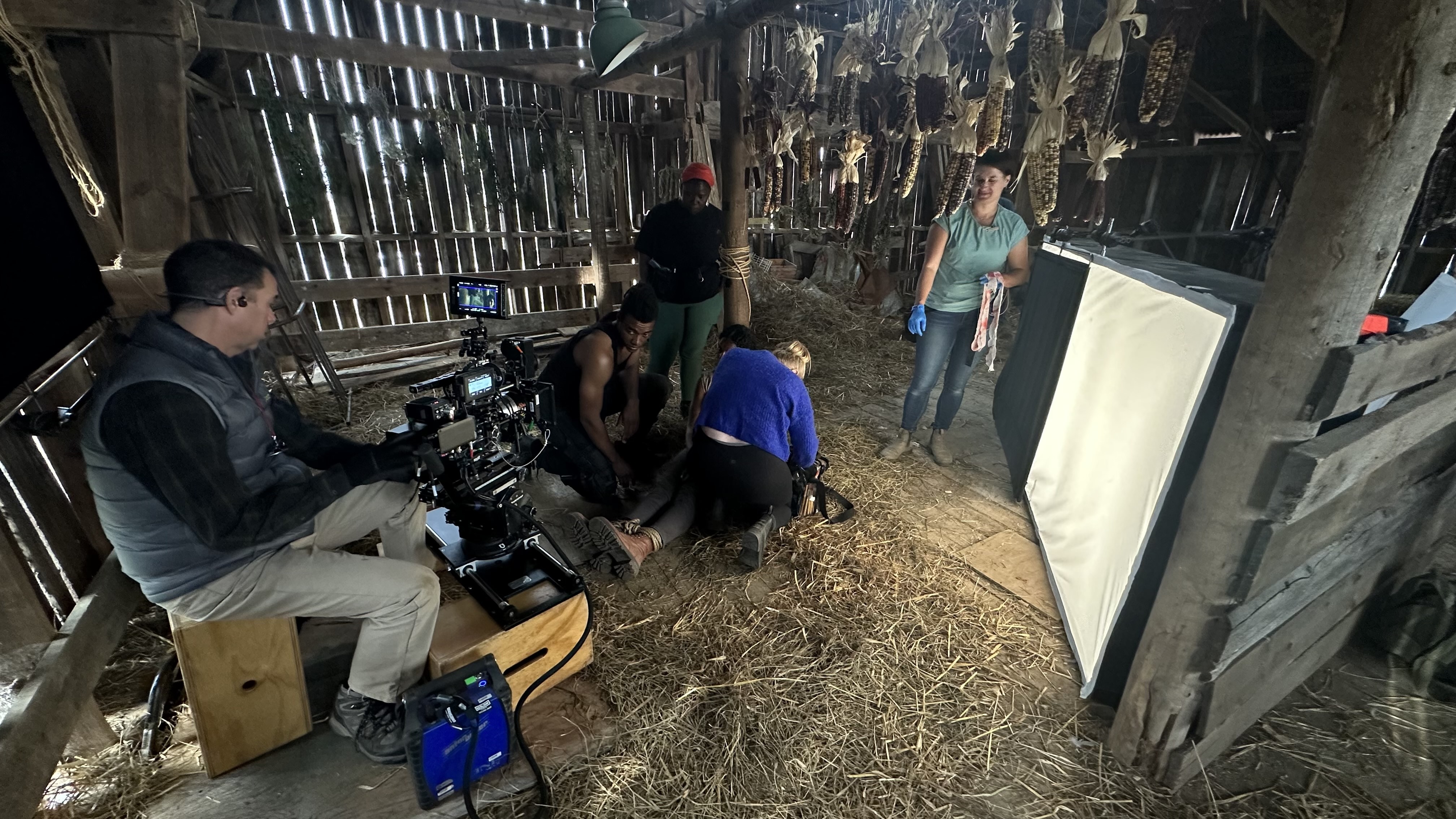
(L-R) B Camera Operator Peter Sweeney, Kataem O’Connor, Makeup Department Head Chancelle Mulela, Milcania Diaz-Rojas, Makeup Artist Trina Brink, and Jessica Cormier (Props) on set of 40 ACRES, a Magnolia Pictures/Mongrel Media release. Photo by Jeremy Benning, ASC, CSC. Image courtesy of Jeremy Benning, ASC, CSC.
So, yeah, that worked well with the slow motion. And then the family dinner sequence, same thing. R.T. wanted it to be sort of this loving, emotional moment where time slows down, and everyone's a happy family, sort of togetherness. I believe it was the same frame rate, and that was the same house location that we did that gunfight sequence in, which we tented that whole house. Because we had day and night that we had to do in a very short period of time there, and we had minors on set, we had to be able to control everything.
So we ended up creating this fairly large tent outside the house that was two stories tall, and deep enough that we could put trees and plants out the windows and then quickly go from day to night. So when you're looking at that scene, that's basically the tented daylight version of the tent, and then the night scene is the night tent. That gave us the flexibility with slow motion and just being able to change time of day, really fast.
That said, I don't remember us testing the slow mo. R.T and I, he came from music videos and so did I, so he knows his frame rates. So I think he was just like, let's shoot 60. And I think we both were like, yeah. We know what 60 looks like. We had a good vibe for, this will be right for this moment. Of course, you can play it back right away and look at it and be like, yeah. That's the right vibe.

(L-R) Director R.T. Thorne and DP Jeremy Benning, ASC, CSC, on the set of 40 ACRES, a Magnolia Pictures/Mongrel Media release. Photo by Rafy. Image courtesy of Jeremy Benning, ASC, CSC.
On your collaboration with R.T., because you were working very closely together throughout this entire process, and this is his first time directing a feature. What would you say to a rising DP that really wants to learn how to cultivate close collaborations like that, particularly with a director?
Well, I don't think it's any different than when I was starting out, which is you wanna just try and meet as many people as you can and put yourself out there to shoot as much as you can. Try and find the local filmmakers in your area and put yourself out there to offer up shooting their shorts. Whether that's if you go to film school, it's your classmates that you end up continuing on with, or it's people you meet in the your local community that wanna make films, or if you find people that have written something that inspires you. If you find someone that has great ideas you're inspired, by that's it. It all comes from storytelling and being inspired by the story and that director has ideas that inspire you to make them into visuals. You know?
You gotta just keep doing that. The more you find those directors, you just wanna cultivate those relationships and keep looking for people. And, eventually, you'll sort of find your tribe, your community, that you grow with. You'll end up maybe doing multiple projects together. That'll lead to something else. But you just gotta keep looking for them. You know?
Because it really is all about the relationship. You need to feel that you're in sync creatively. You're both inspired by the story that you're telling, and then you're riffing off of each other. You know? It's a two way process. And then when you find those people where that feels really smooth and it flows really well, you just you wanna put all your eggs in that basket and try and continue that relationship, do whatever you can to help them develop new things. And, when you spot that in new people, you wanna grab onto it.
There's a tendency with younger filmmakers to really knuckle down on a certain idea and say, “I wanna do it this way, my way or the highway.” So in terms of that collaboration and fostering that collaborative relationship, is there anything specific to how you conduct yourself on set or how you directly collaborate that has evolved over the years, or you've honed in on the best practice for?
It's really about what's best for the project. You need to be open minded because, especially with blocking, things change. You might go into a day where you and the director have got a plan, and you think this is the best shot sequence ever, and then the actors show up, and they've got a different approach to it. They've got new ideas that change the dynamic of the scene, and suddenly all the ideas that you had are out the window. I think to the point of your question is that you have to be completely open-minded. Yes, it's great to have good ideas and have ideas you're inspired by, but then things are gonna change so much or the director might suddenly wanna take the scene in a different direction. And you have to be open to that, and talk it through.
If you still think that your idea is a good one, then you talk it through with everybody. And sometimes you realize that, well, this actually doesn't work anymore. You have to just let go of it. And it's like, at that point, it's not about the ego. It's like, what's the best thing for the project? And depending, if you've got a rough relationship with a director where it it's not a good collaboration, then sometimes that can happen more often than it should. And you start to feel like I'm not being appreciated or, why is my idea not being listened to or whatever. Hopefully, you avoid those relationships. Everyone's trying to come up with the best idea for the show, and you just you can't let your ego get in the way with that, because it's a collaborative process.

DP Jeremy Benning, ASC, CSC, on set of 40 ACRES, a Magnolia Pictures/Mongrel Media release. Photo by Rafy. Image courtesy of Jeremy Benning, ASC, CSC.
Going deeper into collaboration, just a little bit further, I know you mentioned several of the team members on in the camera department. You mentioned the Gaffer, Key Grip, Drone Op, A Cam Op. Is there anyone that you wanna give a highlight to their contributions to the camera team for how they helped to bring the film to life?
Well, definitely, Sasha Moric, our A Camera Operator. Between him and I, he was the leader of getting everything ready in front of the camera, getting the shots worked out. He and I designing it together, his contributions, getting everything lined up with the cast and the art department and the ADs. I mean, a really great operator shines when they're excelling at that sort of thing, and Sasha's great at that. He's good with talking to everybody. He's good at working out the choreography of everything, and he's collaborative. Like, you work together. We talk about everything together, and then he goes and executes and makes it happen. And I add my two cents here and there. But it all comes from story with Sasha.
But, I mean, really, that's what a great operator does for you, because if you're busy working with the director in the next setups and all that, you're busy doing other things. And it's like, you know, it allows you to spread your focus a bit more, especially when you've got these ambitious projects. You need to be everywhere at once. My 1st AC, Craig Morgan, we have a great shorthand. We’ve worked together for years.
My Key Grip and Gaffer, Wayne and Nigel, the spaces we were working in physically, especially at the farm property, were huge. Massive property, moving gear across big areas, setting up the track with the Aerocrane and moving it around and, being quick. I mean, those guys were a little army. We all had a good plan. They led their team as well. So, yeah, I mean, all those three departments carried us through it, because they were the brains and the muscle and the creative energy that got us through it all.
On that note, what's your relationship been with Keslow Camera before 40 ACRES? How did Keslow Camera help bring this project to life? Is there anybody on the team here that specifically really advocated for the project and helped bring it bring it the extra mile?
Interestingly enough, I actually hadn't worked with Keslow before this, and that was just by circumstance because they weren't really in Toronto, and I hadn't worked in places where they were before. With the SIM merger, I'd had a long relationship with SIM, in Toronto and in Vancouver, but primarily Toronto. So it was a natural progression of, Keslow became the new management, and so my relationship continued with Keslow. I would say, Craig Milne (General Manager, Toronto), I've known for a long time, he's been a big supporter of mine. And then when Keslow came along, Stephanie Fagan (Vice President, Business Development, Toronto) has also been very supportive. She ushered us through a lot of this and helped out with getting our package together. Stephanie really was a big supporter of ours and helped us get everything we needed with all the prep and the testing.
Keslow did an amazing job supporting us. You know, we're far away. We're in Sudbury. If we needed something and getting it up there, sending drivers, that all was handled well. We didn't have any problems with camera gear. Everything worked. The cameras performed, all the lenses, everything performed well. It was prepped well. It was all super positive, and it was a great first experience working with Keslow, which is a hybrid answer, I guess, because it's still it's the same people that I had at SIM, but it is Keslow now. So it was a great first experience of the new future of Keslow there.

DP Jeremy Benning, ASC, CSC, SFX Coordinator Luc Benning, and 1st AD Reid Dunlop on set of 40 ACRES, a Magnolia Pictures/Mongrel Media release. Photo by Rafy. Image courtesy of Jeremy Benning, ASC, CSC.
We touched on advice some advice for rising DPs. Is there anything that you would want to add as a capstone? I know a lot of DPs will say, “get out and shoot as much as you can.” Anything in that realm?
Communication and leadership skills are, I think, more important now than ever, especially with how fast things go when you're using text and emails and Zoom calls and having to send documents. It becomes about learning how to be organized. If you feel that's a weakness, being organized in that way with communication and leadership people skills, it is key to focus on. Our job is really about people skills, both in advance of the shoot through electronic communication, and also on the day itself. It's very much about you've gotta be the positive leader.
You've gotta be clear with your instructions to people. You've gotta communicate in a way to your crews that makes them feel like they're part of it as opposed to being dictated to. I want the keys to feel ownership in what we're doing together. It's like, I'll tell them what my approach or ideas for something, but it's always with the caveat that, if you've got a better idea or if you think of a better way of doing what I'm trying to do, I'm totally open to that because everyone's got lots of other experiences that you can tap into. They may have done something like this before or something similar that they can provide some idea that I would never have thought of. That's the key thing, learning how to, I guess, win the collaboration of your crew because it's a bit of an earned thing. You're being judged all the time, especially if you're younger and you're working with a more seasoned crew. They're gonna be like, “Well, who is this, young punk or whatever?” I mean, I dealt with a bit of that when I was starting out.
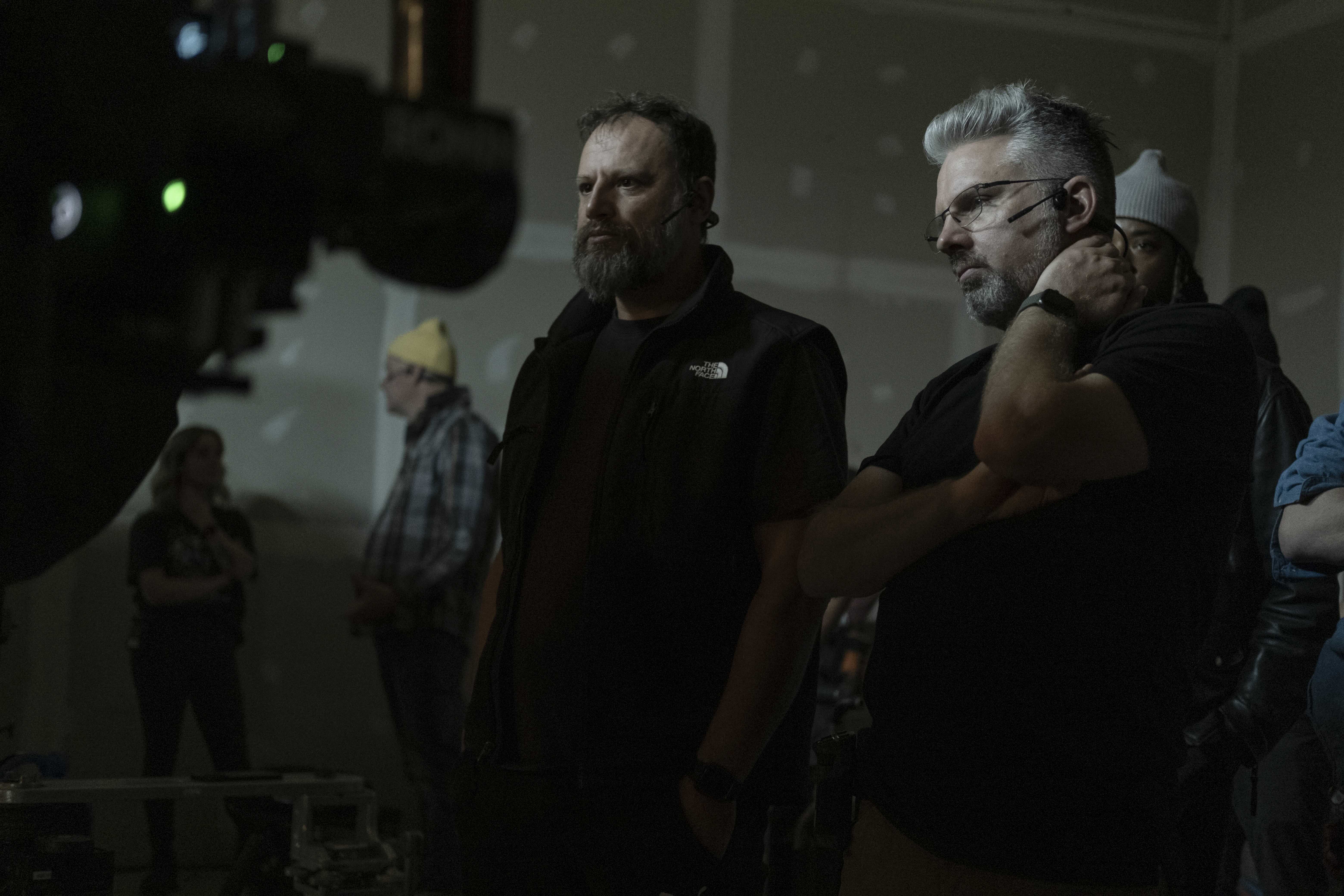
(L-R) A Camera Operator Sasha Moric, DP Jeremy Benning, ASC, CSC, on set of 40 ACRES, a Magnolia Pictures/Mongrel Media release. Photo by Rafy. Image courtesy of Jeremy Benning, ASC, CSC.
You have to almost overcompensate for that by having clear ideas, communicating them well, but also be really open and ask for advice from them, so that it's not like you're trying to dictate everything to them, and they're gonna be like, “Oh, well, that sounds like a great idea.” You want it to be collaborative. That might be something that you don't really know, if you're in film school or you're starting out, you don't have that experience, where do you learn that from?
It's completely a team effort. So it's like, yeah, you may have an amazing vision and ideas, but if you can't communicate that well to a crew and with the advanced time that they need to actually pull it off, and work through all the problem solving of it, then that idea is not gonna happen. You have to learn that, you know? I’ve attended the ASC's Master Classes, and the CSC has their own Master Classes. I think those are great ways to learn that skill set, because my experience of having taught some of those and also watching other people do them, is you really get a chance to hear their thought process.
They usually talk you through all of those things, including the communication, the prep, how they plan it with their gaffer, the conversations they were having. That's really useful insight. I don't think you can get that any other way unless you're shadowing someone, or spending time on set in some other department and you're watching and learning. If you don't have access to that, then those master classes and those workshops also really help. Communication is one of the bits of the job that isn’t really taught. You either have a bit of that in you already, or you learn it from working with other people. [X]
40 ACRES is now playing in theaters nationwide and streaming on all rental platforms. Click here for more information.
To learn more about the work of Jeremy Benning, ASC, BSC, click here.