

The Cinematography of "Untamed" (Part One) with DP Michael McDonough, ASC, BSC
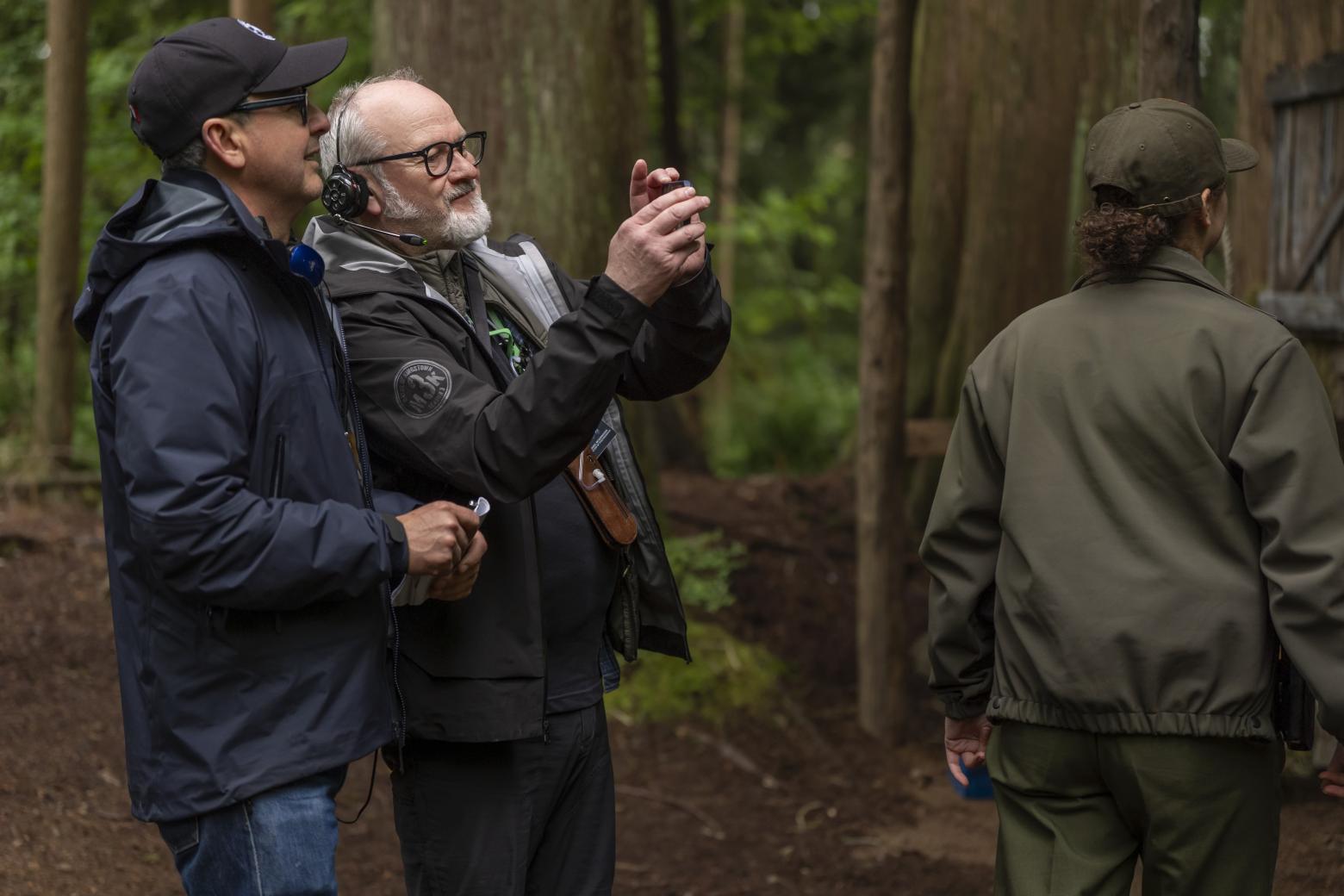
(L to R) Director/Executive Producer Thomas Bezucha, Director of Photography Michael McDonough, ASC, BSC, in episode 101 of Untamed. Cr. Ricardo Hubbs/Netflix © 2025
Set in Yosemite National Park, UNTAMED is a grounded mystery-thriller following Kyle Turner (Eric Bana), a special investigator for the National Parks Service as he seeks answers behind a brutal death. But to find the truth, he must confront dark secrets from his own past, and come to terms with his deep inner turmoil and grief.
Immediately skyrocketing to the Netflix Top 10 after its premiere as a one-off miniseries, UNTAMED received a surprise renewal for a second season.
We connected with first block DP Michael McDonough, ASC, BSC (Episodes 1-2, 5-6) to dive deep into the process behind the making of UNTAMED - setting the series' look and feel, shooting Vancouver for Yosemite, capturing death-defying stunts in the elements, and more.
[This interview contains minor spoilers for UNTAMED]
In UNTAMED, being set in Yosemite National Park, there's obviously a ton of nature. There’s a unique look to both the present day segments, and a visual distinction for the recurring flashback sequences. What was your general approach to the look and feel of the series?
Tom Bezucha, who was the pilot director, who directed the first two episodes and the first block, had actually liked a film I did with Debra Granik called Leave No Trace, which was shot in the woods in Oregon. I think that a big attraction to working together, was just me having some experience working in the woods. That project tended to be a small footprint; negative fills, and bounce boards. We weren't dragging generators into the middle of these national parks in Oregon. That had attracted him initially, how that film had come together. The intimacy between the camera and the actors was appealing to him.
I was also familiar with Vancouver, British Columbia, having shot a film there, a thriller, Lou, back in 2021, which covered some of the same ground in terms of locations and style of shooting. Those two things together, I put a lookbook together to stress the drama of the script alongside the drama of the nature, which is inherent to the Pacific Northwest. Everything there is big. The scale is super dramatic. So trying to put those two things together, yet tell this intimate story within it, where we would go from sweeping vistas to close work around the actors. That was our initial approach.
There's a lot of great moments where we're almost in an aerial shot and then we zoom in and we're right with the characters on the top of El Capitan, or these other landmarks. What character and qualities were you looking for with your lenses to capture those moments and split the difference between those sweeping vistas and those more intimate moments? For your camera selection, how did the location-based elements impact your choices?
I was finishing a series in Pittsburgh, Mayor of Kingstown, and we were supposed to head to Europe, and rather than going east, we headed west. I finished Mayor of Kingstown on a Friday and started prep for Untamed on the following Monday in Vancouver. So I had a rough idea in talking to Tom, the director, what we might want to achieve.
I knew we’d be doing a lot of handheld, and that there were a lot of scenes where we'd have to walk into forested areas or mountain sides, and so I knew that I wanted something lightweight. I also knew I wanted to work with Keslow on this. I’ve had great relationships with Keslow over the years, and Dennis McDonald (COO, Keslow Camera) has always been very helpful. I did tests for Albert Nobbs, a film we shot in Ireland in 2010, but I did those tests in LA, and that was the first time I got to meet Dennis and work with Keslow, and that was a great experience. And so, I knew I wanted to work with Keslow up in Vancouver. I basically just said, “I’m looking for lightweight lenses that would have good weather proofing, but a really lovely optical quality.”
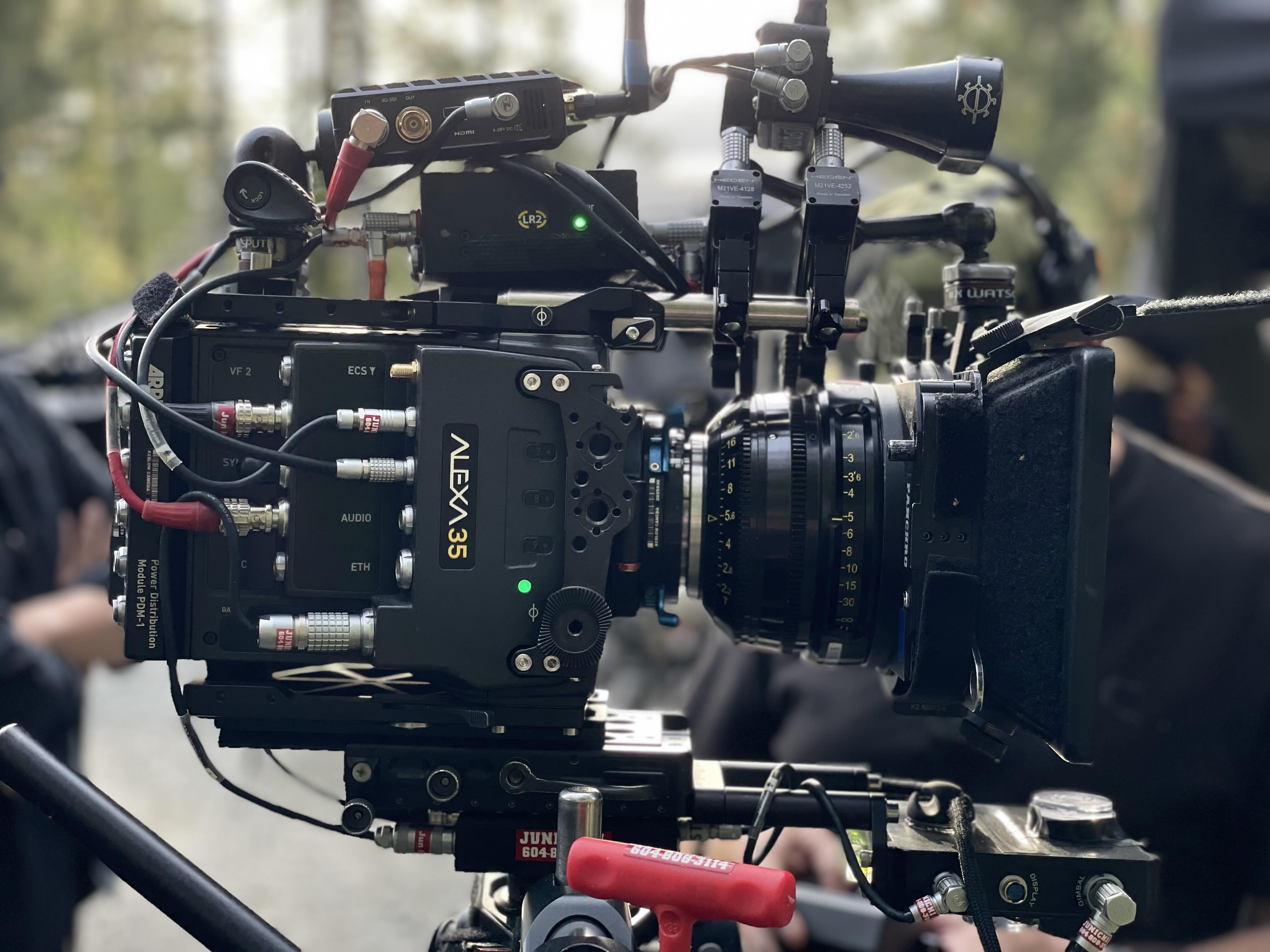
A fully outfitted ARRI Alexa 35 with a Cooke Panchro Classic Prime on the set of Untamed. Photo courtesy of Michael McDonough, ASC, BSC.
Rising out of that, I had used Leicas before, but I really loved the newest iteration of the Cooke Speed Panchros, the Cooke Panchro Classics. They were super lightweight, well weatherproofed, the glass was lovely, and the biggest thing was that the bokeh was just a perfect circle. It was fantastic. In testing, we also knew that we would have some challenges with trying to capture so wide and then very quickly being able to punch in and get something tight in these landscapes. So the Fujinon Premier Zooms were appealing, the 75-400mm especially were really appealing for that.
In the short amount of testing I had at Keslow, I felt the bokeh was a really great match between the Fujinon Zooms and the Cooke Panchro Classics. So that was where we got to in terms of the present day storytelling, trying to be efficient. It was my first show on ARRI Alexa 35. Previously I'd used the ARRI Alexa Mini LF. I felt the form factor of the Alexa 35, as well as everything it can do technically with the sensor, that was going to be a great help for us in some of our more remote locations where we'd literally be hiking up forestry trails and things like that. So, combining the Premiers, the Panchro Classics, and the Alexa 35 just felt like the right package.
Another crucial part of it was the flashbacks. Was to build in something different, something a bit more ethereal. There's a lot of indigenous culture in the background of the show, and trying to bring in something that's to do with the spirit or something ethereal. I was looking for something that would give us that quality, and I always feel with anamorphic it's very much like human peripheral vision. It feels to me very human and the way it sees things and then things fall off and that feels like your peripheral vision.
So I was thinking anamorphic for the flashbacks. Tom loved the Todd-AOs that Keslow had up in Vancouver. The problem I felt with them was there weren't enough focal lengths and a little bit that different, the different sizings meant that it'd be a little extra work for the assistants, and maybe we would have to bring extra rings and donuts etc. So, the Hawk V-Lite Vintage ‘74s we ended up going with, we had more focal lengths, they were a more similarly matched set and so we used those for our flashbacks.
And again, the V-Lites, being about the lightest anamorphics we could find at the time, were helpful in that approach to trying to stay mobile, trying to be able to hike in and out of places. They have a halation that's built in. So, I tried to push it, some of it was pulled back in post, but I tried to push it with using stronger edges that would give me a glow around the characters. There was an element of not wanting to give too much away too soon. It was a sense of not wanting to go too far between the present day and the flashbacks at the beginning. Only once several reveals are made, then we could go further into that separation, to make it more obvious that this was flashing back a year, two years, 10 years even.
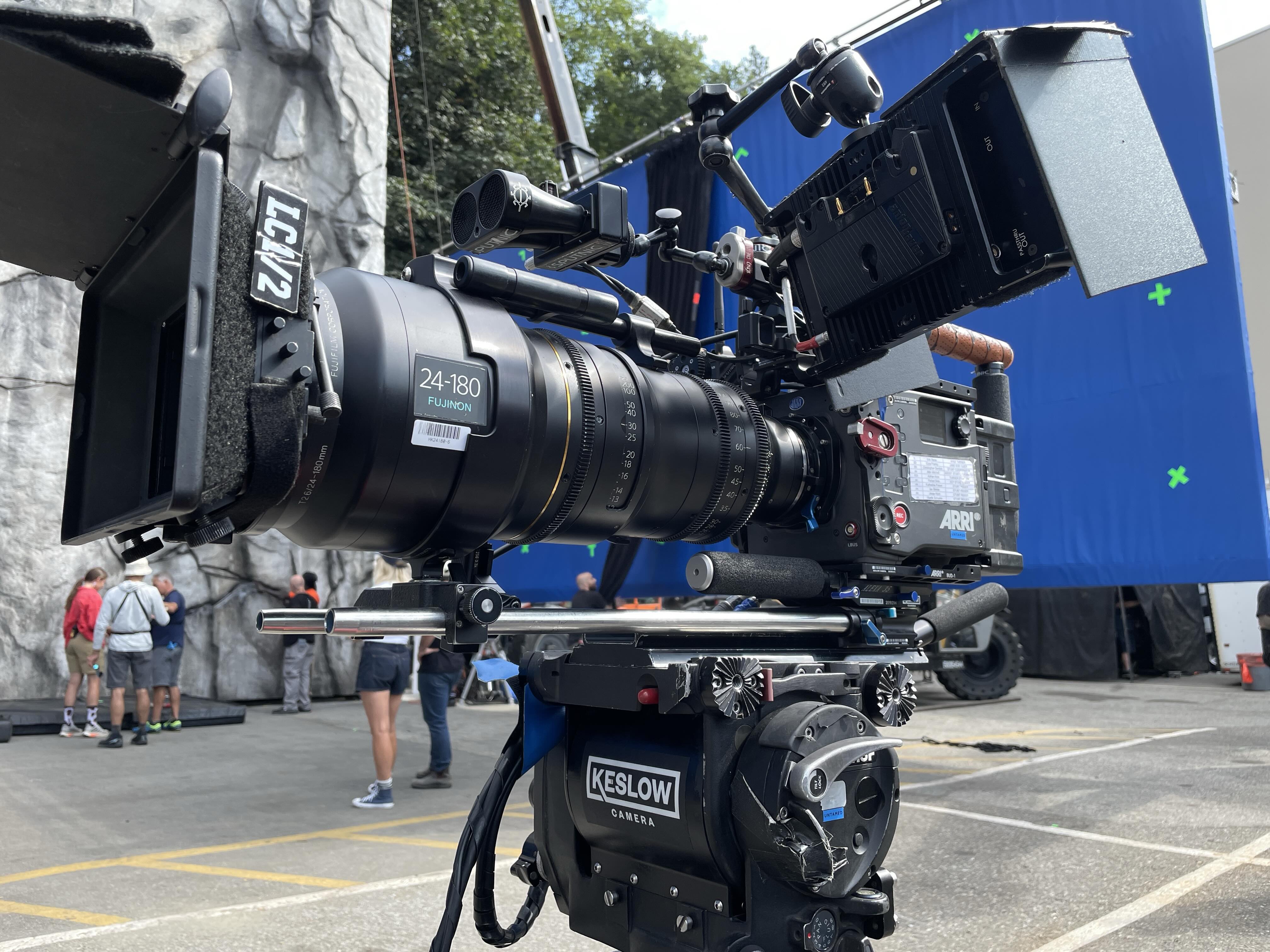
A fully outfitted ARRI Alexa 35 with a Fujinon Premier Zoom on the set of Untamed. Photo courtesy of Michael McDonough, ASC, BSC.
When you're on location, there's some considerations with how you want to build a camera package, or with what you can physically bring with you. How did you accommodate some of these remote locations when determining how you were going to fly the camera?
Quite a bit of it was handheld, but we'd also use a slider. Sticks and slider would be a thing where if we wanted something a little more elegant that may move past some foreground element and just keep that sense of tension, keep the sense that you're being watched as part of the thriller aspect to it, the mystery aspect to it. So, maybe using sliders and sticks to drift past something was one of our big tropes.
Obviously we did some dolly shots, but those were more at locations that were stage builds or city type locations or just where we could get the trucks close. My B camera operator, who was really my second A camera operator, Junichi Hosoi, had an ARRI Trinity and we used that on occasions to be able to do some booms and things that otherwise, where we couldn't get a dolly and do some tracking stuff through the woods. But again a lot of handheld, sticks and sliders and then trying to get some dynamism with being further away on the longer lenses. Those would have been our main tools in the more difficult to reach locations.
What kind of locations were you utilizing? What percentage would you say was on location versus on a stage?
We worked in Whistler in the Olympic Village at the Winter Olympic Park, which is just south of Whistler Village. We used that a lot for the woods and some of the big sweeping vistas. We also went east to Hope, which was very cool to see. The first Rambo movie, First Blood, was shot around there. There's some statues of Sly in the town, and it was very cool. It's a really funky, small Americana-style town, but completely surrounded by these very close steep mountains. If we wanted to be more remote, we went up into the Whistler area, and right up towards the top of the ski jumps, and some of our highest elevation stuff was probably around maybe 4,000 ft, up around the top of the Olympic ski jump.
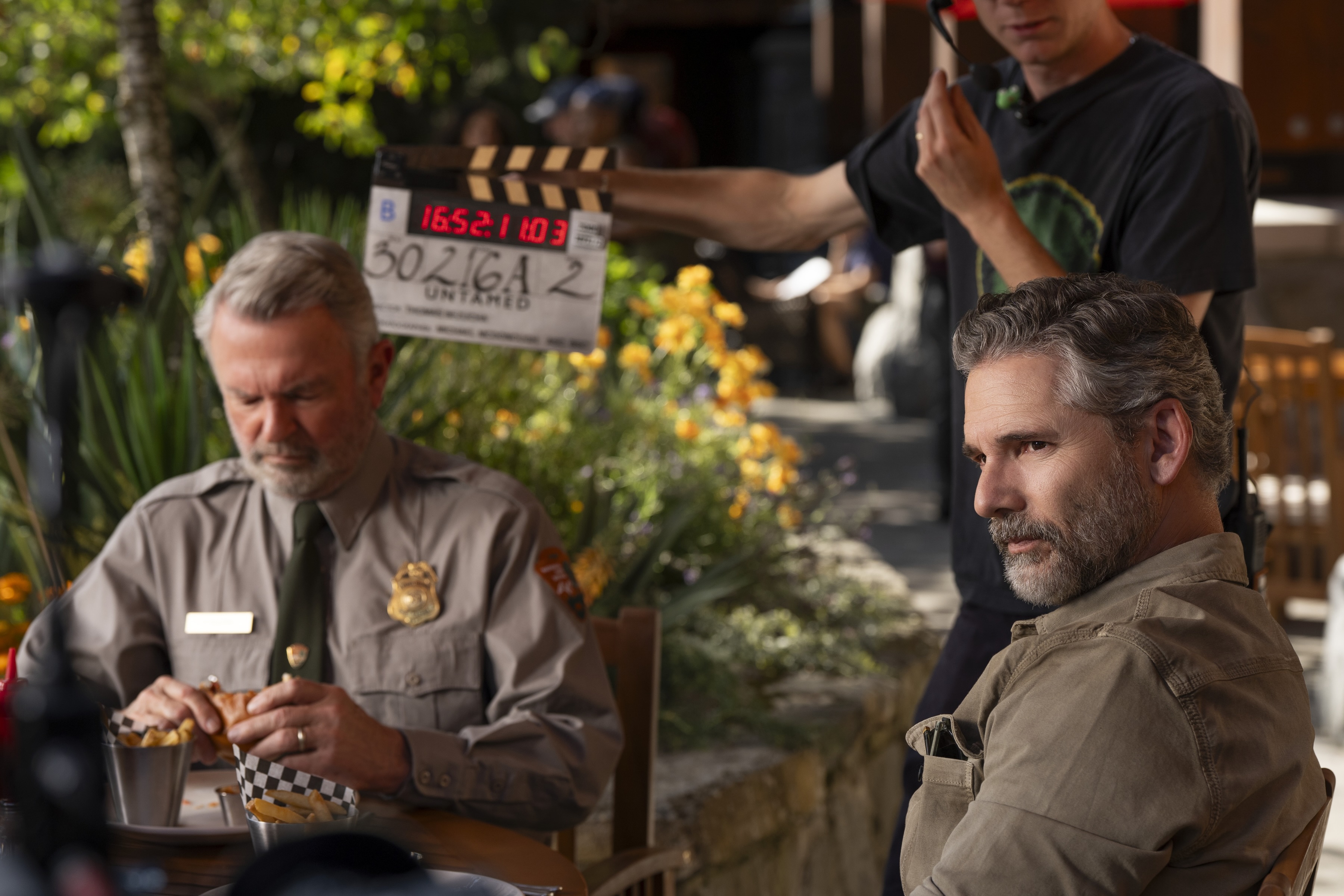
(L to R) Sam Neill as Paul Souter, Eric Bana as Kyle Turner in episode 102 of Untamed. Cr. Ricardo Hubbs/Netflix © 2025
I would say was it 50/50 maybe between remote locations, and then sliding down into trying to find the townscape outside of Vancouver where it still felt we were in the mountains. There's also a beat where we go into what would be a desert situation, and for that we had to head up towards Kamloops, in the interior going further east than Hope, up to find that western desert, high desert feel. There was a fantastic church location there that we headed out to. I had previously been going to film up around Kamloops for something I was prepping that got shut down at the beginning of the pandemic. We actually had packed our camera truck, grip and electric truck, and the camera was coming out of Keslow. That was packed on the Friday, and by the next Monday, when we should have started shooting, we were basically in the throws of being sent back to the US because of shutdowns. So, Kamloops would have been a location that we would have been using then. So, it was nice to actually go east out of Vancouver, and to use some of these amazing locations.
That church, during the desert sequence, when Turner steps in and we've got these godrays coming through the windows, it’s really beautiful. And of course, there's also the casino where we get a little bit of neon light and maybe some LEDs in there to add a little bit more color. Definitely one of the more vibrant interiors that come into play throughout the series.
That was fun actually. The casino area, and the bar that was attached to it, that was pretty full-on in terms of the look when we went in to see that location the first time around. It did take some enhancing, it took some additional work, but it was about halfway there already. Trying to create a visual separation from the Yosemite landscape when heading into the Nevada desert was our goal. Just to give that visual separation, just something more vibrant, I won't say garish, but definitely bringing in more color than we had been used to in the Sierra landscape.
That visual contrast really works for Turner’s character as well, because it's almost like he’s ‘out of the frying pan into the fire’ when he leaves the park for the desert. There’s a chilling moment where goes into this basement, where they were keeping all these kids in poor conditions, and through the visuals alone you get an idea for why he loves doing what he does, where he does it, in the parks.
Yeah, absolutely. This was the second time I was working with Corinne Bogdanowicz as a colorist and we deliberately pushed that, pushed the warmth into the Nevada sequence. And at the same time, we were working to pull back the greens to be more Northern California than Pacific Northwest in terms of the pallet for Yosemite, and then working that within any of the townscapes and the buildings.
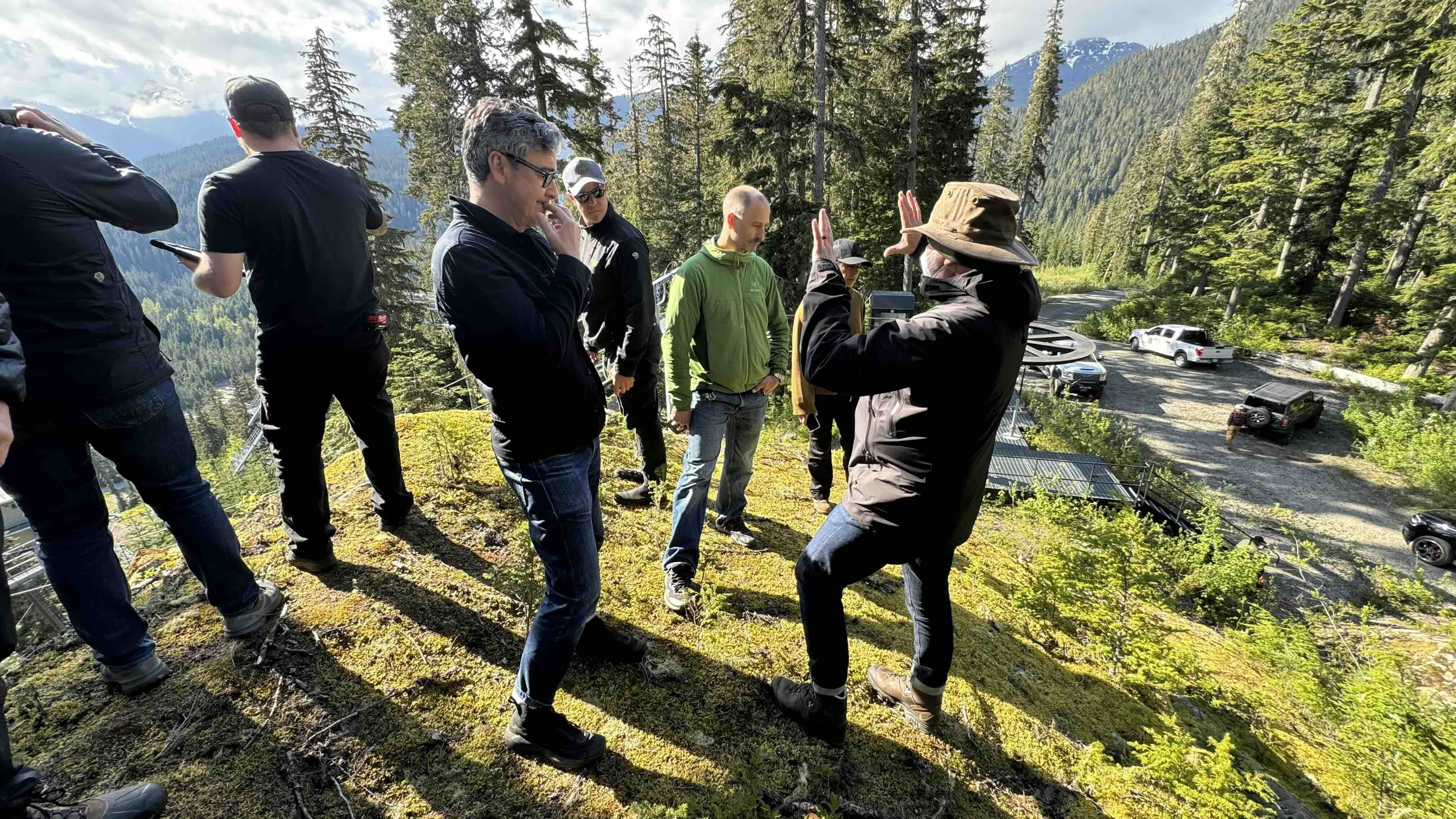
Michael McDonough, ASC, BSC, discusses the next setup with director Tom Bezucha and stunt coordinator Chris Gordon. Photo courtesy of Michael McDonough, ASC, BSC.
In terms of Northern California, there's tons of nature photography throughout, and aerial photography. What was the approach to some of these aerial sequences? Did you do any B-roll segments in Yosemite to stitch together or was it all in Vancouver?
The aerial sequences would have been done in the middle block, that would then have been used throughout. In discussions, the aerial sequences were there to add that scope, to add that sense of getting above the vistas, getting above the mountains. My experience of the show was shooting up in British Columbia. If it feels like you're in Yosemite, that's great and maybe we pulled it off.
As far as I'm aware, we've got some B-roll footage from there, but no actual boots on the ground during production.
Touching on the opening sequence of the first episode, what was the process for accomplishing this intense climbing set piece?
We built a 40ft tall facade of El Capitan in the parking lot at the stage. We used shipping containers and loads of styrofoam and created the rock face that our actors, the climbers for the opening sequence were working on. I believe it was a 40 by 40 ft square. That was several days of filming to pull off that opening sequence.
We used a Technocrane. We had some handheld operators on scissor lifts getting in next to the actors. We built it in the orientation of the sun, so the sun would track over it in the same way as the actual mountain, the larger piece of mountain that we were using just south of Whistler. There's a gondola that goes up just south of the town, it's also a well-known town in the Whistler area, Squamish. So, just south of Squamish, there's another fantastic granite outcrop that is heavily climbed called the Chief. Quite a few of our locations were 3,000 ft up on the gondola around behind the Chief. It was basically a case of marrying all of this location footage, with the stage work, and with some actual B-roll of Yosemite itself.
The stunt team were fantastic. We had a really amazing stunt team, run fantastically well by Stunt Coordinator Chris Gordon. He has stunt doubled for Tom Cruise on several projects. So even heading up on the gondola, I was in the same gondola as the main stunt coordinator, so I felt pretty safe. If anything's going to happen, this is the person you want to be in the gondola with. (Laughs)
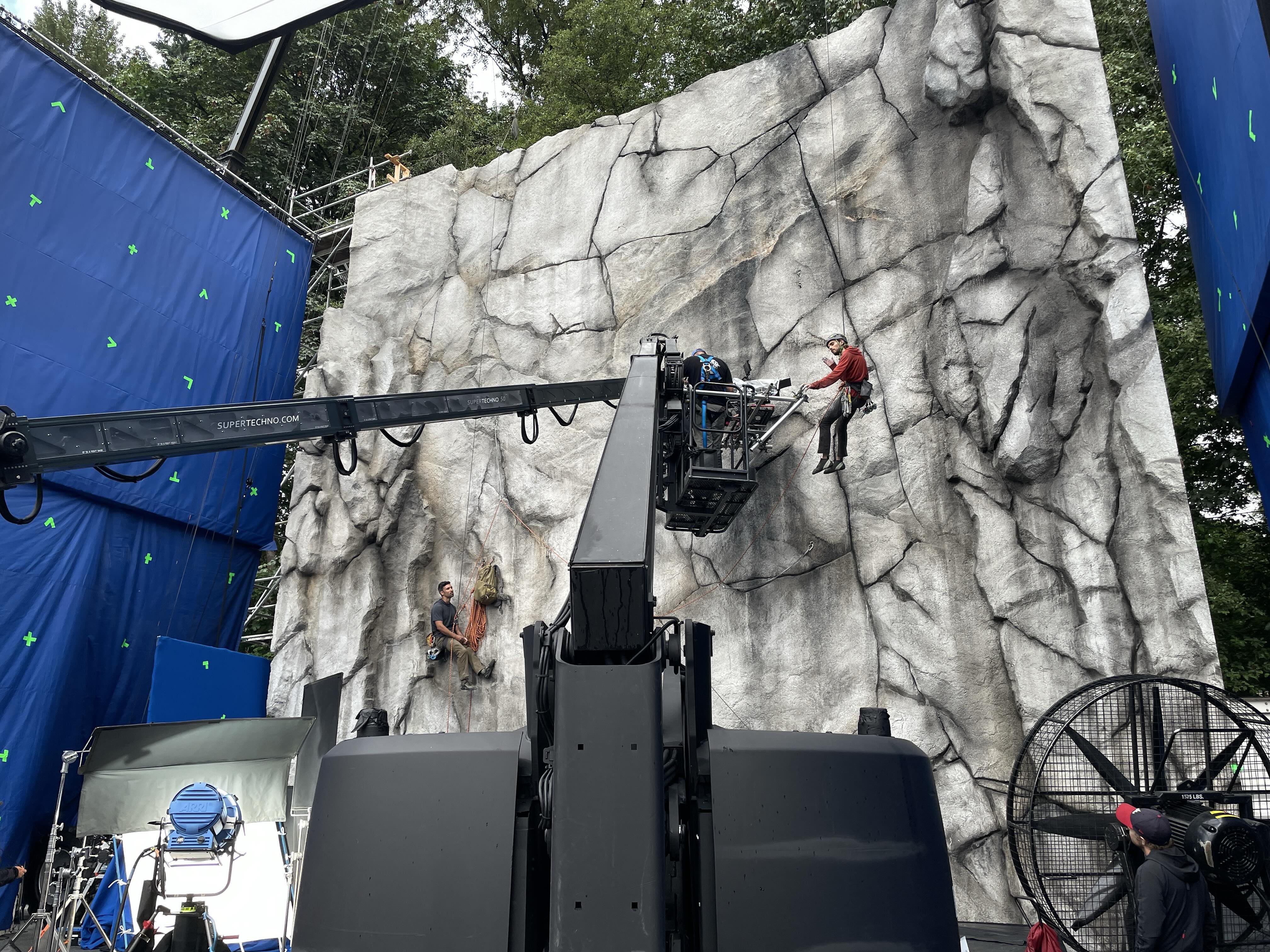
Shooting the facade of El Capitan on the set of Untamed. Photo courtesy of Michael McDonough, ASC, BSC.
On the note of stitching together locations, stage, and B-roll, there's a lot of visual effects throughout the season. What was the process like preparing to implement those moments? Outside of the major setpieces, there's smaller moments as well, such as when characters are coming right up face to face with the wildlife.
Absolutely. Those sequences were heavily storyboarded, the fall obviously down El Cap, that was probably several hundred storyboards. We were basically going through the sequence striking them off, as we completed the shots. So that was a challenge, and that was spread over several days. There was the sequence with the bear, which was done in one of the ski resorts just north of Vancouver, was heavily storyboarded prior to shooting. Anything that was that intricate, we extensively prepared and storyboarded.
There would have been quite a bit of cleanup of the environment as well. This was a John Wells production, and John is pretty adamant about the accuracy of everything. If there was any plant life, or brush or tree, that may or may not be in our location. Then, quite a bit of care was taken to paint that out, to bring all of these disparate locations together into this one Yosemite valley, and El Cap specifically. Even just the color of the rock itself, we did quite a bit of research on El Cap, and matching those colors. We went through quite a bit of trouble to match the colors through the various rock surfaces we were working on. But a lot of it at the end of the day was pulled together with Corinne and the color work.
In episode two, when they discover the body of Teddy in the water, we have some underwater photography. What was that approach like?
We found this amazing pool with some rocks. It was a place the kids would go and dive off into this pool in this river on Vancouver Island. We heavily scouted that several times in pre-production, and we scouted with the underwater camera team, led by Braden Haggerty, who had a lot of experience and had worked in that pool in the past. It was down to prepping between the stunt team. That was fairly complex, because we had fairly high camera positions in high rocks up over this fast flowing river. We had to work with the stunt team even just to get the cameras into those positions crossing the river with boats pulling along ropes to get cameras in positions that we wanted to.
That was probably a four camera day, so that we'd always have a couple of cameras ready to shoot, while others were moving into more out of the way locations. But again, in pre-production, scouting using Artemis and Cadrage to pick those actual positions, right down to the fact that two days before, the stunt team and some riggers could come in and put in their pick points for safety lines. Reid Cohoon was my key grip, and his team built a scaffold on this dive area which would have been 30 ft above the water.
We walked in a Technoscope F27 crane. It had some limitations on the weight it could carry, but it was the only way we were going to get up and over the dive into the water, pre finding the body. So, yeah, the grips again several days, certainly 24 hours in advance of us getting there. We’d walked the crane in, and got in position above the diving rocks which was pretty amazing. That would have been our main camera to cover a lot of that action, the crane. And then, I think we had two or three other cameras in more distant positions, looking along and down, and from across and back.
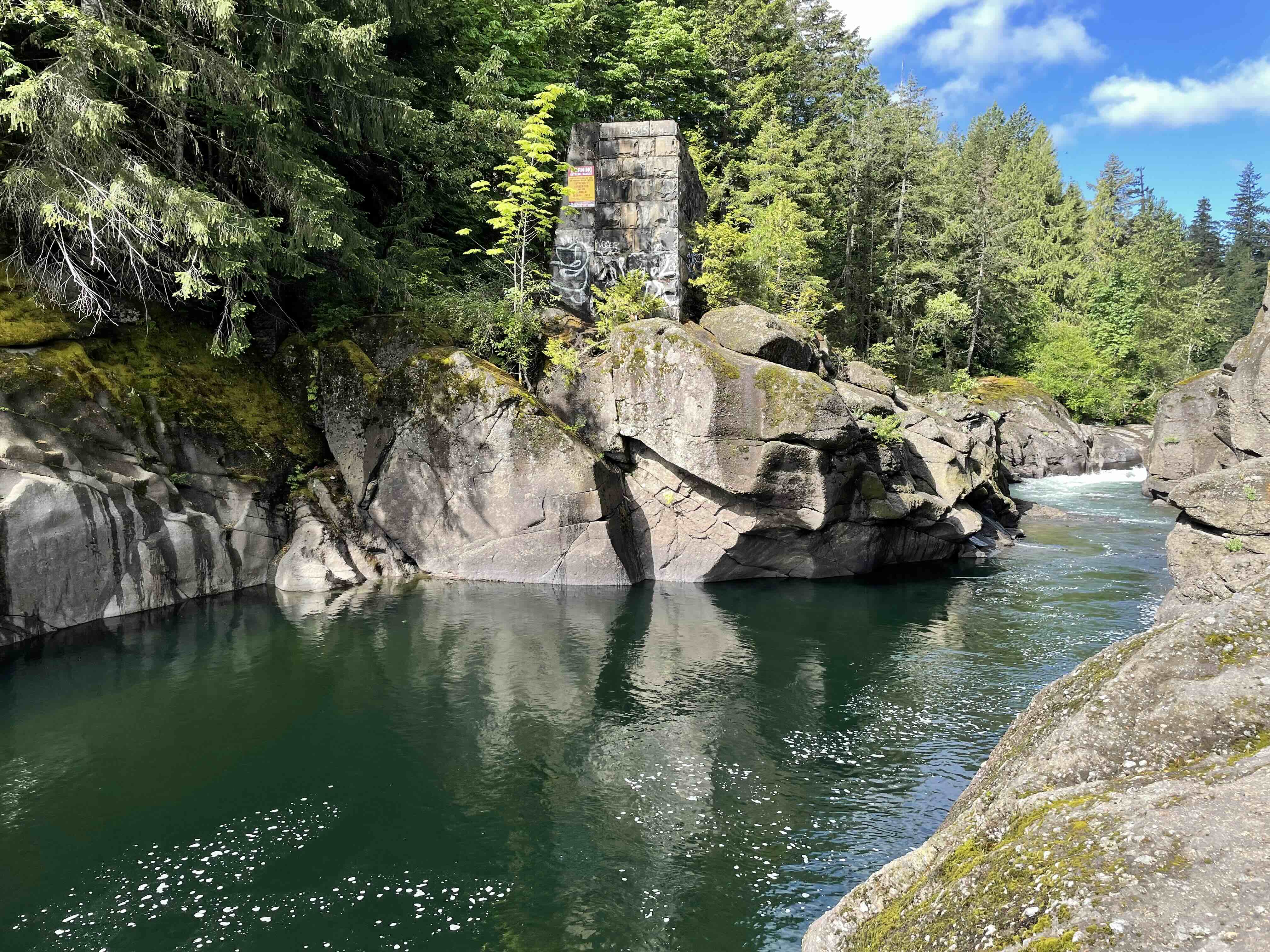
A location scout photo of the rocky pool on Vancouver Island where the underwater sequence in episode 102 of Untamed was shot. Photo courtesy of Michael McDonough, ASC, BSC.
That's something I've heard a lot, that when you're doing such a complicated scene, you want to have as many cameras as possible just in case something goes wrong, and you can't get another one.
Exactly. Most productions will be on board with, we want to do these stunts. There's some very ambitious stunts, and we want to do those as few times as possible. So, you want to have as many angles as possible going into it. And again, that was an area where we had to walk things in, not a huge distance, but going over rocks that might have been quite slick. It's really about taking your time and prepping things in advance. So that water sequence was fairly complex.
And of course, again, you're trying to build a sequence where you're tracking what the sun's doing because in a place like that, I had minimal lighting. Maybe a 4K working off of a portable generator, but we had no access to the other side of the river. So, we really had to rely on the sun as our main lighting, and ideally our back lighting element. So, our day would have been carefully broken up into shooting in various directions and we may had to go back and forth within the coverage.
Well, that's one thing that is difficult about the sun is that if you lose it, it's hard to replicate.
Exactly. We actually had a day where I was really pleased how it turned out. It was at the, what we might call a squatter village in a large grassy valley. It was an amazing location, there were multiple cast members, quite a lot of dialogue going on. It took a full day to shoot that, and towards the end of that day I could see the sun within 20 minutes was going to be behind the mountain. We still had shots to do, and we had kept the close-ups to do at that point, and the team was able to bring in some 18ks around the back, hide the stands in some trees and get me that sun back, that edge of sun for some close-ups to end the day. And it worked really well. I was really pleased with that.
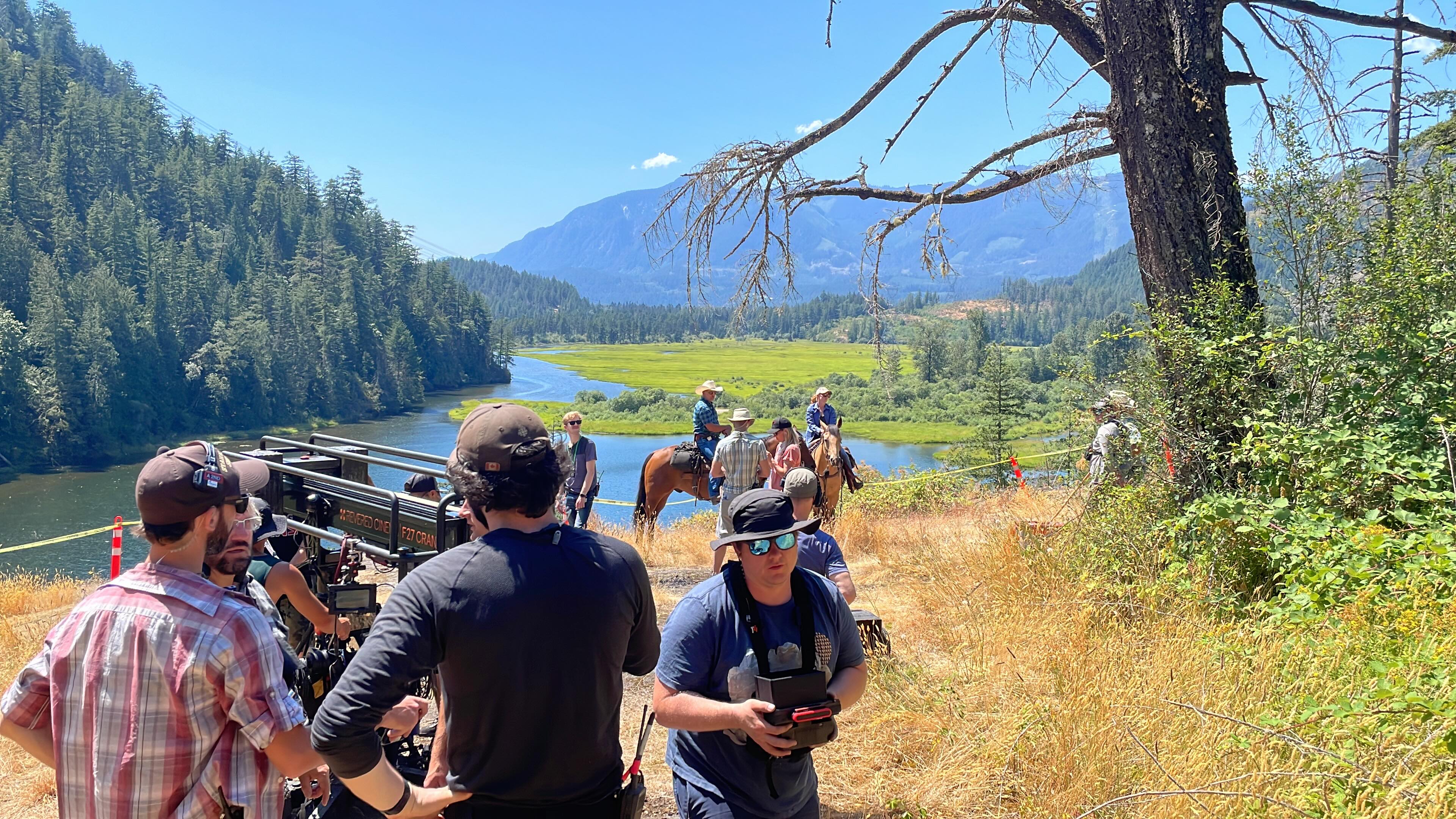
The camera department preps for the next shot on the set of Untamed. Photo courtesy of Michael McDonough, ASC, BSC.
On the collaboration between the stunt team and yourself, the last set of episodes is where the action really starts intensifying. There's some unique visuals that come into play, especially in episode 5, where we're viewing a raid through the helmet cam with almost a night vision look coming in to the drug den. We've got the bomb detonating in episode five. There's a great stunt with an ATV in the same episode as well. What was the approach for those sequences?
It was definitely working closely with the stunt team. They heavily rehearsed these, obviously for safety, and on location tech scouting, there was quite a lot of discussion. The tunnel sequence took a lot of building, and a lot of discussion on how we're going to light the tunnels. The point at which they're moving through the tunnels and using their night vision goggles, at what point do they turn on the flashlights on their weapons? And then at what point do we get into the working part of the tunnel, where we have these rope lights that are illuminating it? And then of course we have the explosion, and all these have to be rehearsed.
All of those moments were rehearsed over several days in the actual spaces. Similarly, rehearsals up in Whistler area for the ATV jump at night. The setup around that sequence was probably my most extensive night lighting on location up in the mountain side. It took me several days to get Condors into place up there for that night work. And then trying to maximize, once that area is lit, how much can we get out of the space and pull all the stage work together with the real environments on location. It was definitely a lot of work with the stunt team back and forth in prepping, how we were going to shoot things, and how they were going to play the stunt itself.
The intense action continues into episode six, where we've got a foot chase through the mountains where Turner takes this incredible fall off the side, jumps onto the tree and just plummets down. And then we get a little bit more night lighting where it's in the moonlight when they have their final confrontation at gunpoint. What was your approach for creating this moonlight? There's a lot of dialogue these days about audiences saying things are too dark. There's this contemporary trend towards realism, but I felt that you really split the balance very well where you could still see what was going on, and it still felt like it was night time.
I'm definitely a big believer in not cheating the audience. If we're storytellers and it's visual storytelling, then people have to see what is happening. So, it is a balance between realism and storytelling and allowing the audience to know what's going on. And these were challenging. That sequence you talk about, the night sequence, the culmination of that was challenging because it was virtually impossible to get big lights to the location in the park.
We had one I think 125 ft Condor, maybe it was an 80ft, that could get close but not really close enough to that particular location. It had to do with the topography. There were houses within a quarter mile of that location, and there were roads, but on a hill. It was definitely challenging. We had to string up some lanterns from tree to tree. We put lines up. I've worked with that quite a lot in British Columbia where we'll use the trees and put up lines and then have lines of lanterns and various other things up within the trees to get some height, some elevation for the night lighting for the moonlight.
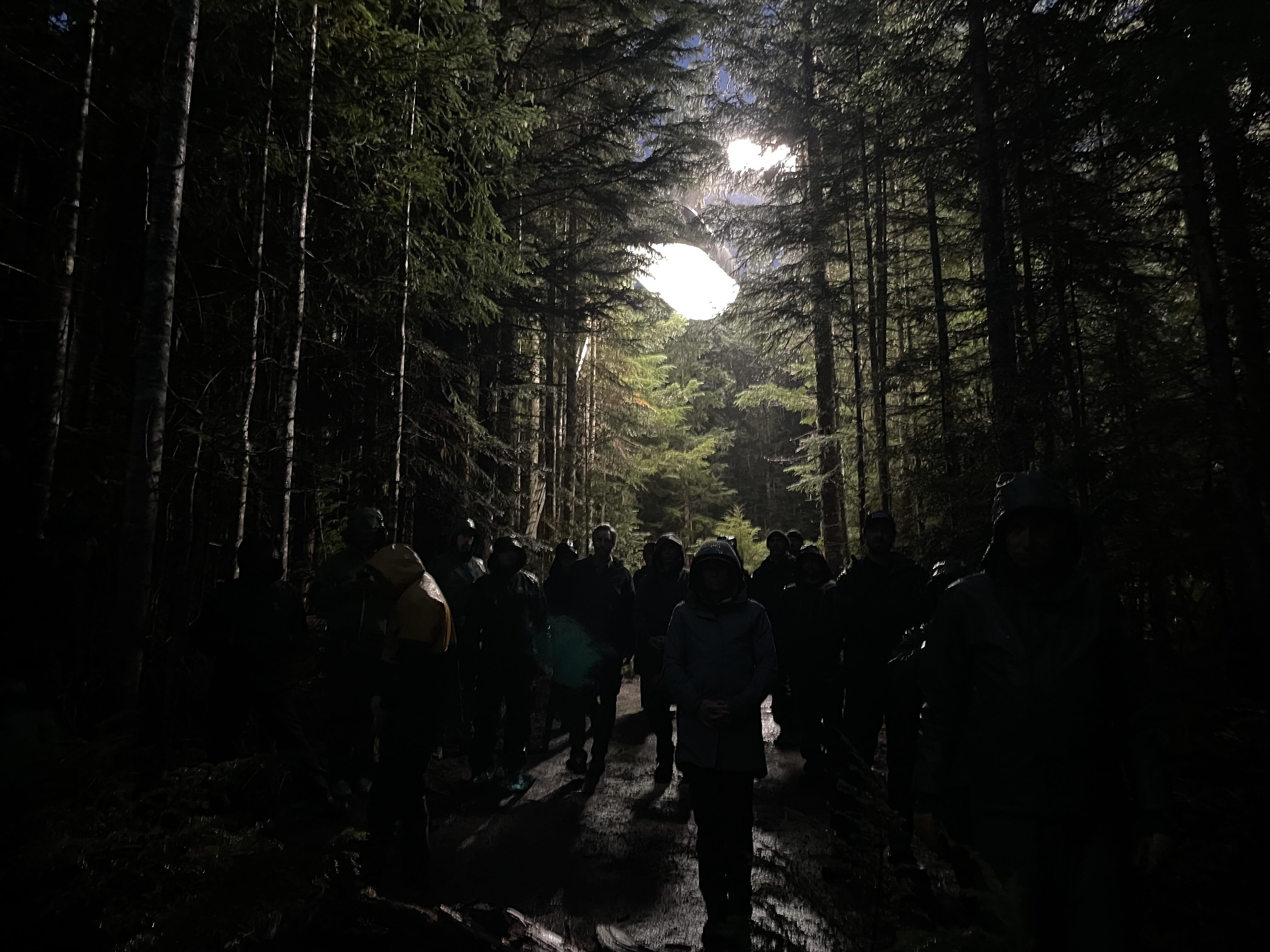
A moonlight setup in the forest on the set of Untamed. Photo courtesy of Michael McDonough, ASC, BSC.
So we had that because we were limited in what we could do with getting Condors close. And there was also a rock face to our right that we had a series of vortexes up there. It was definitely a challenging space. Is every lighting position perfect? No. But again, trying to tell the story, trying to allow the audience to see as much as going on, but still believe we're in a nighttime scenario, is the goal.
I'm also a big believer, whether it would have been film or digital, overexposing negative by two thirds. I like to have a healthy negative. I don't like to be trying to open things out of the darkness. I'd much rather be crushing things down and having nice deep black. So, I would say that sequence, I definitely lit it up on the day, with the intention of bringing it down more in the color grade at the end.
In general throughout the series, there's a lot of really striking compositions. In the last episode, there's the moment where we see Turner’s son in the reflection of the water as they're standing there at the pier and he's debating whether or not he's going to end his own life. There's a fantastic moment when Vasquez is in the field and comes face to face with a pack of deer. One of the things that I really like about the show visually, is that you’re not afraid to just let it sit on a wide shot sometimes, and let the characters exist in this world. Do you have a favorite composition from the season?
I think one of my favorites is when Turner and Vasquez are riding horses around a little bluff. We're up above a river with a valley spreading out below them. I think there was a couple of amazing compositions during their horseback journey. There were a couple of vistas that I loved, that we were very specific about the time of day to get the sun in the right position. And I think those are amongst my favorites. The landscape is amazing, and it's really just a case of not screwing it up. A lot of it comes down to trying to build other things in your shoot day around the fact that you want to be in this place at this exact moment.
It's always a challenge on a TV series shooting schedule, to be as specific as you want about where the sun's going to be. Those vistas were important to everyone in terms of the scale of the show, and so we made a special effort to be at those places at the right time. We got lucky that when we were setting up for those moments, we got the cloud formations, the sun, it would be in the right configuration. I don't remember any disappointment in which we had to go back and retry it.
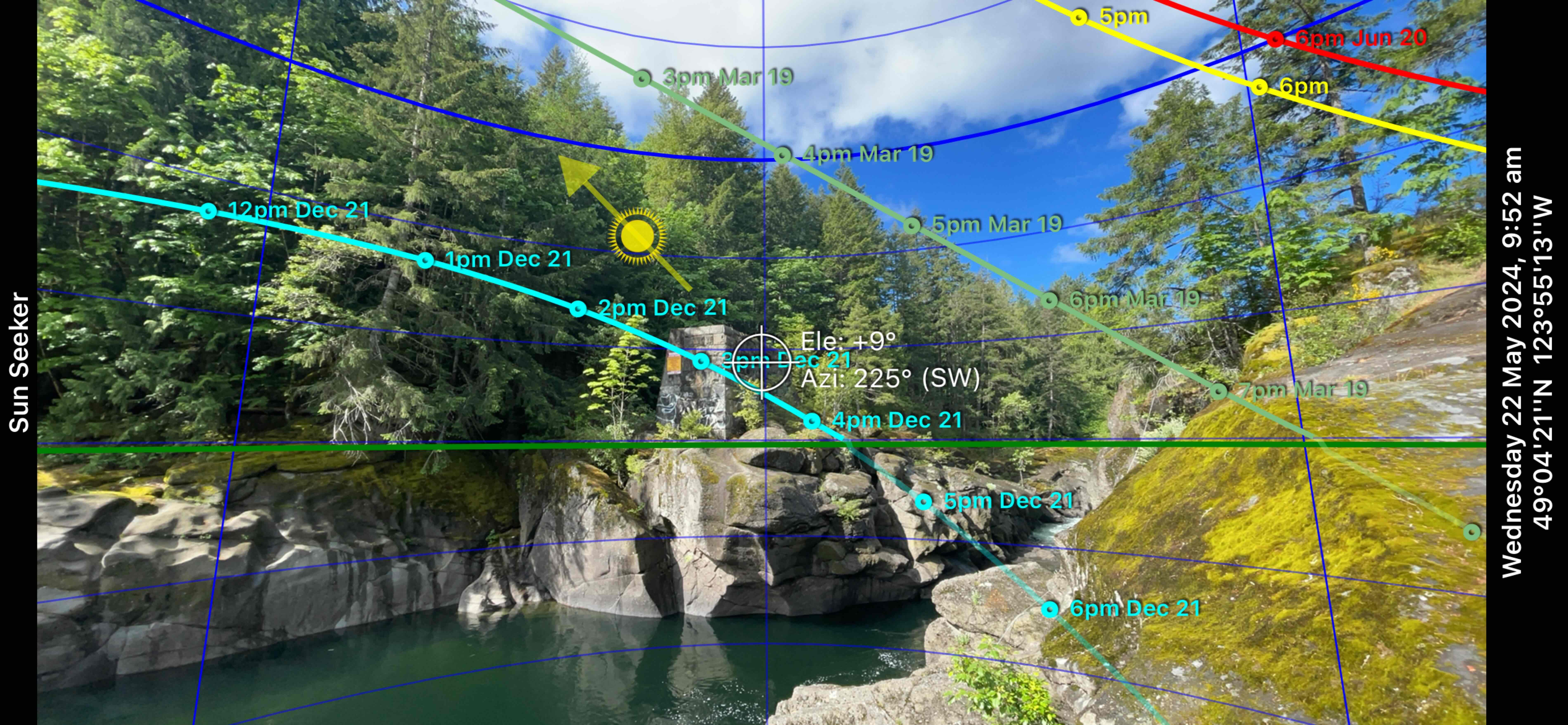
A "Sun Seeker" app screenshot from the set of Untamed. Image courtesy of Michael McDonough, ASC, BSC.
In terms of complicated setups, because obviously it sounds like the underwater cliff dive scene was quite challenging. Would you say that was one of the most challenging moments on the series or were there other sequences that rivaled it in terms of the intensity of the setup?
Leading up to that day in that valley with the squatter village, we had a 50-ft Technocrane on a driving base. We had all the approach work. We had them meeting the squatters, and then we had them exiting in some great vistas. And we had one day to do it, and we almost didn't believe we were going to do it. That was the one day that we were dreading on our schedule, and to actually pull it off was really satisfying.
That was like, “Okay, wow, I can't believe we got that out the way.” One of the biggest challenges was the grasses within that valley. We had to be very careful about what we show, when, and where the crane could go. Even really stressing that every crew member can really only take certain paths, like, “I know it's going to be much easier to cross right over there, but that's right through our hero grassy field.” So we tried really hard to work within that landscape without impacting the shots. We had quite a lot of traversing of that valley floor we had to do within the day.
It was well prepped. That was the key, you do your prep and then you try and follow through on that plan. With some experience comes knowing what you should leave to the end of the day. What can I cheat? What can I pull off in those last 30 minutes when the sun's about to go down completely?
Within the camera team and production in general, is there anyone that you want to highlight their contributions to bringing the series to life?
Everyone worked so well. It was definitely challenging. Brendan Uegama, the DP for the middle block, he had his own set of challenges. What's lovely about the show is it does go through this journey, where it would have been difficult to do too much block shooting, because it's so varied in the journey they take. He had some very different challenges in terms of locations, and lots of tunnel work. His episodes introduced the idea of the tunnels. So that would have been a different challenge to some of the challenges I had.
I felt we worked seamlessly through a very experienced camera crew up in Vancouver. A camera operator Norbert Kaluza, and Junichi Hosoi. We supplemented Sean Harding. I had met Sean on a previous job and he came in and did some great work with some of the multi-camera days, the C camera days. Focus puller Patrick Stepien, is very experienced. I'd actually worked with Nick Watson, who was on B camera previously, on Lou, the movie I did back in 2021. So it was a mix of people that were new to me, and people that I'd worked with before. David Warner, the gaffer, was very experienced and my key grip, Reid Cohoon, I was going to do the series Pieces of Her with Reid when the pandemic shut that down in Vancouver. We didn't do any actual filming, but I just knew through the prep that we had done, that this would be a good match. Their ability to get things into place at the right time was crucial to this shooting.
The writers, Mark and Elle Smith, Mark had written The Revenant, and they are a father and daughter team. They had written the script about five years previously. In terms of quality of people, in terms of how they dealt with everyone, in terms of the people that they are, they really made you want to work hard and pull this off in as good a way as you could. Knowing Mark had written The Revenant, and how powerful that was, and what a piece of work that was in terms of land, characters and landscape, it really drove us to try, and I wouldn't say match that, but to approach that same level of drama with the characters in the landscape. It was knowing that and his background and his history.
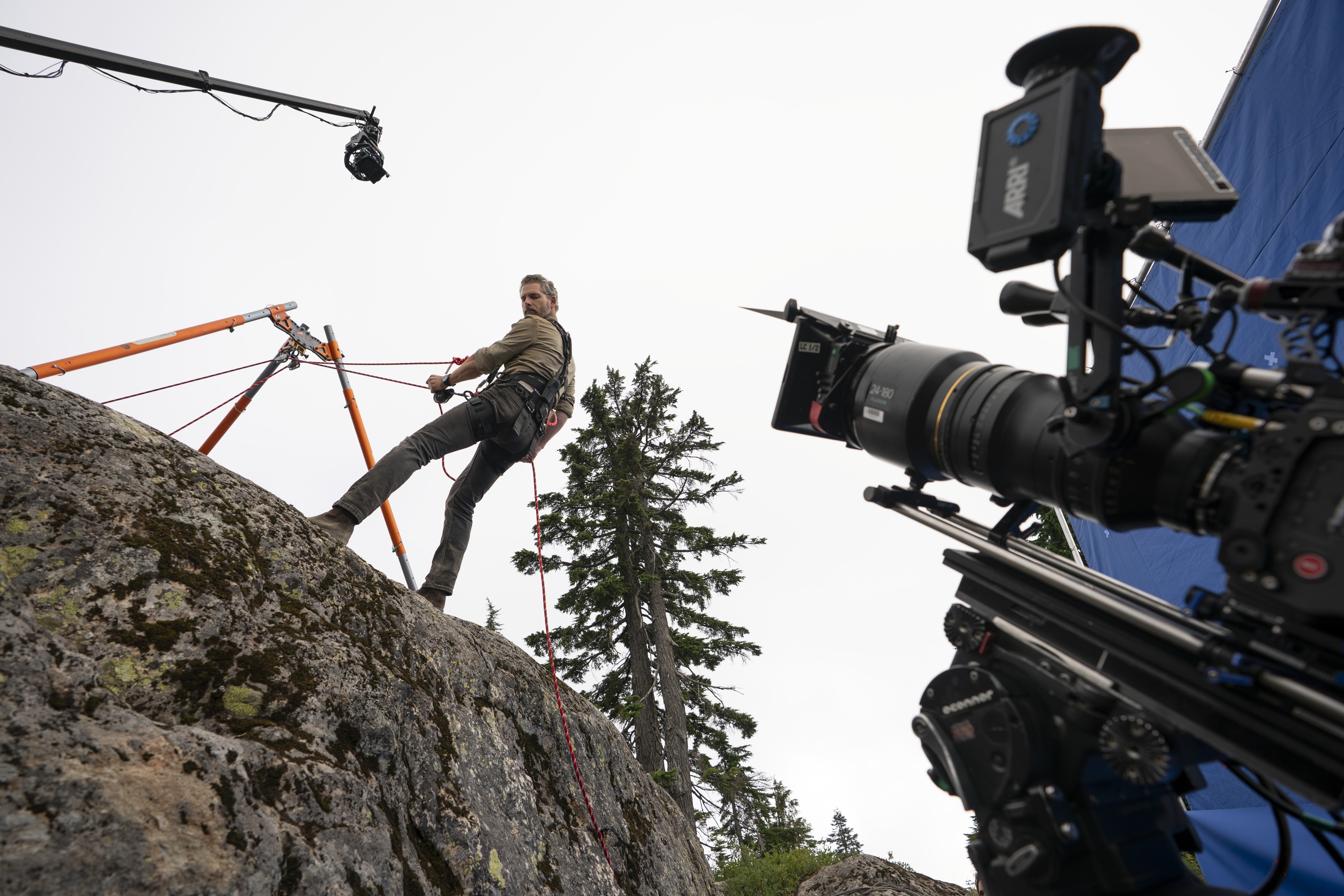
Eric Bana as Kyle Turner in episode 101 of Untamed. Cr. Ricardo Hubbs/Netflix © 2025
Getting to work with Sam Neil was a dream. That was amazing. The entire cast, Eric Bana and Lily Santiago especially. What a fantastic performance. And I have to say, both of those actors were people that, you'd be doing a setup, you'd be trying to tweak it, you'd be tapping some stand-ins in, you'd be ready to go. You turn around and Eric's right there. There's no inviting him to set. He's right there. He's either on a horse, he's on an apple box, he's sitting talking, he was just always present and always there. And the same for Lily. She was so interested in the process and just so present. And when schedules are tight, that commitment from the actors is really something to see. Zero time wasted once we were set up and ready to go. The actors were just always there and always present. Eric would sit on a horse for 30 minutes between takes. You didn't say, "Can you step down and go?" He would say, “No, I'm all right mate." It was a real commitment from them and I think it shows on the screen.
But actually the biggest plus point of the whole project was working with Tom Bezucha, the director who hired me to come in and do the pilot, and then I followed through the rest of the series with other directors. Tom and I, we just had a great time. We were really on the same page, and apart from the occasional schedule stresses, we really enjoyed ourselves on it and it was a fantastic experience, very positive experience.
You mentioned earlier on, your relationship with Keslow and with Dennis in particular. Is there anybody here at Keslow who helped alleviate challenges, and was there any time that Keslow specifically was able to come in and assist in a moment of need?
I mean, it's just the general culture of the company. Right from meeting Dennis back in 2009 or 2010 and just how supportive everyone is. Court Weeks (General Manager & Business Development, Vancouver,) who I've worked with extensively, has been fantastic. There's always something unique in every project. We had to do a rifle scope gag for Lou, and we spent weeks getting various scopes and figuring out how we're going to attach those to what lens we could use, how could we shoot through the scope and move it around and pan it around. Some weird and wonderful rigs were created for that. There's just always been that support.
Keslow went out and bought a set of Signature Primes for me to use on Pieces of Her. And then when that went away in the pandemic, I was absolutely delighted in 2021 to be able to use those on the movie Lou. We had a full set of Signature Zooms and Signature Primes, and it wasn't lost on me the investment that Keslow was willing to make. I was really happy to be able to put them to use a year later on Lou, which was also a pandemic show. We were masked up, I had to fly into Vancouver and quarantine for a week before we could actually start prep and start shooting. But that was an amazing experience. Just think, after a virtual year of lockdown in LA, I'd been shooting Bosch, but you're still coming home to the downtown LA lockdown experience. And so the following April to fly into Vancouver and to just breathe that British Columbia air was amazing.
I should also say, Brad Wilson (VP, Business Development.) Dennis and Brad, no matter what I've been doing, have been incredible. Over the years, I've been mentoring some young DPs coming up, and I would introduce those up and coming DPs to Dennis, and the support they have given them is just incredible. There is a specific DP I mentored, Rachael Kliman, and Dennis and Brad supported her first feature When I’m Ready, and it was just a fantastic thing for them to do.
Steve Demeter (Executive Director of Business Development, Vancouver,) was hugely helpful on the lens front on Untamed. It was fairly heavy on lenses. We had two cameras, multiple Fujinon Zooms, two sets of Panchros. I believe we worked with one set of V-Lites for the flashbacks, but it was still a fairly hefty package and I don't remember any problems, any issues that wouldn't have been solved within moments of them cropping up. Especially in a challenging location shoot, that's gold.
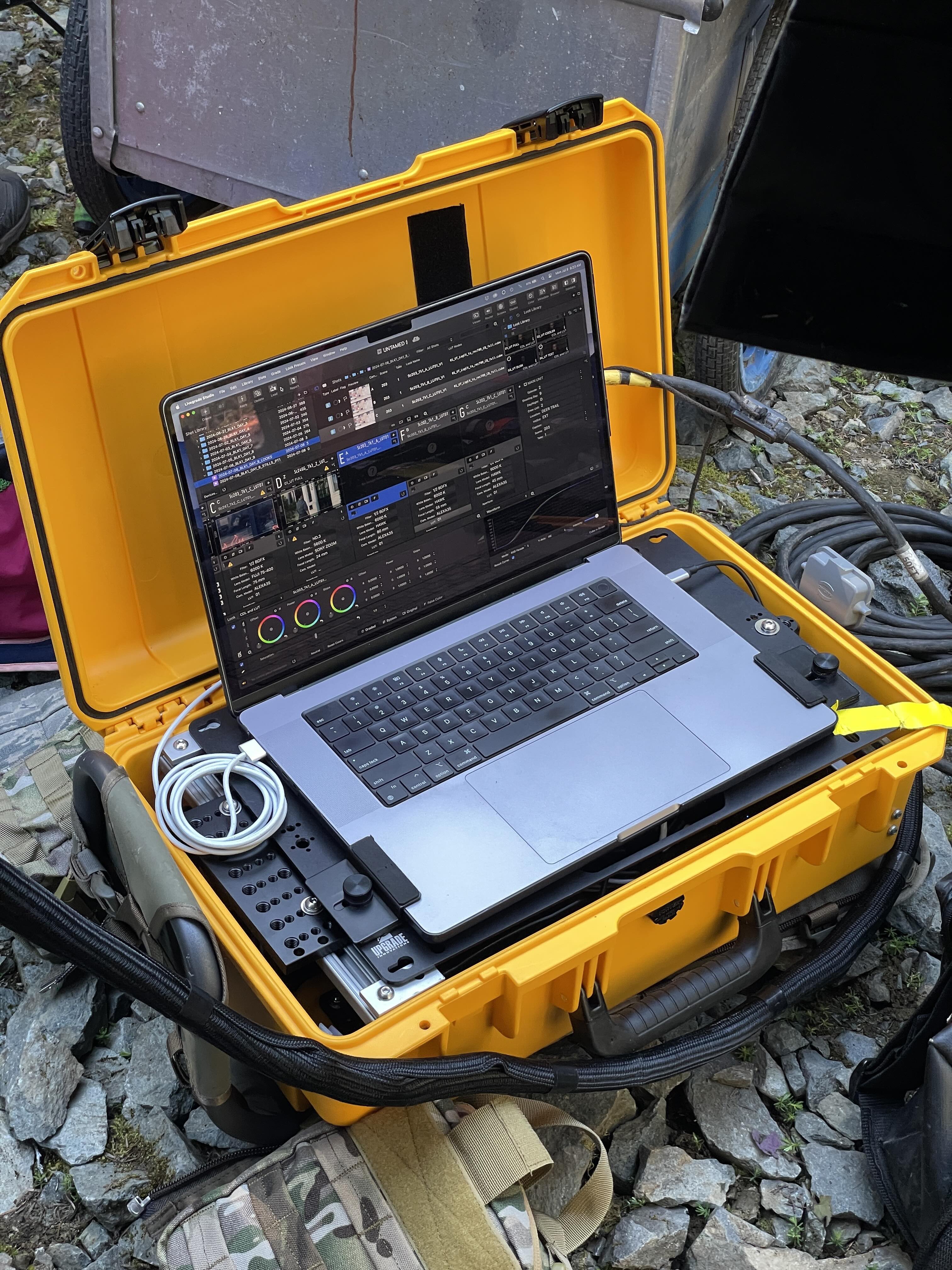
Digital Imaging Technician Robert Popkin's mobile DIT station. Photo courtesy of Michael McDonough ASC, BSC.
The last thing you want is to need to swap a lens or swap a body, when it entails trekking back over a mountain with it on your back, to the truck.
This was definitely a backpack shoot for a good portion of it, 25% of it. We would have lenses in backpacks, hand carrying the camera pre-built to a degree, minus lens. Robert Popkin, my DIT, was fantastic. He created a whole DIT station, where basically, you flip open this Pelican case which he carried on his back, and instantly we had a mobile DIT station anywhere we needed to go.
Often times you see a scenario where we're going to be filming and you're inventing things, you're building things. I'd never seen a rig like Robert’s, in terms of being able to get so much color work ability into such a small form factor, and being able to hand carry that on your back up into location. It was just in early discussions, talking about how, having scouted some of these locations, talking to Robert about there's no way we're getting a cart up there, that he went off on his own and made this fantastic invention.
Restriction really does breed creativity a lot of times. On that, because it sounds like so much, in terms of what funneled towards this show specifically, had to do with other projects that didn't go, or with finally being able to explore an idea or work with specific people later on. What advice would you give to a rising DP in terms of being able to improvise and be creative when those challenges arise?
Absolutely. I mean, obviously the thing is to get into the rental companies as much as you can when you're not working. Experiment as much as you can. Look at what's coming on board. Check out lenses in advance because often times something that isn't quite right for one job, one year down the road that could be the perfect thing. You've already done some research on it. You've already done some prep. When you're not working, any research you can do is never going to be wasted. It's going to come around eventually and be useful.
I've worked between features and TV. And I think what you have to say to yourself is, especially today, you'll do the best you can in the time you're given, with the resources you're given. Don't beat yourself up, be comfortable that you've done your best work within the circumstances, and move on to the next day and the next set of challenges. On top of that, have a plan. Obviously prep is crucial, have a plan, and have enough confidence in yourself to step out of that plan, and in the moment figure out a new plan. Figure out a new way of doing something, a better way of doing something.
Maybe it's something that the actors, in what they're doing, give you that you hadn't thought about before. Or maybe it's something that nature's given you. Try to be flexible enough that you see something, the way the sun is moving through the trees at this moment, try and grab that. Have a camera ready enough that you can just grab it, stick it on your shoulder, and pick up some of these moments that add more depth. [X]