
The Cinematography of "Primetime" with DP David Bolen

DP David Bolen frames up a shot of Chris Hansen (Robert Pattinson) on the set of PRIMETIME. Image courtesy of A24.
Long before there was a film, there were clips. On other shoots, director Lance Oppenheim kept "To Catch A Predator" snippets playing, always returning to the same observation. “Look how interesting it is, how the predator reacts before they know they’re on camera, versus after they know they’re on camera,” cinematographer David Bolen remembers him saying. Neither of them suspected they would one day make "Primetime."
Directed by Lance Oppenheim, "Primetime," a formally audacious and stylish interpretation of true events, follows ambitious TV host Chris Hansen (Robert Pattinson) as he pushes the boundaries of reality television and media ethics during the rise of sensationalist sting operations. Shot on ARRI Alexa 35 camera bodies paired with Zeiss Super Speed primes, 1.3x Hawk V-Lite Vintage '74 Anamorphics, an Ancient Optics 55mm Petzvalux, Angénieux and Cooke Varotal zooms, and Zeiss Ultra Primes provided by Keslow Camera—alongside independently sourced Panasonic DVX100B miniDV units and a 1980s Plumbicon tube camera—the film had its world premiere at the 83rd Venice International Film Festival on September 5, 2026, before its theatrical release by A24 on September 25, 2026.
For Bolen, who shot the film, and Oppenheim, his collaborator of 13 years, the question - awareness of being observed and the impact on subject behavior - reached well beyond reality television. They came to it as documentary filmmakers. “With us, documentaries have never been fly-on-the-wall experiences. We’ve always been like, that doesn’t exist. Once the camera enters a room, it does something to a person.”
With Primetime, they took this shift a step further: a gradual decay to the texture of the image itself. “I think Lance and I have always been obsessed with creating texture, making an image that doesn’t just have color and doesn’t just have composition, but also has a texture that almost feels like you can taste.” As the story moved deeper into its characters’ psyches, the picture would follow. “We wanted the film almost to rot away as these characters’ minds rot away.”
The route there was not tidy. “It was a really crazy, insane experience figuring this out, because Lance always comes with a trillion references: maybe this, maybe this, maybe this.” Somehow, Bolen says, it always resolves into something coherent.
Format, Texture, and Capturing The Early 2000s
The first plan was 35 millimeter film; what changed it was how Oppenheim likes to work. He comes from documentary, and, Bolen says, “He loves to just roll and throw lines out and just try things and experiment.” Film would have narrowed that, since “we could do 35, but it’s really going to restrict Lance’s abilities to do what he wants to do.” The question became how to get as close to that look as possible.
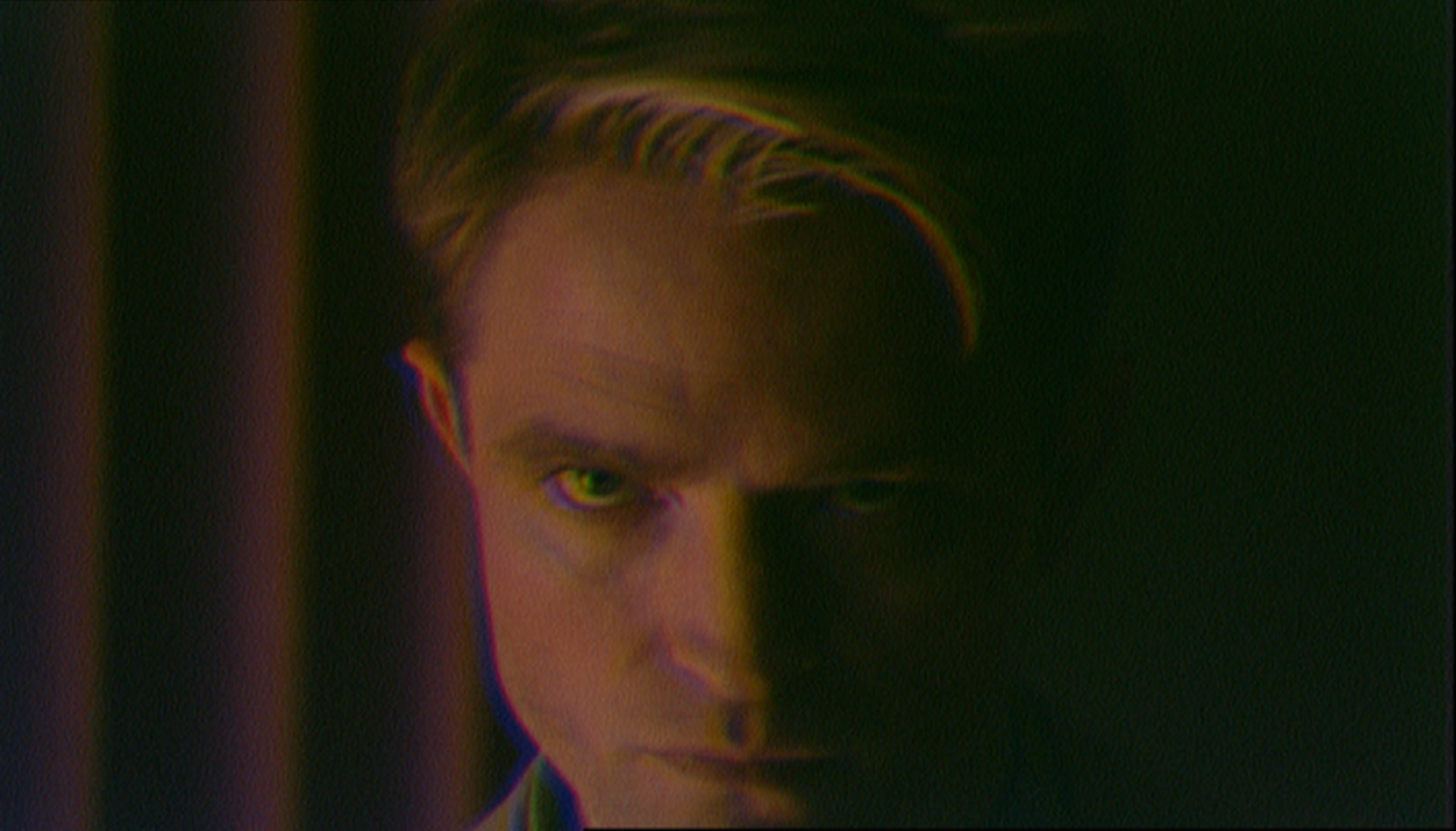
Robert Pattinson. Credit: Courtesy of A24
Behind the answer is a shared instinct about what clean images do to a period setting. “I think Lance and I have this allergic reaction when images feel too clean. There’s something about a period piece shot digitally without any processing, and all of a sudden the costumes don’t feel authentic and the hair feels like a wig and all these things.” Film “strips away all that artifice,” and the Alexa was the nearest substitute, “the camera we’ve come up on.”
Then came the push. “A lot of people are trying to shoot on the Alexa at 800 ISO. Me and Lance generally, on the new Alexa 35, we’re shooting 6,400 ISO.” The noise is a feature, since “we really love the image noise that creates, and it gave us that grungy 2000s look that we were after.” It also let Bolen light with almost nothing. “I’m just putting on a couple lamps. I’m turning on the TV and letting those elements glow and illuminate the people, and it gives the film a really imperfect look.”
There was risk in it. “It’s always scary when you do that,” Bolen says, remembering video village at 6400, an image that was “super noisy,” and the question of what everyone would make of it.
Film re-entered the process in color. At Cinelab in London, the team ran a print to film, testing 35 and 16 millimeter stocks before settling on 16 millimeter 50D. Printing the whole film to it went too far. “It was almost too crazy. It almost looked too much like an old 80s film or something.” So the print became a reference instead of a look. In the grade, “we would go to that print and with our colorist we would recreate the texture and the halation and the glow of it, and we would get it very close.” Where it went too far they could pull it back toward a sharper image, because the 16mm print “makes it almost like this hazy dream.”
Bolen taps into a common sentiment in the industry, that “movies don’t look like movies anymore.” He and Oppenheim wanted “a Michael Mann film from the 90s or 2000s, where it has all that texture, it has all that character, it has all that saturation.” He agrees that Manhunter echoes in the film: “Oh yeah. Number one.”
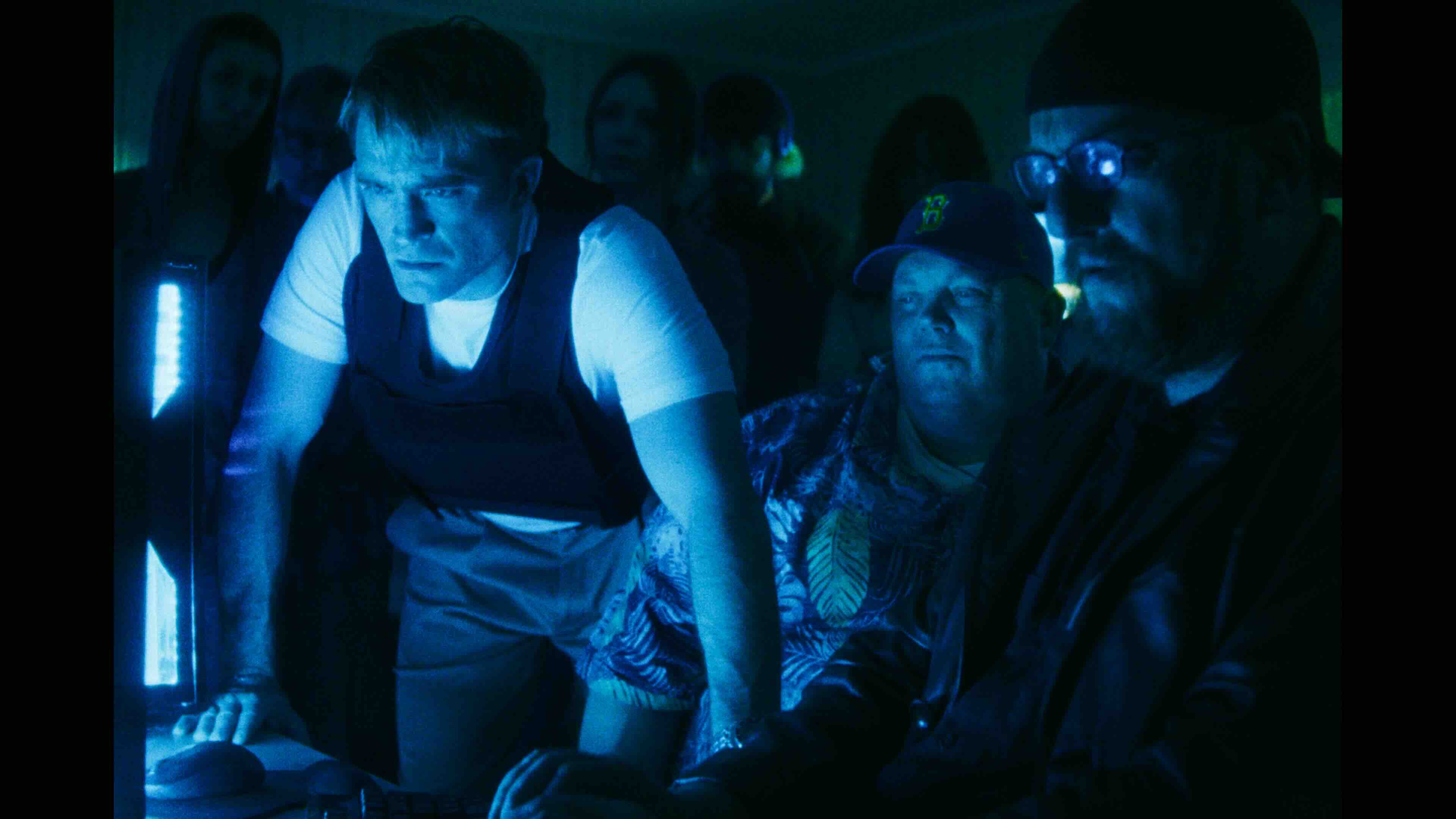
(L-R) Robert Pattinson, Matthew Maher. Credit: Courtesy of A24
The TV Glow
The lighting was a collaboration with production designer Alex DiGerlando, “who is like a hero of Lance and I, and we were shocked when he agreed to do the project.” DiGerlando’s credits include True Detective season one, which, Bolen says, “is my favorite season of television, maybe other than The Sopranos.”
Bolen and Oppenheim pitched him on throwing out the rulebook. Being told how a film has to be made, Bolen says, “makes us all cringe a little bit,” and what they want in its place is a documentary feel at feature scale. “We want to revolt against that. Even though there’s a hundred people on set, we want it to feel like how we feel when we make our documentaries: intimate and minimal lighting and all those things.”
In practice it came down to specific requests. “Okay, Alex, we need a lamp in that corner, and maybe we put a red lamp over there. That could be interesting if he walks into that.” Computer screens were adjusted to look more blue, so the light on an actor’s face carries that tint. Bolen says DiGerlando was effectively a second gaffer, because “in a way Alex was another gaffer. He was kind of lighting the sets with us and making those choices with us.”
Gaffer Chip Carey was “amazing,” and Bolen, who calls this “the biggest film of my career,” credits him with the larger setups: “Chip really guided me through the process of when we did have to do bigger lighting setups, like the lightning storm and things like that.”
The same thinking shapes how actors move through the frame. Bolen is blunt about the alternative. “I hate when an actor can only land in one position and it’s like, here’s your mark, go there and land in that light, and there’s some sort of artifice to it where it just doesn’t feel real to me. I love when an actor can go in and out of these pockets of light and you can tell them, there’s a lamp there, there’s a lamp there, there’s a TV screen here.”
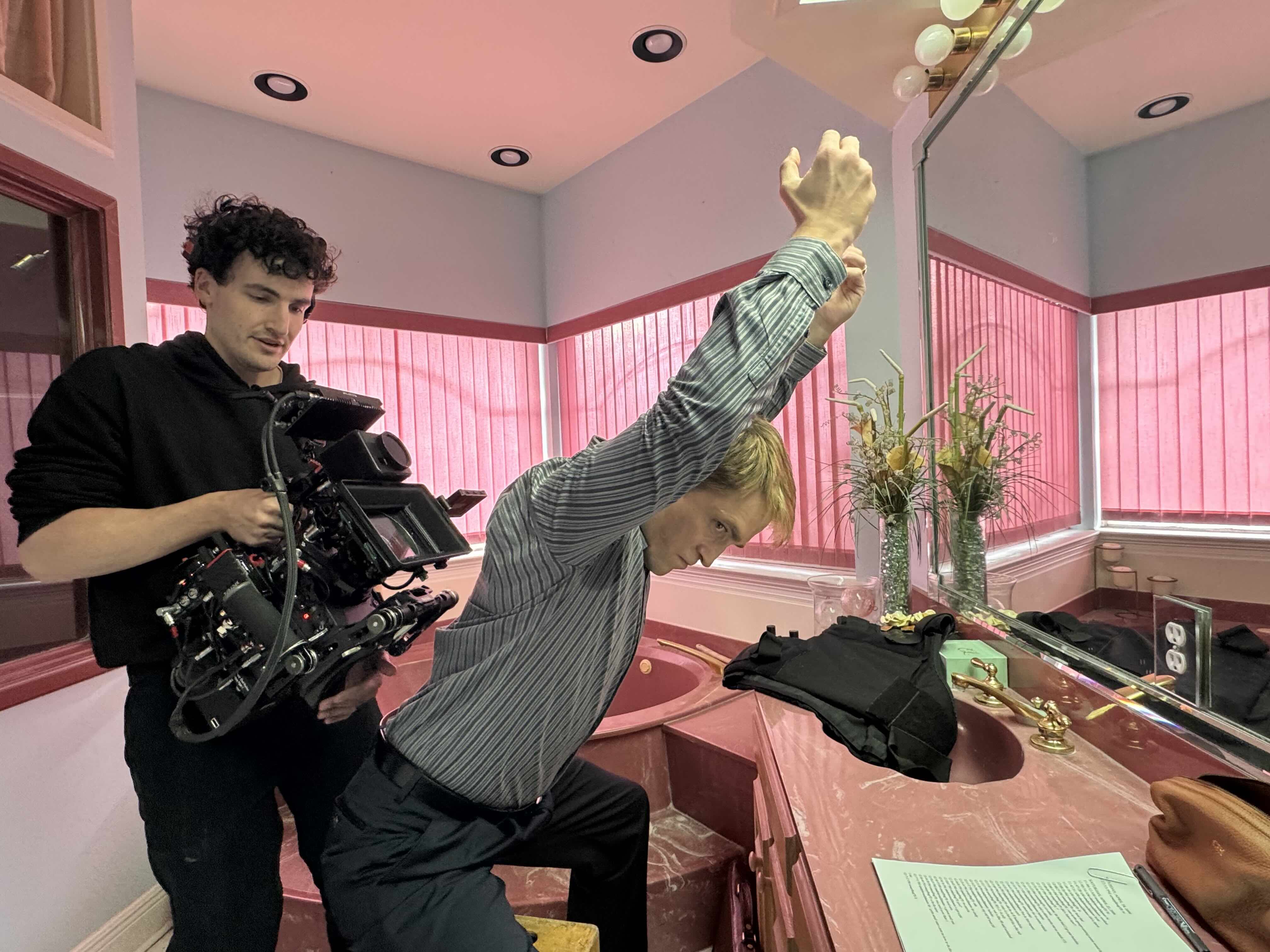
DP David Bolen frames up a shot of Chris Hansen (Robert Pattinson) on the set of PRIMETIME. Image courtesy of A24.
Robert Pattinson, who plays Chris Hansen and whom Bolen calls Rob, is the case in point. “Every single take he’s doing something new and something unexpected. If you put Pattinson in a box, that is destroying what’s great about Pattinson.” Trying different light with him, Bolen, Oppenheim and Pattinson found it could shift the character. “All of a sudden it’s giving the character a different feeling. It felt a lot like jazz in that way.”
Crossing the Threshold
The biggest aesthetic transition in the film comes at a scene with a rabbi, about halfway through, “where some really crazy stuff happens, and that’s where we make the shift to anamorphic.” Before it, the film runs on a little less filtration and slightly cleaner spherical lenses; after it, the second half “has much more of a fever dream feel to it.”
The aim is something subtle; felt rather than noticed. “As a DP, you never want those decisions you make to be like, bam, there it is, right in your face, you notice this weird shift. You want it to be this subtle thing, but all of a sudden, 20 minutes later, you’re like, why am I feeling this way?” The color, “very massaged in post,” does part of that work.
For the first half’s spherical lenses Bolen chose Zeiss Super Speeds, “just all-time classics” that he has been “shooting with them forever.” Their wide-open aperture suited the plan to “use less light” and “give Lance that flexibility.” For the second half, Bolen says, “we moved to the 1.3 Hawk V-Lite vintage anamorphics, and those have really crazy, insane flares, all the light kind of blends together, and the anamorphic bokeh is really beautiful on those.” The aim was a feeling that “we’re in a computer screen” for the second half of the film.
Other lenses filled in around those two sets. “It was the 55mm Petzvalux lens [from Ancient Optics] that was one of our dream close-up lenses,” Bolen says, and it distorts the edges of the frame. The 25 to 250 Angénieux zoom is “me and Lance’s all-time favorite lens,” one that “just looks so weird and has all this weird halation and all this weird kind of chromatic aberration to it.” The more compact 20 to 100 Cooke Varotal sometimes went on Steadicam, where they could “play around with zoom moves while we were doing Steadicam motion.”
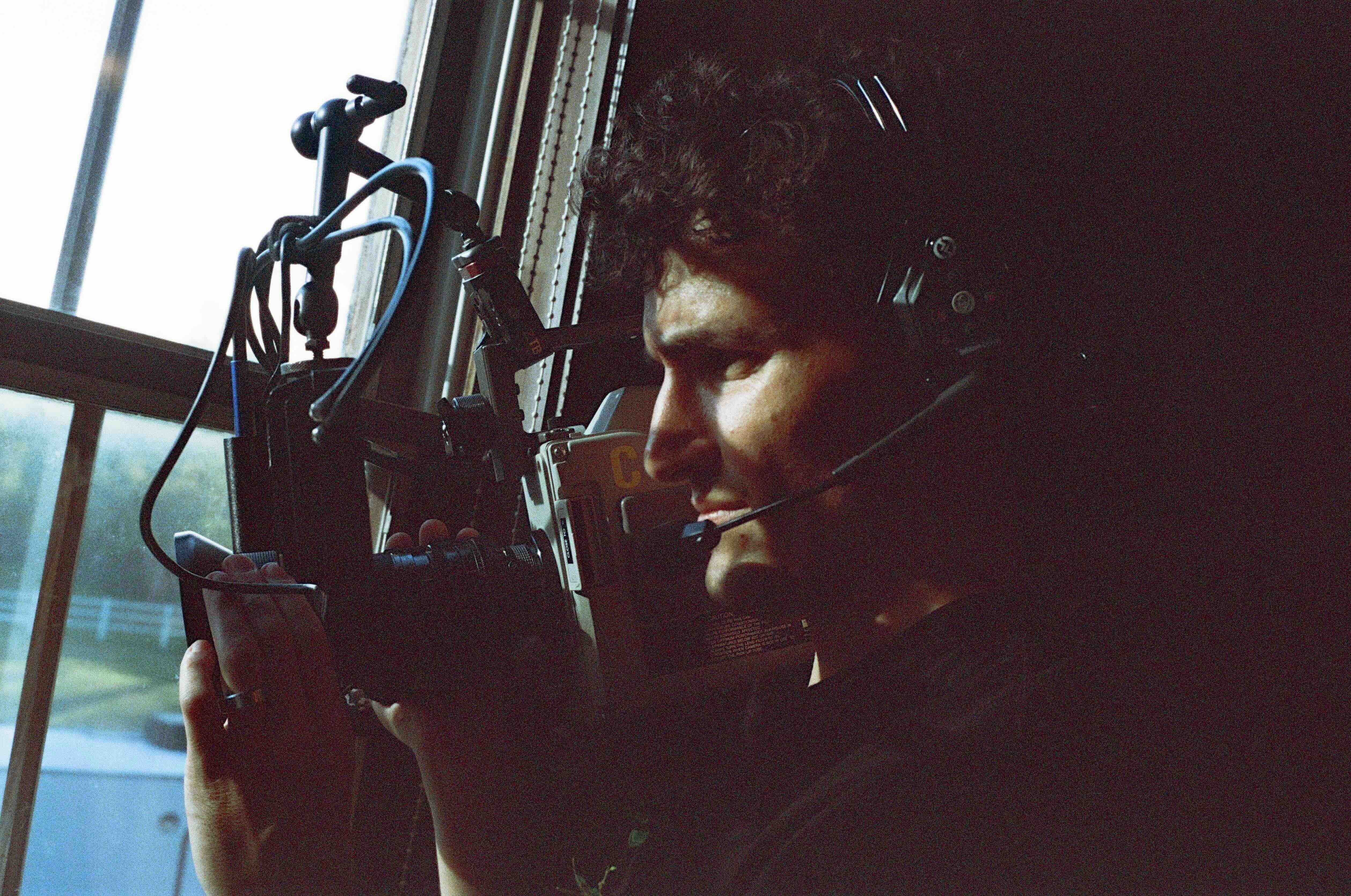
DP David Bolen on the set of PRIMETIME. Image courtesy of A24.
The Steadicam operator, Jarrett Morgan, is known as the Possum. “To me he saved us a ton of time and money because he looks like he’s on a Technocrane the whole time.” That suits Oppenheim’s way of working, since “you don’t have this giant crane in the space,” and the production can “get the Possum to do a move that we make up on the fly.”
A Happy Place Across the Street
Lens testing happened at Keslow Camera’s New Orleans location. “We tested a billion lenses and we went to Keslow, and it was amazing. Matt Pelto (General Manager, Keslow Camera New Orleans) worked with us in such amazing ways and let me come test out a billion different lenses.” The production office was “right across the street from Keslow,” so Bolen could “just walk across the street” and ask, “What do you got in the back? Do you have anything interesting?” Whatever he found went to Oppenheim for a look.
It became a refuge. “Whenever I was feeling stressed at the office, I could just go to Keslow, go to my happy place, play with the lenses, and that was a really beautiful thing.” The warmth had a reason. “At a rental place, as a DP, if I’m speaking completely truthfully, I feel very insecure a lot of the time.” At Keslow, he says, “I wasn’t met with skepticism over all the things I was trying, I was met with excitement and energy, like, ‘Whoa, that’s really cool.’”
The staff offered opinions on how a lens looked on a face or how it flared. “They were never like, ‘That’s impossible.’ They were like, ‘No, let’s figure it out.’” The priority, as Bolen heard it, was the film itself: “They were saying, ‘What’s right for the film, we’re going to make it happen for you.’” Bolen puts the arc of the relationship this way: “I had done a couple of commercials with Keslow before in LA, but this was my first time with Keslow New Orleans. By the end it felt like you’re just going and hanging out with family.”
We'll Do It Live
Oppenheim’s instinct is toward the practical. Cutting to TV or security footage that was plainly shot on an Alexa and degraded afterward, Bolen says, carries “a falsity to it that I don’t love,” and he paraphrases Oppenheim’s answer this way: “No, let’s just get the real cameras and let’s do it right.”
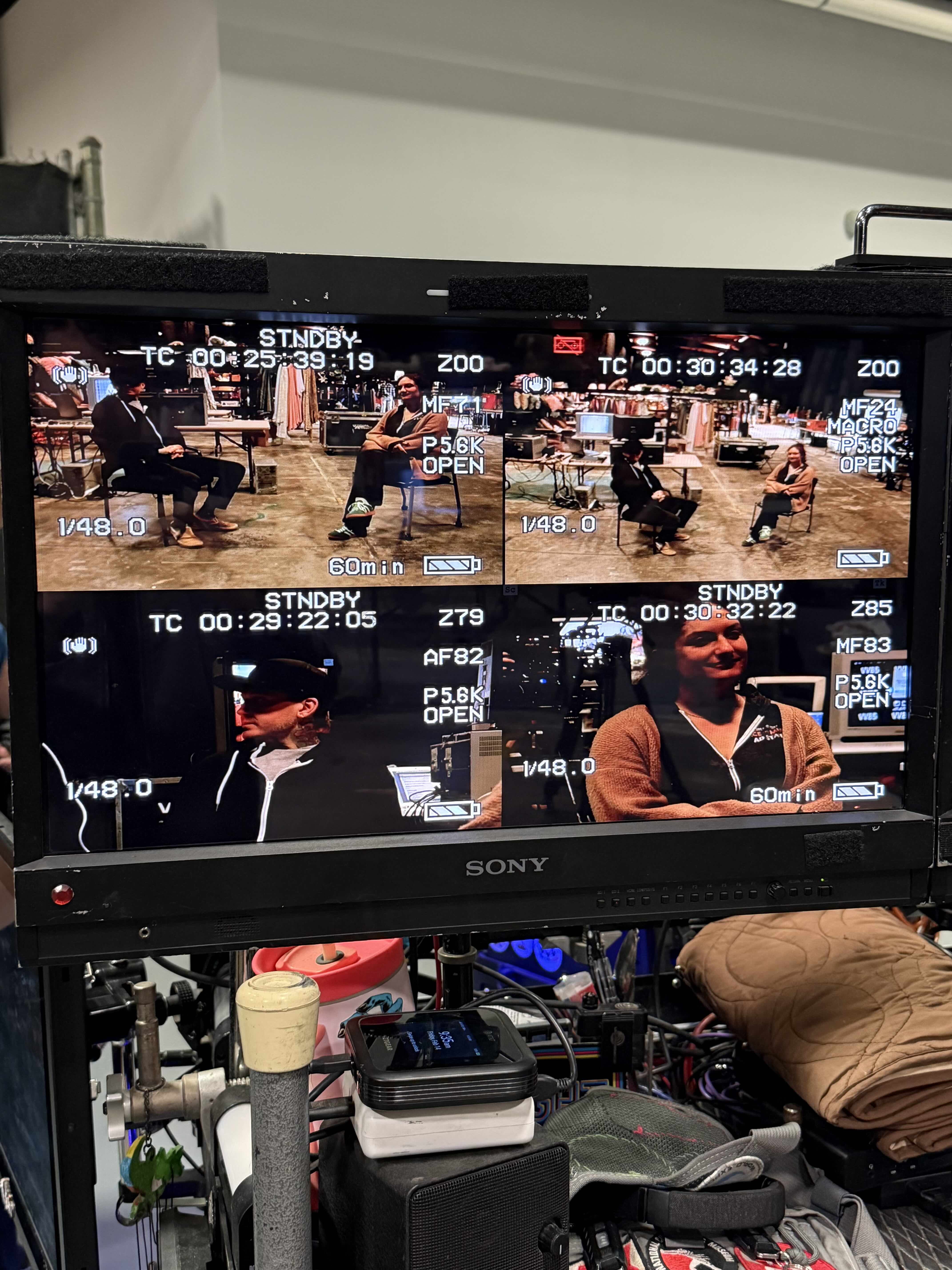
Imagery from a camera test for PRIMETIME. Courtesy of A24.
The first call with Harbor, the color house, covered “a document with 20 different cameras and all these different specs,” and Bolen remembers the reaction well: “The fact that everyone was freaking out a little bit, everyone was like, ‘How is this going to work?’, was exciting. Also scary, but exciting.”
For most of the hidden cameras they used the DVX100B, “the first DV camera to do 24 frames per second” and “very much a camera of that era.” They confirmed with one of the cameramen from To Catch a Predator, “one of those classic camera guys who has so much character,” that it was among the cameras the show used, and his looseness about gear, as Bolen tells it, “kind of liberated us a little bit.” They sourced six, shooting with four at a time and sometimes all six.
The cameras were rigged “all over the set” and shot “like they shot on the show,” so the actors moved freely, knowing a camera was somewhere. “A lot of times that would inform the blocking.” Bolen describes the order of work as a reversal, one where they “shoot it on the hidden cameras first and then adapt the Alexa to that.” In the cut, the DV cameras are the film’s objective eye against the Alexa’s subjectivity, and by the end the hierarchy flips. Bolen has done “a lot of mixed format stuff,” where the DV or analog footage is “the dirty looking footage.” Here, “by the end of the film you cut to the DV footage and it looks cleaner than the actual Alexa footage.”
The DV cameras also had a job inside the story. In each sting house, a control room has producers and crew watching monitors, and those feeds had to reach the monitors on a tight schedule. The workflow: shoot DV tape for the final film, capture it via VTR, and send the VTR feeds to the control room “so that all of those CRT monitors are completely practical. None of it’s green screen.” The actors could watch “Rob’s performance of Chris on a monitor” and react in real time, with “10 other monitors” behind them.
The Insider and Michael Mann were, Bolen says, “the ultimate reference point for it.” He recalls Oppenheim deciding early: “We’re not doing green screen,” even though, in Bolen’s words, “everyone wanted to do green screen.” Bolen worked with first AD Ben Kahn “to figure out how we schedule this so that it actually works,” and with first AC Zachary Blosser on the signal. He sent Blosser “a billion text messages every day,” asking “how do we get a signal off this DV camera? How are we going to feed it into this monitor?” The result, he says, is that “the camera team, led by Zachary Blosser, figured everything out in such an incredible way.” Keslow’s staff helped with recording the DV and routing the analog signal to VTR.
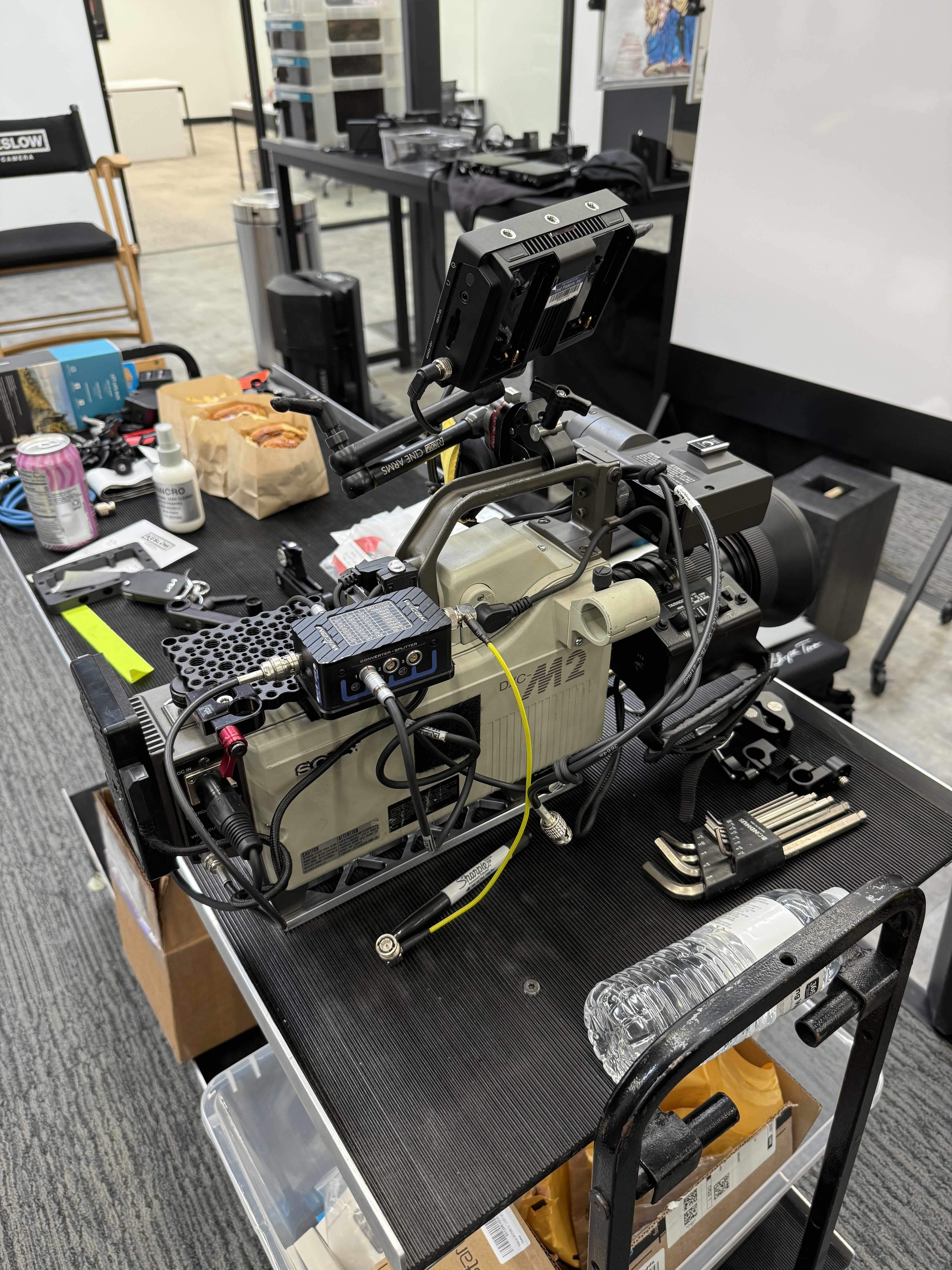
One of the vintage cameras used on PRIMETIME. Courtesy of A24.
Analog Dreams
The film’s dream camera was a different kind of period gear: an analog tube camera. “I remember our DIT pulled it out of his garage.” It was “a Plumbicon tube camera from the 1980s.” “These cameras have RGB tubes inside them, and literally, it feels like they have a soul. If you point the camera at the sun, the sun will burn a hole in those tubes that will forever then live on the image.”
A test with Pattinson at the hotel in prep sold them, and, Bolen says, “we were just like, ‘Whoa. This is fascinating.’ All of a sudden, all this artifice we’re feeling with any sort of production design or wardrobe or whatever, this camera strips that all away.” Oppenheim wanted to shoot the entire film on it, and everyone else thought that was “too nuts.” Bolen and Oppenheim “were really excited about it” anyway. The same flood of texts to Blosser included the tube camera: “This tube camera is broken, can you fix it? Can we get it on Steadicam? Can we put a Micro Force on it?”
The film cuts to it whenever it goes “super psychological or super subjective with Chris when he’s in this weird headspace,” and, as Bolen puts it, it “acts as this dream camera whenever we’re in that psychological realm.” Near the end, in a shot reverse shot on it: “I don’t want to spoil too much, but there’s Rob and one of the Predators. They’re not in the same room, but they’re with each other psychologically in a moment.”
The film’s turn toward horror runs on the same subjectivity. Bolen and Oppenheim “really like when a film starts in one place and ends in another,” moving scene by scene “from this place that feels more objective into this place that feels much, much more subjective.” The monsters, he says, are “not necessarily real figures” but “manifestations of what’s going on in the internal mind of Chris Hansen.”
The Sri Lanka footage began as a last-minute change. Skyler Gisondo, who plays Decoy Dan, was not meant to travel there; the plan was to “shoot in a completely different way,” and then, “last minute,” they decided to experiment, and “that’s ultimately the footage that ended up in the movie.” Bolen puts it this way: “It’s just a testament to Lance’s process of experimenting, because he just wants to try, try, try things. Let’s try things on set. Let’s try things in the edit, and we’ll slowly see what sticks.”
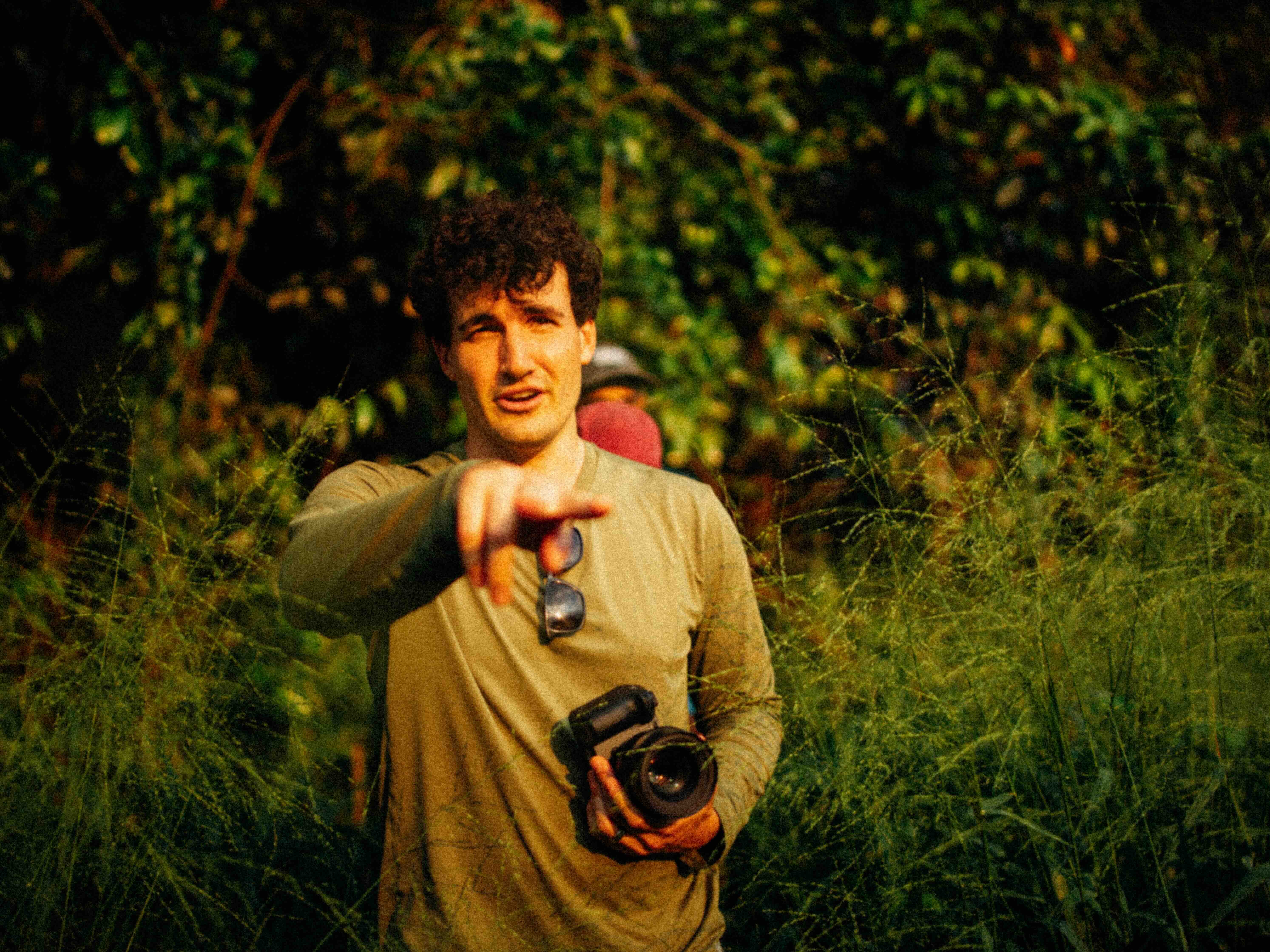
PRIMETIME DP David Bolen on the first day of scouting in Sri Lanka.
Colorist Damien Vandercruyssen, Bolen says, “honestly came up with the look of that Sri Lanka.” The plan had been to keep it close to the rest of the film; then Vandercruyssen asked whether it could be “a little more glowy and a little bit more weird and a little more distorted.” They “really played with Damo” to make it even more dreamlike. Bolen credits Oppenheim’s “willingness to let his collaborators try things and give them that trust in that room to play,” and the Sri Lanka grade is the result.
Through the Looking Glass
The image Bolen is proudest of comes late in the film, at “the low point of the movie, the all-is-lost moment.” Chris Hansen “is at his absolute low and his team is abandoning him and losing faith in him,” and a lightning storm rages outside. They silhouetted him against a big window in a kid’s bedroom in one of the decoy houses where the stings take place. Bolen sees “a lot of contrast in terms of what’s going on with the morality of this movie and this show and all these things,” and “having a grown man at his low point in a kid’s bedroom” struck him as “such an interesting thing.”
It cost time. Bolen estimates “four and a half hours,” because the rain and lightning kept looking wrong. “We were getting yelled at. It was crazy.” Still, he holds the line. “It took a long time, but every now and then you’ve got to push for those images that are really special to the film.”
The other shot he holds up is the camera’s passage through a computer, which Oppenheim was set on doing for real. In Bolen’s recollection, the first thought in the room was “I guess it’s visual effects,” and Oppenheim’s reply was “No, we need to travel through it somehow.”
Bolen and DiGerlando started brainstorming, and Bolen “started buying all these miniature cameras off of Amazon.” One was a “mock colonoscopy camera,” “a little camera attached to a wire” that “you can pull it through things.” DiGerlando came up with the idea of building a physical tube representing the inside of the computer, with “all these weird LED colors and shapes inside of it,” on “a little control system where you could spin it.” The team built “a little mini track for the colonoscopy camera” to move through it, and the shot lands, as Bolen puts it, “on Alex Winter, who is the actor playing the whale character.” Of the finished shot, he says: “I think the resolution was like 480p, but it doesn’t matter because it works for that moment. It feels a lot more visceral than if we were to do it in visual effects.” And of the director behind it: “I appreciate that Lance pushes us to do the more difficult thing.”
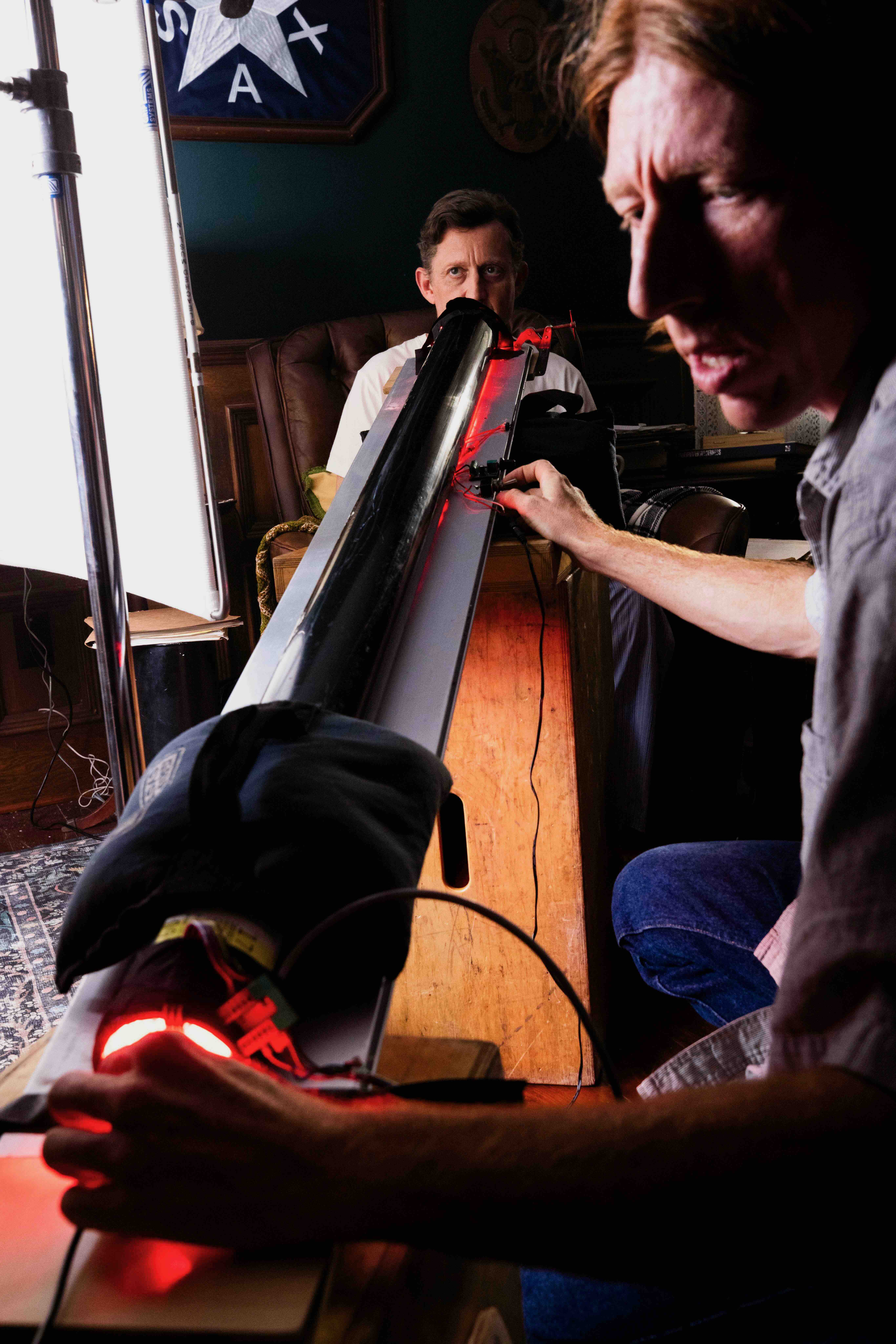
The custom "colonoscopy" camera rig used on PRIMETIME. Image courtesy of A24.
The lesson Bolen takes from the film starts with trust. “The number one thing is you’ve got to trust your internal process.” The process is a 13-year partnership with Oppenheim: “He’s my brother. He’s my best friend.” Oppenheim is also, he says, “by far my closest collaborator.”
Bolen says “there was a lot of insecurity: oh, maybe our process doesn’t work for a big film; maybe we do need to do it a different way.” Big directors told them what they would need. “All those things that people told us were wrong, we realized we have to move past that and just trust our instincts and trust how we make movies together.”
“Every day I was like, ‘Lance, we’re getting fired. Someone’s going to say this is too grainy and we’re going to get fired.’ But luckily, A24, they supported us every step.” It persists. “Every time we shoot a commercial together, we’re like, we’re going to get fired. But somehow we always get through it.”
“There is no right way to make a movie. You can make a movie in a way where you take no risks, and I think that’s the wrong way to make a movie. Me and Lance like taking risks.” Technique sits under all of it. “The technical things are important, but to me it’s more of a feeling.”
His advice to young cinematographers carries the same idea. “It’s the Netflix effect. You often see shows that, even though they’re completely different subject matter, look exactly the same.” The way out: “Make something that you love, and that love will come out.” And the measure of success is closer to home. “But even if people weren’t stoked, me and Lance would have been happy with it, and to us that’s all that matters. We just need to be happy with it as creators.” [x]
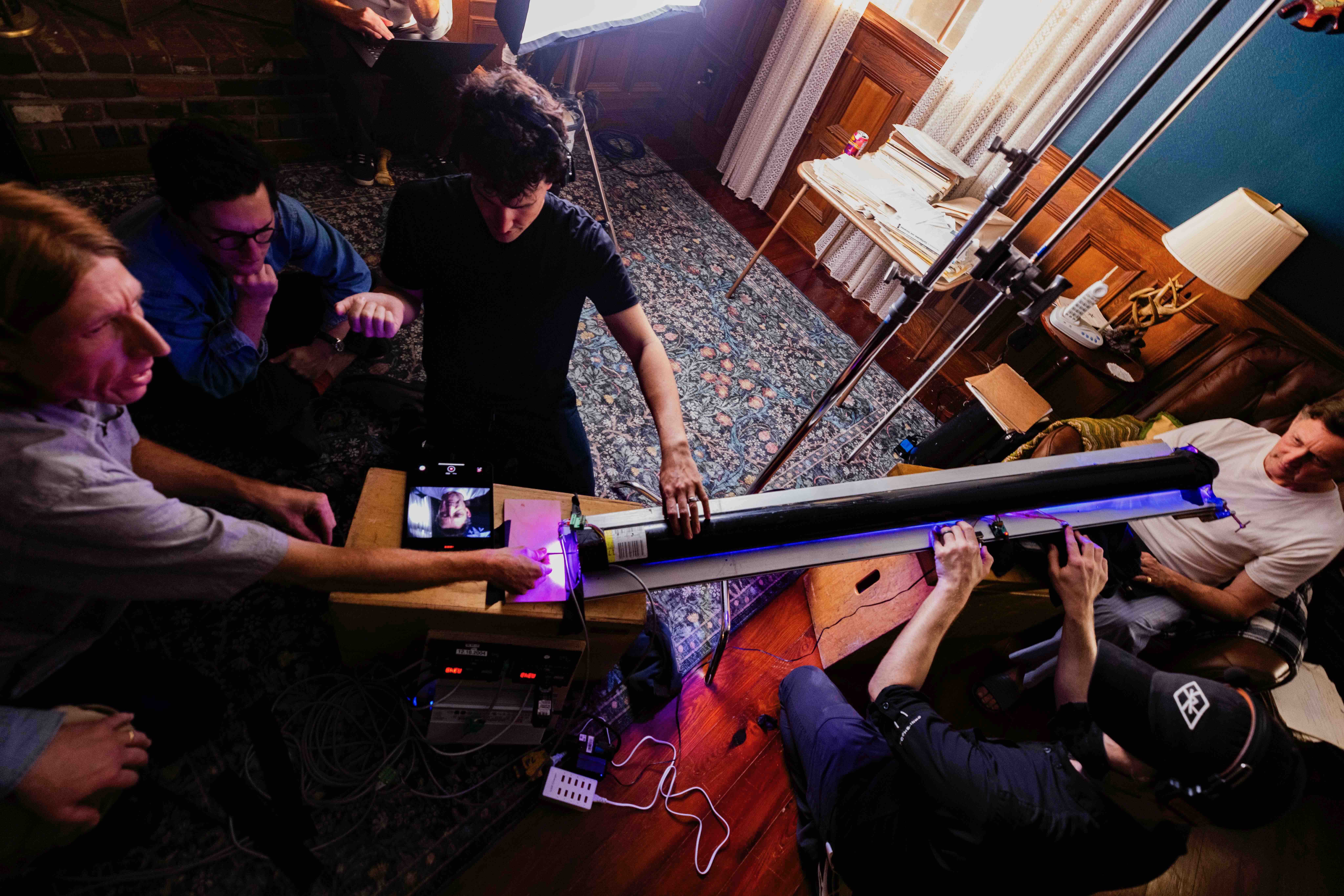
DP David Bolen and director Lance Oppenheim between takes with the "colonoscopy" camera rig on the set of PRIMETIME. Image courtesy of A24.