
The Cinematography of "Killa of Laverne" with Stephen SmallWarner

On the set of “Killa of Laverne.” Credit: Ron Kurokawa. Image courtesy of Stephen SmallWarner.
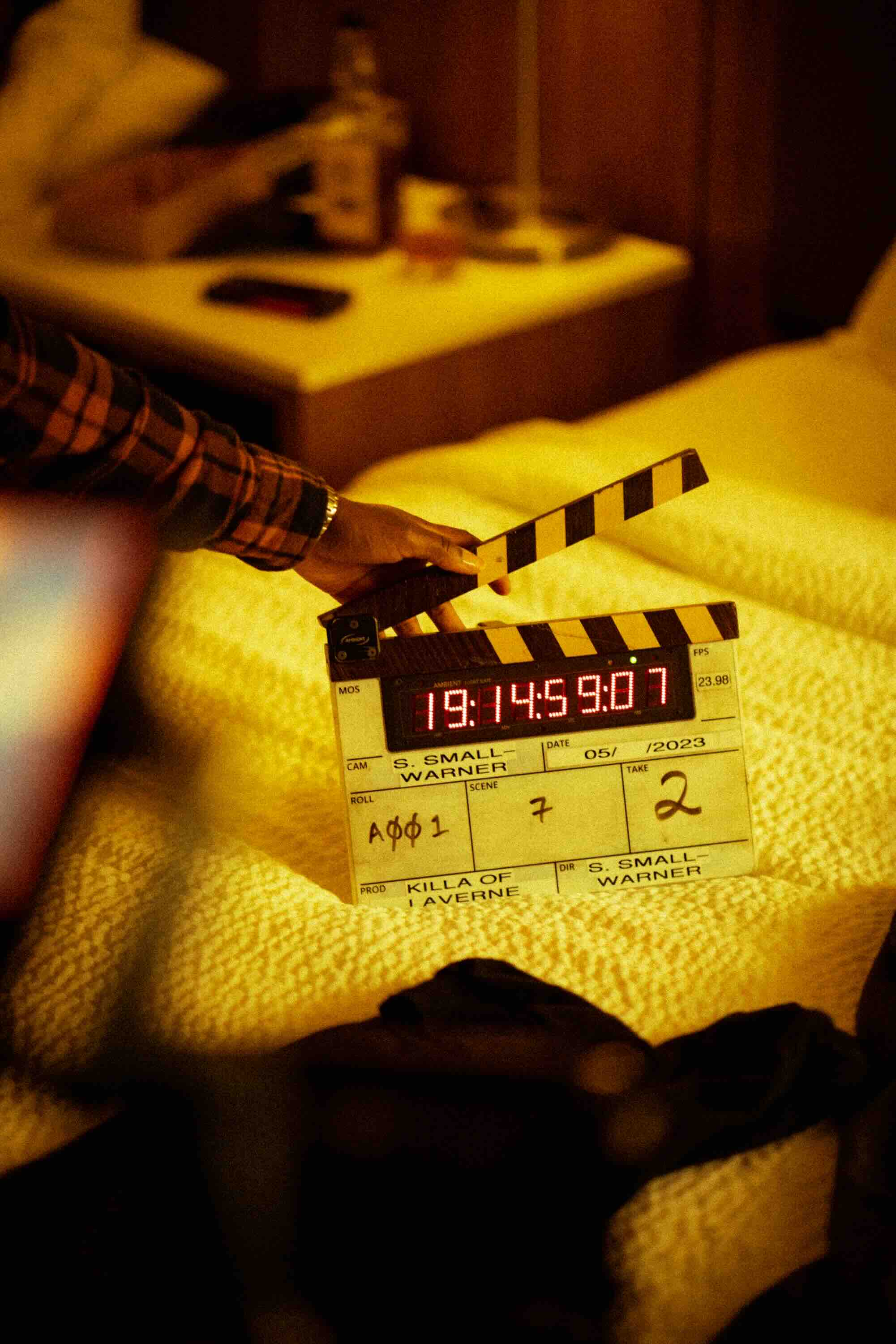
A man in a suit sits in a hotel room the night before he is due in court. There is a case folder, and he's drinking heavily. These ingredients are ones an audience will recognize. Stephen SmallWarner says he used "familiar procedural ingredients; a single space, hotel, suit and tie." From there, all bets are off.
The frame is 9:16, composed natively for a phone held in one hand, and it is the argument of KILLA OF LAVERNE, the 14-minute vertical drama SmallWarner wrote, financed, directed, shot, and edited himself. He hashtagged it a short film on YouTube "so that it would just get out there," but that is not how he thinks of it, and it is not a micro drama either. What he is doing, he says, "is trying to form vertical as its own language," and the name he gives the result is plain: "I would call it a vertical drama specifically."
The wager underneath is stated just as plainly. "Can a vertical drama carry the impact of The Godfather?" SmallWarner asks. He is careful to add that this does not mean making The Godfather for the mobile screen. "We're saying, okay, with the principles that we have, the first principles of storytelling, of cinema, can we impact with this medium? And I think that is always my question. Can we impact?"
What follows is how he went about answering it: a structure borrowed from the one-act play rather than the micro drama, a narrator who may not be reliable, a full-frame camera on sticks, a short list of lenses, and a set of split diopters, a stuck adapter and a Mamiya lens that he did not want to use.
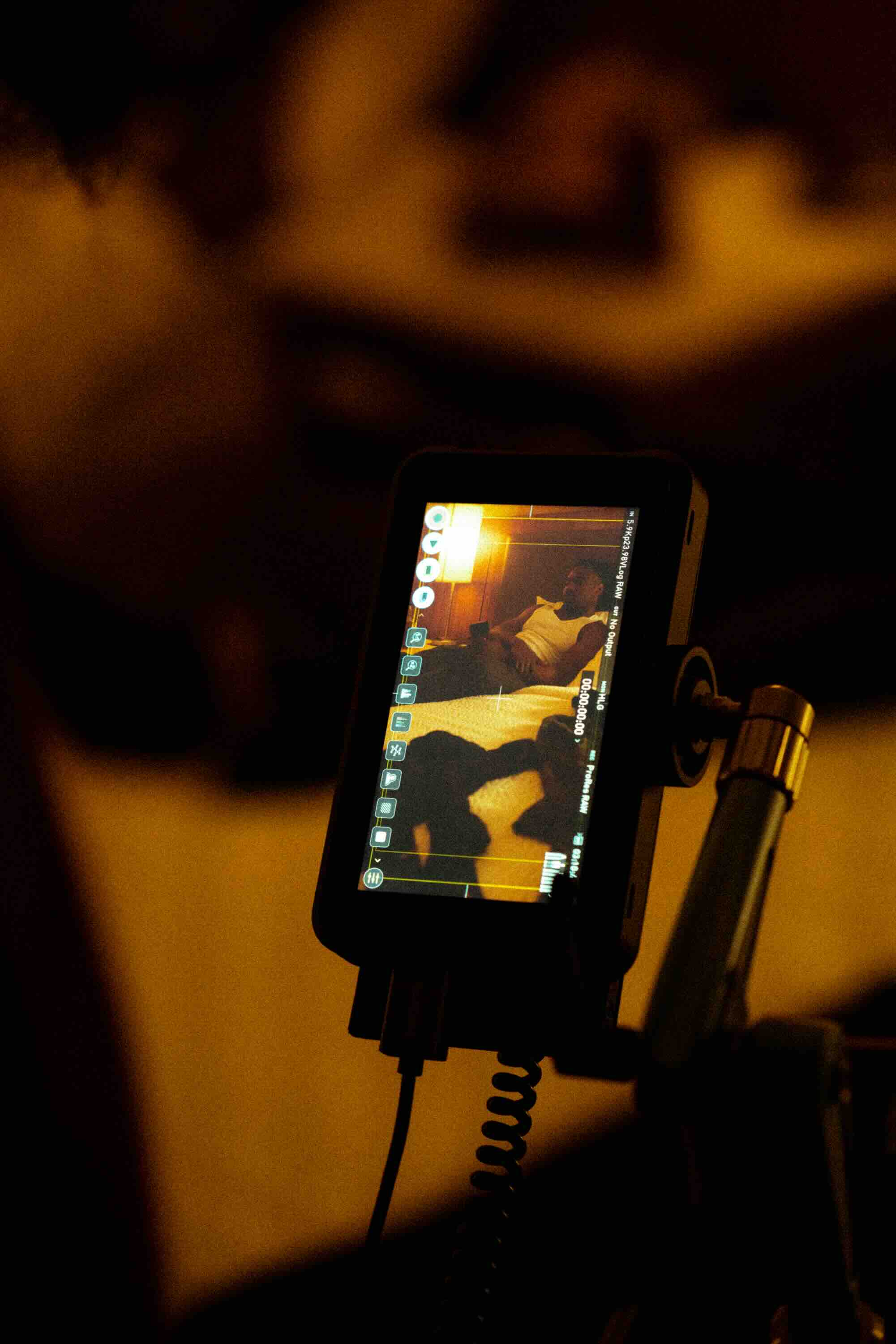
On the set of “Killa of Laverne.” Credit: Ron Kurokawa. Image courtesy of Stephen SmallWarner.
A One-Act Play for the Phone
SmallWarner's thinking about the form runs back more than a decade. He wrote a paper on it in 2013 and made his first vertical piece in 2017, "just to see how it would feel for itself." That same year he became the inaugural Filmmaker in Residence at the Tribeca Film Institute, and in 2020 he published Vertical Filmmaking: An Innovation in Cinema. He knows how that commitment might sound: "some may call it pioneer, I call it plague."
As a student of mobile IP, he sees the micro drama's habits as technical in origin. The features attributed to micro dramas are tied to the platforms' technology and to the rise of micro-payments, and they bent storytelling the way advertising did when television arrived, "similar to ads when TV came about." His own interest runs the other direction, toward craft, and the nearest precedent he could find was not a screen medium. Since "it's not like I can go back to vertical dramas that existed before," he went back to the one-act play, which has "no resolution, sometimes there's no setup. It's more of a moment."
That lineage, in his view, is what separates a vertical drama from a micro drama. He cares less about micro-payments and, even within social, does not "necessarily care about hooking somebody in 3 seconds." He names Glengarry Glen Ross as the one-room work most familiar to cinema people and Amiri Baraka's Dutchman as another that comes to mind, especially, he adds, because he is a New Yorker. What the theatrical tradition gives a filmmaker is "that idea that we can do so much in a room, we can establish so much."
Killa of Laverne, as he puts it, is what happens when first-principle filmmaking craft is applied to a new format. Built to break into eight parts, the film leans on the idea that "the structure of story and how we use story also has these natural dips, pivots and cuts," so the hook need not be placed according to the technical qualities of a platform. He can "use the craft that has been around a hundred years plus" to move from part one to part two to part three. He is not negating the necessity of hooks for success; he simply says, "I didn't make this in order to be quote unquote successful. I made it for the craft of it."
Standing-Your-Ground, Unreliably
The man at the center is Alton, played by Stephen Barrington, and the story, in SmallWarner's account, is about a man struggling with a choice and how he comes to grips with it. He placed that choice inside a world audiences may recognize as a criminal procedural, then pushed the procedural to the background. There was a break-in, he confirms, though he does not specify whose house; he says only that it was "into his world." Alton decided to "quote unquote stand his ground," and what SmallWarner wanted to show is "the in-between, the aftermath, the quiet moment of a single person named Alton that did this."
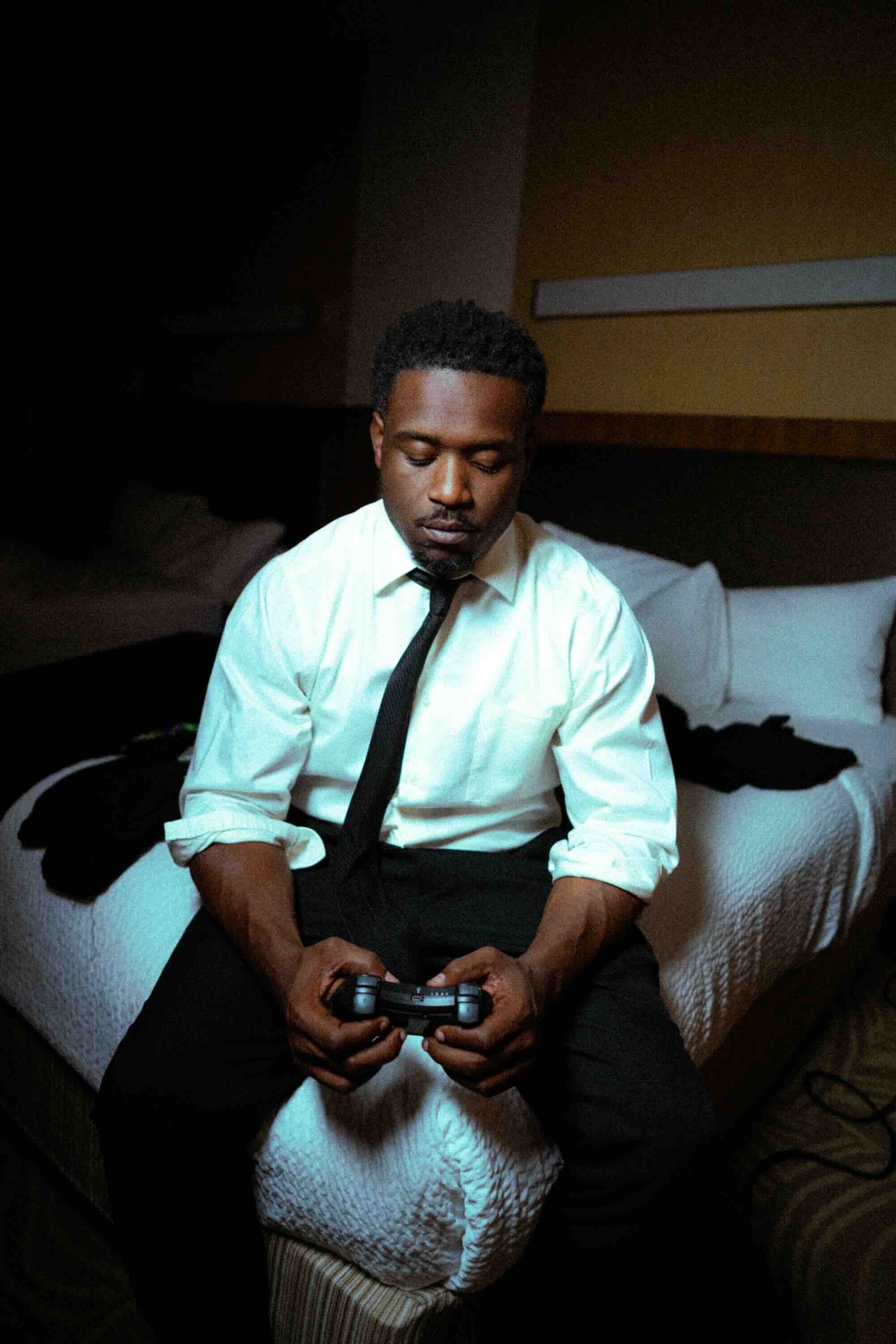
On the set of “Killa of Laverne.” Credit: Ron Kurokawa. Image courtesy of Stephen SmallWarner.
Killa of Laverne sits in a space of moral ambiguity: not whether Alton's choice was legally right, but how a man searches for clarity within himself after making it. It is a conversation SmallWarner thinks we rarely get to see, especially with Black men navigating the American legal system, and the question he keeps returning to is "how do we approach these things internally." Making that work imposed a discipline on the writing. Timothy, the kid played by Brandon Pilgrim, who "did a phenomenal job," had to be built entirely from information in the folder.
SmallWarner gravitates toward the unreliable narrator because he is using it "to examine a psychological mindset." The viewer's questions may be Alton's own: "is what I'm saying real?" Alton never says it explicitly. At the outset he seems well, but there is no telling how much he has already had to drink, "a motif I continue to layer in," and no telling where he is mentally. Some of what he says "may be just what's in the folder, but applied to what he would like to think."
There is one exception. In the bathroom, Timothy says he was going to be a father, and Alton answers that he saw her on the stand. SmallWarner calls that "the extent that I stretched it": the moment where Alton seems to be recalling what he actually saw rather than what may be in the folder, and the only line where he considered writing beyond what the folder could contain.
Underneath runs a generational conversation, and Alton, like his maker, is a Junior. "I myself am a Junior, so some of it is my own psychological layering onto it." He left the rest open: "I did leave a lot up to the viewer to fill in, and from the response, some people filled in things that I was surprised to even hear, to be honest."
One on One
The theatrical lineage also maps onto how the work is watched. "Traditionally, filmmaking was one to many. TV became one to few. Mobile is one to one," he says. "That's the guiding principle behind making it natively vertical." A single-room two-hander or three-hander "fits the mold of production" and the viewing experience alike, and the vertical screen, he says, is perfect for that. Mobile may sit at the top tier of distribution, with numbers in the millions, but the question he thinks storytellers should be asking is how to engage someone one to one.
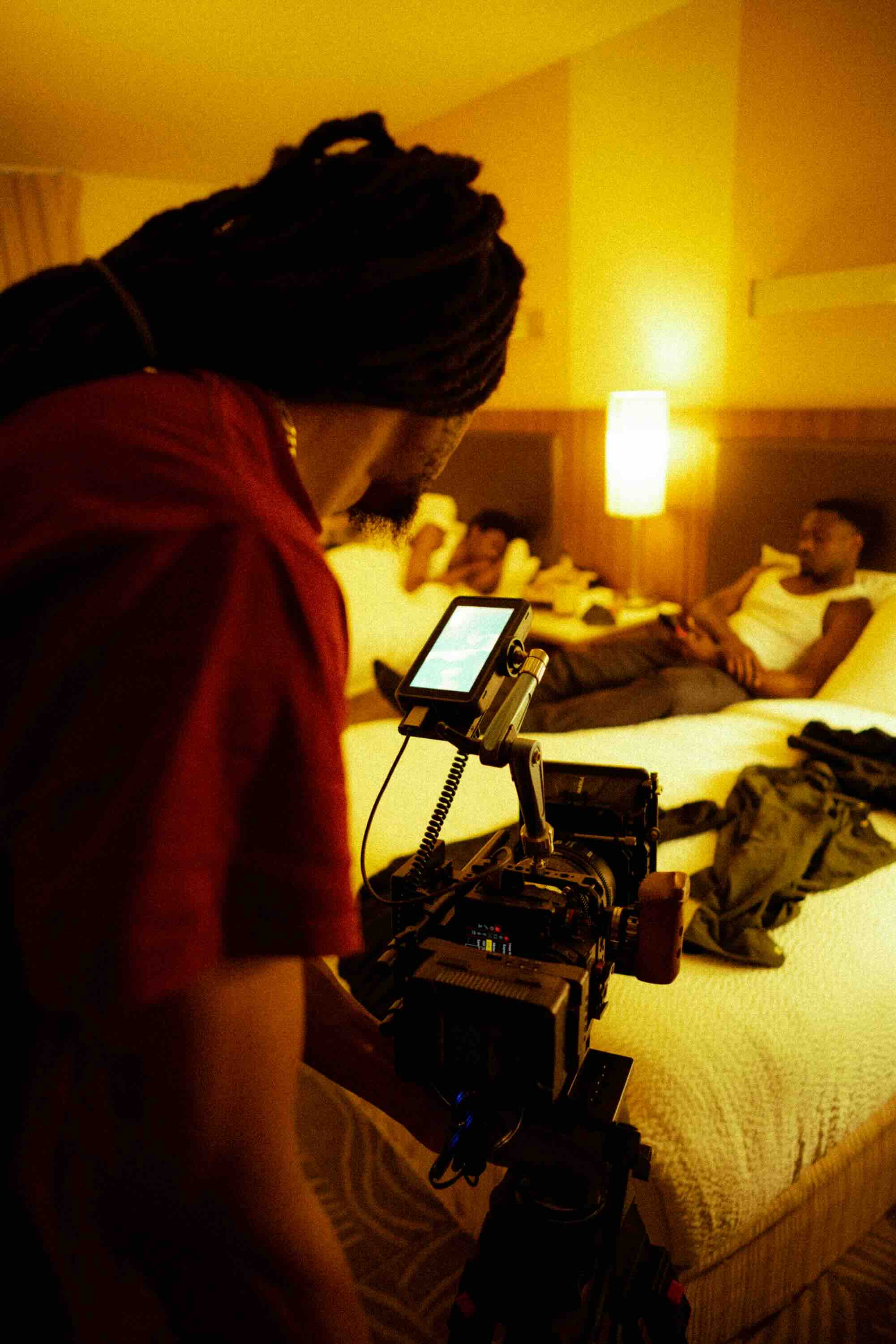
On the set of “Killa of Laverne.” Credit: Ron Kurokawa. Image courtesy of Stephen SmallWarner.
That points toward where the format is heading. Micro dramas, which followed user-generated content, now have production value but are fed by the speed of their platforms and by micro-payments. As major brands move into entertainment and need to engage their existing audiences more deeply, he expects something better than the didactic to be required, and that means challenging the viewer, a duty he describes as "to challenge and push the medium, push the story, and push the viewer."
The support behind that ambition is unconventional. Keslow Camera has backed his experiments for years; he has no studio head and no agency mandate, and he wants to engage the format as a filmmaker and artist who controls his own story. Some viewers reacted unfavorably, and "even that was amazing to me," because it is the power of cinema reaching someone looking at a phone.
Before release, he showed the project to an executive at a very popular micro drama company that was crossing over into the US, something he says he had not shared with anyone. The response was "this is not what we're looking for." He understood it. Financial viability matters, he allows, but a period of technological shift also offers a chance to tell different stories and "find different ways and different models," and he has a romance setup and a comedy setup waiting. Many filmmakers do not want to be creators or tap dance for social, and he understands that, but a short film as show-and-tell, proof that "if I can make this short, I can make this feature," is not what interests him. He wants vertical to become its own thing. The chance to go direct to an audience is there, he says, though platforms and technology keep getting placed ahead of storytelling, connection, intimacy and engagement.
His thinking draws on a master's degree in international media producing from NYU Tisch Asia, where the question was how to tell stories engaged from many entry points. The first screen has changed in the past decade, from the television in the house to the phone: "Most people turn over, and even if they try for an hour or two, they're going to pick up their phones." Capturing images for the big screen has never been easier, by his figures. A V-Raptor XE is about $15K for 8K, and cameras under $10K shoot 6K, enough to spread across a billboard. But bottlenecks at the theatrical level and consolidation among streamers stand between image and screen. One to one, by contrast, "seems to be wide open space. Nobody's challenging or telling me anything."
The audience numbers are modest by streaming standards, and he knows it. "This is taboo to say," he allows, but Killa of Laverne currently has 1,400 views. He frames that number the way a filmmaker would: if 1,400 people filled a theater to see his film, he says, he would be ecstatic. For him it signals that "there's something leaking through here." He has also built a dedicated website for Vertical Motion Pictures, verticalmotion.pictures, so the work can be engaged outside the environment of YouTube.
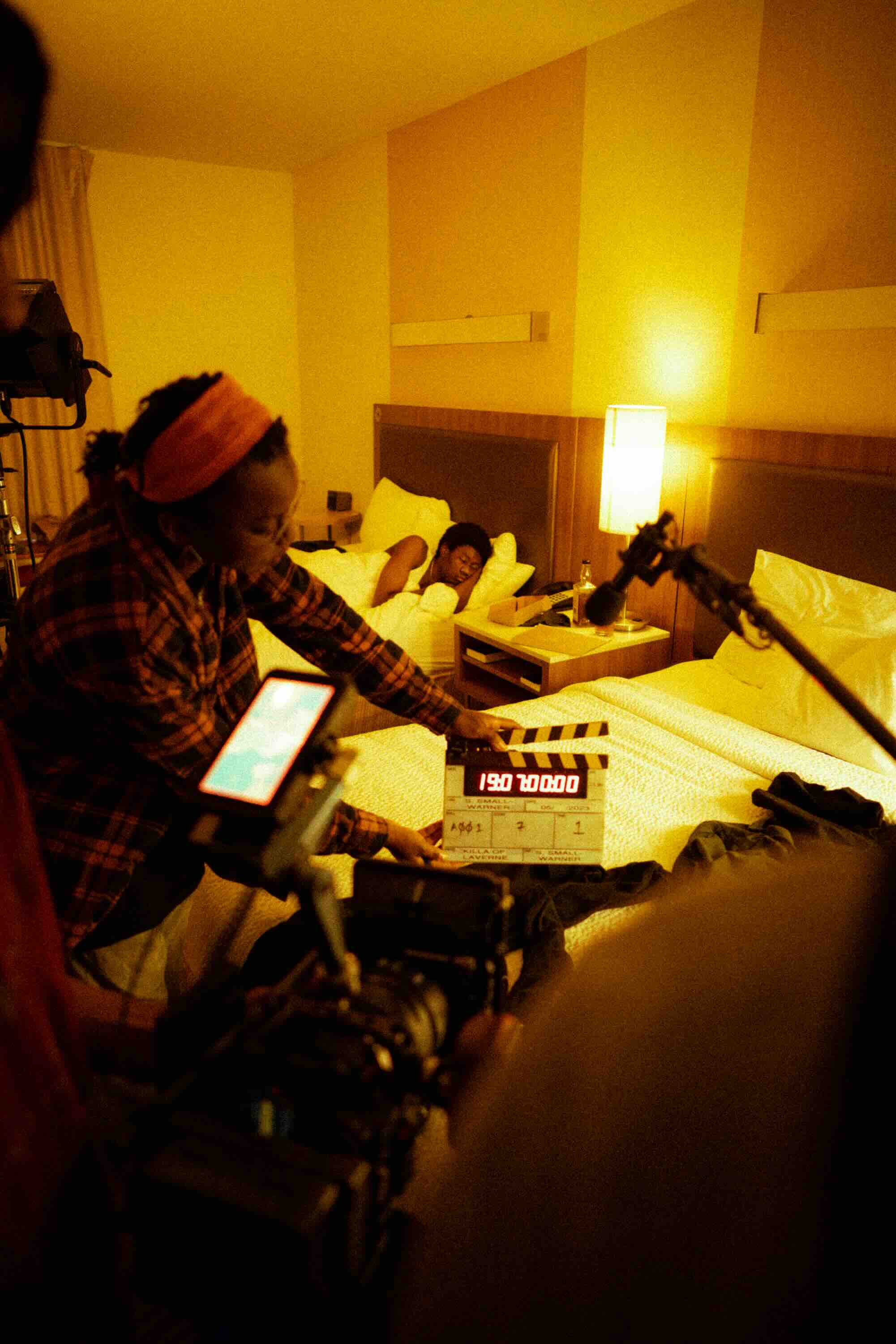
On the set of “Killa of Laverne.” Credit: Ron Kurokawa. Image courtesy of Stephen SmallWarner.
Full Frame, Sticks, and "the Camera That I Had"
On the camera, SmallWarner's account opens on a constraint and ends on a rule. "Because of how everything happened with the production, I just had to use the camera that I had": the full-frame Panasonic S1H, recording 5.9K to Apple ProRes RAW. Yet he also treats full frame as a rule regardless of body, for the extra space it gives a 9 by 16 frame, and he saw the industry moving from Super 35 and crop sensor to full frame just as he began turning his camera on its side. He is of two minds about whether any of it was a choice. He does not want to say he had no choice, since crop sensor and Super 35 were available, but the size of the crew, and the fact that he was also operating, settled it.
One of his friends, the DP Chris George, came with an offer: "Steve, I could give you a day, what do you need me to do?" George operated with him. SmallWarner describes himself as a hybrid out of necessity, which meant needing something small enough to move with in a space he already knew would be tight. "I'm an on sticks kind of guy. I'm kind of an old school filmmaker in that sense."
He tested other options first. At another rental house he tried lenses and one of their RED cameras, which he flipped vertically to test; it was "beautiful, beautiful." But, he says, "I had to think about the holistic set." That is a habit of documentary work. He is directing a feature documentary called Agandi, a decade in the making, following an ER doctor through Uganda, Jamaica and Atlanta, and it taught him to go into a space, use what it has and light it as realistically as possible.
In the hotel room that meant two Aputure panels and a number of smaller Aputure MCs tucked into different places. It was a small space, and he did not want a lot of lights. He's usually drawn to a single, directional source, but Killa of Laverne went the other way, "a lot of small soft sources," with nothing strongly directional, so the room reads as naturally lit. The S1H's dual ISO gave him flexibility. The location was a real hotel because there was no production designer, and because he did not want a home. For story's sake he wanted to take away the idea that the film was taking place where the break-in happened; instead it unfolds in a hotel the night before Alton was supposed to go to court, "a moment where we're not in the traditional space."
The Stuck Adapter
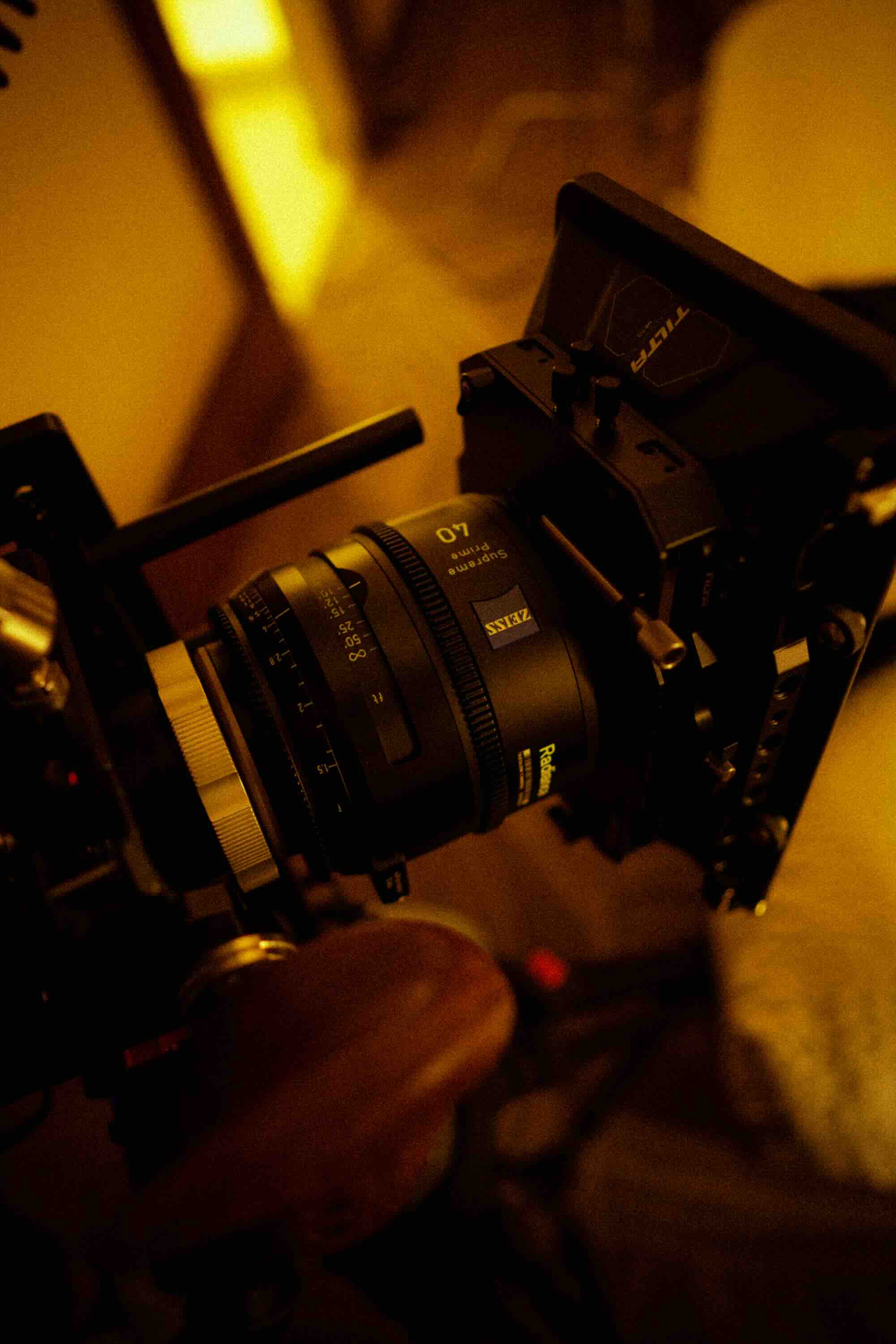
On the camera went a full set of Zeiss Supreme Primes, the Radiance set, courtesy of Keslow Camera. They are very sharp, a base he could count on; paired with Apple ProRes RAW, "crispy if I need it to be crispy." At T1.5 they gave him speed in a small space where he had to supplement light.
On the set of “Killa of Laverne.” Credit: Ron Kurokawa. Image courtesy of Stephen SmallWarner.
Despite the full set, he planned to shoot on two lenses. The reason is the shape of the frame: "the wide in the vertical frame is different. It functions differently. It feels different." He is sure he could find a reason to use a wide angle in vertical, but "we lose some of what I think is the beauty of portraiture in it." He stuck to a 40mm and a 65mm, which on full frame gave him the closeness and intimacy he wanted and enough width to "frame wides around subject and not around the environment." Framing that way layers in enough of the environment to navigate the story as if the whole room were visible.
Then an adapter intervened. The 65mm stuck on it. "I wanted to really play and now this is stuck," he says. The 65 stayed on the camera for most of Killa of Laverne, and it became his character lens for the way it renders faces. A portrait-length lens on full frame, it let him step back or get closer and spared him constant lens changes; in his words, it was easier to deal with. It reinforced something he already believed about the format: that the operation behind the camera for verticals should be small, nimble and flexible.
The stuck adapter also forced the one lens decision in the film that SmallWarner did not choose. With the 65 stuck on the PL adapter, he couldn't swap in another Supreme, so the bathroom scene was shot on his 35mm Mamiya, mounted with its own adapter. "I was so upset about it. I was like, oh my God, we have a box full of amazing lenses, and I have to use this Mamiya lens." Sasha SmallWarner, the film's producer and his wife, was sitting there, asking, "Steve, what are you going to do?" There was, he says, a lot of hemming and hawing. Then came the turn: "The exact qualities that this lens does not have works inside the bathroom." The Mamiya lacks the sharpness and breathing of the Zeiss glass. "It almost felt sterile," and he reasoned that "the audience will feel, without knowing, that sterile quality." The Mamiya 80, he adds, has a great deal of character because it is made for a medium format body; the 35mm has less of any kind of character, which suited the bathroom.
He credits being both director and DP: creatively he knows why a lens works, and he happens to know the distinct qualities it brings. The Mamiya was not what he wanted - "I really didn't even want to use that" - but with everyone on set asking what he was doing, "we've got to keep moving." If viewers watching on five-inch phone screens pick up on optical differences between lenses, his reaction is simple: "That will be a win."
The Ghost in the Diopter
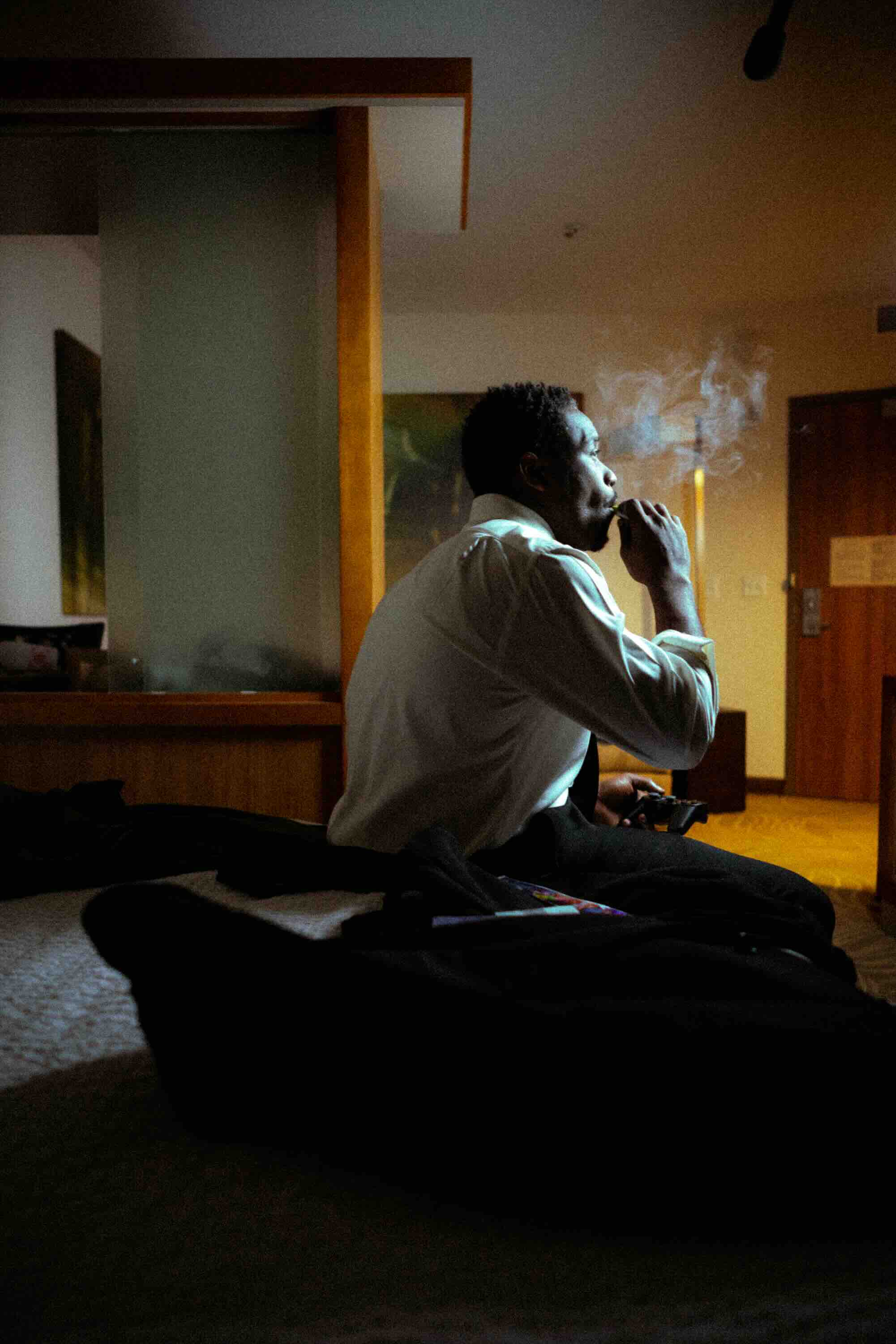
Native vertical, SmallWarner says, brings filmmaking back to first principles: "films in the 60s, Hitchcock, deep focus, split diopters." Without a horizontal frame, he was trying to solve how to tell more story with as much depth as possible, and the solution led to a split diopter: "I need a split diopter just to try it." Directing and shooting, he wanted to use it far more than he did, since it gave him more story through depth.
On the set of “Killa of Laverne.” Credit: Ron Kurokawa. Image courtesy of Stephen SmallWarner.
What he ended up using it for was to introduce a ghostlike figure without it becoming a ghost story. Blur and fall-off insinuate the presence rather than announce it; he wanted to avoid being "super didactic, even with my visual language," and then bring the viewer back down to reality. He is candid about what it did not deliver. He did not get to do the deep focus he would have attempted "if I planned it a little bit better," with more shots built that way, so he tried to "hijack it by using the split diopter," and it "did give an interesting effect."
The glass beneath it mattered too. The Supreme Primes are usually used for commercials, he notes, but the Radiance set has a blue coating, and he came to see that some of the fall-off and blur in the last scene were layered optical effects produced by that sharpness; he was a little open, though not wide open. He worked from a Tiffen 138mm split diopter set, with strengths from +1/2 up to +3. The diopter glass was thicker than he wanted and the separation showed, which gave the image what he calls an ethereal quality: a texture you can feel with sharpness still coming through. It is the balance he is after, between the ultra sharpness of the 2026 digital age and optical softness that keeps the image from feeling too perfect or too clinical, a way to get "the best of both worlds."
The rig ran out of room. He was layering ND filters with a Tiffen Low Contrast 1 inside the matte box, but the case holding his filters "wasn't really made for it." So he "taped it on the front of the matte box," the ND filter, and behind-the-scenes photos show him carrying it, tape visible. For him that improvisation is part of vertical's appeal: there are no rules, but the format embraces the quality of filmmaking he likes.
That preference for doing it optically shapes where he looks for glass. He was very aware of the Clairmont Camera acquisition, drawn by the question of what lenses were used in the 60s that he could bring to a young audience, one that may never have seen them in use or understands them only as a digital effect. He wants in-camera effects that "stand the test of time," and he hopes the example reaches other filmmakers: if a look can be done optically, it saves time in post.
Playing Jazz on a Clock
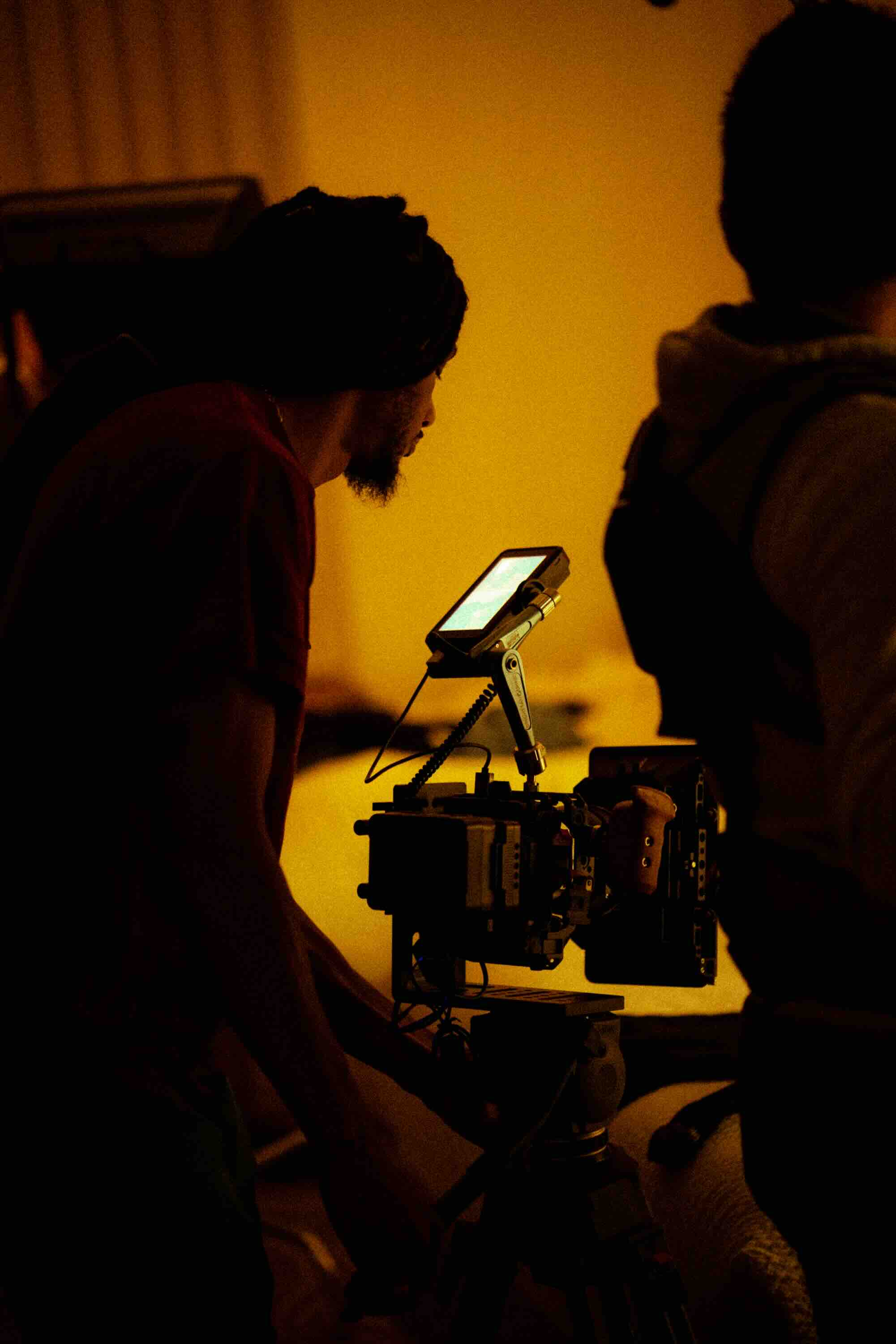
SmallWarner describes his approach to image-making in musical terms. "I would consider myself, if I was making my films in some type of musical style, a jazz player," he says, and he thinks a lot of documentarians are, out of necessity: balancing planning and set-ups with allowing things in, trying things, playing with different looks, making mistakes. In Jamaica, shooting the documentary, light came in the back of a filter and produced a ghosting effect. He had black wrap ready to go, looked at the image, thought wait, hold on, and left it for a second while his producer asked what he was doing.
On the set of “Killa of Laverne.” Credit: Ron Kurokawa. Image courtesy of Stephen SmallWarner.
The pressure that works against that play is financial. He funded Killa of Laverne "out of my pocket," and the pressures that come with that make play harder in a time-based medium where every minute counts. "I think sometimes as filmmakers we forget that there's this whole quality of play behind it, that it's not exact, that no matter how much we plan, it's not exact."
The same impulse carried into the edit, which he also did himself. Even while shooting he knew certain frames would not be in the final cut, but, working in vertical, he rolled anyway to see what a portrait face looks like in movement, and he ended up using some of those frames for marketing. They reflect something he sees in the format: complex, deeply layered portraiture "that kind of feels like you could touch the skin," a quality he thinks has mainly been seen in photography. For a filmmaker, he says, the format is "really an interesting playground."
What comes next is built on the same principles: impact, and one-act plays. He is reading more of them, and he is taking ideas he first conceived as longer-form and stripping each down to its character, asking how to tell that story in this medium as opposed to what he may have planned it for. He has two pieces set and ready to go. He acknowledges that open gate has become more ubiquitous, especially for filmmakers who have to deliver multiple formats, but he implores them to go further: "I challenge filmmakers to make it natively vertical, natively 9 by 16." Shooting natively changes how he lights and designs. "I could place lights super close, because there's no side," he says, which invites soft lights very near a subject to see how that looks and feels. It changes production design too: for his next piece he wants to play with the fact that he does not need the whole set, asking how to layer and how to occupy layers.
Setting The Standard For The Next Generation
SmallWarner describes his mission plainly: "I make one-act verticals built around great performances and stories I care about, work that can live alongside film and TV. It's important that the culture gets involved, so they can own and be part of a new format they can grow with." Each piece he finances himself is part of something larger. "I want to build a catalog, and keep working with people who are playing the long game in mobile IP, making work that's built to last and worthy of it." "Vertical Motion Pictures is where that catalog lives," he says. "When someone asks what vertical cinema can be, I want them to point there."
The partnership with Keslow Camera sits behind that ambition. SmallWarner says he is endlessly curious about what Keslow's inventory would look like in vertical, and he thanks Robert Keslow, Jack Keslow, Mel Mathis and Ari Brown, the last of whom helped him on a more recent project that was not vertical, for the "flexibility and the openness to use some of cinema's most tried and true trusted gear to push that into such an innovative and untested realm." His company, SMWR, is his last name; he is very family oriented, and "I always feel at home at Keslow."
He returns, in the end, to the invitation he has been making throughout: "everyone should be playing with it. We should see what comes out of it." [x]
On the set of “Killa of Laverne.” Credit: Ron Kurokawa. Image courtesy of Stephen SmallWarner.