The Cinematography of "Christmas at the Kringles" with DP Brandon Cox

On the first day of the 20-day shoot, cinematographer Brandon Cox still wasn’t sure he had picked the right lenses. He had chosen a set of DZOFILM Pavo anamorphics for CHRISTMAS AT THE KRINGLES after only one day of testing, and that day hadn’t given him much of a feel for them. “I was like, ‘Oh man, I don’t know if I picked the right ones,’” he recalls.
The film, directed by Kevin Lewis, follows Mark and Julie Severson (Ron Livingston and Rachel Bilson) into the Christmas cult of Nick and Carol Kringle (Thomas Lennon and Arden Myrin). Cox and Lewis wanted to make what Cox calls “the anti-Hallmark movie,” and they built it out of their favorite films, from Sergio Leone westerns to The Shining, pushed as far as they would go. “That was the whole idea: just do everything we love about movies, but elevate it, turn it to 11,” Cox says.
The first shot on the schedule was the scene in which Carol Kringle and Julie Severson meet for the first time, on a visit to see Santa at the mall, and the first lens on the camera was the 75mm. Within half an hour of putting it up, Cox had his answer. “When I put that lens up, I was like, ‘Okay, that’s why I picked these lenses,’” he says. “It just lit up. Everybody’s like, ‘Oh my god, this is the movie.’” Lewis was just as taken with them. “All Kevin kept saying was, ‘Oh my god, these lenses are awesome. Oh my god,’” Cox remembers.
They had 20 days to shoot, on a budget of under $2 million, with an old Craftsman house in Los Angeles standing in for the Kringles’ home. “We knew that we couldn’t go back,” Cox says. “So every single detail had to be down to the science.” The answer was to plan almost everything in advance, which, as Cox tells it, is also what gave the actors and the camera room to cut loose once they were on set.
The Kringle Lens
Lewis gave Cox the script some time after the two met in early March of 2022, telling him, “I have this crazy Christmas movie you have to read.” Cox read it and loved it, and then, he admits, forgot about it until Lewis called to say the film was going ahead.
From the beginning, the two wanted the film to have a visual style of its own. Cox compares it to the way you know you’re watching a Wes Anderson film shot by Robert Yeoman, or a Steven Spielberg film shot by Janusz Kamiński. He wanted Lewis to have that kind of signature, and he points to Lewis’s Willy’s Wonderland, the 2021 Nicolas Cage film photographed by Dave Newbert, as a picture with “so much visual energy and visual impact that it also affects what’s going on screen and what the story is.” For this film, he says, “we wanted the Kringles to have their Kringle vision, or Kringle language.”
Much of that language comes down to where the Kringles look. When they talk straight into the camera, Cox says, it isn’t simply a way of getting a close-up. “That was deliberate, always with the Kringles, because when you’re under their spell, they’re hooking you in.”
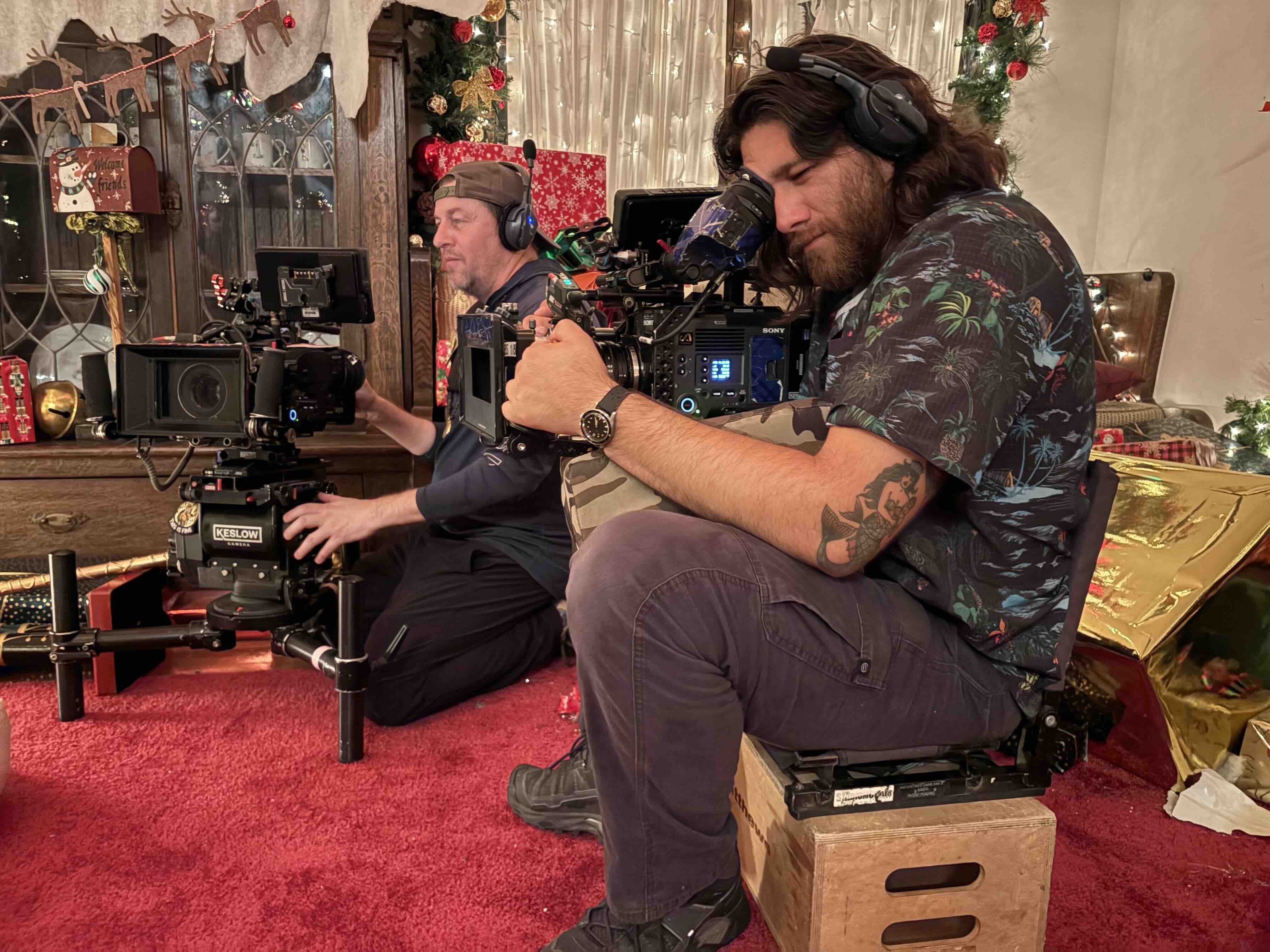
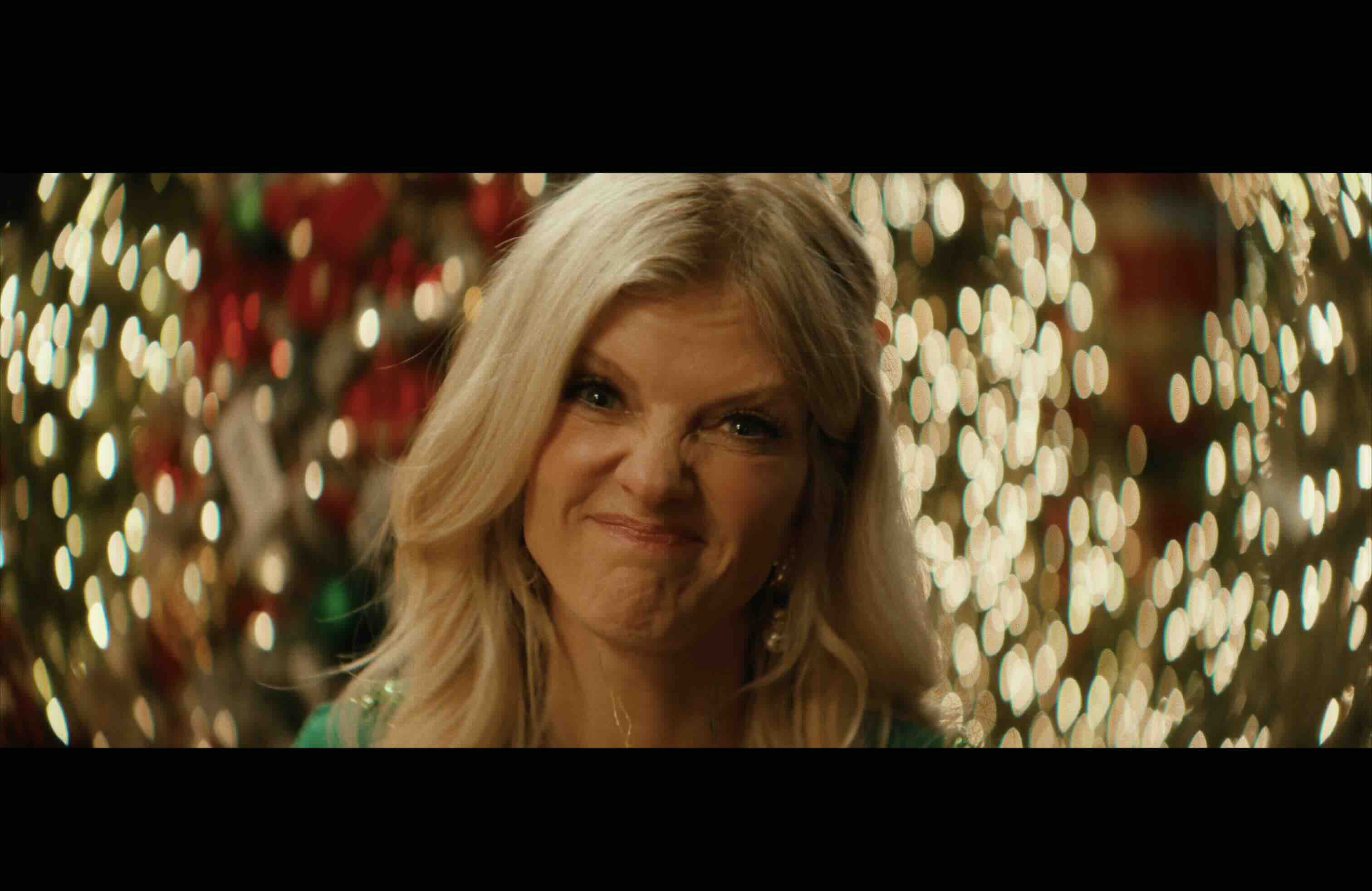
Cox shot on two Sony Venice 2 8K cameras from Keslow Camera. Once he and Lewis decided to go anamorphic, he chose DZOFILM’s Pavo 2x primes, a compact Super35 set, in their Blue Flare version. The production carried nine focal lengths, from 28mm to 180mm, but it was the 75mm T2.1 that Cox calls “the Kringle lens.” Any time Myrin’s Carol is talking to the Seversons, the coverage on both sides is on the 75, looking straight into the lens. As focus falls off, the lens turns the lights behind the actors into soft, rounded shapes that seem to shift around the frame, which Cox describes as “just something magical.”
Among Cox’s favorite shots in the film are the POVs of Carol and Julie at that first meeting, which he loves for the way the lens “sort of bent on the sides.”
A Hallmark Movie That Just Went Wrong
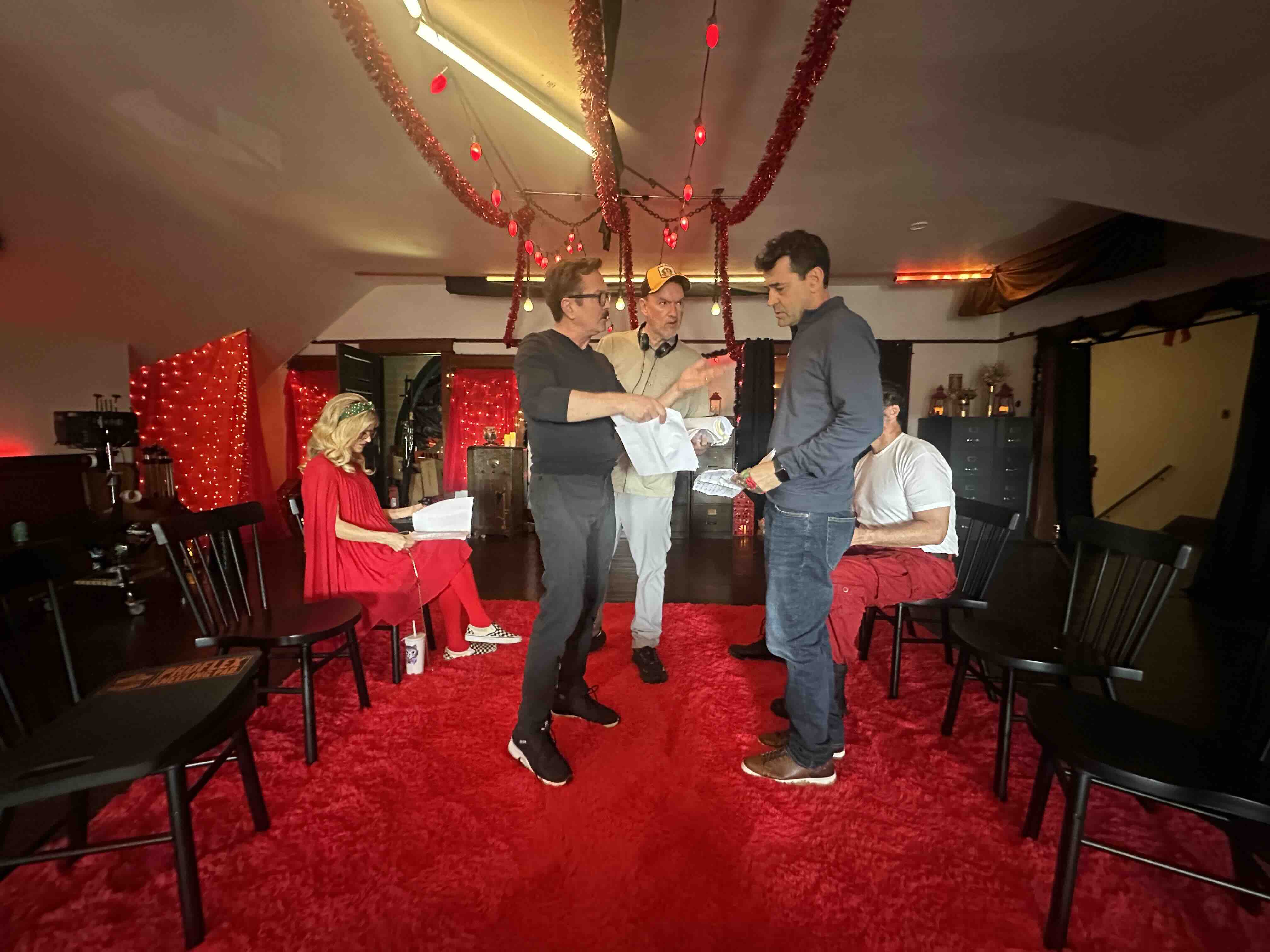
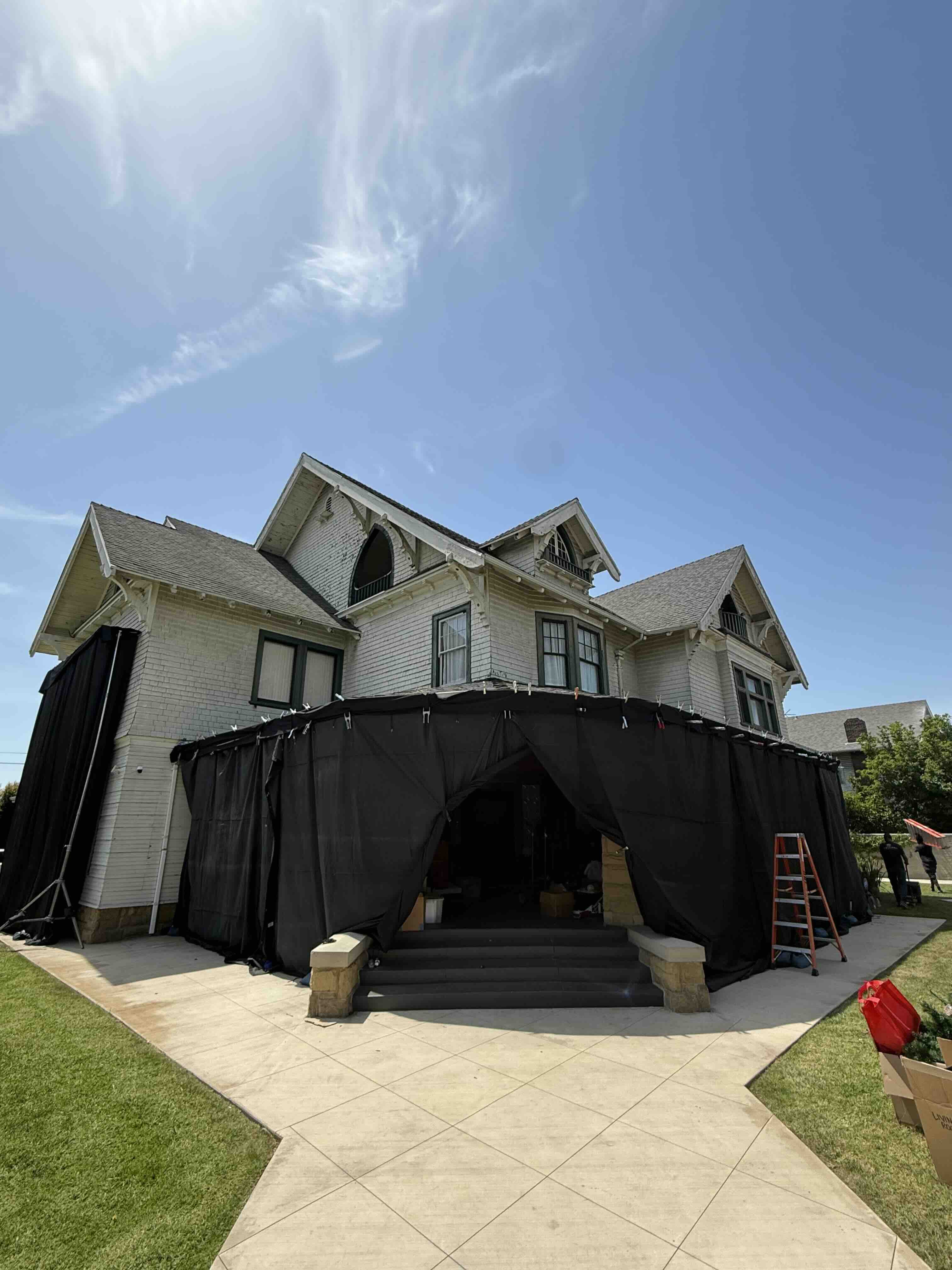
The film was originally going to shoot in Kentucky. When that didn’t work out and the production landed in Los Angeles, Cox wasn’t sure it could be done. “God, we’re going to shoot this in LA? Really? Can we do this?” he remembers thinking. The Kringles’ house became an old Craftsman in West Adams, and production designer Charlie Lagola, who Cox says “had a tough task,” divided it into areas for the tree room, the foyer, the dining room and a lounge.
Cox asked Lagola to fill the place with Christmas. “Anywhere I look, I want Christmas lights on the ceiling. I want them everywhere,” he told him. “I want trees, because I want people to feel like they’re inside of a Hallmark movie that just went wrong.” In any space connected with the holiday, he wanted the lights to surround the characters in every direction, so the audience would feel as if they were inside a snow globe, and as if they were being welcomed in. “So it’s like a false pretense,” Cox explains. “You’re like, ‘Oh, hey, come on in.’ Even though we’re batshit crazy, but I want you to feel happy and warm.”
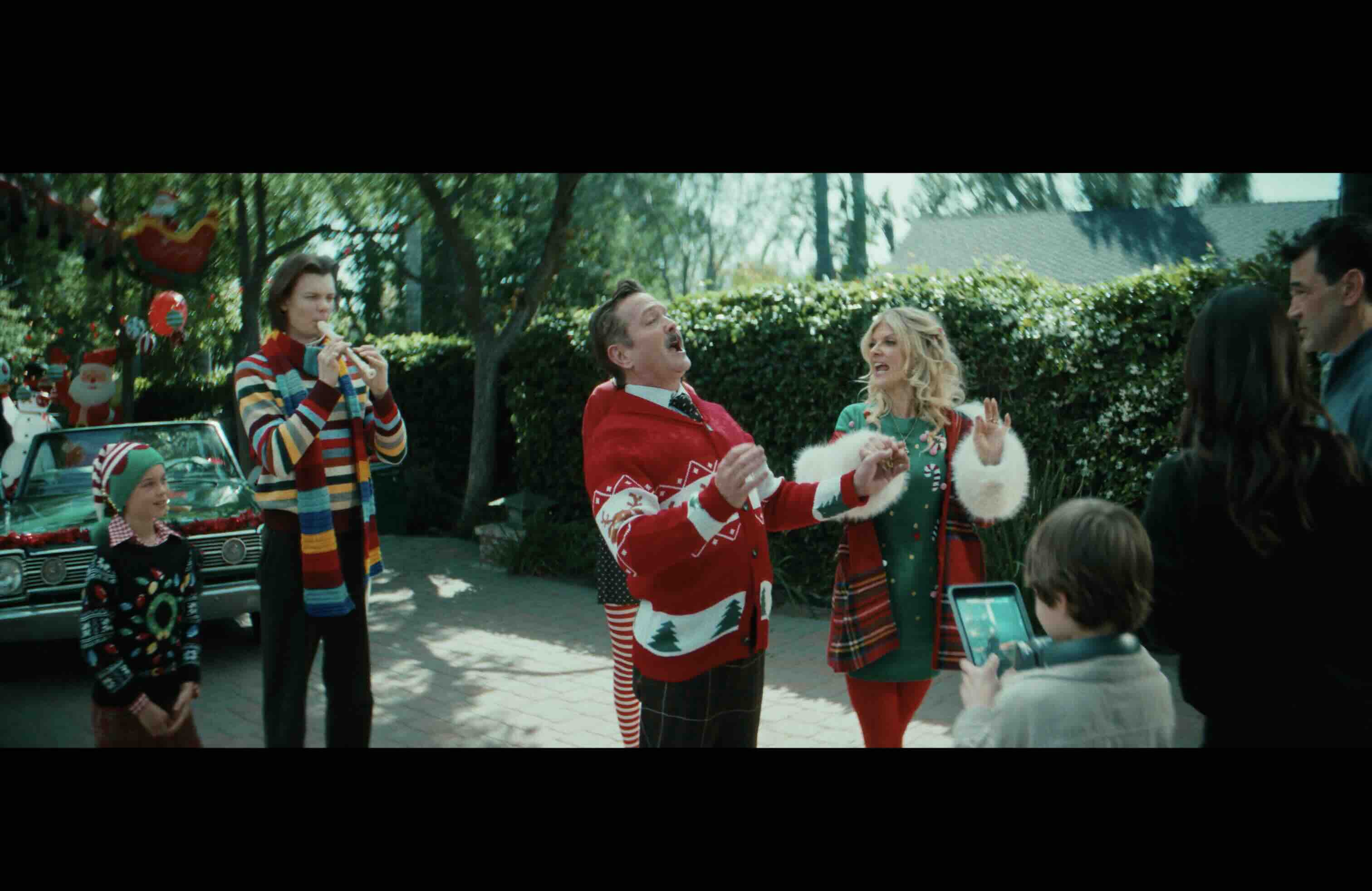
The other rooms got their own treatment. The basement, Cox says, is “all red and green and weird.” For the man cave that Donald Faison’s character keeps in the garage of his mother’s house, Cox started from the strips of LED neon people put behind their TVs and wondered what it would look like “if this guy just had tons of that everywhere.” The set dressing added retro ’90s pinups and a small fridge full of beer. The costumes followed suit, with plenty of Santa outfits and bad Christmas sweaters, or as Cox puts it, “just goofy Christmas clothing.”
Gaffer Eric Munk, who had also gaffed One Spoon of Chocolate for Cox, came back for this film and, with his team, worked with the production design department to make sure all of those lights held steady on camera. Cox asked them to avoid LEDs and use “the incandescent old schools” instead. Out of all the lights in the house, he thinks three sets flickered.
Norman Rockwell Meets a Graphic Novel
The two Venice 2s were the main cameras. For a handful of tracking shots to and from the house, Cox also used a DJI Ronin 4D, which he found worked well alongside the Venice. He thought about adding an FX3 but decided the film didn’t need one. He is using the Venice again on his current project, which is a change for him; normally, he says, he would be on an Alexa 35. “I’m really starting to get down with the Venice, because the color science is really great on it.”
There was no DIT on the set. Cox’s usual DIT lives in Atlanta and couldn’t come out to Los Angeles, so Cox worked without LUTs and without loading any presets. “So I just said, ‘Listen, I’ll shoot it. I’ll expose it right,’” he says.
Before the shoot, he talked through the look with colorist Cooper Shine of Sugar Post. “I want this to look like Norman Rockwell meets a graphic novel,” he told him. He wanted something that felt vintage, like an old Christmas movie but with an edge to it, and he wanted a print look. When they got to the grade, Shine worked from film LUTs based on Kodak’s color science. Cox remembers them as “like 5274, or some old EXR stock, 5289, which is the 800T stock,” with a Premier print look on top. Layered together, they gave the image “that hard sharpness, that edge,” and let the reds and greens of the set lighting come through at full saturation.
The difference between the two families is built into the color as well. The Seversons’ new house is “kind of bland and dull,” Cox says, while the Kringles’ is “warm and inviting and alive.” The goal throughout was to “make it look as close as we can to film without shooting film.”
One of Cox’s favorite frames is a wide three-shot in the inner sanctum, from the scene where Julie is introduced to the cult and shown a Yule log film. Lennon, Bilson and Myrin are sitting there clapping, and Cox says the frame “feels old but new,” which he puts down to the lighting, the production design and the costumes all coming together. He thinks it was shot on “like a 40 mil,” and the only 40mm in the package was the Pavo. The color wasn’t there yet when he shot it, but when Shine showed him the graded version, he was satisfied: “Okay, this works. This is exactly what I was wanting.”
A Split Diopter, Held by Hand
A lot of the film’s more playful camerawork goes back to Lewis, who told Cox to “Just go nuts. Have fun.” The idea was to pay homage to the filmmakers they both loved, among them Sam Raimi, Sergio Leone, Joe Dante, Steven Spielberg and Brian De Palma.
You can see that in the sequence where Julie is drugged through her tea, which Lewis described as “a magic carpet ride on acid.” For parts of it, Cox handed one of the production’s 138mm Schneider split diopters to his B-camera operator, Oscar Galvan, and had him hold it in front of the lens by hand, so that part of the frame “drags and does weird things.” Cox wasn’t sure it would work. “I didn’t know if it was going to work or not, but it did,” he says, and the shots are in the finished film.
After that, Cox used a split diopter whenever he could. The package included strengths from +1/2 to +3, and by his count the film has something like 15 split-diopter shots, more than he has done on any other film. One of his favorites is at the dinner table: the grandma is eating ribs, a kid off to the side reacts, and she throws the bone. There are more in the basement scenes, techniques Cox says he had always loved but “just hadn’t really had a chance to flex my muscle on.”
The snap zooms were planned the same way. “That was all by design,” Cox says. They were a nod to kung fu movies and Sergio Leone, to Kill Bill and the old Shaw Brothers films, and “how they’d use a zoom with a correction to it.” He shot them on an older spherical zoom, a 25-250mm Cooke Cinetal Mk III, a vintage T3.7 lens that he also used for a zoom on Lennon. The film also gave him the chance to do a smash zoom, something he had always wanted to try. “You never get to do that kind of stuff, right?” he says.
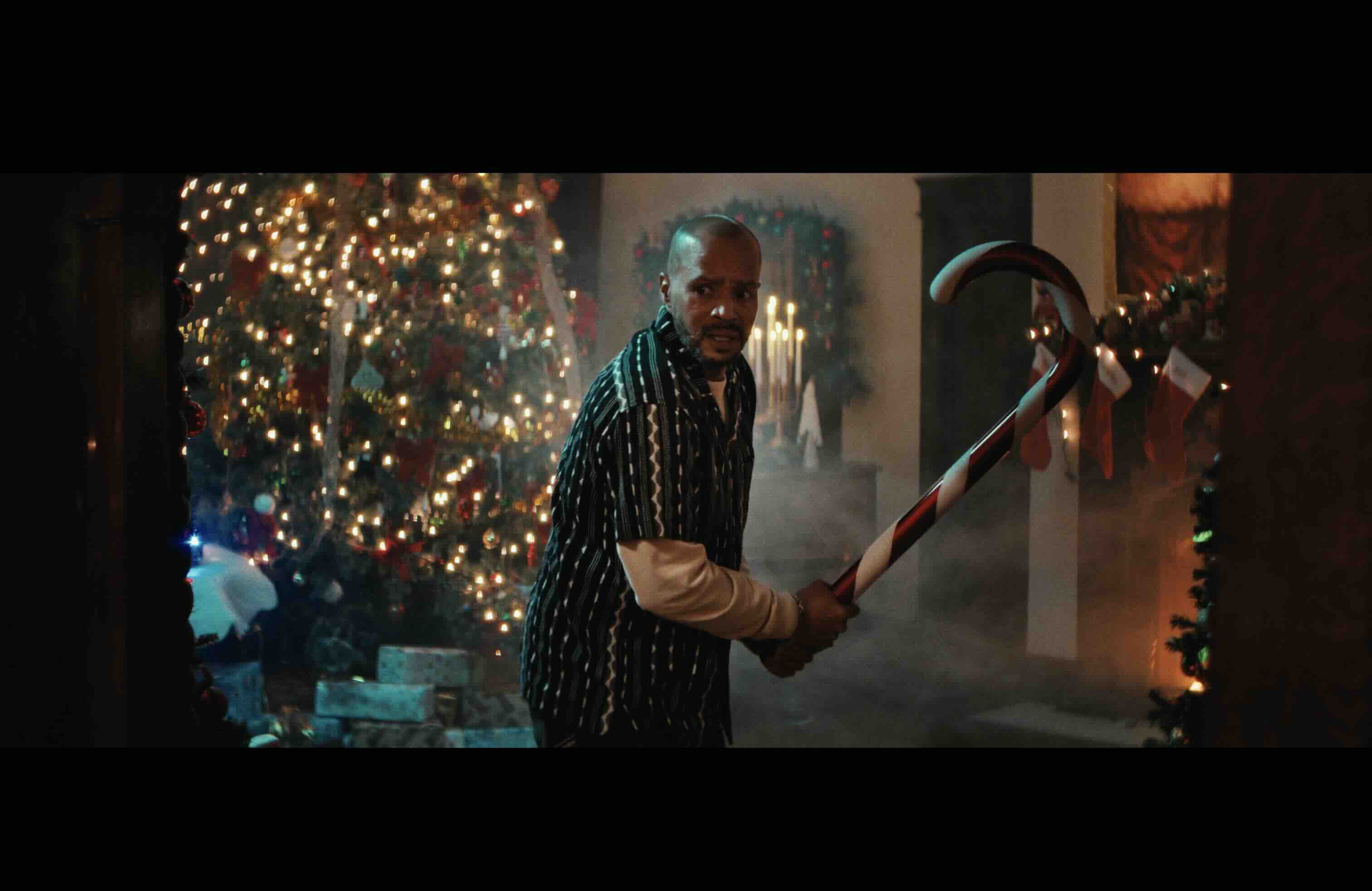
The most direct Leone homage is a face-off between one character holding a chainsaw and another holding an axe, which Cox covered in complementary low close-ups. “I was like, ‘Just make it a western standoff, man,’” he says. Other references are less obvious. A slow zoom on Lennon’s character as he watches a couple kiss under the mistletoe was inspired by The Shining and its slow zoom on Jack Nicholson. And there is a slow push-in on Donald Faison holding a candy cane that Cox likes for no particular reason. “I just think it’s fun,” he says.
Covering a Dinner Table Like a Fight Scene
Cox came into the film with comedy experience. He has shot two seasons of Free Bert, Bert Kreischer’s Netflix series, which he also shoots anamorphic, using a different rental house. The main thing he learned there was to give performers room. Lennon and Myrin “both can just riff and go off,” he says, and Lewis encouraged them to take the scenes “somewhere and go with it.” There was so much improvisation that the film could almost have run three hours.
He protected that freedom by keeping the camera wide. He built scenes around complementary wides, a wide over and a wide shot of the whole group, with a second camera beside the main one on a lens that was “a little tighter.” “So I just would keep it wide and let that comedy happen,” he says. When a line worked, Lewis would ask the actors to repeat it for the close-ups: “Oh, say that again if you can.”
Anamorphic isn’t the usual choice for a comedy, but Cox had examples in mind. Ghostbusters was shot anamorphic, and so was Manhattan, Woody Allen’s black-and-white film and one of Cox’s favorite movies. He wanted the width for a grindhouse feel that draws on everything from the ’60s to the ’90s. He admits the whole approach was a gamble. “So it was kind of like I put it on the lottery. I gambled on it, and it worked out. It was luck,” he says, though he adds that he “felt very confident in the platform we chose and how we did it.”
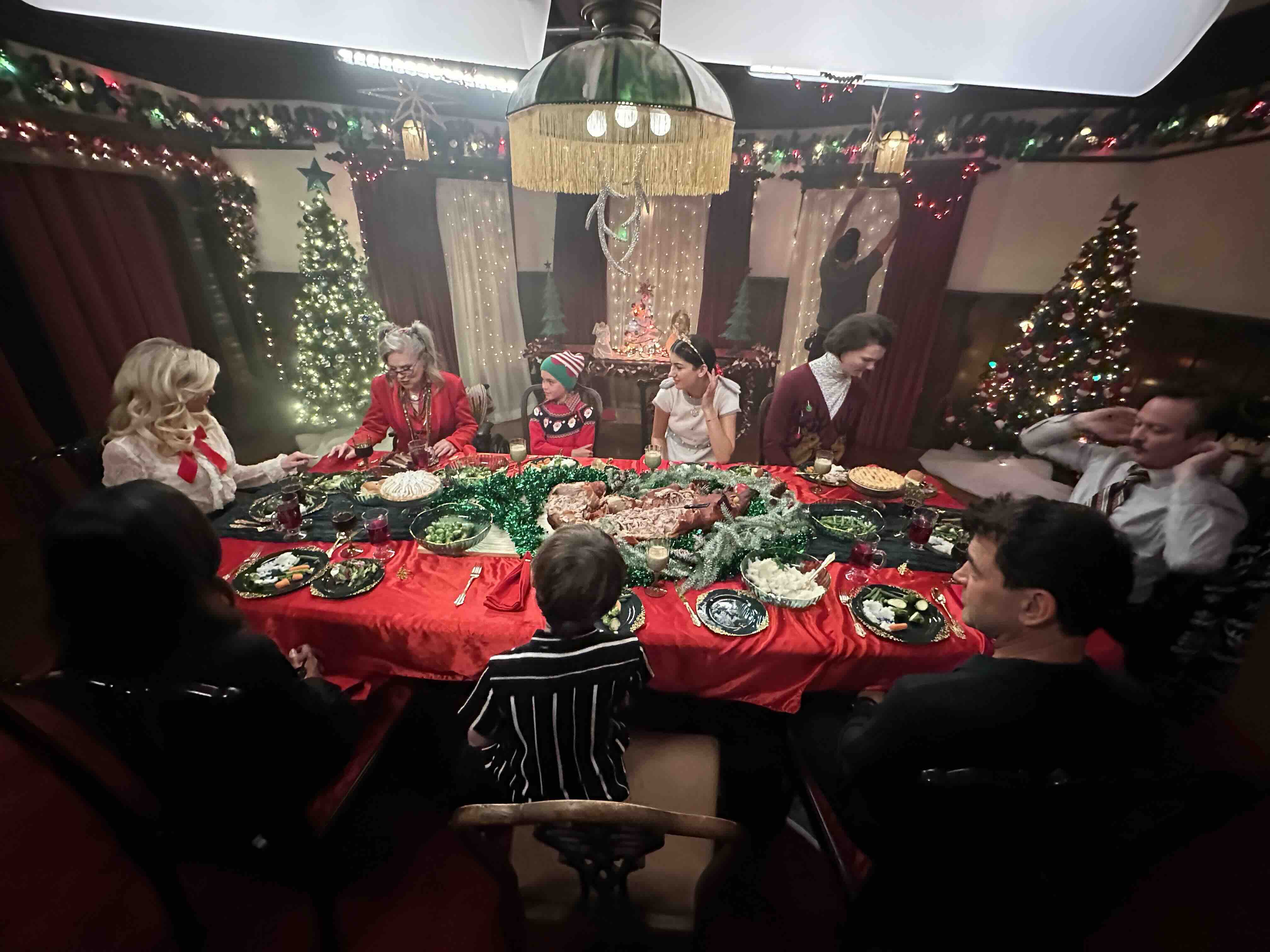
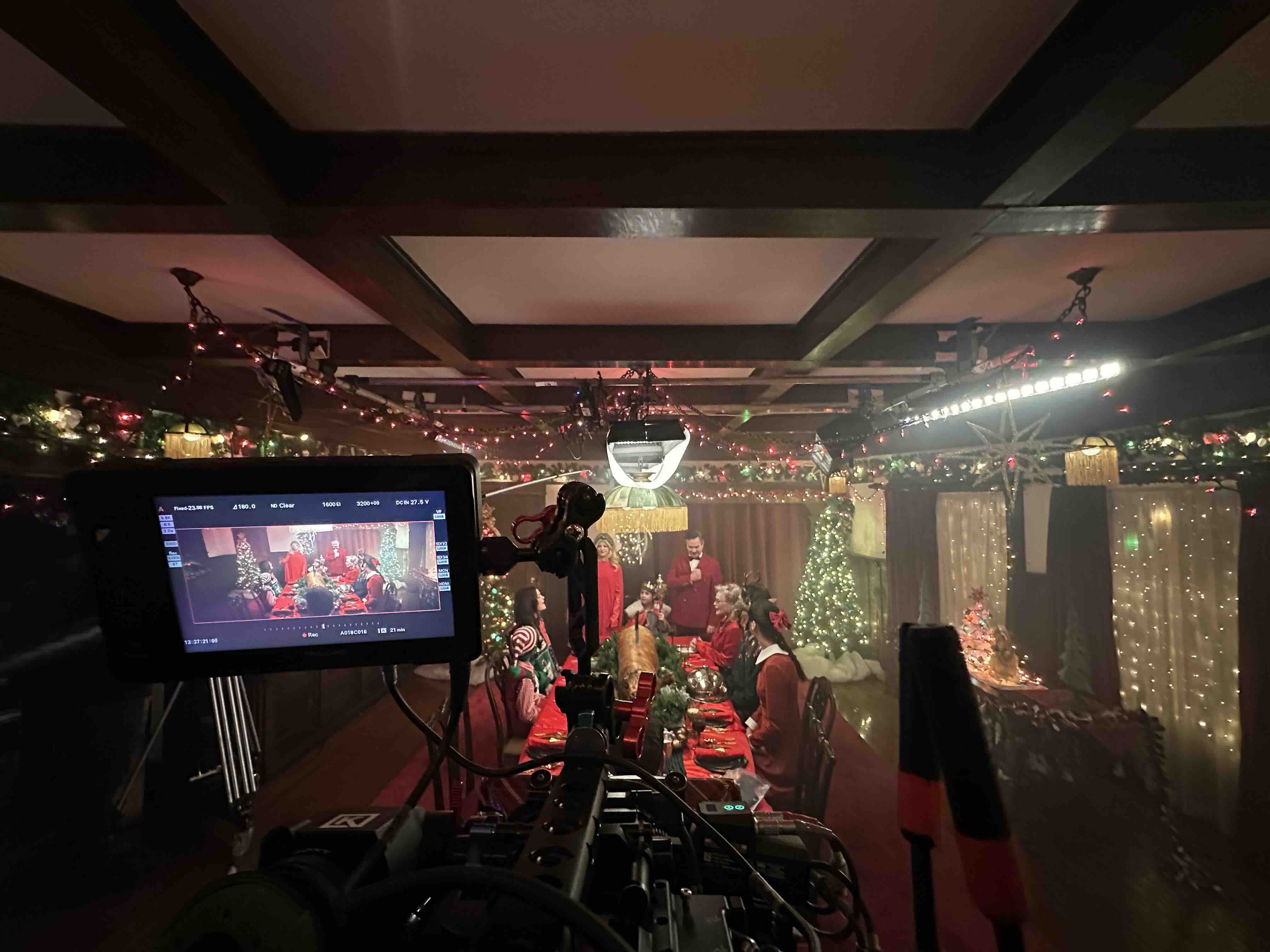
For the more complicated scenes, Cox fell back on his experience shooting action. He has made action films in 19, 18 and 15 days, and those schedules taught him how to get through a large number of setups quickly. The film’s dinner table scene, with nine or 10 people around the table, is what he calls “a DP’s nightmare,” because every reaction has to be covered. He and Lewis worked out the seating in advance. Carol sat across from Julie and Livingston across from Lennon, with the kids who didn’t have many lines in the middle and Grandma Kringle at the end. That gave Cox two conversations to cover and a clear idea of how many shots he needed for each. He kept both cameras moving, one on a dolly and one on sliders, and usually started with a wide lock-off before moving in for singles and overs.
“It’s a different sort of muscle you have to exercise,” he says. An action scene gets broken into sections, and he approached the dinner the same way, while leaving enough room for Lennon and Myrin to ad-lib. They did, often heading “out in left field” before bringing it back to the script. One whole bit was cut from the scene, Cox says, even though it was “so freaking hilarious.”
He lights with the same goal in mind. Cox wants to “leave that sandbox so that they can play,” so instead of crowding the set with lights, he works from the windows, from practical sources and from the ceiling. That way the actors can get up and move around whenever they want, without anyone having to stop for a 20- or 30-minute turnaround.
From Kubrick Stillness to Balls-to-the-Wall Handheld
Cox operated A camera, with Arthur Castellano as 1st AC and Jason Nobles as 2nd AC. Oscar Galvan operated B camera, often on a Ronin 2 gimbal, with Austin Millinder as 1st AC and Gerardo Leon as 2nd AC.
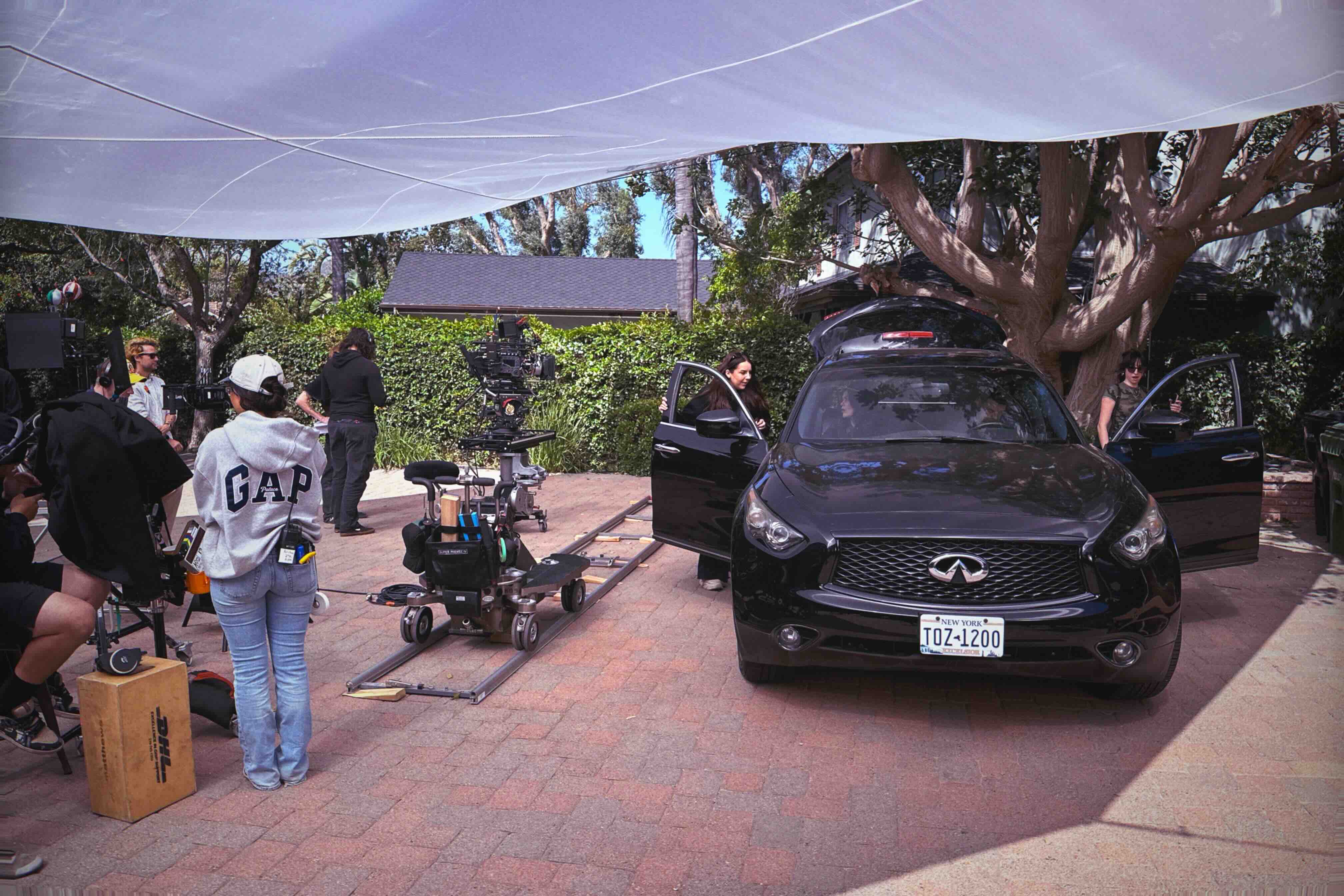
The camerawork gets wilder as the story does. The early scenes are composed and fluid, shot on dolly, sliders and gimbal, and the Ronin was used for the approach to the house and for moves through it. The dinner scene has no handheld at all, only sliders, sticks and dolly. When the story moves up to the inner sanctum, the camera stops moving altogether. Cox wanted what he calls “our static Kubrick vibe” there, with wider frames and locked-off shots. Then, in the basement, with the gimp and the man with the chainsaw, the camera starts pushing in and going handheld, and the handheld gets rougher as the film goes on, until it ends up as “all-out balls-to-the-wall crazy camera shake, shutter, handheld.”
Getting the camera into some of those spaces was a job in itself. The 1930s house has no elevator, and the inner sanctum is a large attic at the top of a tiny stairwell. Key grip Dave Leite, who Cox says helped a great deal with the dolly and camera moves, worked out how to get the dolly up there; Cox believes he built ramps so it could be pushed up the stairs. Leite told him, “Don’t worry, I’ll get it up there,” and when Cox apologized, Leite answered, “No, we want to do it.”
Because there were children in the cast, the production worked mostly during the day and had few night shoots, so Leite’s team tented the house. For day exteriors, they would take the tent down or leave one side up, and much of that rigging was done on a pre-rig day.
Shooting the Movie on Paper
With 20 days to shoot and a budget Cox describes as “well under $2 million, almost two million bucks, maybe about 1.8 or something,” there was no room for mistakes, so he and Lewis prepped “religiously.” In between location scouts, they rented an apartment so they could work together, since Lewis lived down in Orange County, and spent four or five hours a day going through the script scene by scene. They stopped each day before they burned out. By the end, Cox had a shot list of 40-some pages.
They also watched a lot of movies: Sam Raimi’s films and Terminator, a few Hallmark and Christmas movies to get a feel for that world, and then Indiana Jones, Sergio Leone and Gremlins. Each time, they asked themselves what they liked about a film and what they wanted to bring to their own.
Cox is convinced the film wouldn’t have worked otherwise. “I think had we not shot the movie on paper, I don’t think we would have been able to pull it off,” he says. The shot list became “the Bible of that movie.” And because both of them knew exactly what they needed, they had time on set to say “Let’s just try this” when a new idea came up. As Cox puts it, “the more you plan, the better you’re off to succeed.”
Cox also gives a lot of credit to Keslow. His main contact was Mel Mathis, Keslow’s senior vice president of marketing and a friend of many years, and he had help from Robert Keslow, the company’s president and CEO, and his son, Jack Keslow. Cox brought Lewis to lunch with Mathis to talk through what they wanted to do. “I owe all to her and having that relationship,” he says. “Without having that relationship, I don’t think it would have happened.”
“This Is Just a Fun Movie”
What Cox seems to remember most is how much everyone laughed. Takes had to be redone because people couldn’t keep a straight face at what Lennon, Myrin or Livingston were saying. Lennon, a veteran of Reno 911! and the comedy group The State, takes his work seriously, and Cox didn’t think he would break. “Arden broke him every single day,” Cox says. “She was his comedy equal.”
Cox was partly responsible for Myrin being cast. She plays Bert’s wife on Free Bert, and when the production had Lennon but still hadn’t found its Carol, Cox suggested her to Lewis, called her and sent her the script. She read it in 30 minutes and told him, “I’m in. I’m in. I don’t care. I’m in.” The two actors had worked in the same comedy circles for years without ever working together. Cox says they now talk three or four times a week and are trying to find something to do together. “It was kinship the moment they met.” Myrin, in turn, helped bring Beverly D’Angelo and David Wain onto the film.
The blooper reel at the end of the film, a throwback to Cannonball Run, gives a sense of how much fun they were having. Cox is quick to credit the writer, Zack Imbrogno, and he and Lewis have already started talking about a sequel, which Cox says they would keep at Keslow.
For Lewis, this film mattered a great deal. “Man, if I don’t hit it with this, I don’t know what I’m going to do,” he told Cox. But he also kept it in perspective: “If people have a problem with this movie, then they’re not human, man. This is just a fun movie.” That was always the point for both of them, to give audiences “a fun filmgoing experience.” “And I just wanted to have fun,” Cox says. “And so I think we succeeded. I really do.”