
The Cinematography of "Boots" (Part One) with DP Bruce Francis Cole

DP Bruce Francis Cole on the set of "Boots" episode 103. Image courtesy of Bruce Francis Cole. Cr. Patti Perret/Netflix © 2024
“BOOTS,” now streaming on Netflix, is a drama-comedy series set in the 1990s that follows a bullied gay teen, Cameron (Miles Heizer), as he follows his best friend into Marine Corps boot camp. Forced to conceal his sexuality, Cameron must find the strength within to become the best soldier he can be, while remaining true to himself at his core.
In honor of the series premiere, we connected with DP Bruce Francis Cole (Episodes 1-5, & 7) to discuss the season, from shooting the series in the elements on location in New Orleans, to finding inspiration in some of the iconic films of the 1980s and 90s.
How did you come on to the project? Is there anything that drew you to this story?
Like many projects, this one came through my incredible agents Miann Wilson and Mira Yong at WME. It was at the height of the streaming wars, and a lot of shows were being shot. I gravitated towards this one because it was so well-written; the pacing read like a feature film.
I pitched for it, met with the producers, and eventually with the pilot director, Peter Hoar, who was just coming off his acclaimed episode of The Last of Us. It was exciting to work with a director who had so much buzz. The show brought me back to New Orleans, a city I'd shot in before, so I was able to bring on much of my same crew. We went back to Keslow Camera, where Matt Pelto has always been a great support.
I developed a visual bible for the show, and Keslow was gracious enough to provide numerous lenses and camera bodies for testing. I got with Robert Keslow here in L.A. and we did two rounds of tests. After settling on an initial package, I went to New Orleans for more tests, this time focusing on filters and building a final LUT with my colorist Natasha Leonnett at Picture Shop. It was great to go back to a familiar setting like Keslow Camera in New Orleans with my familiar crew.
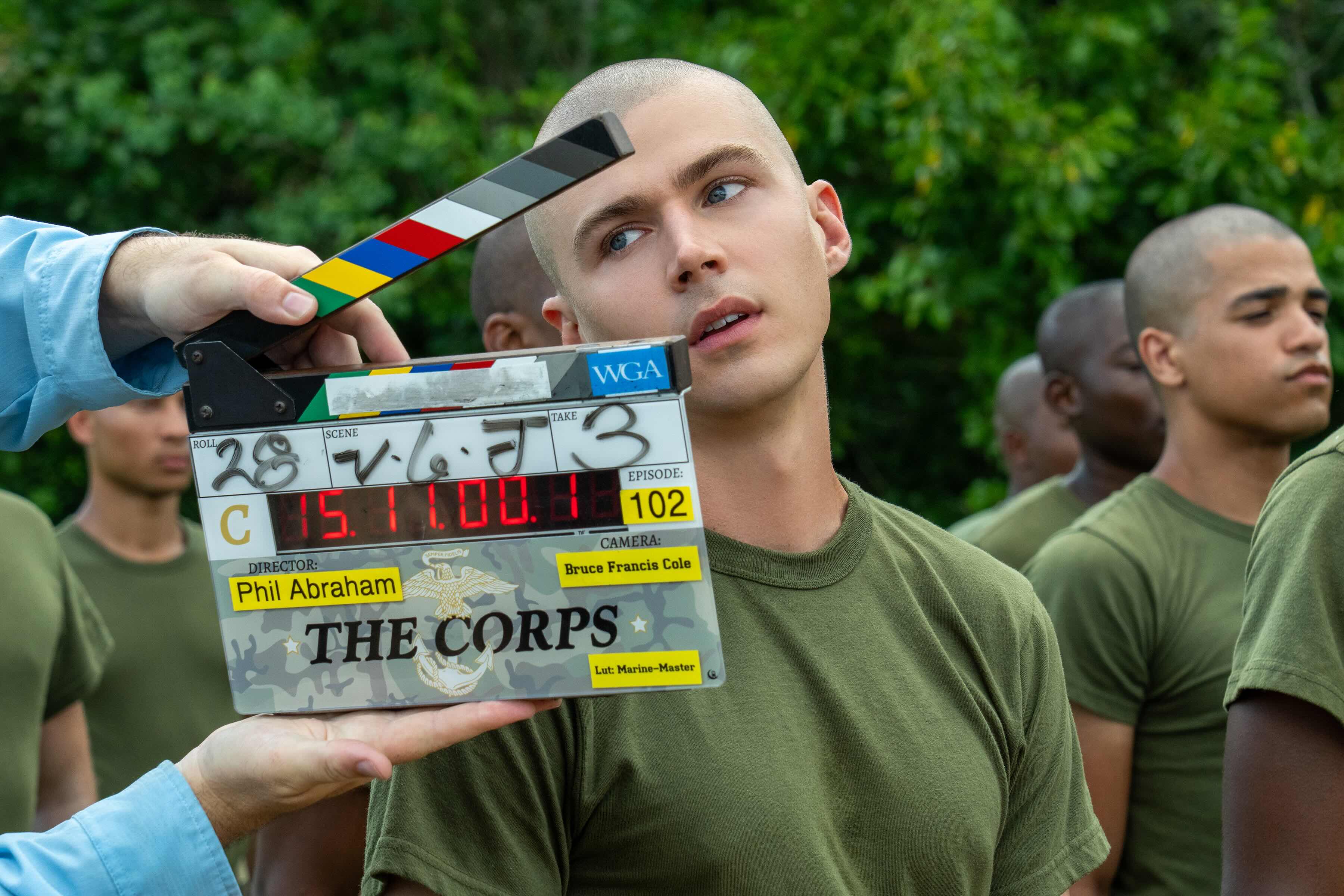
Miles Heizer as Cameron Cope behind the scenes of Episode 101 of Boots. Cr. Alfonso "Pompo" Bresciani/Netflix © 2023
In terms of the cameras and lenses, what qualities were you looking for? What was your vision for the look of the show, and what was the process like in making those selections to bring the vision to life?
One of the first decisions was to go as wide as we were allowed. We settled on a 2:1 aspect ratio, which is the Netflix standard for widescreen. The showrunner, Andy Parker, didn't want to go wider because he felt it would make the show feel too self-serious. One of our references was Cool Hand Luke, with its super-wide frames that hold two, three, and four-shots while incorporating the environment, and Full Metal Jacket for its symmetry and expressionistic lighting.
To achieve more of a large screen feel, we opted for anamorphic lenses. We chose a look that felt more sharp and polished to represent the organized, stoic world of the Marines. For this military world, we used ARRI/Zeiss Master Anamorphics because they provide a clean image with minimal distortion, which was important for environments with many vertical and horizontal lines.
For the "home world," which includes flashbacks, we used a set of Caldwell Chameleon SC lenses for the first three episodes, then switched to Xelmus Apollos for the last 5 episodes. The goal was for the lens choice to subtly contribute to the sense that these were two different worlds without being too heavy-handed. Later in the season, for some action sequences, we also used a crash camera unit with Blazar Remus anamorphics.
For the camera body, we used the ARRI ALEXA 35. It was new at the time, and we felt that shooting in Super 35 4K would give us the texture we wanted without being too high-resolution. We wanted to control the texture ourselves rather than using internal camera settings.
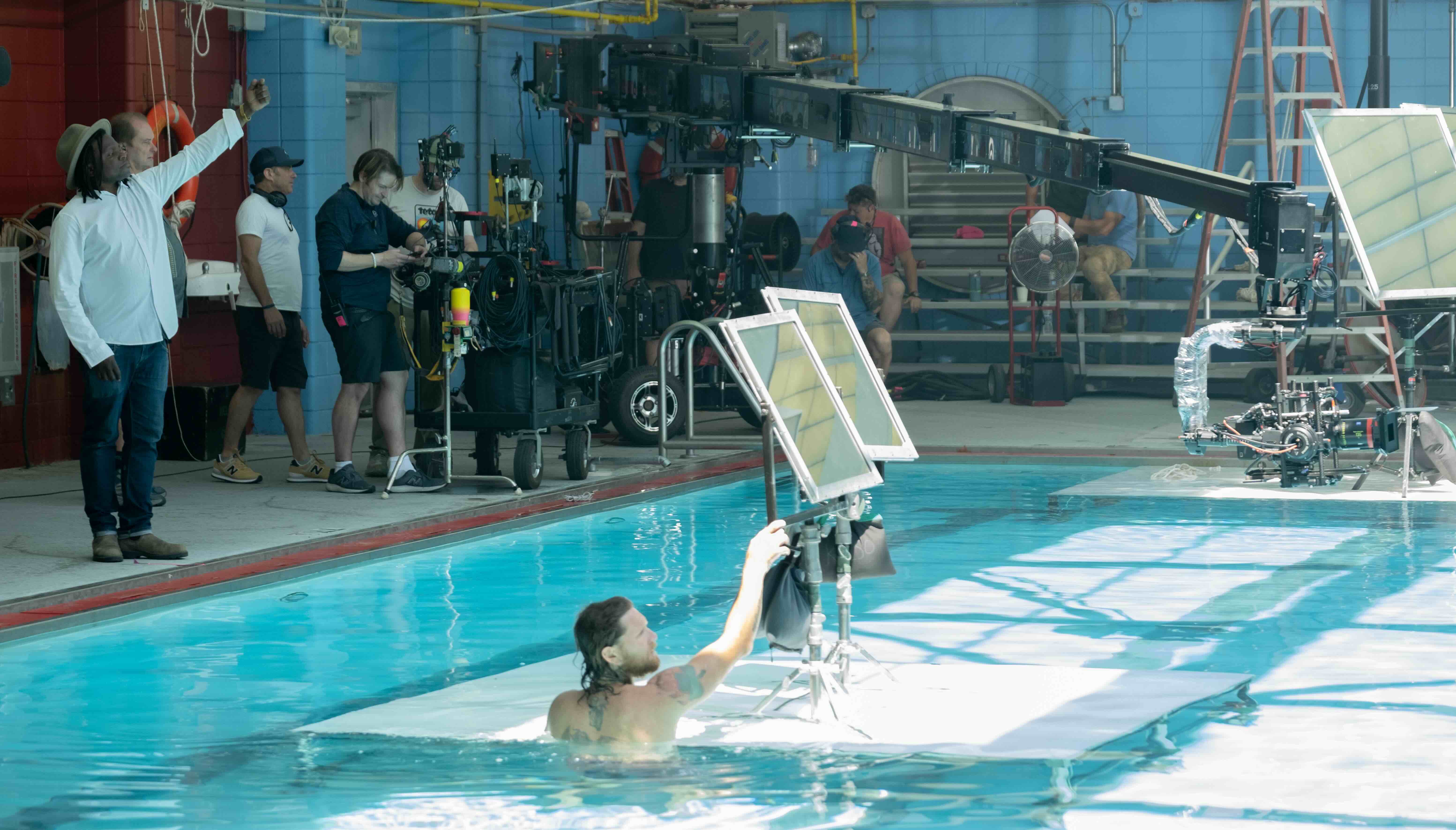
A technocrane on the set of "Boots" episode 104. Image courtesy of Bruce Francis Cole.
What kind of unique methods did you use for camera movements?
Between my A operator, Remi Tournois and my stellar Grip team, Gary Kelso and Moses Mott with Iron Grip, we owned stabilized heads with technocranes, jibs, and E-carts. Having this gear at our disposal allowed us to get smooth, dolly-like shots on location floors without laying track. For the big exterior scenes on the obstacle courses, we often had three or four cameras running simultaneously to capture all the action with the recruits in a short amount of time.
A key element of the show is the main character, Cameron (Miles Heizer), has a manifested inner self, who he talks to throughout the series. This required a lot of doubling of the main character in the same frame. We didn't have the time or budget for motion control, so we did a "poor man's motion control." It was an old-fashioned split-screen effect where the dolly grip would try to replicate the camera move with the same timing. We’d shoot with a body double and then use VFX to stitch the shots together. We had to simplify the camera moves for these moments, but it was a cost-effective way to achieve the effect.
On the lighting side, what was your general approach? These are some incredibly sterile environments, but there’s a great balance with the lighting that softens or amplifies those elements depending on the story.
Early on, the showrunners and studio noted that they didn't want the series to fall into the typical desaturated, gritty look often seen in military movies. We wanted the audience to come back again and again, so we developed a look with more warmth, especially in the skin tones.
My gaffer, Dorian Celestain, rigging gaffer Ferdinand Duplantier, and I, played with different lighting scenarios to transform the sterile squad bay into a space that could feel warm, sometimes secretive, or ominous. The interior set were lit with mostly custom built giant 20x40ft LED soft boxes so that we could control the color temperature for time of day. Even the hard sources we opted for DMX controllable theatrical units so that we didn’t have to lower the grid to change the look in between setups. As the series progresses and the recruits’ attitudes become more aggressive, we introduced hard, raw tungsten light. For inspection day in episode four, the showrunner wanted it to feel like everything was exposed, with nowhere to hide. To create that tension, we blasted 7 old-school 24K Dino MolePar tungsten lights through all the windows.
For the interior night scenes, we leaned into creating as much shadow as we could, inspired by the expressionistic lighting in Full Metal Jacket, shot by Douglas Milsome, BSC, ASC. To motivate the hard, warm light coming through the windows, I imagined there were sodium-vapor courtyard lights on the base at Parris Island SC. To simulate the effect of sodium vapor industrial lighting, My gaffer and I were toying with how warm and expressionistic the light could get. Inspired by James Turrell installations, we came up with this idea we called "super tungsten.” We achieved this by dialing the lights to a temperature of 2200 and adding a hit of red and cross lighting with a touch of yellow. This helped create the feeling that even when the recruits sleep, it's uncomfortable, with this constant, harsh light pouring in. While we were shooting, the writer of the book approached me and let me know the piercing light throughout the squad bay was exactly how he remembered it. We definitely pulled from Deakins.
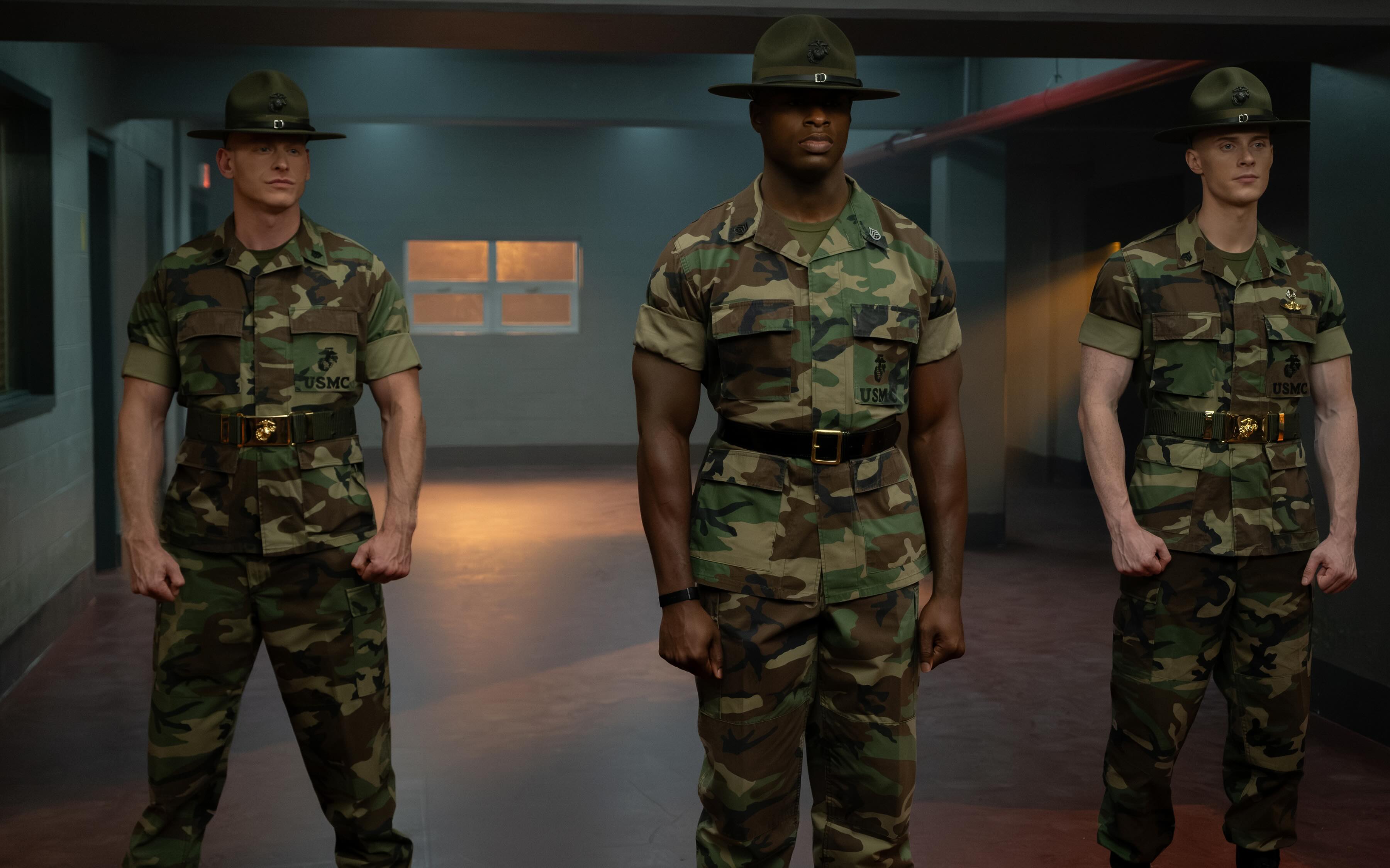
(L to R) Nicholas Logan as Sgt. Howitt, Cedrick Cooper as Sgt. McKinnon and Max Parker as Sgt. Sullivan in Episode 105 of Boots. Cr. Patti Perret/Netflix © 2024
There are numerous on location moments throughout the season, where you’re in the elements as a contrast to on base. Were there any challenges to those sequences?
Shooting in New Orleans in the middle of summer during hurricane season was incredibly challenging. The weather was constantly changing, sometimes reaching 100+ degrees. Filming in the swamps for the final episode was particularly difficult.
The crew was fantastic. Many of them had just come off shooting Antoine Fuqua's Emancipation with Will Smith, so they were used to brutal conditions. Still, the heat was intense. We had to have multiple operators for Steadicam and handheld work so they could give each other breaks.
I want to give a shout-out to my first round of operators for going the distance in that heat, the New Orleans guys, Steve Acheson and Steven Parker, who we called "Happy." Honestly, the whole crew was fantastic. Huge shout out to the team: Pedro Gomez Millan, AMC, Louie Leroy, Mary Casteel, Rob Stenger, Cody Gautreau, and the whole camera Team and all the day players. Thanks to everyone at Keslow - I’m literally prepping a show and doing re-shoots with Keslow right now. In a couple of weeks, I'm heading to shoot All the Sinners Bleed with Jimmy Whitaker, ASC in Atlanta, also with Keslow.
Are there any moments or compositions from throughout the season that stand out when you look back?
Episode five is the one I hope everyone makes it to in the first round of viewing. Not only is it a big throwback to Full Metal Jacket, but the whole episode is so lyrical. It dives into one character’s unraveling, and it allowed us to venture away from standard television coverage.
My favorite scene from episode 5 is the day Ochoa (Johnathan Nieves) is at the target practice range. There’s a shot in that scene that I've been trying to get for a long time. It's that iconic shot from 80s films - Tony Scott did it, and Allen Daviau, ASC, did it many times in films like E.T. and The Color Purple - where the sun is enormous behind a silhouetted character. My first AC, Louie Leroy, helped me time the day so we could attempt the shot at both sunrise and sunset. We got pretty close to the dream!
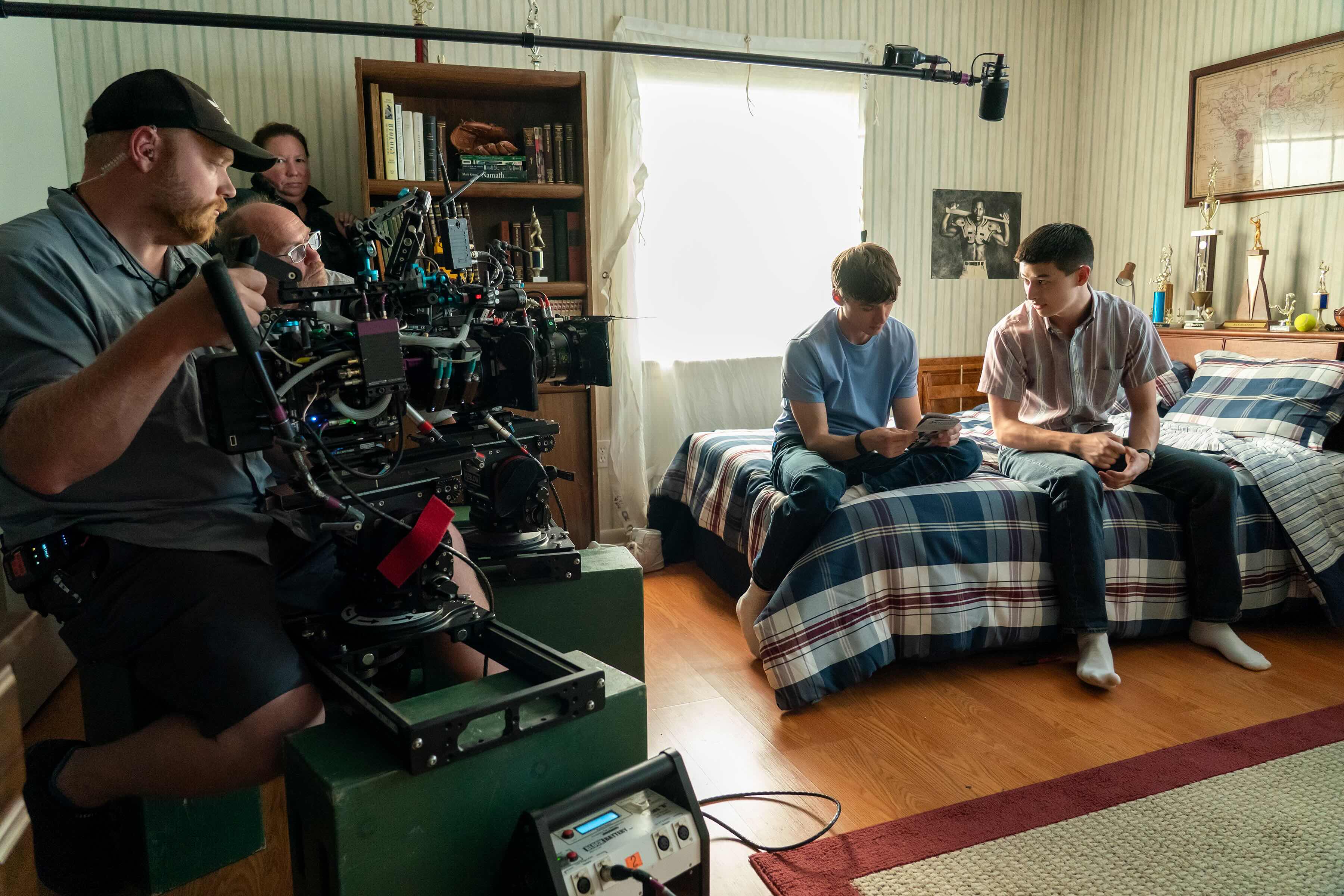
(L to R) Miles Heizer as Cameron Cope and Liam Oh as Ray McAffey behind the scenes of Episode 101 of Boots. Cr. Alfonso "Pompo" Bresciani/Netflix © 2023
Is there anything you took away as a lesson from Boots that has influenced how you work going forward?
The biggest thing I learned is that there's no shortcut to getting better. The more challenging the situation, the better you become. I got a buddy, Jeffrey Waldron, who's a DP - he’s done Dear White People and Haunted Mansion and is doing the new Daredevil - and he told me he realized one day he just had to get good at shooting cross-coverage. It’s about not running away from challenges but embracing them.
Whether it was dealing with the weather, shooting five episodes back-to-back, or managing four or five cameras at once, I learned to run into those challenges. It’s like working out a muscle; you have to keep pushing through the difficulty to get stronger. [x]