

The Cinematography of "Twisted Metal Season 2" (Part Two) with DP Fraser Brown, CSC
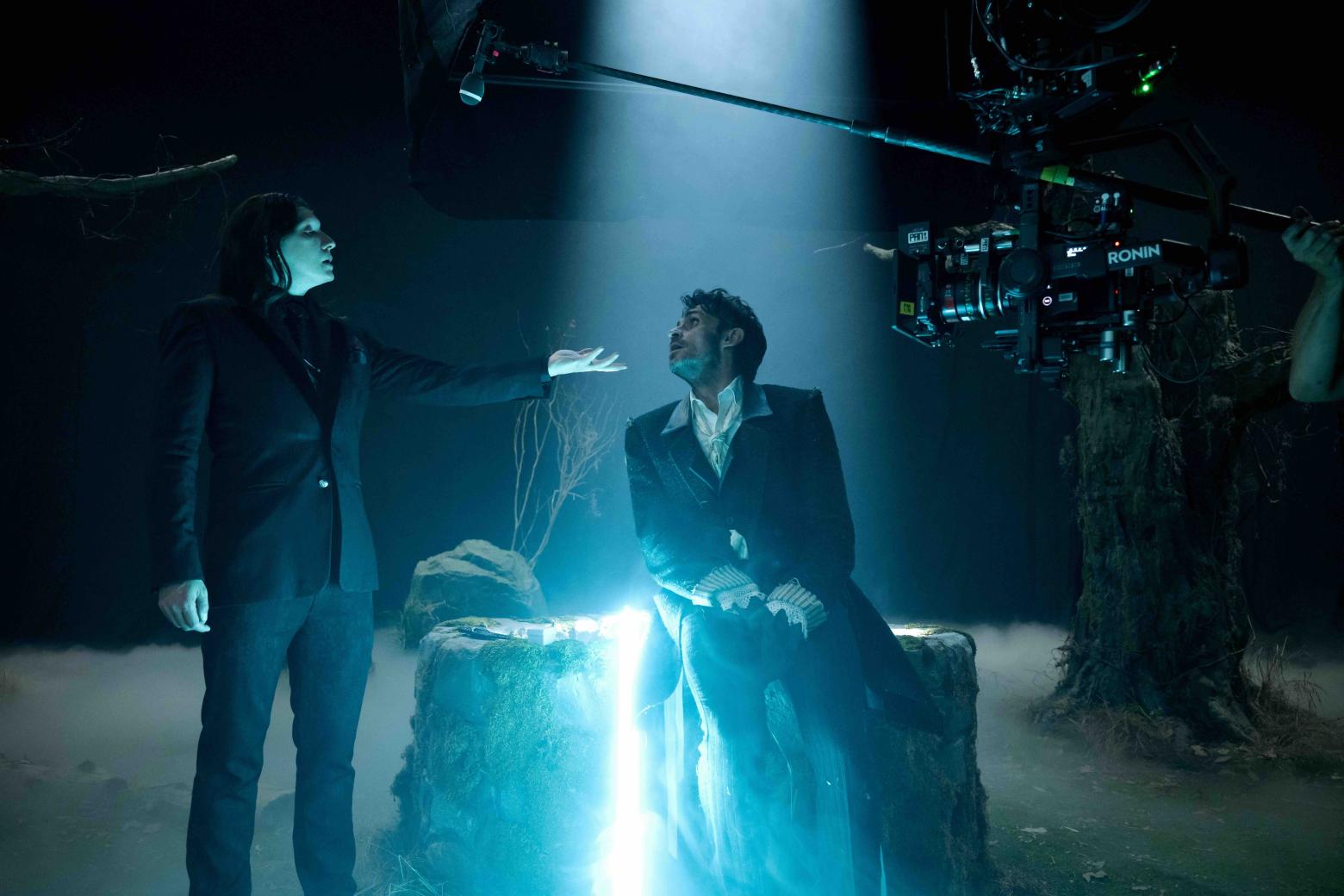
(L-R) Anthony Carrigan as Calypso & Richard De Clerk as Mr. Grimm, on the set of "Twisted Metal" season two. Image courtesy of Spencer Combs.
For the second installment of our feature on Peacock's "Twisted Metal," season two, we connected with DP Fraser Brown, CSC (Episodes 3-4, 7-8, 11-12) to discuss his approach to the hit action-comedy — from unique first-person camera rigs, flashbacks to the 16th century, and channeling 80s horror vibes, to collaborating with first block DP Spencer Combs, implementing complex visual and practical effects, and everything in between.
This season was your entry into the "Twisted Metal" world, along with alternating DP Spencer Combs. What was it like collaborating with Spencer? There's definitely a lot of unique visuals in your episodes specifically, how did you strike that balance?
I had played the original Playstation games growing up. As soon as I had the interview, I was like, "Oh, man. I love the game." And Friday nights playing, that was the best. I wasn't familiar with the first season, so I went back and I watched it, and definitely the writing and storytelling was there.
And when I spoke to them, I'm like, "Well, what do you guys want to change? What do you want to do?" They wanted to elevate the show, make it more cinematic, and make it more of an over-the-top action movie. It's like the 80s action thrillers that we all loved and grew up on while playing Twisted Metal.
I was always going to be the one coming in second because I was on another show. When the scripts came out and Spencer got involved, it really evolved into what it ended up being. Each script is luckily so different that each one had their own theme. So, as far as an overarching look of the show, it was up for debate, which was the most exciting part because sometimes you get, 'Oh, we don't really do this on our show and this is what the show looks like, yada yada.'
But on this one, for example, one of my episodes was a horror episode that takes place in the high school and it's basically an 80s slasher horror movie. Spencer had a ton of big races on tarmacs and stuff. So the look was ever evolving, which was so cool. Every time we would prep, we'd talk about the themes and the looks and the tone and intent of each episode. I love that part going into it.
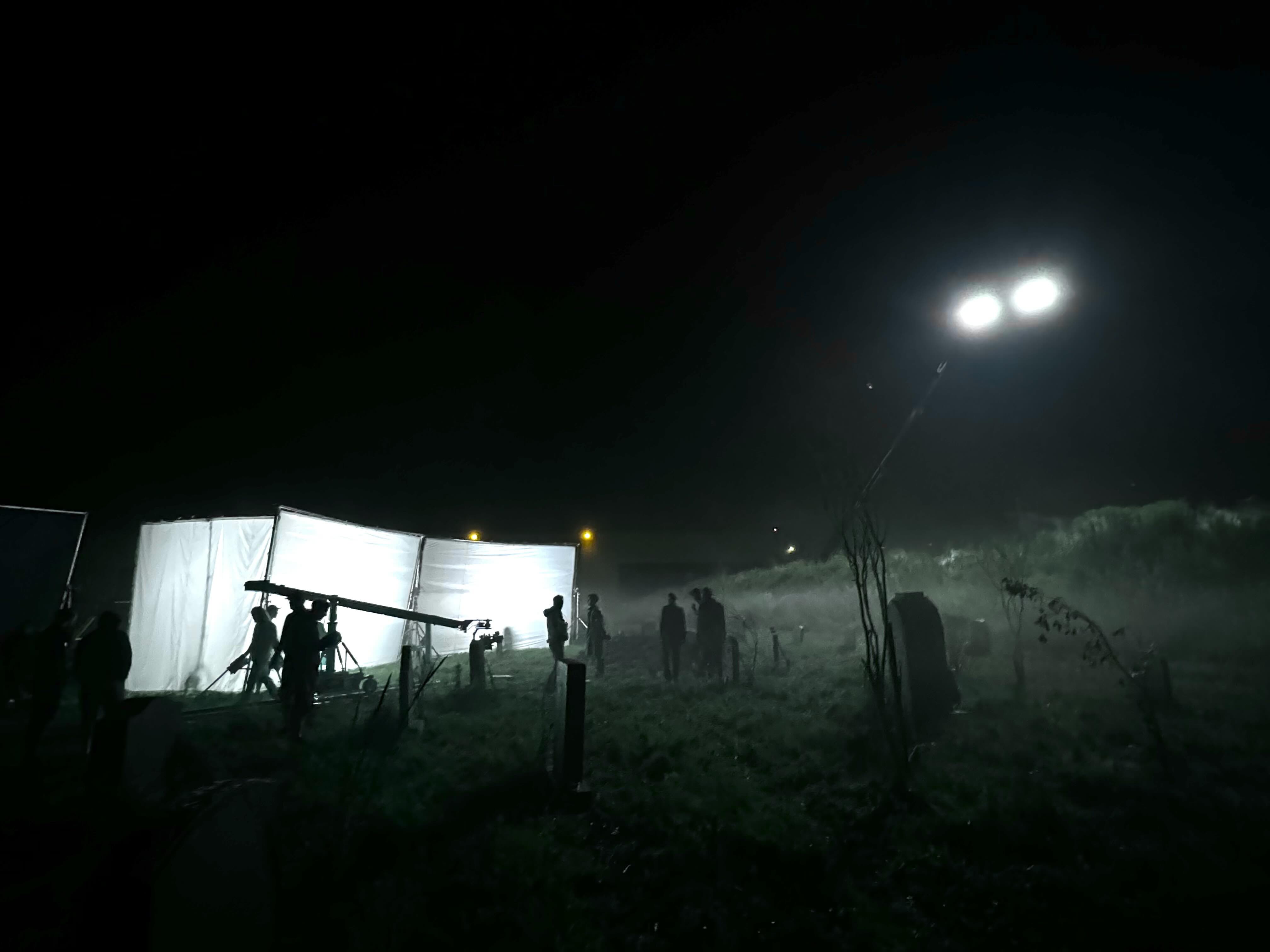
The cemetery set from episode 3 of "Twisted Metal" season two.
Photo courtesy of Fraser Brown, CSC.
Starting off with episode three, we’ve got this really awesome foggy cemetery opening where we've got Mr. Grimm being introduced, and we learn about his ability to drain people of their souls. There's obviously a lighting element to that effect. How much of that was done practically?
Yeah. So for that scene, for the VFX alone, we did a test and the VFX coordinator chose what color it was going to be. The team gave us all the pixel specs of the color which was this aqua green and then we programmed that into a Titan tube chase pattern that was a breathing motion, almost like your heart's being deflated. We programmed that so the color and everything was chosen way ahead of time. Visual effects came in and enhanced it.
The main set piece of episode 3 is when our heroes meet Axel for the first time, and they're in this drive-in that has been taken over by an eccentric evil scientist. From a cinematography perspective, one of the elements that stood out to me instantly, is this force field that the evil scientist is using to keep everyone trapped there, represented with these light tubes. How did you decide to implement those practicals into the storytelling?
One of the main questions in the script was, “How do we keep the two characters in this drive-in prison? What keeps Axel from driving around the world?” The writers said, "Okay, it's an invisible force field." From there, we discussed, what does that look like as an audience member? What visually is it? Is it a shimmer in the air? We went through many processes of what that could be.
We decided to do a visual light cue that gets enabled when you get close to it. That way, as an audience member, we know that something has been activated. Now there's a set stage for the scene to happen. And also, practically, a light cue is so much simpler than VFX, right? The VFX team already had so much to do on Axel. Our Art Department built the machine that he rolls in, but during shooting, we had six people push Axel around. So they all have to be painted out and whatever else, right? His speed was also difficult to accomplish practically, so we had to fine tune that element with VFX as well.
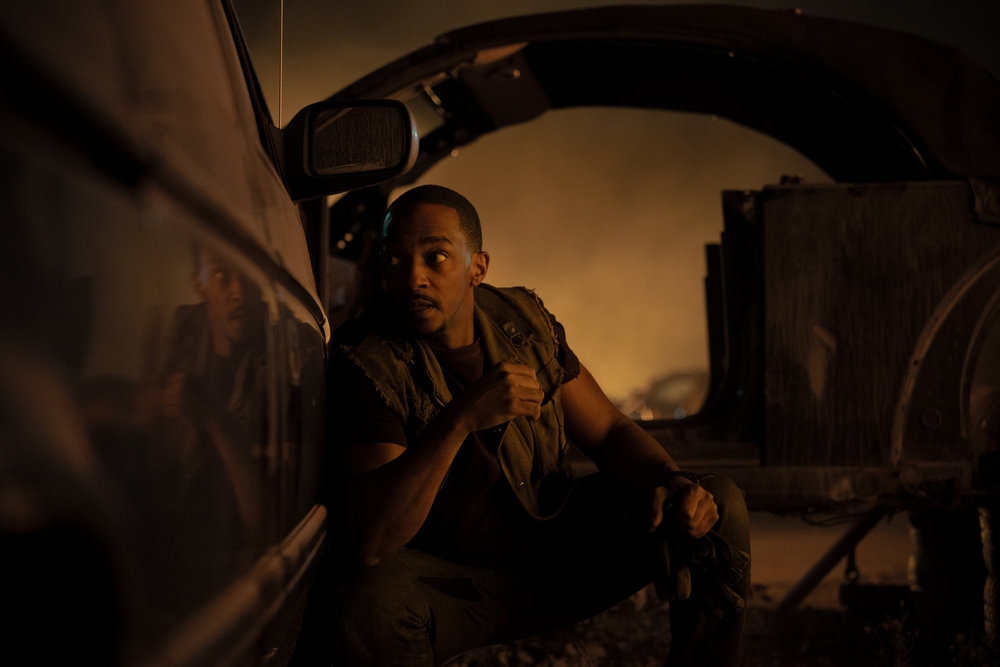
TWISTED METAL -- “T3STDRV” Episode 203 -- Pictured: Anthony Mackie as John Doe -- (Photo by: Pief Weyman/PEACOCK)
We decided to go with this Titan tube rig, and then our Production Designer found these gnarly standing lights with this cage on them that we just put all the Titan tubes in. From there, we encircled the whole set with them. There's a lot more we did than what's in the show. The lights actually went all the way around the set’s perimeter, but it gets blocked by all the debris and wrecked cars.
It was a long debate about what the force field should be, but I think it ended up pretty cool. And then to light the actual drive-in at night, we had three large lifts depending on which direction we're looking at. So, if we're looking at the main screen, we had a 135 with 360s on it. And then we would place three of those around.
With those lifts in place, no matter which way we looked, we always had a nice backlight. The grips built these 12 by 12 frames with Titan tubes in them, with magic cloth on wheels, and we dragged those around the drive-in to light the faces of our cast.
When our leads have their encounter with Axel, and then they're recouping in what looks like a cockpit of a crashed plane, there's a really strong firelight coming in from outside as well.
There's two parts of the scene. One is, John arrives with the sister and they're going to have a nice family moment. So that's all moonlight. It's a little romantic, it’s blue. It's soft. It's quiet.
Then, Axel arrives, and everything explodes and things go crazy. The first explosion rips through these cars, and they explode. From there, we decided that those flames would be the main key for the rest of the scenes at the drive-in.
So we pushed a ton of fire. We kept cool backlight to keep the idea that there's still moonlight, but we lit everything warm. I think we built 10 PAR can rigs. We built a cube, and we put a ton of PAR cans in at different angles, and we placed them all the way around the drive-in behind crashed cars or bushes or whatever. They lit up the foreground and background, and they all had their flicker effect with different gels on them, so they had a lot of punch there.
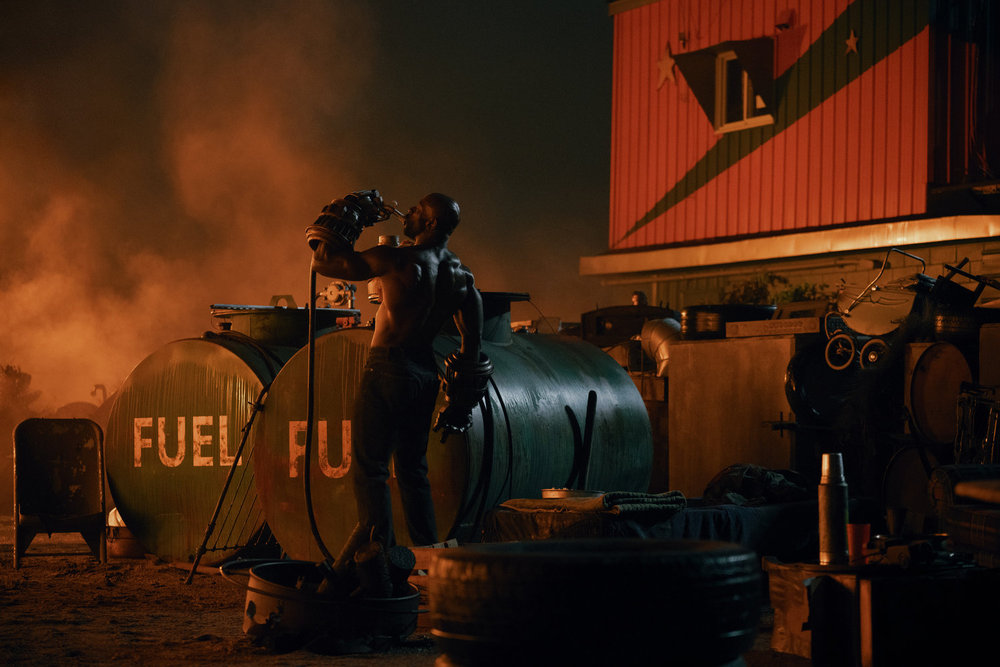
TWISTED METAL -- “T3STDRV” Episode 203 -- Pictured: Michael James Shaw as Axel -- (Photo by: Pief Weyman/PEACOCK)
The fire effect works seamlessly. It’s always ideal when a visual shift can align with a story beat.
Yeah, especially when it's all crosscut between Mayhem and Quiet learning to drive, and then you have Dollface and John at the drive-in. We wanted to make sure those scenes felt apart, because visually, they can be the same very quickly and especially in the world of Twisted Metal where they don't have any power anywhere. In this universe, you really have to rely on moonlight heavily, or fire, or what you have to generate power. And then story-wise, that sometimes doesn't make sense. Visually, it can get dull very quickly, so you have to push it a little bit.
When I spoke with Spencer, something that really stood out to me about the season is that it doesn't really go for that traditional look that you expect with a post-apocalypse. There is still a lot of color that comes through. There's a decent amount of clarity. It doesn't really feel very dire visually, which I think compliments all the comedic elements, too.
Yeah, I agree. They're having a good time, in the weirdest possible way. (Laughs)
It's funny because there'll be a scene where you’re like, "Wow, this is pretty brutal." And then they'll make a crack and you're like, "Okay, they're still having fun."
I like the idea that they always have enough gas and bullets. In The Walking Dead, or Mad Max even, they don't have anything. It's like, "Oh, this one, they have all they need, so what's the next thing?" And I think that's fun.
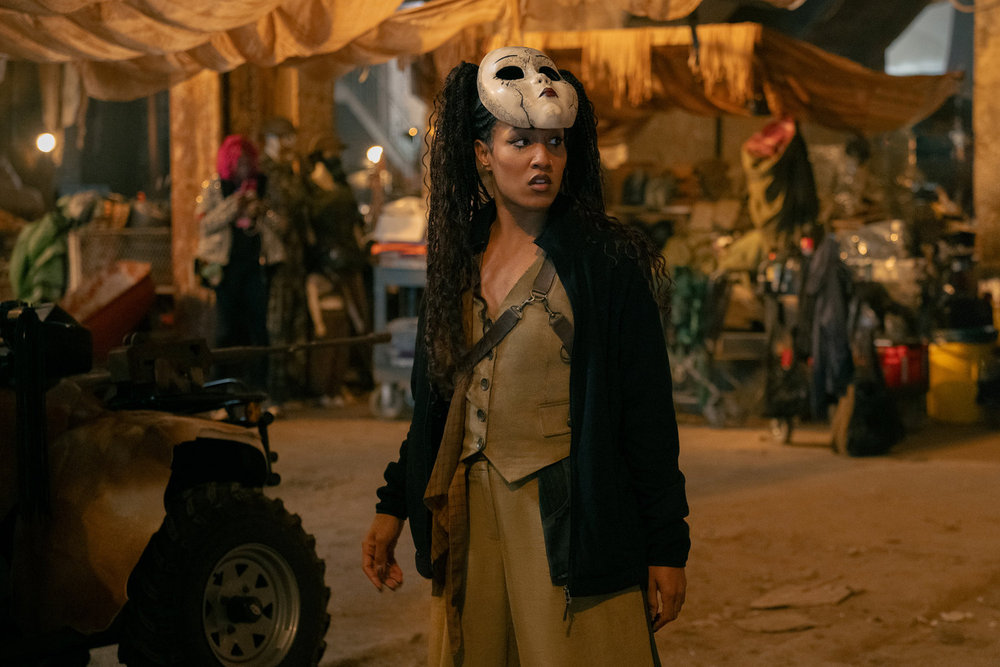
TWISTED METAL -- “LZGTBZY” Episode 204 -— Pictured: Tiana Okoye as Dollface -- (Photo by: Pief Weyman/PEACOCK)
Jumping ahead to episode four, where we’re in Diesel City. We see this flea market that's set up for a big arms meet, contrasted a little bit with the upper echelon of this society. What was the process like for finding the look of these unique settings? Especially during the flea market sequence, there's tons of practical lights flickering, there's a lot of haze in the space. How did you land on the look?
Diesel City, we shot that at the Hearn, which is an old power plant in Toronto. It's endlessly big and many shows have shot there. Star Trek, Titans, 12 Monkeys all shot there. It's big, empty, cavernous, all cement — I can't tell you how big it is. It's unbelievable.
We chose a section that we could dress nicely. And then, to get rid of some of the sight lines, because we have to pretend that it is endless, we did a lot of explosions and sparks in the background. It's like they're drilling for gasoline. One of the main references was Terminator 2, at the factory at the end — like the smelter's on, but they're not really producing anything you can see visually.
There's also an element of security to Diesel City. They have snipers up top, and a heavy military presence, so they can enforce a ‘no violence’ rule. With those elements in the story, we could introduce some more spotlights, and some warmer background backlights on camera. So we chose Ruby R7s, which is six PAR bulbs in a circle with one in the middle. You can physically see them on camera, but it doesn't look like a traditional film light.
So we placed those all the way around the upstairs of the structures looking down. So anytime you look up, you saw them. It was cool. We wheeled around our big soft lights again, the two 12-bys, for all the key lights. Each vendor stall also got its own individual practical that would light the stall entirely itself. Those were either a tungsten bulb, a Titan tube in a housing, flood lights, or even clip-on work lights.
The rest of it, when we get more into the emperor's palace, it got a little cleaner. We brought in some more daylight through the windows, like you'd actually want to hang out there. When they get to the orgy scene, almost 99% of it was lit with practicals on the set. Some broken chandeliers. We had one spotlight chasing around, but other than that it was all practical based.
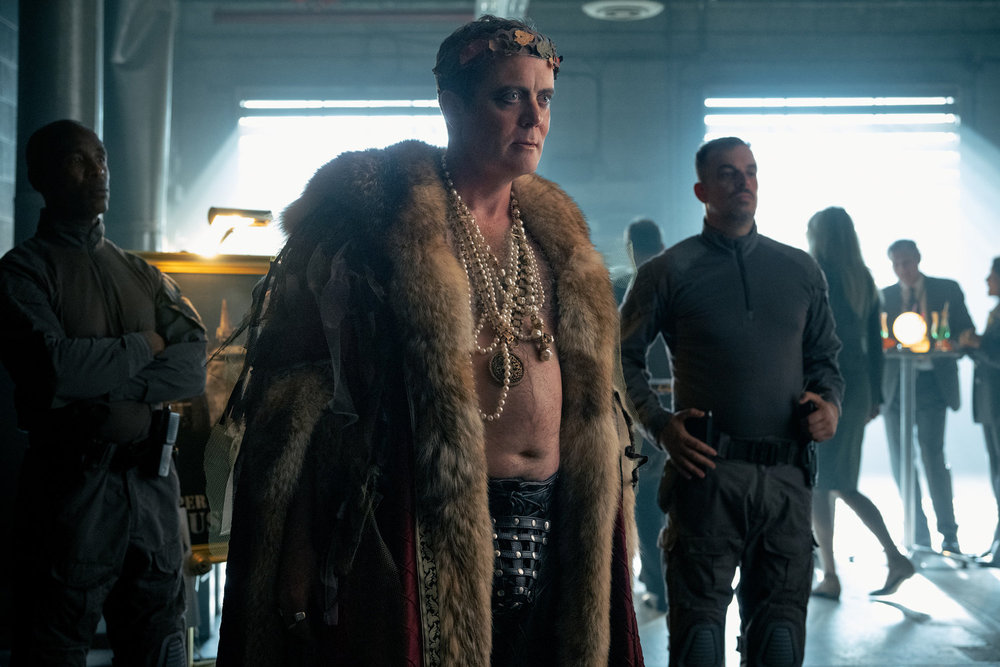
TWISTED METAL -- “LZGTBZY” Episode 204 -— Pictured: Jon Daly as Emperor -- (Photo by: Pief Weyman/PEACOCK)
There’s also a classic “laser hallway” gag, where our heroes are doing this acrobatic routine to get through to the vault. Was that something that had any practical elements?
Oh yeah, that was 99% all real lasers. We ended up buying our own lasers. We did some testing as far as angles — if the laser goes straight, you won't see it, but if it comes at an angle towards the camera, not hitting the camera, but at that 45 degree angle, you can see them with some smoke.
Any laser that was close to the actors was a CG laser. So all the wide shots, and a ton of the actual coverage, was all real lasers, and then they just added a couple to make it a close call at certain times. You don't want lasers anywhere near the actor’s faces. Our lasers were low grade, and completely safe, but it's just, “How many lasers do you want in the face?” None, that's the answer. (Laughs)
From there, the episode takes a pretty action-heavy turn. There's a fire that breaks out in the vault. What was the process for that effect?
The original set was built at the end of the hallway, which was a real location, all dressed and everything. When we did the fire element, we rebuilt that one wall section, with the dressing, on a sound stage so all the smoke could be vented out.
We put up six SkyPanel S60-Cs with fire effect for the backlight, and then the rest is all real fire. We had a flame bar in front of the camera, flame bars behind the actors, and then the wall had rigging for fire as well. VFX enhanced the whole thing afterwards. Let's say we did 60% on set, and then they did the rest of the 40%, the dangerous part, they did in post.
MJ, who's our showrunner, he wanted practical all the time. Everything that couldn't be done on set, we would either change, or they'd eventually give in to CG. But all the jumps, all the cars, all the explosions, that's all done on camera. Even a baby holding the gun, that's all real.
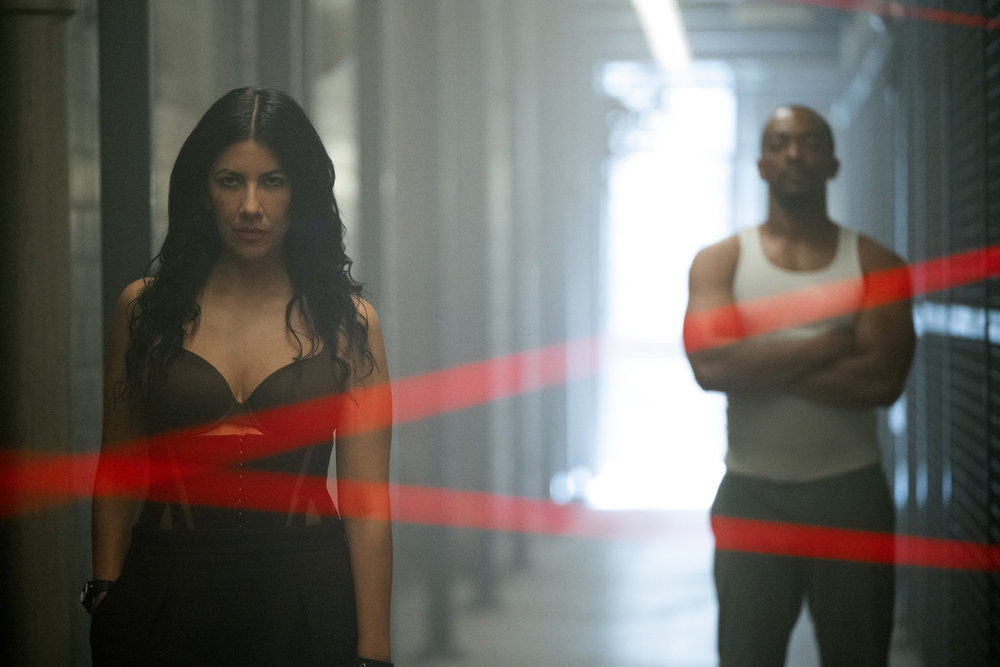
TWISTED METAL -- “LZGTBZY” Episode 204 -— Pictured: (l-r) Stephanie Beatriz as Quiet, Anthony Mackie as John Doe -- (Photo by: Pief Weyman/PEACOCK)
Episode 4 also continues to devolve, as this riot starts breaking out and there's all this fantastic stunt choreography. There's what appears to be a oner in there, covering some of this fight. What was the process like just choreographing these sequences, and executing them? Especially if you're throwing a oner into the mix, that can easily double or triple the amount of time it takes to shoot something.
Because the amount of scale and work that was done at Diesel City, we added a second unit to do the fight upstairs, and the riot fight, while we were shooting the outside with main unit. So second unit's job was just to create that chaos at all times. So a lot of those are stunt doubles.
Like there's one girl that looks exactly like Mayhem. She's running right in there. She's on someone's back. But that's Mayhem's stunt double. They did a great job of creating the chaos that the scene required and also the world building that they did.
Jumping forward to episode seven, where the tournament has started. There’s this wonderful fight scene in the ice skating rink, which felt like a callback to The Running Man, where it's classic 80s action but there's some slapstick in there as well. What were the challenges to these episodes where there is so much more action?
I've done a lot of action throughout my career. I was on Titans for all four seasons. I've cut my teeth on it. The ice rink, we shot that at a roller rink, so there's no ice. Which, when they first pitched it to me, I was like, "You guys are crazy." (Laughs)
And they're like, "Have you ever shot on ice?" I'm like, "Yep, I've shot on ice. It's a nightmare. It's just a white floor, right? It's just nothing exciting." The art department pitch was, "Let's shoot at a roller rink and we'll cover it with dry ice and you'll never know." So we found a place in Hamilton that's a little rundown, a little post-apocalyptic. It looked great, and you can't tell that it's ice or not ice.
It had a lower ceiling than we originally thought. Originally, I thought the ceiling would be way up there, and we could do a soft base to the whole thing or whatever. So we got our department to build these practical standing lights that go, they're like a 45 degree angle, and then a straight line, and they're about 12 feet tall. So we built about 20 of those to place around the ice rink.
We put Titan tubes in all them and we created this cold look, an 80s steel blue look. And then we rigged one spotlight over for the trophy, and then the rest of it was just large soft sources keying them. The art department had a couple really thin skateboards for some of the actors to wheel across. A lot of rope gags they used to do it. And visually it's so different than all the other scenes in the show. It’s was really techy, and cool.
To your point, I couldn't tell that it wasn't an actual ice skating rink. Better to have accomplished it through really great practical effects, and smart choreography, rather than actually worrying about your actors slipping, or your operator slipping, or whatever it might be when you're on the ice.
And then we could also move the camera any way we wanted. This way, we’re not dictated by what we can do, and not do, on ice — with weight capacity and everything. We could do anything we wanted, and bring any gear out we wanted. We never had to protect the floor, or protect the ice... it was freeing. We were all a little worried, but it worked out great.
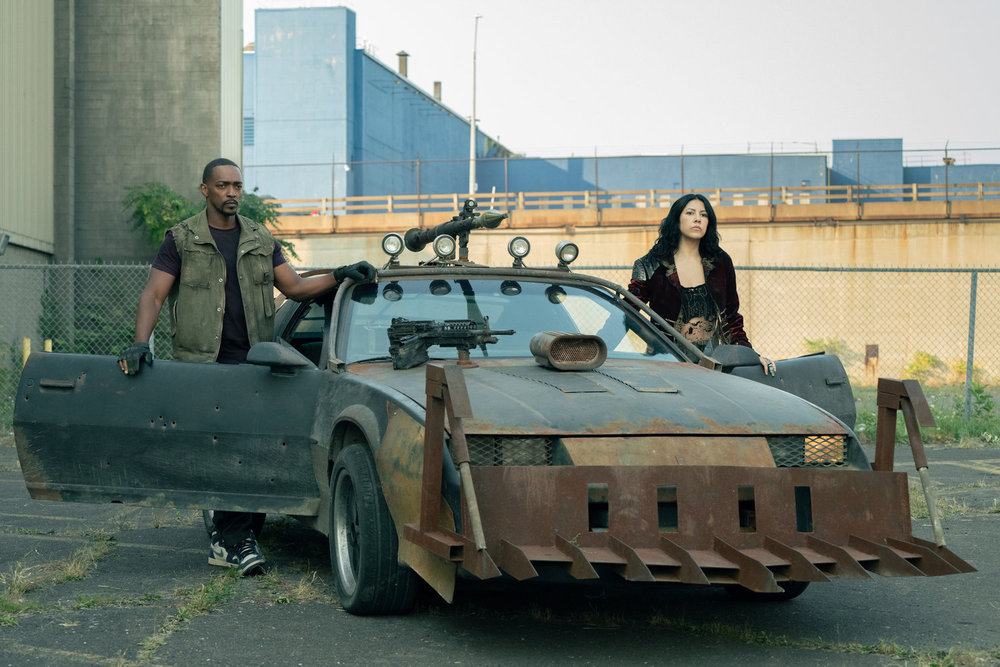
TWISTED METAL -- "H1TNRVN" Episode 207 -- Pictured: (l-r) Anthony Mackie as John Doe, Stephanie Beatriz as Quiet -- (Photo by: Pief Weyman/PEACOCK)
There's also a little bit more car work in episode seven as well. And since that's something that we haven't touched on yet, what was the process like covering these insane chases and whatnot that are happening throughout the season?
This was the first bigger car chase that I got to do in my episodes. Which was a lot of fun. It's also a bit more character and story based than some of the other ones. There's a lot of in-car dialogue, and story development. So, it was different than the other chases, but also had some of the same big gags and big camera moves that they needed to do.
So we had pod cars built for our hero cars. In the episode, Mayhem also gets a new car, and her car self-drives. There was a lot of talk about how we're going to do the driverless car, flying around shooting missiles, and doing stunts, without anyone driving it.
We talked about a person in a green suit. We talked about making another pod car, which is expensive, because you need two cars, one without the pod, and one with the pod. By the end of it, somebody said, "We should make an outfit that looks exactly like a car seat." And that's what we did. So, there's this person driving the car wearing a carseat suit. It was awesome. (Laughs)
Sometimes the simple approach is the best.
It worked out really well. A lot of fun. We spent about four days shooting the driving stuff with the actors, and then second unit went back and shot a bunch of the drone stuff and some of the bigger chases. That's how we did it. The main unit would do all the acting stuff, and we would also storyboard it all out, and then second unit would come in for the stunt work or action shots.
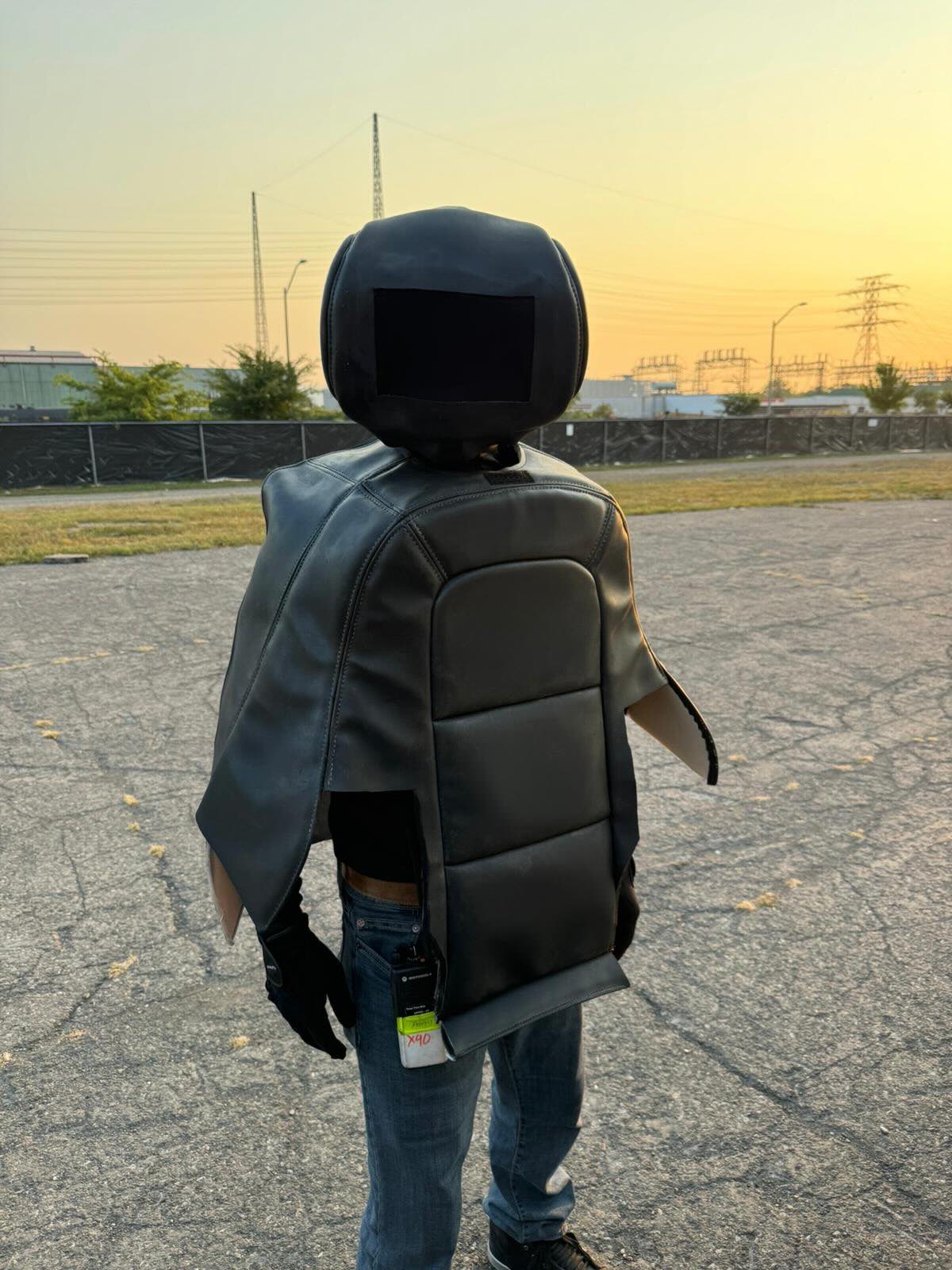
The "car seat" costume worn by a stunt driver on the set of "Twisted Metal" season two.
Photo courtesy of Fraser Brown, CSC.
In episode eight, which you mentioned earlier, you’re really embracing that 80s horror vibe. Especially in the high school, when we've got all the lights flickering, really altering the mood. There's a great fight scene with Mayhem and John teaming up, where we've got this orange light pouring in. This episode also has a fantastic first person sequence in the opening. It feels like a video game thing, perhaps not coming from that "Twisted Metal" influence, but still playing in that aesthetic sphere.
I work on a lot of shows that don't have a thought-out visual identity, or it's something being discovered through the process. With Twisted Metal, all the writers and producers, and the art department, and Spencer and I, we all really understood what the show was trying to do. Twisted Metal knows what it’s about, which is so great because they can really push it.
So when we got to episode 8 and we wanted to do a horror movie, we could push it so far that it's almost unrealistic, without breaking the show’s internal logic. High-end genre-based filmmaking, which is so fun. And we talked about big great visual references and great horror slasher movies and put them all in there.
On the first person sequence, here at Keslow in Toronto, they had a helmet rig pre-made. It has all the rigging on it. We rigged a Sony A7 on it with a prime lens, and then we set it up to pull focus and run around. It was edited, with some jump cuts, but the original intent was that it was a long oner.
On our Alexa, we originally did a shot where we went around his head and went into the back of his head, and then it became first person digitally. Then he goes into the garage, and then goes to the dining room, and that was all one take. The intent was that the whole set was lit from the outside, or hidden lights inside, but it was always intended that the actor could go anywhere he wanted in the room and kill the bad guys or whatever.
It was also fun working out how the actor was going to do all the stunts with the helmet on, which weighs a little bit. Lucky, Michael James Shaw (Axel), is a big guy.
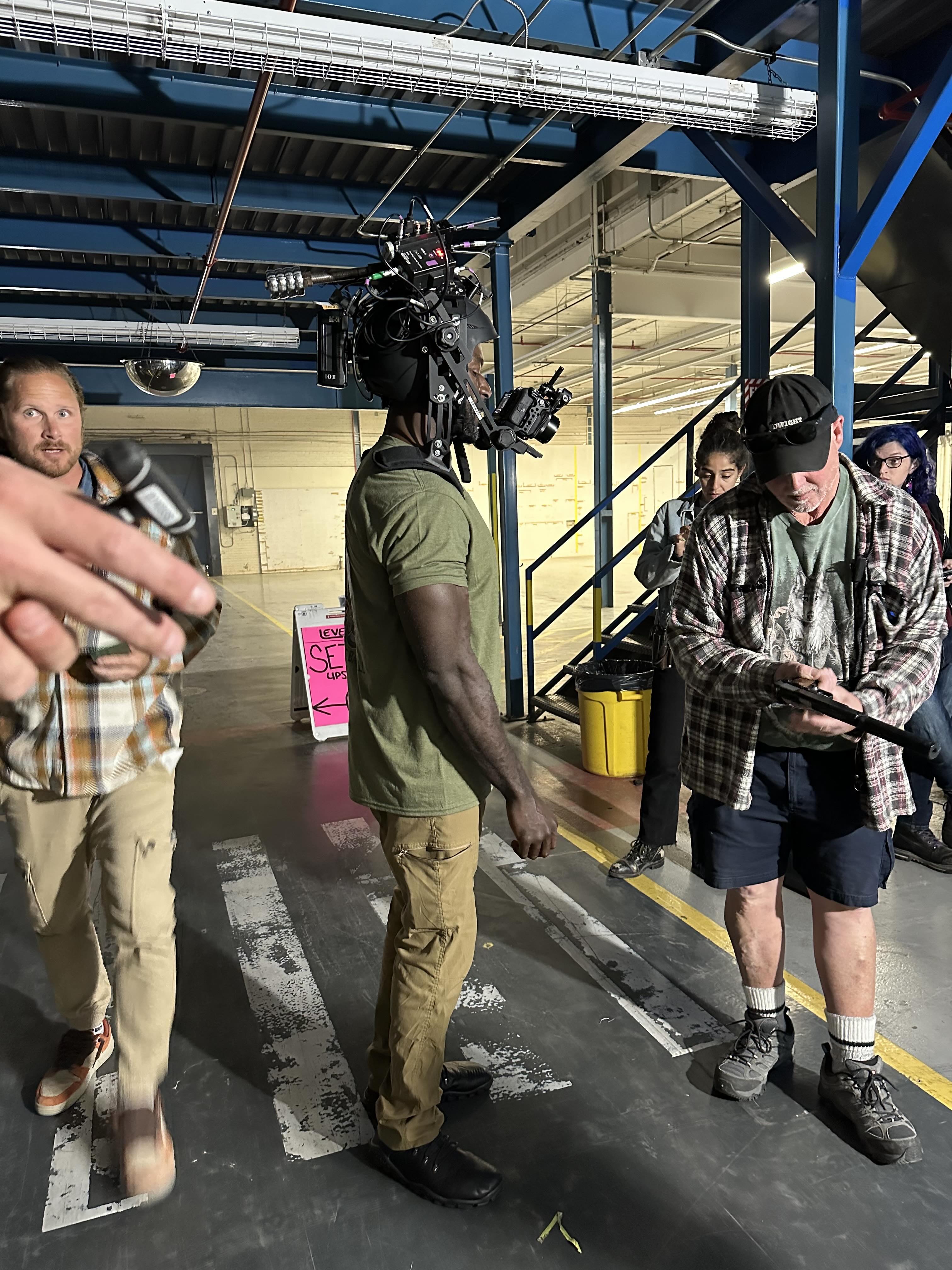
Michael James Shaw as Axel prepares to shoot the first person sequence in episode eight of "Twisted Metal" season two.
Photo courtesy of Maika Boettcher.
Later in the episode, Axel rips these villains apart. We see it happen, ripping limb from limb kind of thing. What was the process like, working with the special effects team to fulfill these really cool gnarly gags with the gore and whatnot?
The main thing about working with the special effects team, is about where the camera's going to be, and the angles to sell the best rip of the arm or the head. So, the director and I would storyboard the whole thing out. We'd talk about which actual limbs we're going to tear off, the right arm, left arm, head, leg, whatever it could be. And then we would talk about where the actor will be, where the camera's going to be, where the lighting is going to be.
And then we make sure the gag is sold. Where all the blood spray is going to be, etcetera. It's also about keeping your shots specific for that intent, because not all the angles are going to sell the blood or the massacre, right? So you’ve got to shoot for the gag.
You also only have so many resets, and it takes so much time to do each one. You’ve got to work with wardrobe to make sure they prep the costume, exactly where it's going to rip, and how it's going to rip.
There's five of those crash test dummies in the fight, and each one gets a fatality. We'd have them each set up, and we'd make sure that they're not sharing each other's background. One person's going to process while we're shooting the leg being ripped off, etcetera. So, it's very piecemeal as you get into it. You can only walk so far with a blood gag tube attached to your pants. (Laughs)
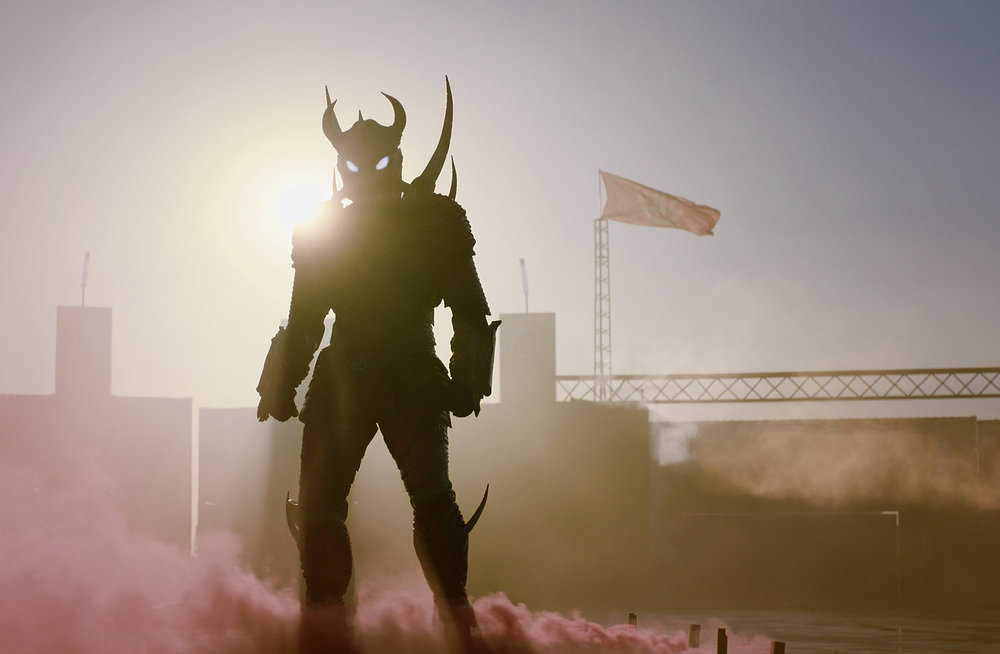
TWISTED METAL -- "OHLYNTE" Episode 211 -- Pictured: Minion -- (Photo by: PEACOCK)
Coming to episode 11, we are in the final arena. We've got the introduction of this horrific character, Minion, in this suit of armor that reminded me of "Bram Stoker's Dracula."
Oh, of course. Yeah, that and Power Rangers.
In the episode, there’s this horrific giant explosion that kills half the audience, which is a huge plot point that seems like it will have a major impact going into season 3. What was the process for shooting this big epic penultimate episode?
Our art team built a huge arena out of shipping containers. They built the main arena, which was huge, and there's a tunnel outside the arena. So it's a two-layer design, that was all practical. We shot in total about 14 days of actual driving, for second unit and main unit.
We really wanted to get the camera in the car with them for this episode, and we wanted to be able to connect the characters to the other cars. So we had a Mini Libra head with a short zoom on it that we could rig inside the car and outside the car. It could be on Anthony Mackie's face, and pan and zoom in and see Sweet Tooth shooting missiles, and then come back to Anthony driving the car. The connective pieces were a bit more involved, and usually each pod car would have about four to five cameras rigged to it. Usually one remote head that we could zoom in, and change the angle or change the perspective of.
We had a commander, a sand buggy with a remote head on it. At one point we had the drone every day. And we had a wire cam at one point, which got some cool shots when we had it. We also had a 50-foot scissor lift at all times, with a long zoom, like a 25-300mm, up 50 feet looking down on all the driving for the crowd perspective. So, there was a lot of gear and a lot of organization that needed to go into orchestrating the whole thing and all the days together.
Calypso's box was built on top of the arena, about 45 feet in the air. So to get up there, you need your own lift to get the actors up, and they have to be harnessed. So we rebuilt that on the ground, and we did all the photography on the platform on the actual ground. As far as the crowd, we shot plates of the crowd. We built risers.
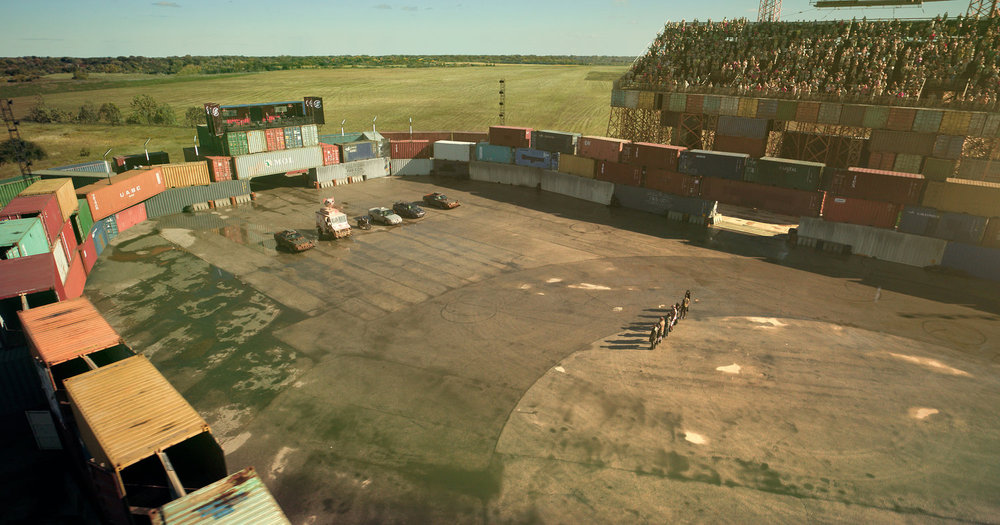
TWISTED METAL -- "OHLYNTE" Episode 211 -- Pictured: Arena -- (Photo by: PEACOCK)
Then we placed those above the arena with CG. We had a sight line, of what would be a CG shot and what wouldn't be. There was great debate about how many shots we were allowed to have the crowd in, how many not. And the big explosion, which is 90% CG, we talked about where the explosion would start and end, as far as the arena goes. We did large dust balls and big fire effects for the actual explosion. The special effects team did a very good job.
The hardest part of shooting that arena was the continuity of the cars and the chaos, because we're shooting that arena for almost 14 days. It's like, "Hey, where's Sweet Tooth's car at this time? Where's John and Quiet's car? Which are they identical? Where's that? What is this?" So, when you watch the episode, I think it's almost seamless as far as continuity of each car, and where each explosion happens over the course of half a month's work.
I can imagine that's a lot to hold in your head, as the DP, or as the director, or the script supervisor. You basically need to have a big diagram at all times like this is where it is at each moment.
The director did a digital overhead video, a map he made digitally where it shows the life of each car and where they go. So he has a video of where John's Roadkill is going, where's Sweet Tooth going, and it's all time-based. So, at any time, we could reference the video about, "Oh, John’s Roadkill would be at this entrance coming in to do this missile shot, and Calypso's up there,” and this and that. It was all pre-thought out. He had a great visual bible for everyone to look at as far as where everyone was at the time.
We had every toy you could think of. Also, as I made a long list there of all the cars and moving tools, we had everything standing by as far as what we wanted to do.
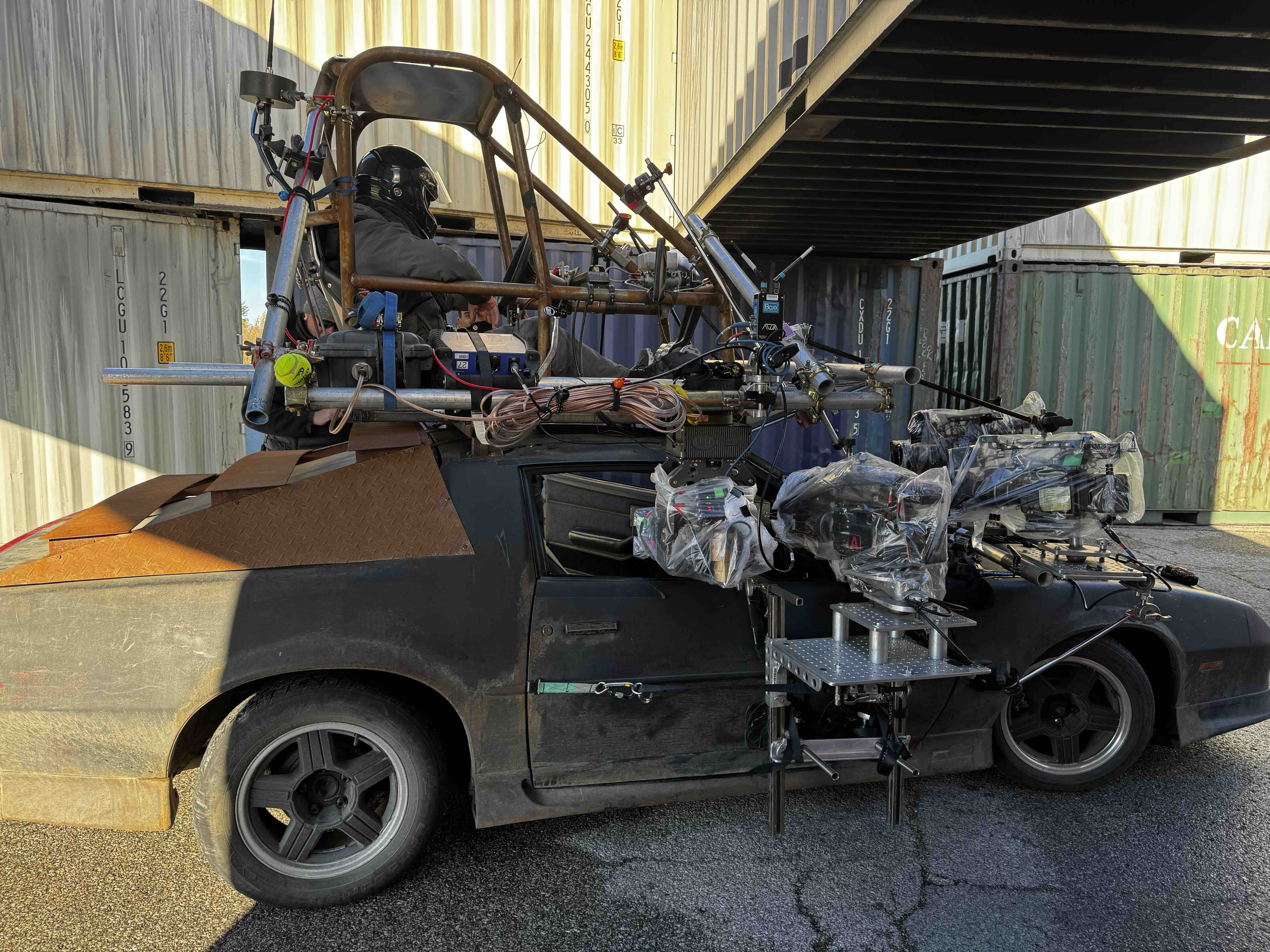
A picture vehicle on the set of episode 11 of "Twisted Metal" season two.
Photo courtesy of Fraser Brown, CSC.
You need the proper resources to do something at the scale that you're doing it, for sure. Otherwise, it's going to feel like a Roger Corman movie, a "Death Race" or something along those lines, which obviously is in the DNA of "Twisted Metal," but you want to elevate it for audiences in 2025.
Yeah. It's also the finale race, so they threw everything they had at it. It's also nice to really see the actor’s driving, like Anthony is driving the car, Stephanie is driving her car. Obviously there's a pod on top, but you could feel them in the world a bit more which I think was an evolution for the show, to show drama within the action.
We didn't do any volume work or any LED work on the whole show. Sweet Tooth's truck had a lot of blue screen just because we didn't have a pod car for it, and it's a big truck and there's lots of characters in it. There was one other scene we put blue screen up for Roadkill, but it was just scheduling-wise that we had to. 80-85% of everything is real driving, real car rigs. I think you can tell it looks very grounded.
On to the finale, which has one of the most striking visuals throughout the season with this black and white flashback introduction to Calypso in 1585. What was your thought process behind making that sequence stand out?
We pitched hard to make it black and white. I read the script and I immediately sent MJ a GIF of the girl coming out of the TV from The Ring. I was like, we have to do it, it has to be The Ring. We got to do that. So, Bill Benz, the director, he’s on board, everyone's on board. And then we got the Ancient Optics Petzvalux Primes.
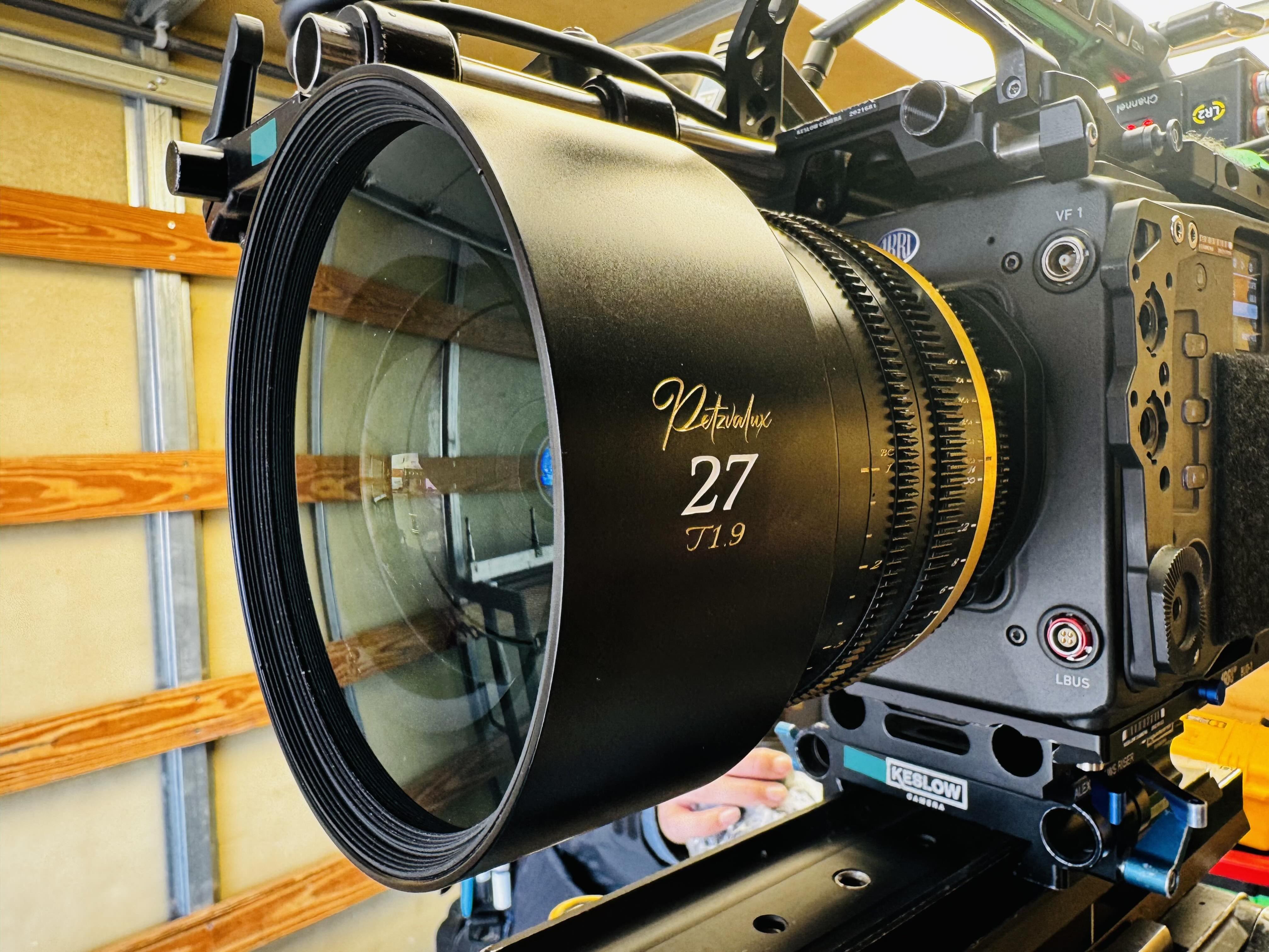
Ancient Optics' Petzvalux Primes on set of episode 12 of "Twisted Metal" season two.
Photo courtesy of Fraser Brown, CSC.
Bill was pushing hard for those. He said, "We got to test these. We got to test these." He's a big stills camera guy. So we got those. We tested them. They were awesome, especially in the forest. All the trees are curving. And we pushed it hard. We really wanted it to feel different than the rest of the show.
Then, you flash forward to the 80s, where he makes this pitch for a Twisted Metal TV show. So that was the location that we enhanced with the backdrop and some palm trees and stuff. It made it feel like California. We tried to get a lot of sunlight onto the set, but we don't want to overpower the projector, so the projector became the main light source for the presentation and for the scene.
We tested projectors. We chose that projector, an 11K, xenon projector. So it's bright, and we painted the wall a gray color so it wasn't so white, and it actually bounced nicely and it filled the room up. So yeah, we exposed for the projector and that turned out great. The slides were hilarious and the whole vibe of that pitch is excellent.
In terms of shooting for black and white intro, were you looking at a LUT that was black and white on set, lighting specifically that way? I know that sometimes shooting for black and white, you have to make the wardrobe certain colors to still give that depth and color separation that you want. And so what was the technical approach to creating such a sequence that stands out visually from everything else?
We didn't do any live grading on the show. We had a show LUT that we built, that we put into the camera that we lit and exposed for, which was a pretty subtle LUT. For this sequence, we made all the monitors black and white, and then for the dailies, our DIT, Joshua Jinchereau, he pushed the blacks way down, and made it feel like that high contrast old film stock that we all wish we could shoot on.
As far as the wardrobe goes, yeah, they got it immediately. Calypso was going to be wearing all black in the pioneer times. Some of those crisp whites around the neck really popped once we added that bleach bypass, high-contrast, black and white look. We were lucky enough to get some sun behind Calypso which really popped him out of that darker background.
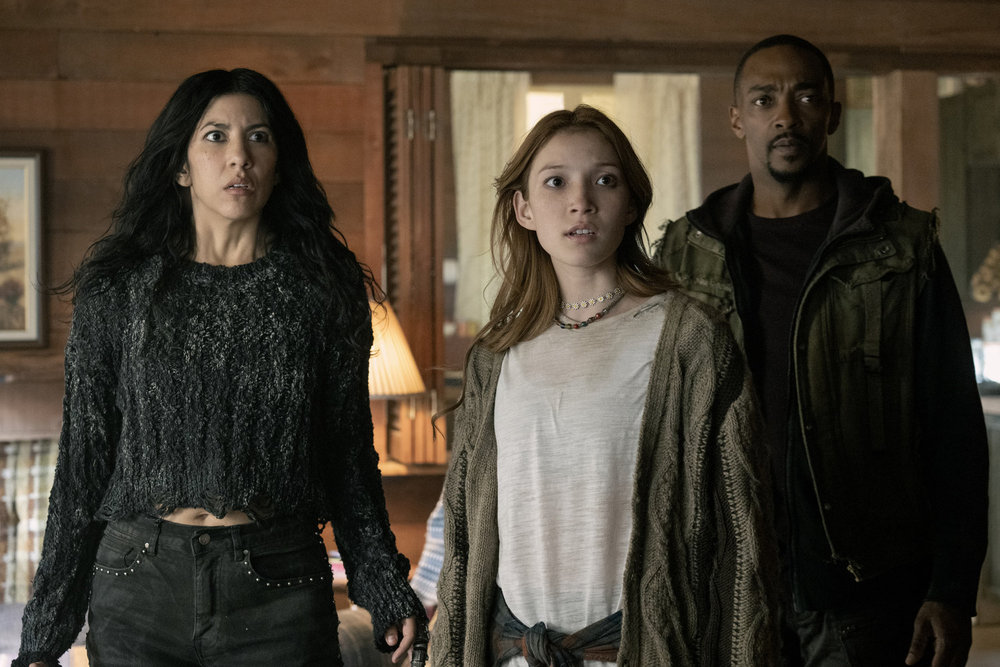
TWISTED METAL -- “NUY3ARZ” Episode 212 -- Pictured: (l-r) Stephanie Beatriz as Quiet, Saylor Bell Curda as Mayhem, Anthony Mackie as John Doe -- (Photo by: Pief Weyman/PEACOCK)
Later in the finale, we’re finally at John’s childhood cabin. In this space, the look feels way more grounded, really relying on the natural light coming in through these windows. It is very moody. From a character and a story perspective, it feels bittersweet for John, he's there and he made it, but he doesn't have his sister. So many of those moments are him going through the family photos, or in his sister’s childhood bedroom. What was the process of coming up with that feel to compliment the journey of the characters and the story?
The exterior of the cabin was shot just north of Toronto, in the woods. It has a little lake next to it. It's beautiful. We rebuilt the interior of the cabin on stage, because the interior of the actual location is pretty small, and we had the big fight scene.
We needed to make sure we had flyaway walls, or areas for rigging lines to be put in. It's like we wanted to make it feel like a time capsule, from an era before the apocalypse. It hasn't been touched. Light pours in and it has a potential of being an oasis for them, but will it? We're not sure.
We put strong sunlight in, big shafts of light, which is something I hadn't done too much in the earlier episodes. We wanted to make it feel special in there. It also has electricity, so we got to put all these warm practicals in, and give it a feeling of safety and comfort, especially after the intense season that they've been through.
So, now they have a refuge to be in. It needed to be homey, but it also needed to be colder and a bit more bleak visually, even though it's a heightened reality versus the rest of the season.
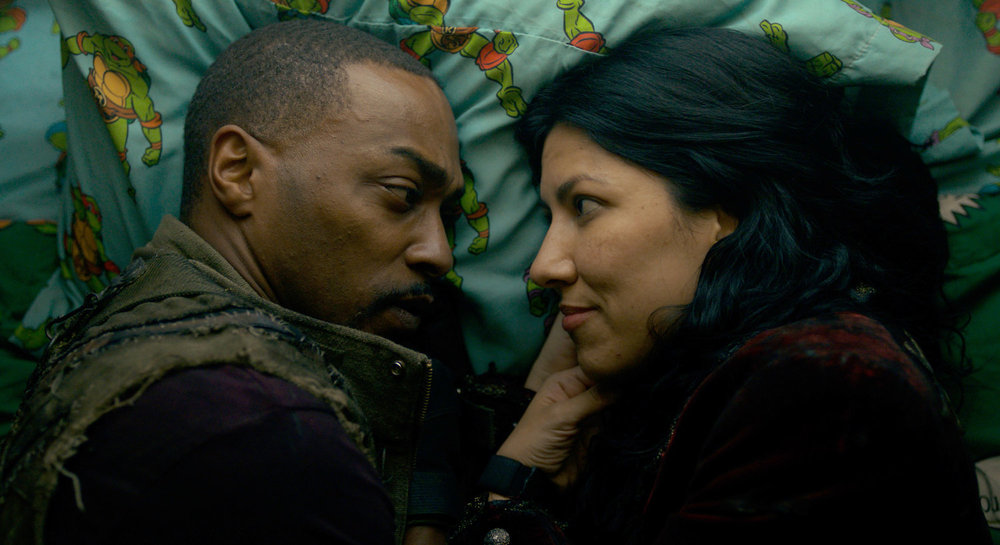
TWISTED METAL -- "NUY3ARZ" Episode 212 -- Pictured: (l-r) Anthony Mackie as John Doe, Stephanie Beatriz as Quiet -- (Photo by: PEACOCK)
The cabin fight scene with Minion — was there anything unique about that fight versus some of the other action throughout the season?
Yeah, it was a challenging fight. It's a small interior cabin fight, so it needs to be a bit less grounded. Interior fights like that have their limitations as far as where you can put the camera, where you can put the lights, where the rigging's going to happen. So there were long talks about which wall needed to fly out, where the lines would be for any of the poles, what stunt double would do each one — because we have two suits, one's a stunt suit, one's the on-camera suit, so it's a lot of figuring that part out.
The bedroom fight was very difficult. It's a very tight set in there, and how to get sunlight or a key light into that narrow section. And I think we ended up with a mirror board in a lift, with a 4K into it. So there's a nice harsh shaft, but it didn't bleed everywhere, so you don't get too flat in the lighting. I think we filmed that fight for about two days, maybe a day and a half. But it was tricky with the costume and the moving of the actors and the choreography of it, because it's very different.
The outfit limitations really change how we do the fights. The stunt performer is on lifts to raise them up a bit, and the costume was super bulky. So yeah, it was tricky. Plus, the finale of the fight has the door open, staring at a translight that we put up, and they're talking forever in front of this translight, in front of a door, which is always a little tricky. But yeah, I think the cabin stuff is one of the best parts of the show.
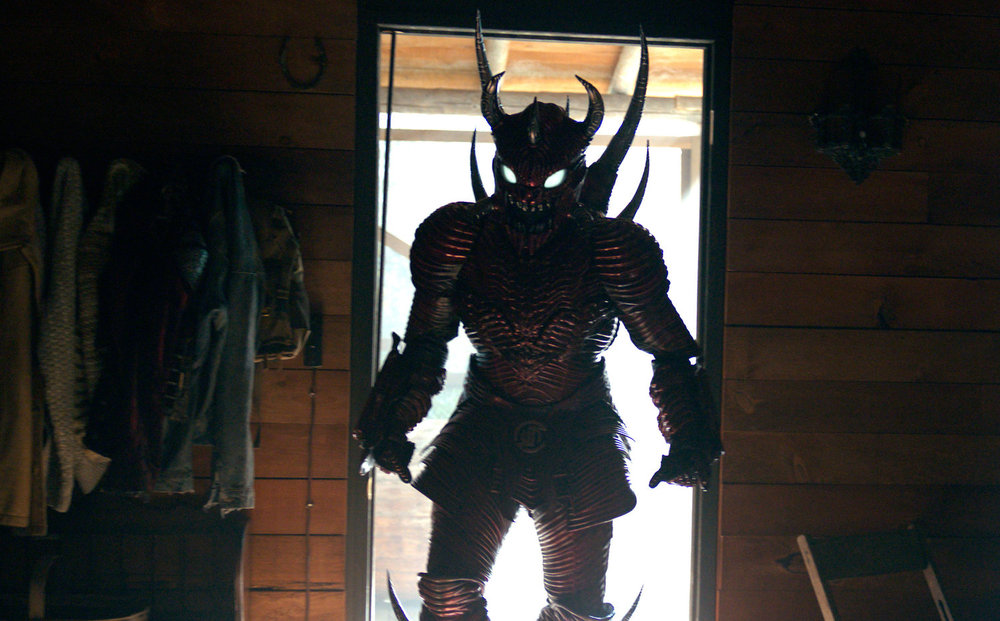
TWISTED METAL -- "NUY3ARZ" Episode 212 -- Pictured: Minion -- (Photo by: PEACOCK)
Something that I asked Spencer that I want to posit to you as well, having talked about every episode individually or just some key moments from each episode. Were there any unique moments, setups or challenges that really stand out in your mind? What comes to mind when you think about the experience of making "Twisted Metal" season 2?
A few things. I think one, as I mentioned earlier, working on a show that understands what it is, and its target audience, was the most rewarding part. The showrunners and the writers, they all knew what they were making, and the tone that it should be. So instantly, if something came up they'd be like, "No that's not this show," or "That is this show," whatever it could be.
I felt that working on a show that has a true identity visually was so freeing, it was so exciting. You can instantly expand on the world that you're creating, especially season two, and not being on season one, which is always tricky because you come in, and then you have to maintain it, or there's certain things that they love or hate, depending on what it is. And this show is all just genre-based gags, which is so fun.
I’d been blessed enough to do a ton of car stuff and action stuff on Titans. So to bring that over to Twisted Metal, I felt it was something I could help improve upon with them. They hired such great stunt people and stunt drivers, the best you could ever hope for. And some of the stuff they did with those cars is unbelievable. So to be able to help put the camera in the right spot for them to capture that was so fun.
Sometimes, you’d just show up and you'd be like, "What should we do here? Where should we put the camera?" The stunt team is like "You put the camera right here and it will be perfect." You're like "Okay." And it was, all the time. They were so fun to collaborate with.
Having the support from the producers for what gear was required, or how many cameras were required, was always great. We had a great camera crew, great lighting team, great grip team. Everybody who worked on the show I think all walked away with smiles because they had such a good time working on it. That's a rarity to work on a show where people actually enjoy showing up every day.
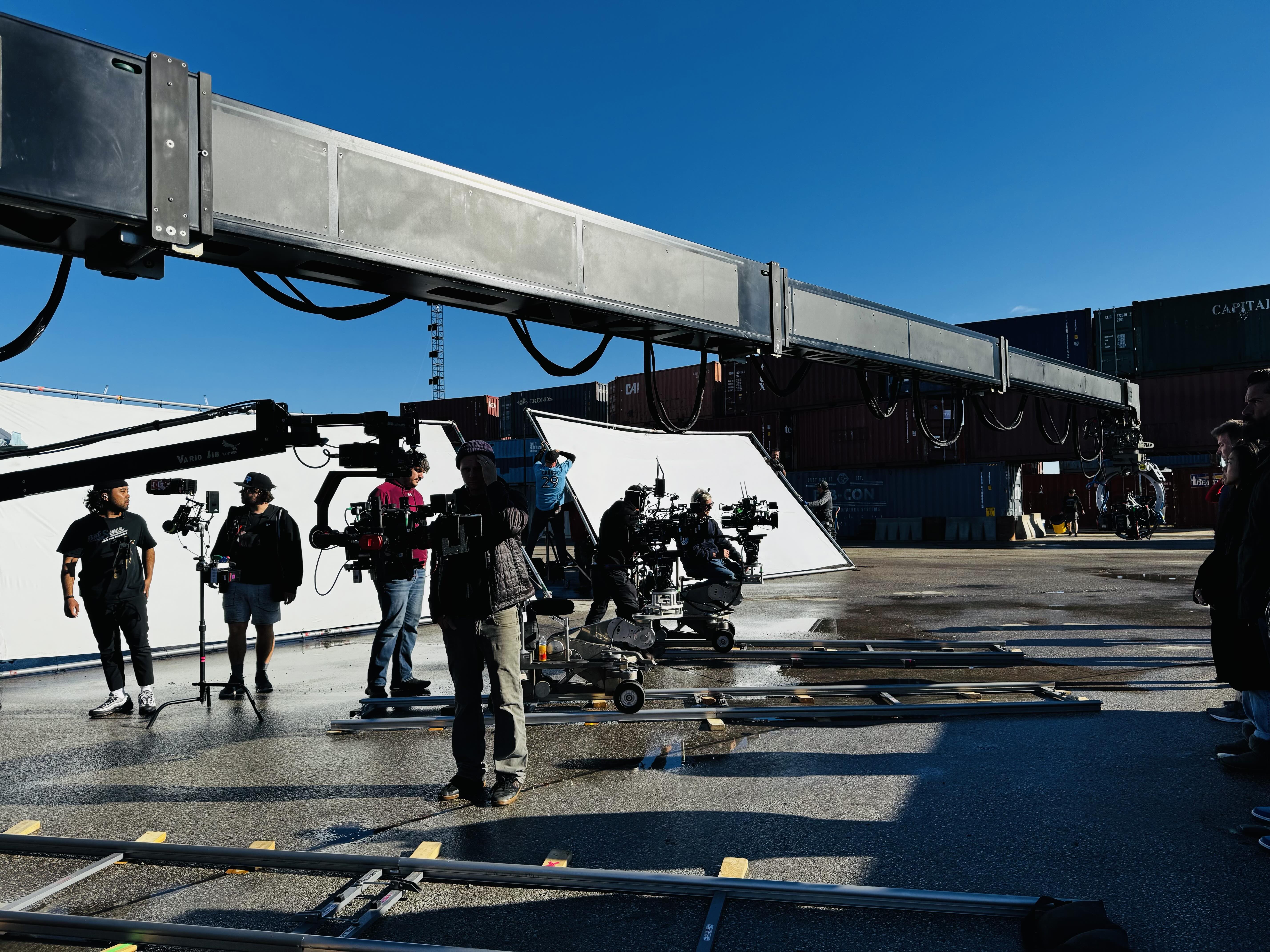
The camera team prepares for the next shot on the set of "Twisted Metal" season two.
Photo courtesy of Fraser Brown, CSC.
I know you mentioned that you came up through lighting, and so cameras and lenses aren't really your wheelhouse, but what was the process like working with Keslow Camera?
I’d done jobs with Sim Camera before, with Jim Teevan (Executive Director of Business Development, Keslow Camera Toronto) which now is Keslow Camera. Jim and I have made movies together for a long time. Jim was a focus puller before, so I made movies with him on the floor. It was nice to come full circle with him like that.
Nowadays, it's nice to also make movies with him through a different lens, because now he works at Keslow. As far as working with Keslow, it was great. We had a great experience. We got all the tools we needed. We broke many things and nobody said anything about it. (Laughs) We just turned them in politely and got new ones.
So that process was excellent, because we went through a few things, and it was challenging, but I think everyone understood what we were trying to do. Everyone was very on board to create the type of show that we were doing, which is cool.
Is there a anything from the process of crafting "Twisted Metal" season two that has impacted how you work on future projects?
I think after working on Twisted Metal season 2, my knowledge of shooting action and visual effects has definitely been elevated to a new level that I hadn't seen before, especially with how they choreographed the car work and how they set up the stunt work. It was huge, and I think also working with actors of that caliber was also invaluable.
Anthony Mackie is Captain America, he comes with a certain level of respect and a certain level of how he likes to work. And same with Stephanie Beatriz, she's incredible. Working with excellent talent who can deliver, it's your job as a DP to make sure they elevate the story in a visual way in addition to what they're bringing.
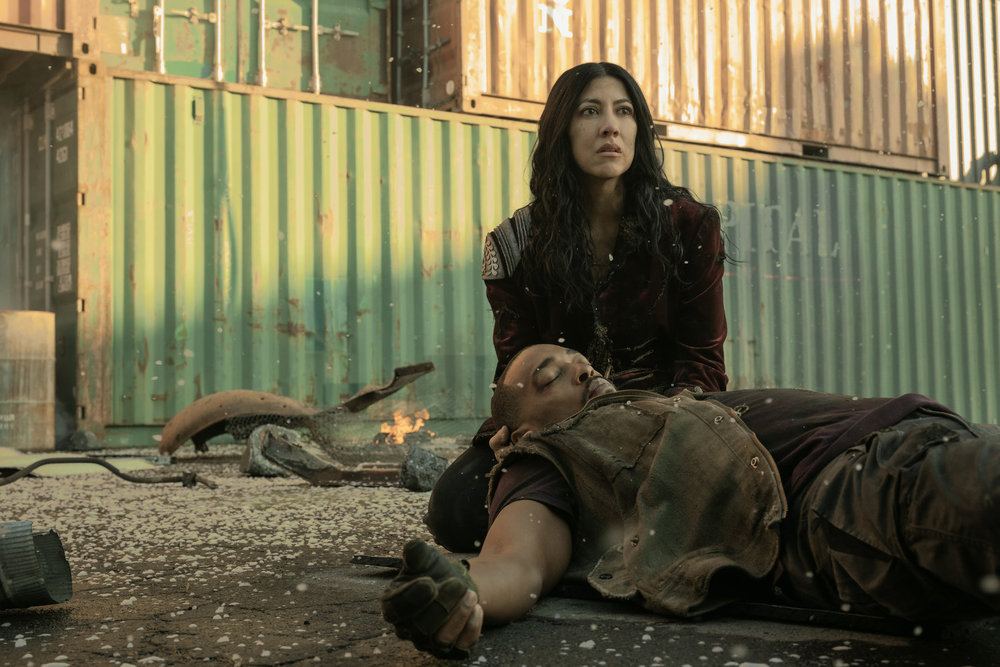
TWISTED METAL -- “OHLYNTE” Episode 211 -- Pictured: (l-r) Stephanie Beatriz as Quiet, Anthony Mackie as John Doe -- (Photo by: Pief Weyman/PEACOCK)
One of the things I love about MJ, the showrunner, he is willing to take chances on you visually, and he would catch you if you fell. Because you'd push the envelope as much as you could, and sometimes you'd be like, "Oh that's too much," or "That's not enough," but you're all working together to create that. And some shows don't have that — there was always a sense of creative freedom on this show which I think is rare, especially on a season two of something.
I still text MJ all the time, like, "Did you really put Crash Test Dummies at the end of my episode? That's the best thing I've ever heard." The music at the end of eight is Crash Test Dummies while he fights the crash test dummies. It's brilliant. He and I, we have the same sense of humor. So, I really appreciate it. The show is made for me. (Laughs) [x]