

The Cinematography of "Twisted Metal Season 2" (Part One) with DP Spencer Combs
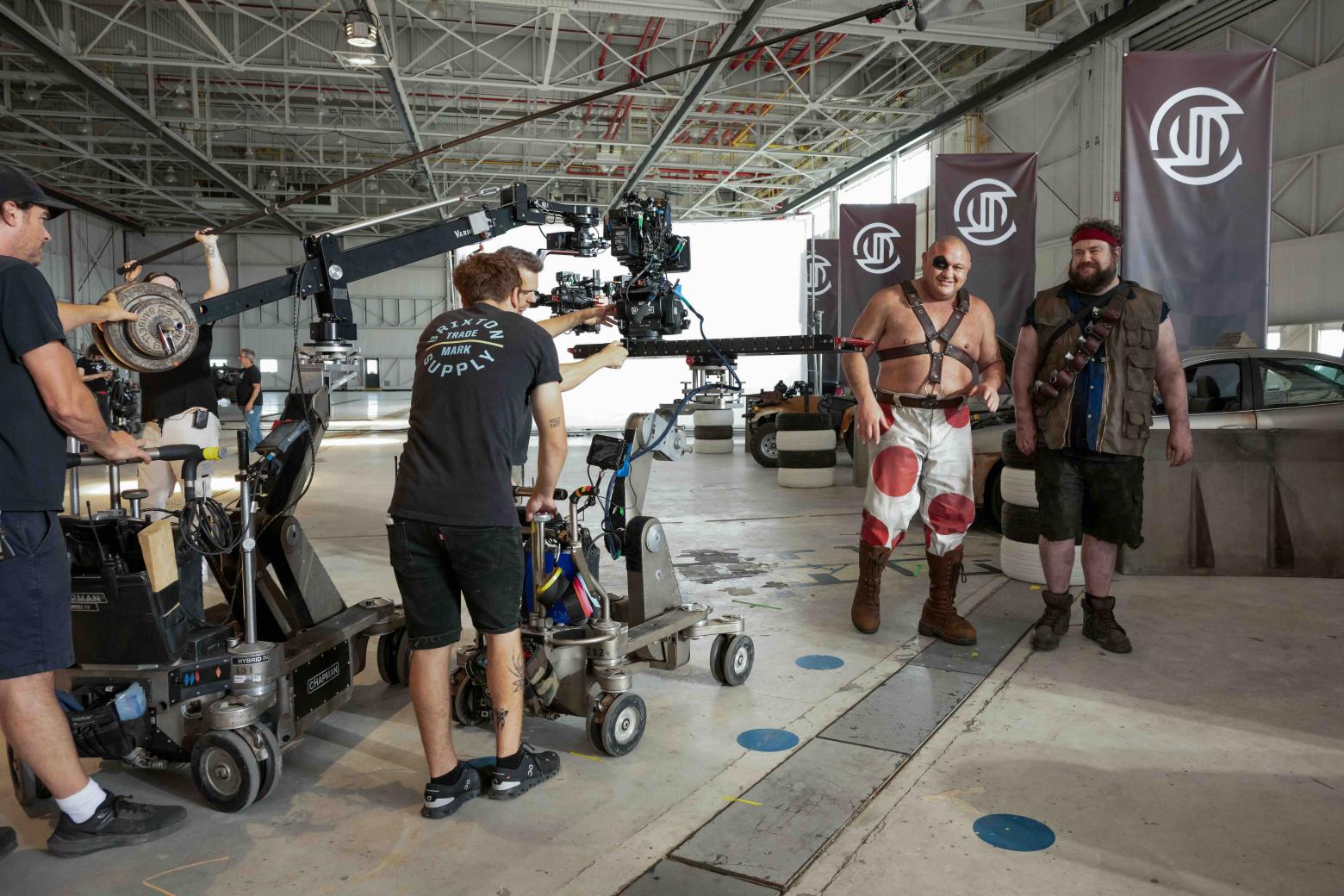
The camera crew (L-R) A Cam Dolly Grip Caley Wilson, B Cam Dolly Grip Adam Boston, and B Cam Operator Scott Baker, frame up Stu (Mike Mitchell) and Sweet Tooth (Joe Seanoa) on the set of "Twisted Metal" season two. Image courtesy of Spencer Combs.
For the second season of Peacock's "Twisted Metal," the series underwent a major visual overhaul. We connected with DP Spencer Combs (Episodes 1-2, 5-6, 9-10) to discuss reinventing the look of "Twisted Metal" — capturing dynamic and complex action sequences, treading the delicate balance between action and comedy, and collaborating with a large team to bring the series to the next level.
The series feels a lot more colorful than you might expect from a post-apocalyptic story, where the trend is usually “let's desaturate it, let's use all earth tones.” There's a lot of color throughout, and the show generally has a clean look. What was your general approach, and how did you evolve the look versus the first season?
The look of season two has changed quite a bit compared to season one. One of the first things showrunner/creator Michael Jonathan Smith (MJ) mentioned when I came on board was emphasizing a more vibrant color palette. To your point, it’s easy as a cinematographer, at least for me, when you're in that dystopian world, to lean into that desaturated ugliness. I wanted to keep some of that grittiness while still emphasizing a bit of color. It takes the subject matter, that can be gruesome and bloody and crazy at times and lightens it a little bit. So, that was the jumping off point, to be true to the world that we're in, but also to play into the video game aspect of it.
When the show was presented to me, the potential larger scope was emphasized, “This is going to be much bigger and we want it to have a different look from the first season." I thought there was a real opportunity to give Twisted Metal a more stylized version for season two. It was also presented to me early on that because of the scope, it needed to be executed in a real efficient way from my side. There was going to be a lot to do in a day so we have to be efficient, and we have to get the days done. So to me, that meant minimizing lighting setups when possible and the scope, which I tend to do anyway. Getting together early with directors, producers, art department, and creating a plan that would allow me to shoot in a predictable way and also be flexible. I come from a camera operator/steadicam background and for me, it is always about making stronger compositional choices, giving things a more modern look, a little more weighted frames, integrating foreground as much as possible and more varied lens choices. Things that I could do quickly and are inherent to efficiency.
The ability to find imagery and beauty all around you and work in an almost docu style, to be able to start at this point where, “Okay, if we shift this into backlight the whole time, if I use some longer lenses, we shoot through the cars, we’ll have something that's stylized and interesting and efficient. So that was my approach, consider where the light is coming from, with some creative blocking and strong composition and lens choice, we can give it a quick stylized look without taking any more time to do.
I was drawn into the show for many reasons but the action/comedy aspect of it was really appealing and challenging to me. How do you make it funny when Sweet Tooth has a giant sword and is slicing someone in half? To me, there needs to be a lightness in the visuals to tread that tonal line.
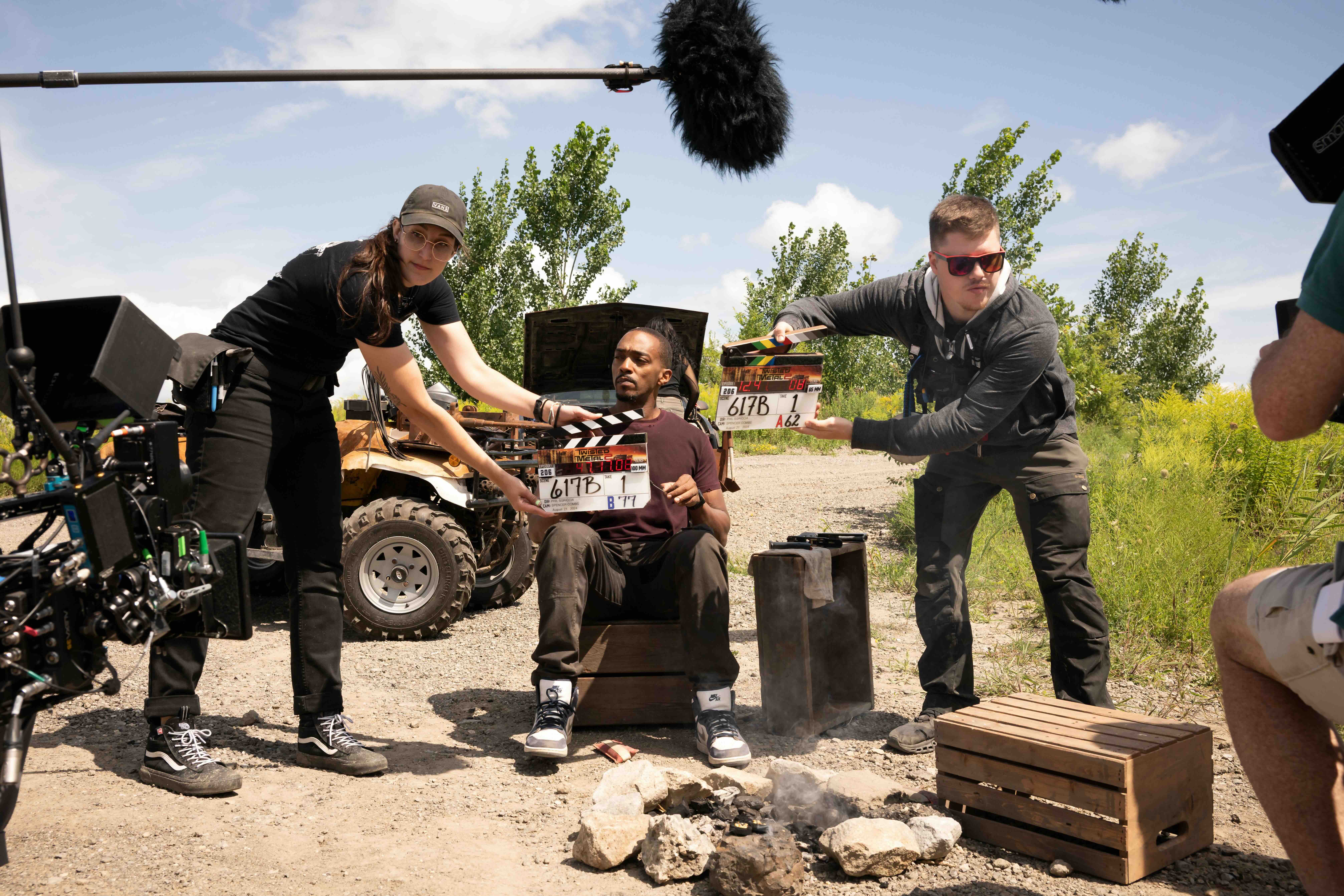
John Doe (Anthony Mackie) with the camera team (L-R) 2nd AC Ashley Binette and Camera Trainee Jesse Hammond, before the next take on the set of "Twisted Metal" season two. Image courtesy of Spencer Combs.
In terms of lenses, what optical qualities were you looking for? Which lenses did you end up landing on? I noticed that there's a lot of really nice blooming highlights throughout, and moments where there's really beautiful bokeh as well. What was the testing process, and why did you land on what you did? On the camera side, did you test multiple options? There’s slow motion used throughout the series, was that a factor in your choice?
We tested two cameras, the Sony VENICE 2 and the ARRI Alexa 35. We ended up going with the Alexa 35, I love the Venice 2, but for various reasons we went with the Alexa 35, they’re both great cameras. I came onto the project a little later but my ideas coming in were very similar to what was already in motion. To be versatile with S35 in terms of lens options, to have a reliable camera, efficiency, and physical size, we wanted to go with an ARRI. Ultimately, the look that came out, was what we were going for.
From there, we chose Leitz Summilux primes due the speed of the glass, the cleanness of the image, they have that bit of a cooler color as well which I like. We wanted to shoot a very deep stop and have a real clean image to start. For me, I use a certain amount of diffusion, often Pro Mist, that gives you a bit blooming and softens that ultra crisp Summilux/Alexa 35 look. It brings it down, and that diffusion almost creates its own fill light in a sense. So, you can be a little more contrasty in lighting. You have that decreased contrast/blooming that you can dial down in coloring and can reintroduce some contrast. You can bring it back and you still have a bit of softness that has a more film look, but you still have the speed of the glass, and the sensitivity and colors of Alexa.
That was our primary main unit setup, but we also had second units running the entire season. We had seven camera bodies across the whole project on board all the time. We had three cameras we would have on main unit, with the Steadicam body bouncing back and forth, and three or four bodies on second unit. We primarily shot on primes for main unit but on second unit, in addition to the Summilux’s, we also had a couple of Angenieux 12:1 zooms, a set of Zeiss CZ’s for in car stunt work and a 18-80 Fujinon zoom for the arm car. We really liked the range of that lens for the arm car. It allowed us to do a lot of versatile looks — we typically had an arm car, a motorcycle camera, and then two ground cameras running during some of those big race sequences.
If I need a zoom I really like the Zeiss Compact Zooms as they match the Leitz primes well, their coolness, their crispness, but we needed a better range and the Fujinon is also a good match. We had a real mix, but I think we came up with something that worked throughout the whole show.
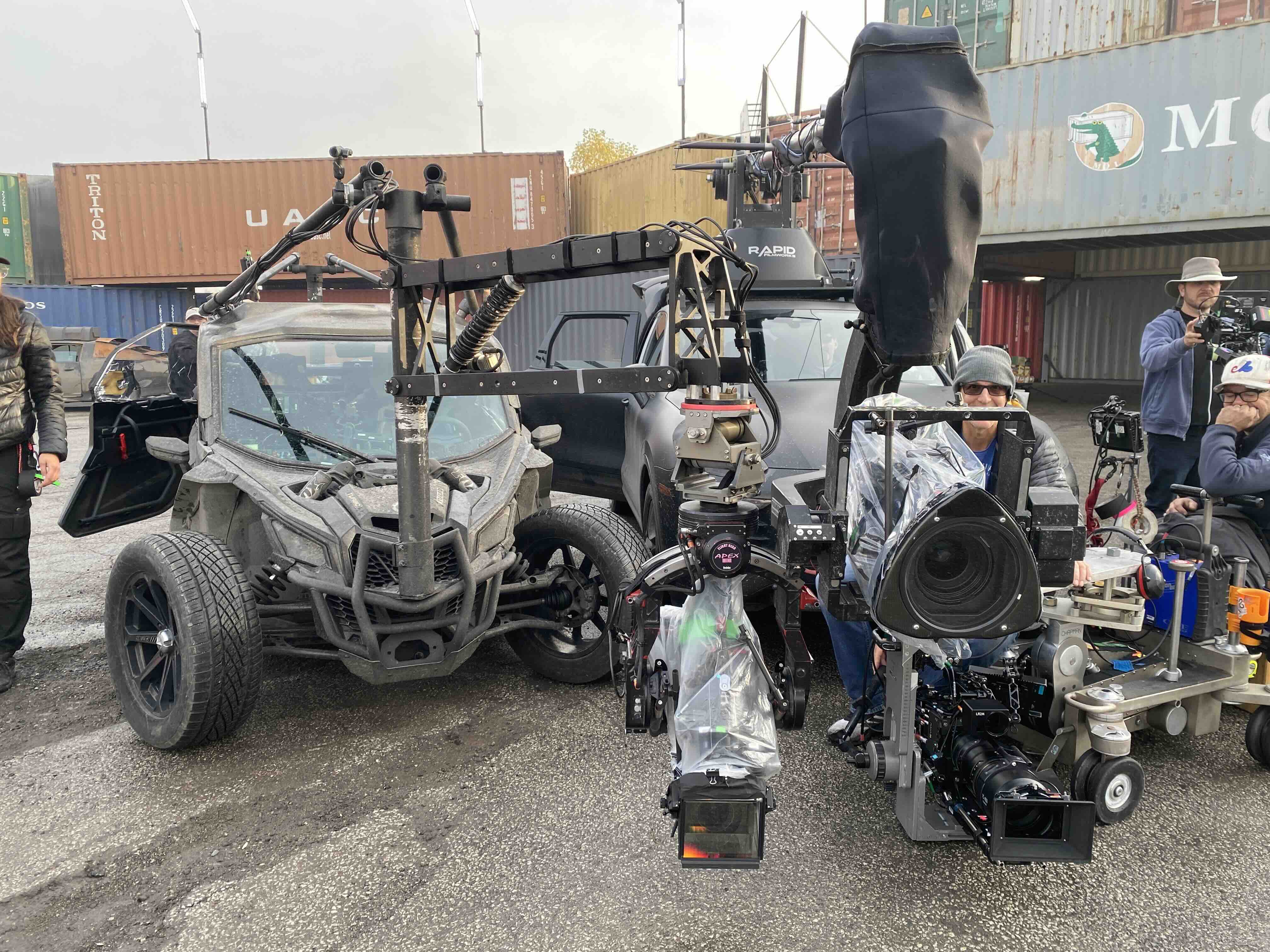
Some of the high-tech camera arm cars and rigs on the set of "Twisted Metal" season two. Image courtesy of Spencer Combs.
I know you mentioned Steadicam, camera car, and motorcycles. What other unique methods of moving the camera came into play, especially during these incredible car race sequences? How did you accomplish the aerial photography?
Tons of drone. We worked with Chris Bacik at Sky Eye Media for our drone work - they were so integral. Everybody across the board was amazing.
In terms of movement, we had everything. Steadicam, handheld. We had miniscope cranes, techno cranes, there were often multiple Ronins working, along with helmet cams, and dollies of course.On second unit we always had the arm car, motorcycle camera with remote head, cable cam, and drone. It seemed like we had every possible type of camera platform available.
It was so fun to have all those resources at our fingertips. And then to have such great technicians and artists running all of it at all the time was a blessing. To have such a broad diverse group of people, and to be able to give them a task and just let them do their thing, it was fun.
There’s so much action throughout the season. What was the process like collaborating with the stunt team? It seemed like there was an impressive stunt in almost every episode, whether it’s a giant car flip or a fight. It was pretty intense, from the first episode all the way to the finale.
I was lucky to shoot almost all of the second units on my episodes and all of the second units for the final two episodes. David Barrett was our second unit director and Logan Holladay was the second unit coordinator. Logan, I've known a long time from our days on Sons of Anarchy, he was pretty young and did motorcycle stunt work and he and his dad would drive the motorcycle side car camera platform. They were pivotal in the way Twisted Metal looks, as the action is such a huge part of the show. Their attention to detail is unmatched, I’ve never seen anything like it. You can see from the show, the stunt sequences are incredibly integrated, from the movement of each vehicle to the interaction or fighting amongst individuals.
They were so committed to running entire huge sequences together. They wanted to have it all be congruent, like a live-action event. From there it was just our job to go around and cover it. I've done a lot of action in my career, and at first, I was like, “Why don't we parse this out?” But I believe their thought was, now we are all in sync, and now we are all running together, and we know where everyone will be, and it's just a matter of us moving the cameras and capturing different moments.
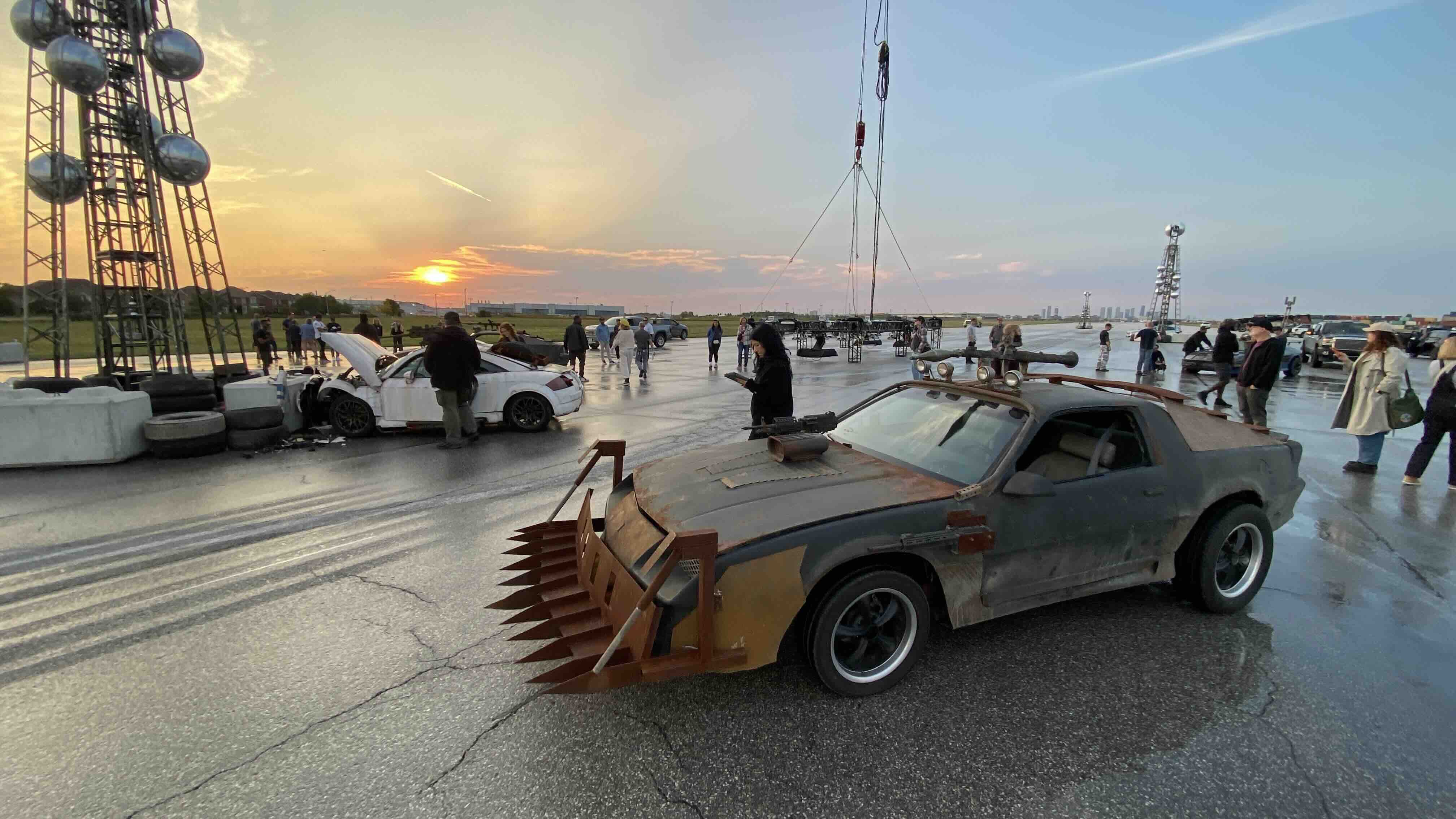
One of the key picture vehicles for "Roadkill" on the set of "Twisted Metal" season two. Image courtesy of Spencer Combs.
Everybody was in the moment working together, whether they were on camera or off, and the sequences would run far longer than maybe the section that we needed to shoot. So, their desire to keep it all fluid and as one congruent action, really was helpful, and it lent itself to success, because I don't know how we would have ever gotten it done otherwise. It was so easy to reset. “Okay, we need this piece from behind Sweet Tooth’s truck. Okay, here we go.” And everybody already knows what they're doing. It was like a dance for sure.
Generally, the idea was, let's get it going and shoot it as we go, because you never know what you're going to see in the background, who's going to be there, who should be there. And we succeeded at it a lot.
On the comedy side, I'm curious how you were covering some of those moments. Did you want to shoot with multiple cameras? Sometimes, when shooting comedy, someone will say something off the cuff that you only get one take of. Was that an element as well? Was there a little bit of room for improv when you were covering those sequences?
If you mean cross coverage, we did both, occasionally we would cross shoot but not always. I have a varied background in comedy, drama, and action. I'm very lucky. I shot Veep S4, which was amazing, I had operated on it the first 3 season, one of my favorite projects ever. We cross shot everything on that. For some of the sequences in Twisted Metal, if the light and blocking was favorable, I would be totally open to cross shooting especially when things are off the cuff, and the cast is riffing heavily. That being said, Stephanie Beatriz and Anthony Mackie, those two are freaking amazing — not only amazing actors, but so consistently funny, that if you needed to shoot individually, it was never a problem. They were ready to accommodate anything. The entire cast was like that!
Philip Sgriccia and Bertie Ellwood were the directors for my blocks. We'd go from shooting these crazy action scenes on second unit, all the stunt work, and then we would shoot the in car moments for the stunt/race sequences on main, either car mount, pod car, or green screen. The ability for them, the actors and the directors, to keep the funny going when needed, in the midst of all this chaos and these crazy running sequences, was really good. As I said, that was what really drew me to the show, that chaotic action and comedy.
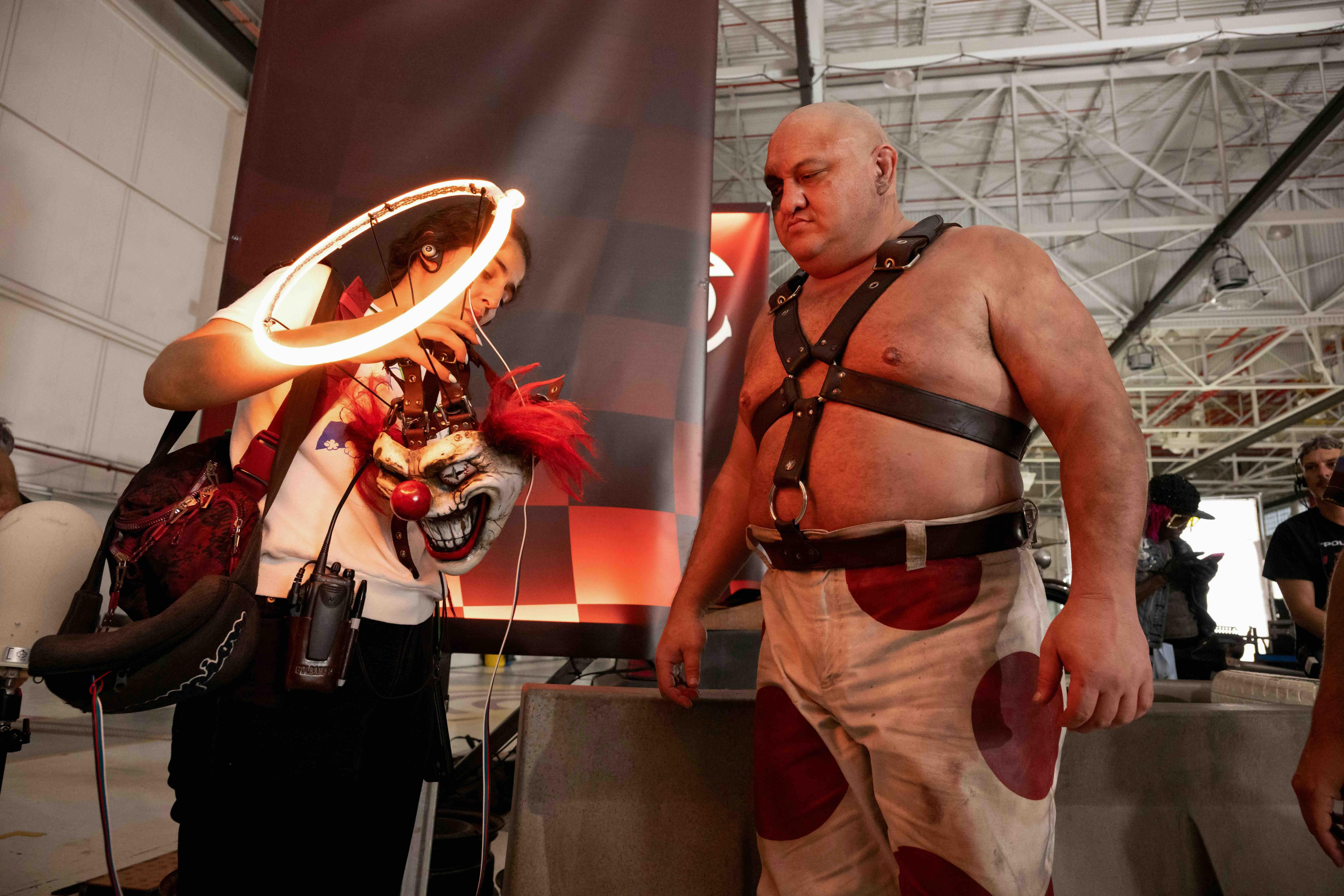
Set Costumer Golbahar Adib assists Sweet Tooth (Joe Seanoa) with an LED-outfitted mask on the set of "Twisted Metal" season two. Image courtesy of Spencer Combs.
To touch a little bit more on the technical aspects, I wanted to get your insight into working with the special effects and visual effects teams, because obviously there's a lot of these elements throughout. There's a lot of gore and violence, so it's integrating with multiple departments, where it might be a little bit of practical effects, some visual effects, and obviously working with stunts as well.
I truly don't think I've ever been on a show where people collaborated so well together. The integration and communication was so strong between Sophie Vertigan, special effects coordinator, and Joshua Spivack, visual effects coordinator. Sophie was this mad genius who never said no. She and her team had amazing ideas on how to make the “usual” special effects something special. The scope of what we were doing was pretty big, for example, the start of the tournament race was shot over about 5 days and it was not uncommon to have 3-4 giant practical bombs on every run we did.
The efficiency of their ability to reset those effects was impressive to say the least. Josh Spivack was a true keystone as the show is so visual effects heavy and they really came out amazing. Not only in the effects that were scripted, explosions, rockets, gun fire, blood, etc.... but also scene replacement. Occasionally, we were somewhat limited in our location options, certain sightlines and backgrounds that were restrictive, and Josh really came through in assuring us were he could help us out. That is also a testament to Marc Alpert, our producer, who really had a sixth sense on where he was going to rely on VFX to make up for any limitations we may have had originally.
It was very tightly integrated, and the visual effects and special effects meetings were some of the biggest meetings we had, because it was trying to really define who was taking over which elements. We all wanted so much of it to be practical in the beginning without a doubt but obviously that wasn’t always possible. Sophie came up with some amazing effects, like all the colored bombs. Five gallons of gasoline going off in multiples down a runway where we were shooting a race was no big deal. And it was flawless how often it happened.
Logan and Dave Barrett jumping cars through fireballs, over other cars. We did that twice in one day because it didn't time out the first time. So, to ask a team, “Okay, let's rebuild this and we're going to do it again at the end of the day,” and we did it no problem, was amazing. It was unbelievable, and it was about everybody communicating and working together so well.
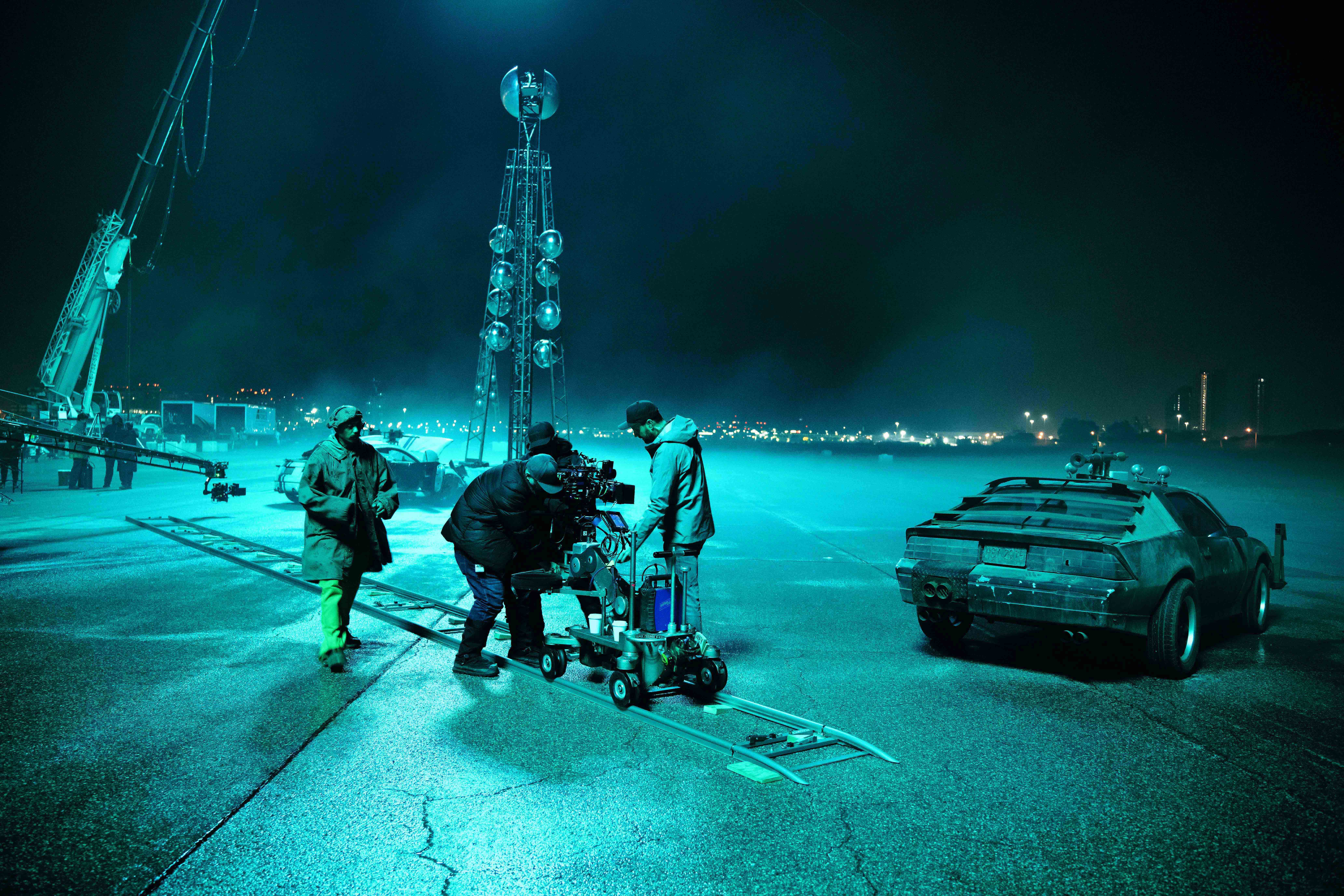
The camera team (L-R) Grip Roman Magdangal, B Cam Dolly Grip Chris Radway, B Cam Operator Scott Baker, and B Cam 1st AC Sean Bally, adjust a dolly on the set of "Twisted Metal" season two. Image courtesy of Spencer Combs.
On the note of those colored bombs, there's so many interesting visual flourishes that come in through some of these action sequences. I was wondering if you had a particular set-piece or moment that really stands out to you as one of your favorites from the season.
For me, the biggest sequence was the Tesla coils/Watkins Storm in episode 10. When I read the script, I knew what a Watkins Storm was from the first season, which is a lightning storm, full of colored lightning, which is unique to the world of Twisted Metal. Well, now we're having a race in a void, with a Watkins storm going on, with lightning hitting Tesla coils. So, I read that and was like, “What the f***? How are we going to pull this off?”
Huge Tesla coils, racing cars, giant stunts and explosions, massive interaction. David Breeze, the gaffer and I, came up with various ideas on how to make this happen, as well as with Josh, the visual effects coordinator. That was the biggest set piece, and the biggest part of the show at that point in production. We decided on two 200 foot construction cranes with two 50 by 40 truss boxes, each with 20 vortexes, two 40k lightning strikes, and four S360’s.
We wanted to create this wave of color, as well as lightning effects to represent the lightning that hits the Tesla coils. It was very big, and allowed a good ¼-½ mile of shootable space in that environment. It took about five nights of work to get it all done. And then we had to be able to replicate that on stage for our in-car work.
It worked really well and that was another huge collaboration. Another testament to our producer, Marc, who pulled the trigger on it and decided to let us go for it. We had more budget friendly approaches that would not have been as good and would have limited the scope of what we were able to shoot. Marc found a way to make it happen. That was the biggest hurdle for me, and one of the most successful.
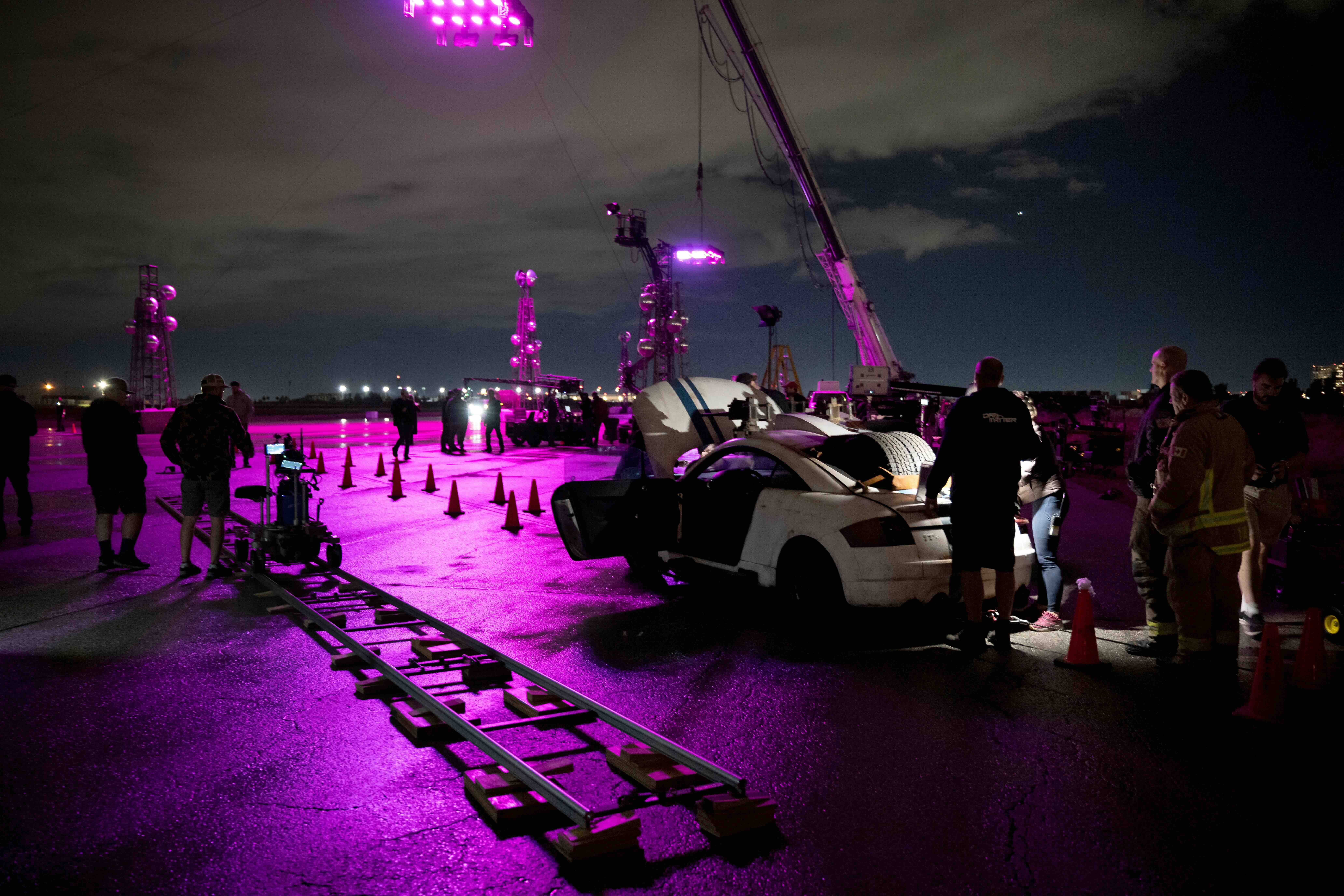
The camera team readies for another take of an action sequence on the set of "Twisted Metal" season two. Image courtesy of Spencer Combs.
It felt like each character in that sequence had their own color palette.
We were trying to do that. I think part of it was dumb luck, but we were definitely trying to create a sort of both cohesive and definitive look for characters.
Walk me through the process of creating the look of the flashbacks. Many of them are at night, but overall there’s a dark feel to those sequences. Was there any specific approach to lensing or filtration for the flashbacks?
Because of the way it laid out, Fraser shot most of the stuff originally that I was then flashing back to. He shot it in his style, how he wanted it to look. Some of the flashbacks are unique to each of our episodes and we gave them our own unique look. For several, we shot them fairly “normal” rather than getting too locked in, and then I relied on some techniques I use in coloring that we can augment. Some directors/showrunners bump against giving flashbacks a different look but I like to differentiate them a little bit, even if very subtly. So, I relied on doing it in coloring — Charles Bunnag at Light Iron, our colorist, did a great job and had some amazing ideas.
How involved in the post process were you?
I was able to color all my episodes. I prepped by choosing a few LUTs that fit my idea of the look I wanted, that simplifies the process a bit with a good starting point.
Some episodes needed more work than others. Episode 10, the Tesla-Watkins Storm was a lot of work. I come from a still photography background, which is where I started out when I was young. I like to shoot in camera, the way I want things to look, other than flashback moments and specialized sequences. Hopefully we have a decent look going into coloring, so it's just a matter of sweetening things, tweaking the minor details. So, I was very involved in the coloring process throughout, and it had various iterations or emphasis. Some episodes were smooth sailing and simple, and then others were more work.
I thought the looks Fraser and I created came together well. My first two episodes were day, and then he jumped right into night shoots as this story progressed. So there was a fluidity to it, where, as we progressed through the season, the show started to mesh. I think it's very cohesive and it looks good.
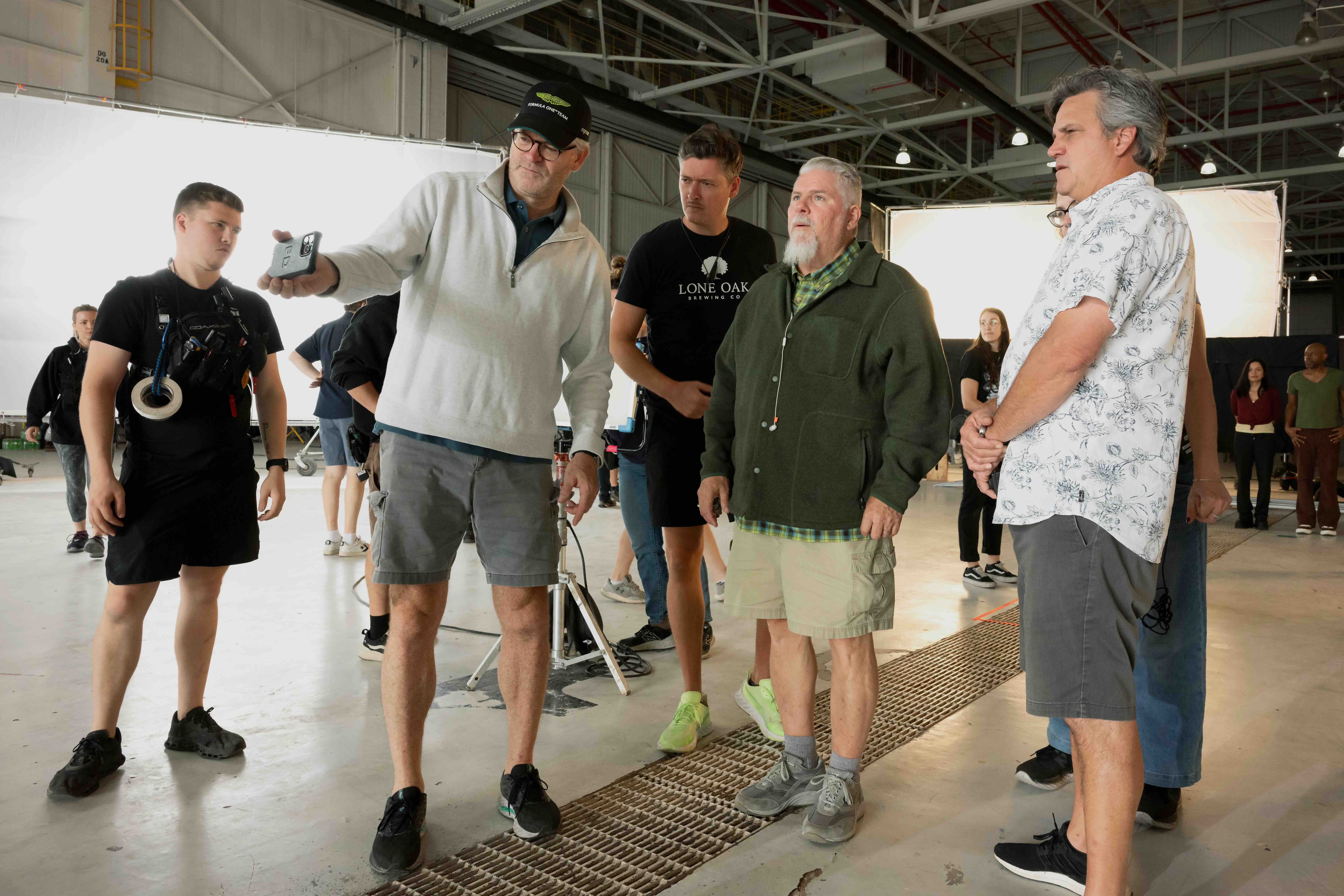
(L-R) Camera Trainee Jesse Hammond, A Cam Op Francois Daignault, A Cam 1st AC Andrew Stretch, Director Phil Sgriccia, and DP Spencer Combs on the set of "Twisted Metal" season two. Image courtesy of Spencer Combs.
Is there anybody on the crew, in the camera department, or just in general, that you want to highlight their contributions to making the show a reality?
Working with MJ (Michael Jonathan Smith) and Grant DeKernion was an absolute highlight — they were amazing collaborators and a big part of what drew me to the show during my interview process. Marc Alpert, our producer, was a magician and another genius in making all of this happen. Chris Shaw, the UPM, was equally fantastic. And the directors, Phil Sgriccia and Bertie Ellwood, brought such clear visions while always staying open to new ideas.
The foundation really started with Carey Meyer, our production designer, and the entire art department. They were unbelievable — from the cars to the locations, everything they created elevated the shoot. When you’re surrounded by such strong environments, the work becomes easier and more inspiring.
On the camera side, the scale was extraordinary. Between first and second units we often ran seven cameras a day — not even counting four FX3s and a 3 camera array for plates. At times, we had 15 or more cameras rolling. Andrew Stretch (1st AC) and Maika Boettcher (A-cam 2nd) were absolute powerhouses in keeping gear organized and the crew organized and moving — even as plans shifted constantly. Not to mention perfect focus pulling from Stretch ALL the time. Our operators were equally essential. François Daignault, our A-camera operator, was a force of nature — with unshakable energy and creativity. Scott Baker, our main unit B-camera operator (and A-camera on second unit), became my right-hand man. He and I were both bouncing between units, and he was always reliable, positive, and collaborative. Joseph Perron stepped up as our camera coordinator and handled it all with ease. The entire camera crew was excellent.
Another rock for me was our DIT, Joshua Jinchereau. He’s both an artist and a technical genius — my go-to whenever I faced challenges.
And of course, David Breeze (gaffer) and Pete Newman (key grip) were integral in making it all run smoothly. I couldn't have done it without them. Top to bottom it was a great crew.
Keslow Camera’s support was crucial. The last-minute asks, the specialty gear — periscopes, swing-and-tilts, “more cameras, more lenses” — they delivered it all seamlessly. Jim Teevan and Matt Scott at Keslow Toronto made sure everything worked flawlessly. It was truly impressive.
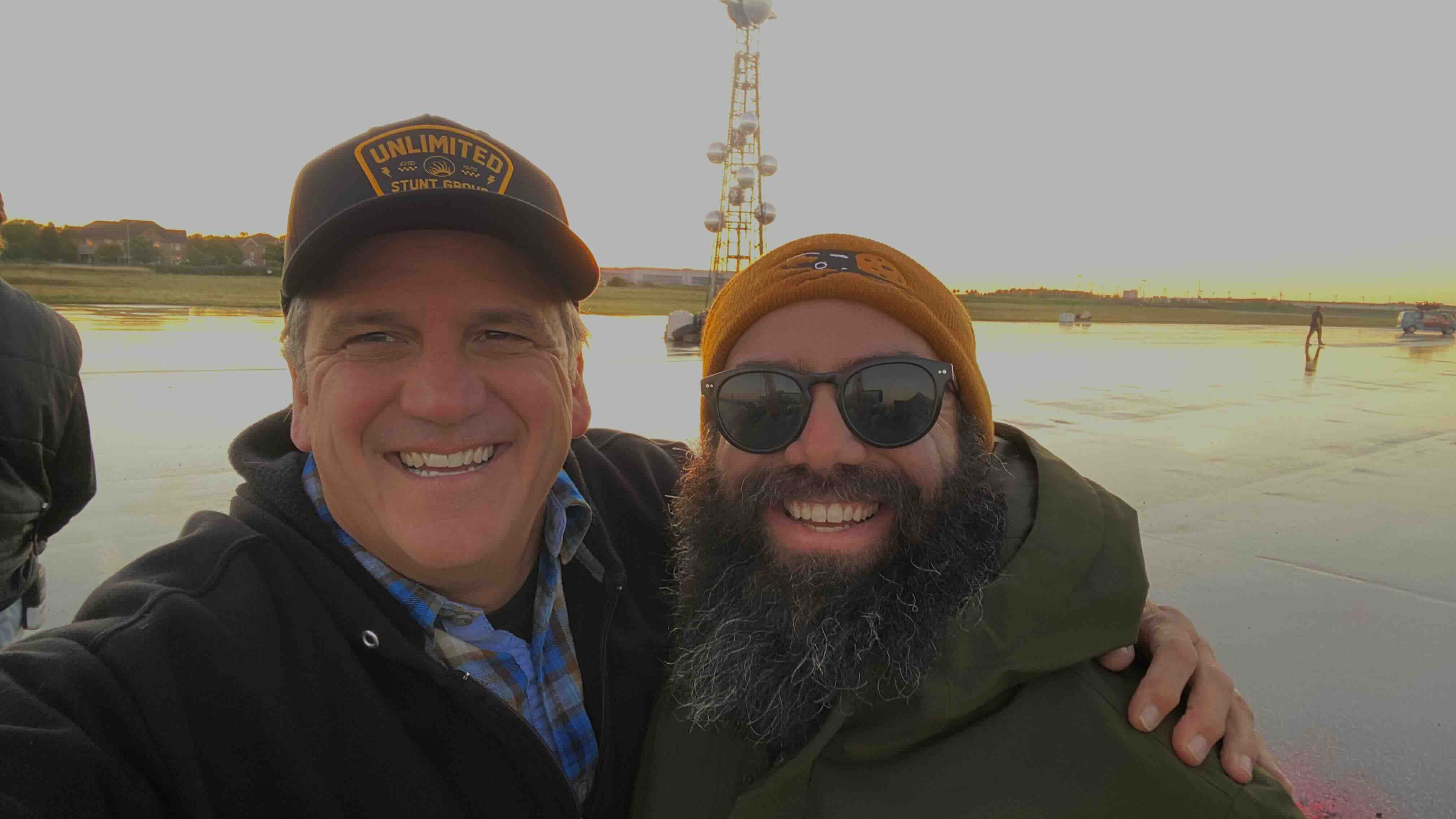
DP Spencer Combs and Showrunner/Creator Michael Jonathan Smith on the set of "Twisted Metal" season two. Image courtesy of Spencer Combs.
So much of what you've been touching on is the collaboration and how efficient and productive everybody was working together. Are there any communication tips or insight into collaboration that you could impart onto a rising DP?
I came up through operating, where you’re sometimes caught in the middle between a DP and a Director — and sometimes their visions don’t align. So being able to bridge the gap is a useful skill and making friends and building trust with people isn’t just helpful, it’s essential. Whenever I start a new project, that’s one of the first things I focus on.
Relationships really drive the work. Ingratiating yourself with people, earning their trust, and showing that you’re open to collaboration sets the tone. Ideally, you find yourself on a project like this one, where everyone is pushing to create something special. Over time, I learned that listening, staying open, and making it a true group effort leads to far better results.
That doesn’t mean you abandon your own voice, you don’t need to compromise completely. But it does mean recognizing that everyone brings unique strengths, and ideas, and we’re all working toward the same goal.
If you’re pursuing this path, you probably already enjoy working with a team. For me, that’s what makes filmmaking so special. At its core, it’s about collaboration — the merging of different talents, perspectives, and ideas into something bigger than any one person could achieve alone. [x]