

The Cinematography of "She Dances" with DP David Morrison
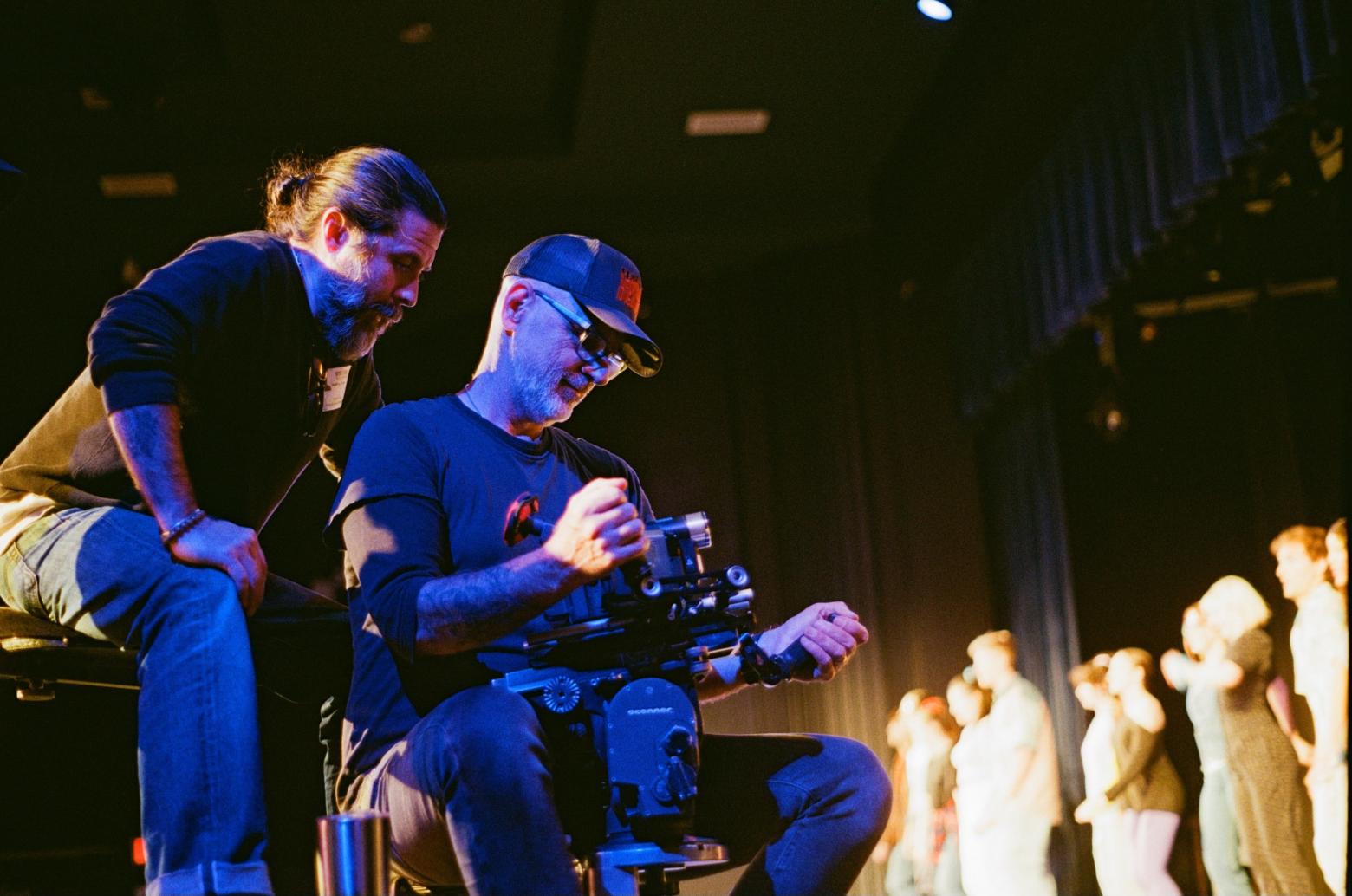
(L-R) Director Rick Gomez and DP David Morrison line up a shot on the set of SHE DANCES. Image courtesy of Geoff Storts/Macaroni Art Productions.
When cinematographer David Morrison first read the script for director Rick Gomez's debut feature, SHE DANCES — a quietly devastating story about a father, his dancer daughter, and the grief binding them together — he didn't reach for the phone. "When I stop crying, I will talk to you," he told Gomez. "Can I have an hour?" It was all the answer the director needed.
The resulting film is a technical and emotional achievement that belies its modest budget: a work of split-screen choreography, Super VHS nostalgia, and FPV drone poetry that transforms a regional family drama into something formally adventurous. Shot in Lexington, Kentucky, on the Sony Venice with Leica Summilux-C lenses through Keslow Camera, the picture finds Morrison operating his own camera for the first time after years as a television DP — and rediscovering, in the process, exactly why he fell in love with the craft.
The film opens on home video: grainy, four-by-three, suffused with the particular warmth of footage that was never meant to be art. It's real material — footage Steve Zahn, who stars and co-wrote the screenplay, shot with his family by their pool — and it immediately establishes the visual grammar of the film's flashback sequences.
"Flashbacks for us now were shot in Super VHS or Hi8," Morrison says. "You think back to Oliver Stone's JFK — we can invent them with black and white and flash frames — but for us, memory looks like Super VHS, I like the way the colors flatten and pixelate a little, and everything's softer. There's a certain hopefulness to it."
Rather than treating Super VHS as a found-footage shorthand, Morrison approached it with the same rigor he'd apply to any format. “We found Super VHS cameras, tested them, even put them on a Fisher 10 on fully lit sets, and I would do the automatic zoom and embrace all the idiosyncratic movements. We very much treated it like a real camera." The result is flashback material that feels genuinely remembered rather than cinematically reconstructed — a distinction that proves central to the film's emotional logic.
Morrison draws a cultural parallel to the cyclical rehabilitation of technological aesthetics. “It’s like synths in ’80s pop. When grunge came along in the early ’90s, people couldn’t stand that sound anymore. But now it’s come full circle — if you use those synth textures today, it feels bold again. Super VHS has gone through the same cycle. The four-by-three image has a kind of nostalgia to it now.”
That nostalgia is wielded with intention: one of the film's most visually striking gestures is the transformation of the home video image from a letterboxed square in the opening to a full-frame presence at the end, with the daughter's silhouette dominating it. "There are a lot of transformations and evolutions," Morrison notes. ""We always like it when technology, sound, production design, and wardrobe all echo the themes in their own ways; it becomes another expression of dance.”
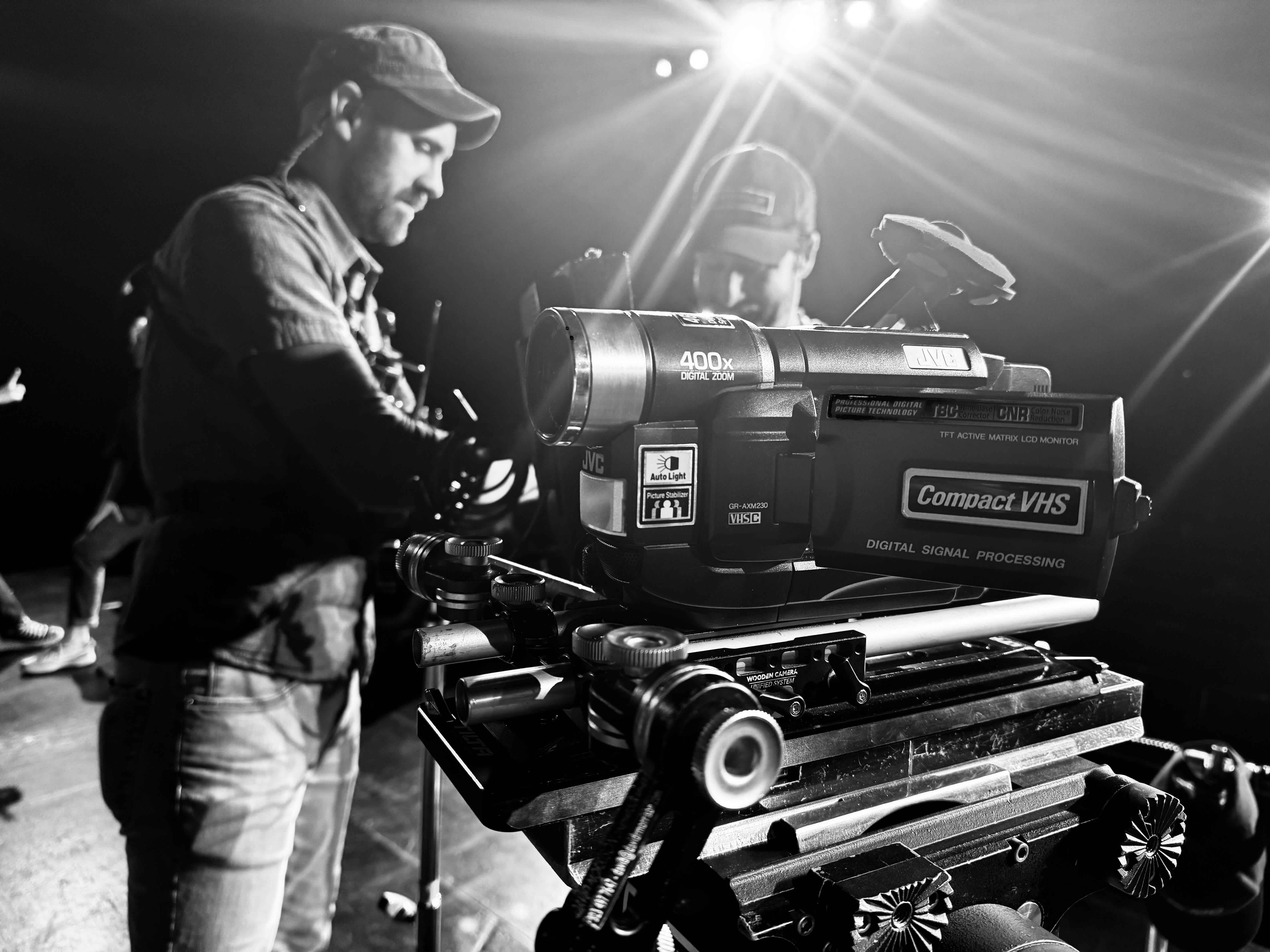
Colin Garcia and Geoff Storts prep a Super VHS camera for the next take on the set of SHE DANCES. Image courtesy of David Morrison/Macaroni Art Productions.
The Grammar of the Split Screen
Among the film's most discussed formal elements is its extensive use of split screens — not as a retro affectation but as a structural and emotional language. Morrison's preparation for these sequences was meticulous. "We went through the script and identified four different kinds of split screens," he explains. "There were existing splits, like the opening sequence with the separated family. There was the split screen of the two friends on a FaceTime call. There were pan-motivated splits, like in the flashbacks. And then there were object-motivated splits."
Each type demanded its own logic for entry and exit. "How do you get into those in a seamless way and get back out? Prep was really spent on my FX6 figuring out the math." Morrison arrived a full week early — before the actors were on set — to work out a shorthand with Gomez that he could then execute intuitively on the day. "Rick, being an actor, said about the character-motivated splits: 'No, we've got to make it funnier.' Those split screens needed an assertive quality, like a punch line. They had a certain rhythm."
For the Summilux-C glass, the precision of the format was non-negotiable. "For split screens, if you're only using a third or half the frame, I don't want any aberrations throwing it off. I want it as clean as possible." Morrison's preferred working aperture — "my sweet spot on any lens is two-and-a-half stops down from wide open" — meant the T1.4 Summilux primes could be worked at T2.8, retaining sharpness and fall-off without sacrificing the image quality that split-screen compositing demands.
Some of the most striking split-screen moments, Morrison admits, were not entirely planned. The sequence in which father and daughter drive in parallel, their rearview mirrors lining up perfectly at the center of the divided frame, was a happy accident on set. "We looked much smarter than we were," he laughs. "I tapped Rick and said, 'Look — the rearview mirrors are lining up.' When you lay the groundwork for these things, happy accidents come and grace your shoot." Production designer Jen McLaren, he notes, contributed similarly serendipitous gifts throughout the shoot.
The most technically demanding split-screen sequence — the FaceTime call between Claire and Kat — required two camera crews positioned roughly 300 yards apart in the rural Kentucky hills, with unreliable Wi-Fi and only Gomez able to monitor both feeds simultaneously. "He wanted to see their phones on screen at certain times," Morrison recalls. "He just wrote it out: 'I want to be here on this, here on this.' It's like two band members learning music — you rehearse the scene, they're just beats, and you know your beats." Shooting the sequence took approximately seven takes. “We shot the scene, Rick and editor Coby Toland went off to cut it together, while the crew took an hour break. On an independent film that’s unusual — every hour is precious — but when they came back, we all gathered to watch the rough cut of something we had just created together. It was beautifully executed, and the moment brought the crew closer. You could feel that we were making something magical.”
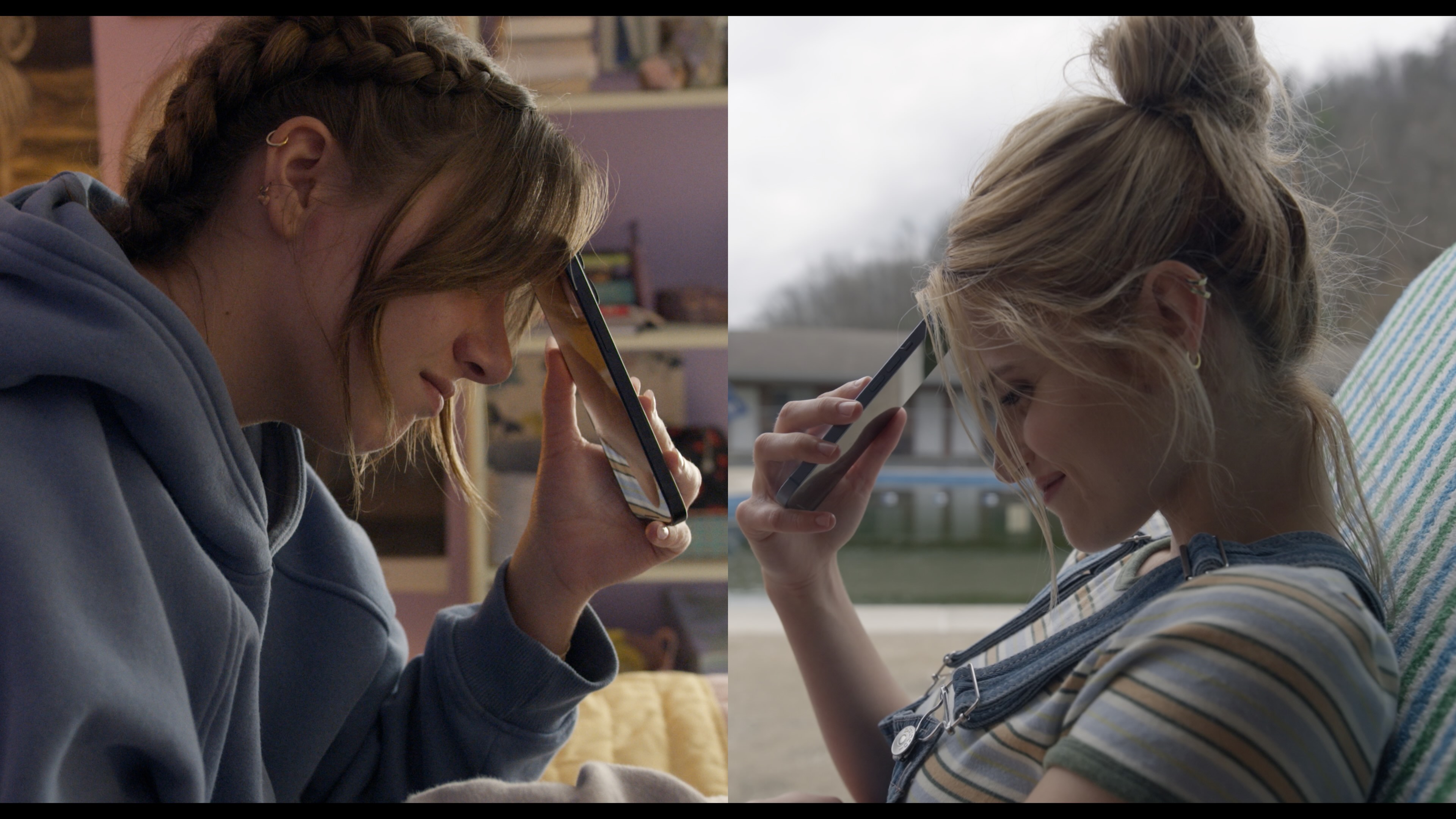
(L-R) Mackenzie Ziegler and Audrey Zahn in SHE DANCES. Image courtesy of Macaroni Art Productions.
Looking back at the sequence, Morrison credits Gomez for deeply embedding the characters’ emotional arc in the blocking and framing. “At the end of the scene, when the two friends make their forehead promise, if you step back and look at the whole frame, it forms the shape of a heart — almost like a heart emoji. Rick has a rare instinct for understanding not only the two stories unfolding in each half of the frame, but the larger emotional truth created by the image as a whole.”
The One-Er as Narrative Tool
The film's extended one-take sequences presented a different category of challenge. A pivotal sequence follows the lead character as he searches frantically through the back rooms of a hotel — through service corridors, a rehearsal space, a ballroom — in a move that required days of choreographic preparation and the coordination of the production's largest extras day.
Morrison and Gomez studied their reference material carefully. "We looked at Birdman and saw where they cut and how they go upstairs — what you can do. And we watched Gaspar Noé's Vortex and figured out: what does a one-er actually mean, where can you hide cuts, and what are your limitations?" Once they'd walked the space, shot stills, and understood the path, they could bring the crew in with a clear vision. "The AD, Elaine Gibson — it will not be the last time I mention her name — was critical. It took a couple hours to set up, but we nailed it on the fourth take."
For Morrison, the key to the sequence's success was identifying its pivot point. "The opening to the one-er was the hardest part. Once I knew I got through that and could nail the comedic pans, I felt free. Remembering all those moves — 'You're going to take four steps here, pan left, pan right, move in' — it was like memorizing Shakespeare as a senior in high school."
Ultimately, the version in the film incorporates cuts. "Rick was always asking himself: 'Am I showing off for technique's sake, or does this actually advance the story?'" Morrison reflects. "We have a much more muscular cut with the one-ers fully intact, but we felt it pulled away from something. It's so tempting — all the tools. One-ers have become a popular way to flex that muscle and show off. But do they add? Does it propel? You're always checking."
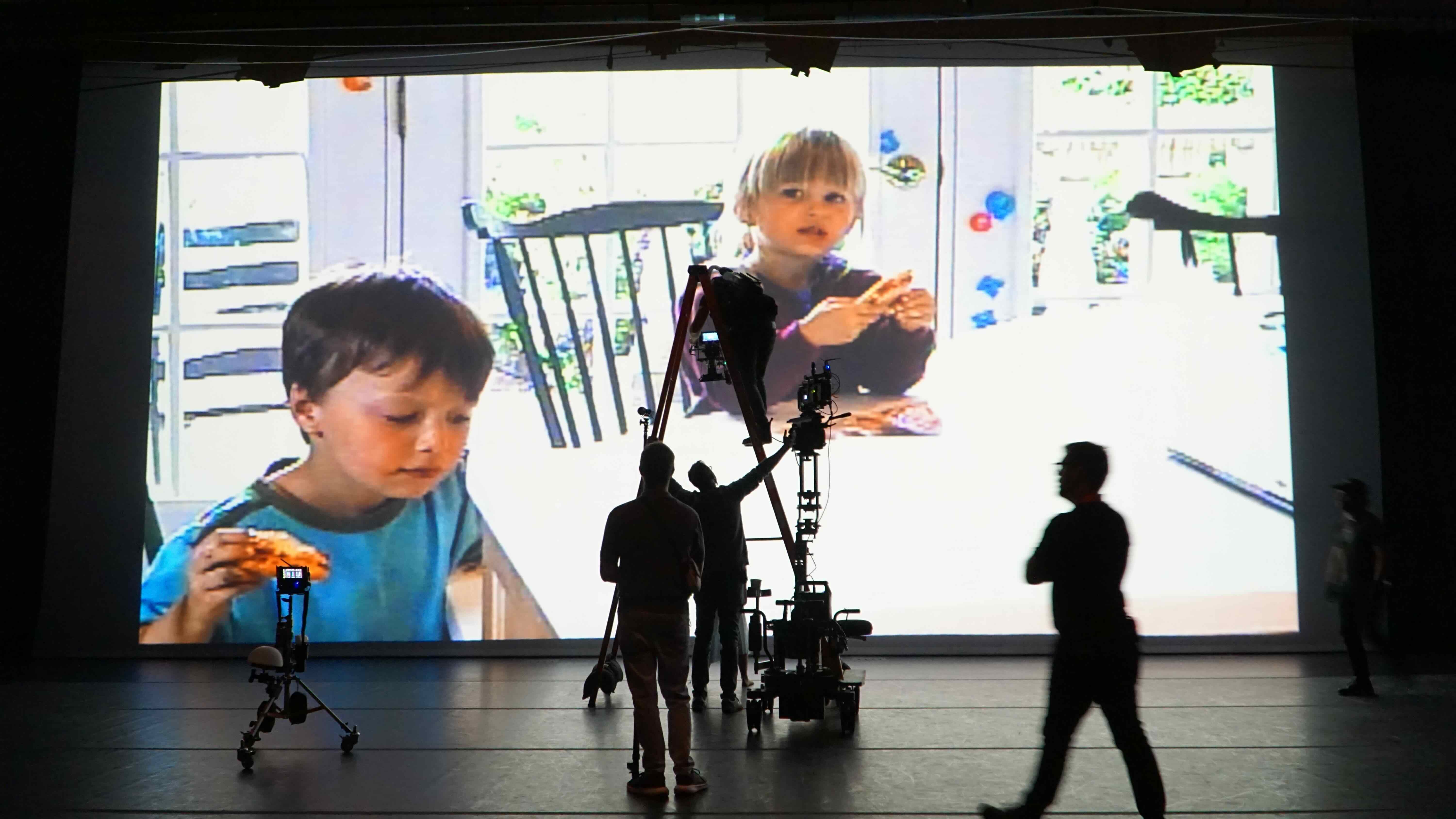
The crew preps the home video backdrop for the finale of SHE DANCES. Image courtesy of Joe Matarrese/Macaroni Art Productions.
Finding Dance from the Air
The film's dance sequences — expressive, cathartic, and formally unlike most treatments of dance on screen — represent perhaps Morrison's most unexpected innovation. For decades, Morrison notes, the cinematographic language for dance has remained essentially unchanged. "There's the low wide — two feet off the ground, proscenium angle — and then you have a medium and you follow as they move." Dancer body rigs exist, but constrain movement. Something was missing.
"I'd always felt dancers are tracing invisible lines when they move," Morrison says. “If you could see the paths dancers trace through space — like a light painting. Picasso did these photographs where he drew in the air with a flashlight, and the camera captured the lines. Dancers are doing the same thing with their hands and feet. The question became: how do you show those invisible lines?”
The answer came from an unexpected direction. Producer Ginny Gomez, Rick's wife and producing partner, suggested bringing in Morrison's son Finley — an experienced FPV drone pilot — to try something new. "I'd done FPV stuff for The Walking Dead, but I'd never thought of applying it to dance."
Father and son share what Morrison describes as a lifetime shorthand, built on years of visiting locations together and studying how the lines of a space converge. “When we were in Rome at the Pantheon, we’d stand in certain places and say, ‘Look — it’s the sweet spot of this building.’ We were always looking for those moments where the geometry of a space comes together. When Finley first started flying drones, I used to tell him: You’re rarely going to have 45 seconds for a move.. How do you make something compelling in two or three seconds? You have to think in moments — quick lines, like those Picasso light drawings — gestures that connect directly to the dancer’s movement.”
Morrison and Gomez kept the direction to Finley intentionally loose: fly as close to Audrey as possible, find those invisible lines, do what a crane or handheld camera cannot. The results exceeded expectations. "The first take, Audrey was doing her dance, and he did this quick pass by with the back pan — suddenly you feel this energy." Zahn, watching from the set as both producer and father, began to cry. "He said, 'Oh my God, I've never seen dance covered like this.'"
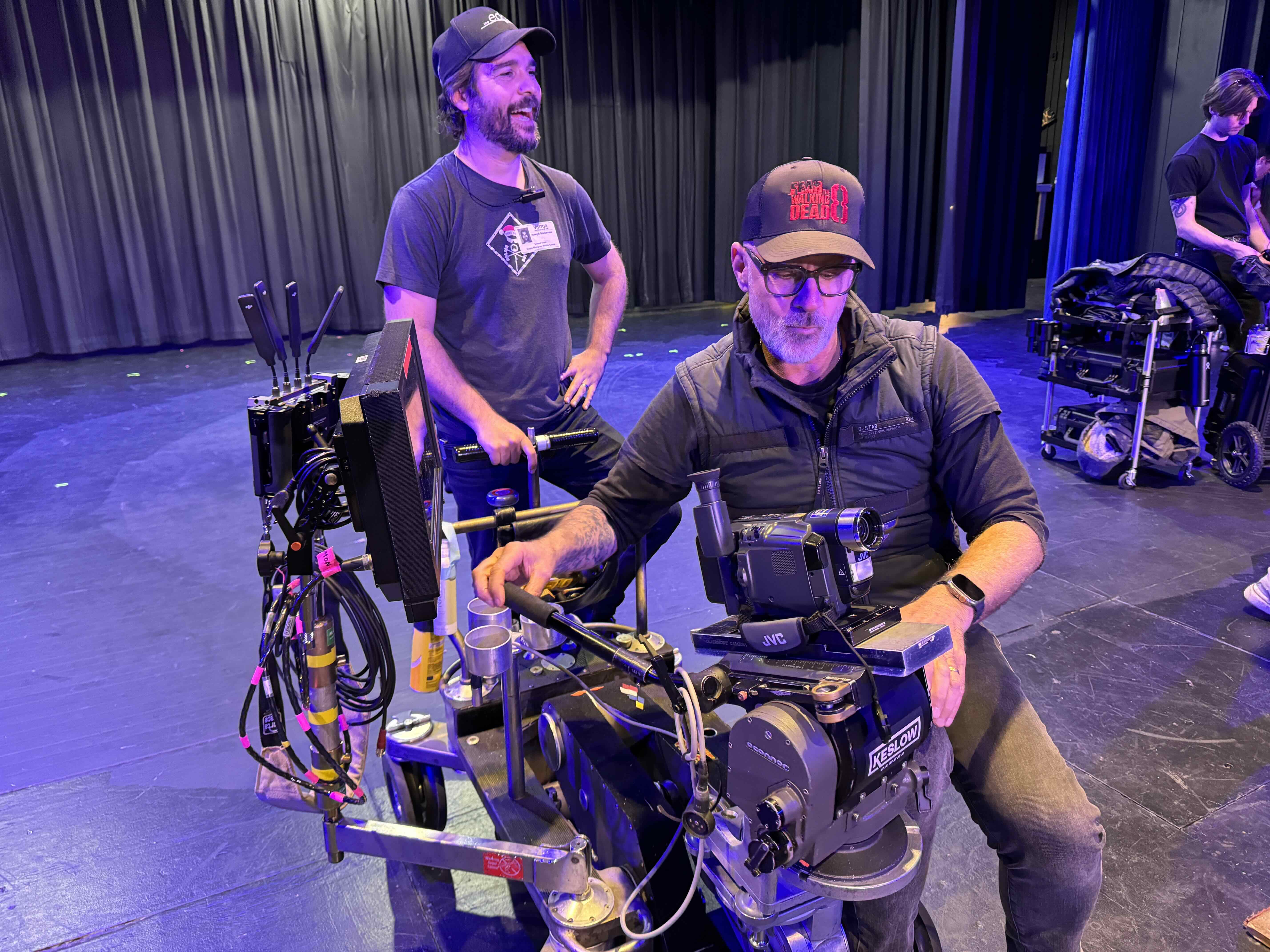
DP David Morrison mans the camera on the set of SHE DANCES. Image courtesy of David Morrison/Macaroni Art Productions.
In the final cut, the drone footage appears only three times — briefly, almost subliminally. "You don't know what it is. You just feel this breathlessness. She's expressing her grief for the first time through dance, giving her dad a place to put it." At the sequence's conclusion, the camera rests on Audrey's back as she breathes, the sound of her exhale filling the theater. "We, as an audience, are in that because of those drone shots. There's a release that happens, and you earn the breath."
Morrison notes that at the time of production, FPV footage of dance was essentially nonexistent online. "I can't wait to explore that more."
The Restraint of Light
Working with a director whose instinct is away from visible cinematography presented Morrison with one of the most philosophically interesting challenges of his career. "Rick doesn't like lighting at all. He wants the performances to feel real and grounded." In several key scenes — including Ethan Hawke's scenes in the distillery office, shot under practical overhead fixtures twenty feet in the air that the crew had no time to address — Morrison had to resist every professional instinct.
"Rick and I would go on these long walks, and I said to him, 'My job as a DP is to improve things. I feel like I'm failing you as a collaborator if I don't fix this.' He stopped, put his hands on me and said, 'No — you're giving me freedom.'" The lesson was hard-won. "I did less on this film than I've ever done. I had to accept situations I couldn't fix — like the end of the movie where Steve and his daughter have their moment — and just embrace it."
The validation, when it came, was pointed. Ethan Hawke, watching the work on set, later mentioned to Rick Gomez and Steve Zahn how beautiful it was, noting how much freedom Morrison was giving the director. “He said something like, ‘David’s giving you so much freedom,’” Morrison recalls. “And Richard Linklater is always trying to get his DP just to give him stuff.”
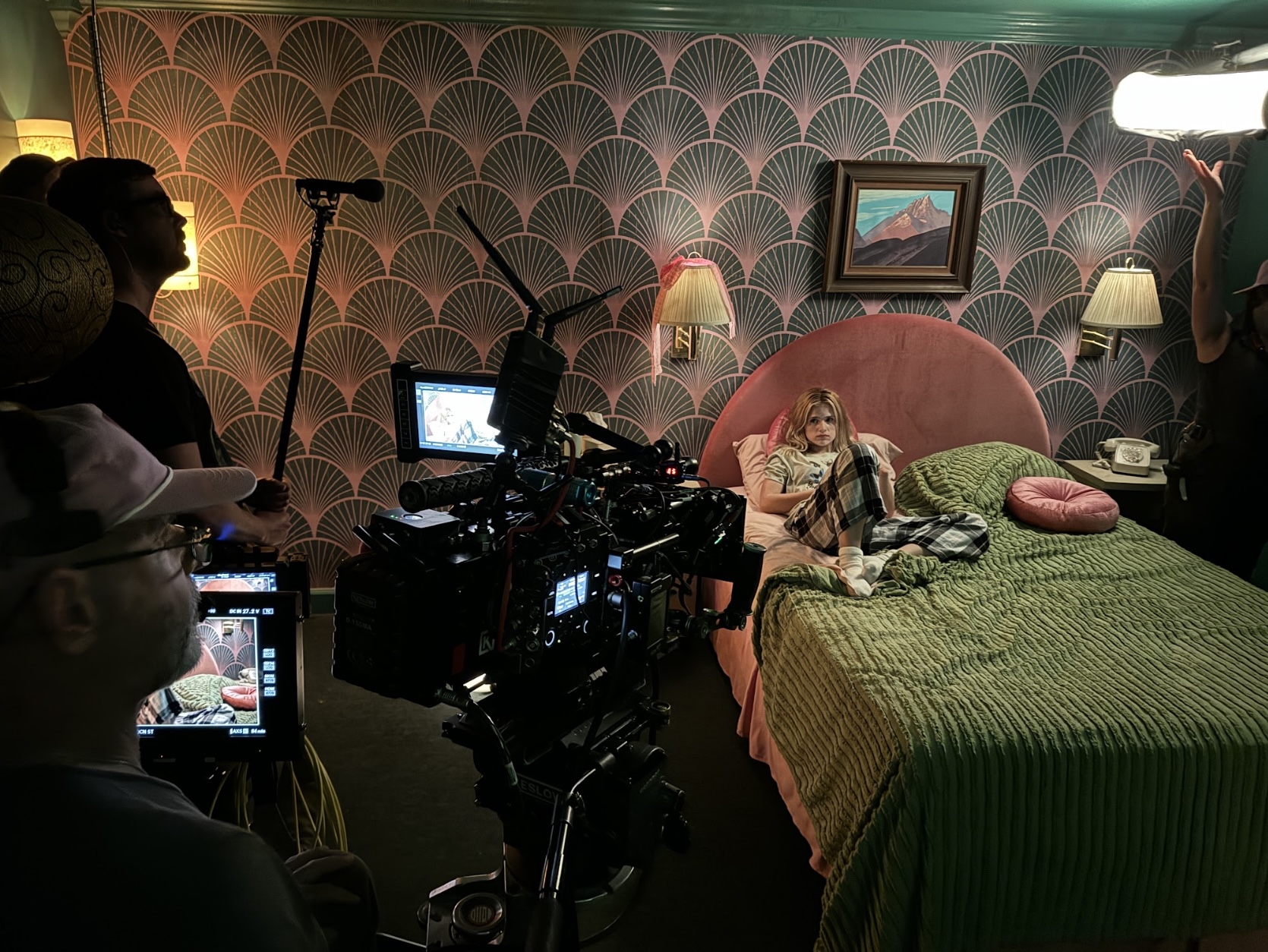
Audrey Zahn waits for the next take on the set of SHE DANCES. Image courtesy of Steve Zahn/Macaroni Art Productions.
Morrison finds himself in a moment of personal recalibration on this front. “In some ways, DPs have too much control now. Everything today can look incredible. The lighting, the lenses, the color — the craft is at an extraordinary level. But sometimes all that beauty isn’t actually connected to what’s happening in the story. I’m less interested in cinematography that calls attention to itself. The work that moves me is when the visual language and the performance are completely integrated — when the cinematography is serving the moment rather than defining it. It might sound sacrilegious coming from a DP, but these days I’m really striving for that balance.”
The exceptions — the moments where stylization is permitted to surface — are carefully earned. The motel room sequence, with its 1970s-dressed set and time-lapse passage of time, is openly acknowledged as the film's one moment of overt visual indulgence. "It's the one part of the movie that says, 'Okay, this is an independent film — we can stretch a little,'" Morrison says. The influence of Wong Kar-wai is deliberate, and he remains ambivalent about the choice.
For the dance sequences' cooler, saturated blue palette — and for the colored light bleeding through the motel windows in shades of pink against green wallpaper — Morrison looked to cross-backlight as a foundation. "Nothing is better than cross-backlight for dance," he says, citing Vittorio Storaro as a touchstone. B-camera operator Ashley Hughes, a former dancer herself, was positioned to maximize flare and backlight throughout. "There's a certain explosiveness to it."
The High-ISO Approach
The Sony Venice's sensitivity profile was central to Morrison's strategy for navigating the production's limited resources. "I love the Venice for that reason. I could light a whole room and let actors and operators move without relighting. You're still telling the story, but you can light a space." Night exteriors on Fear the Walking Dead had given him a framework: "I did all my night exteriors at 6400 ISO with ARRIMAXs at 2%. You still want the spread and distance, but there's so much freedom."
Crucially, Morrison declines to treat high ISO as an excuse to abandon control of exposure. "When I shoot 6400 ISO indoors, I still put an ND.6 — sometimes a .9 — behind the lens. I want the gaffer to work to give me light so I can choose my stop. It's light in the bank. If a director wants to go to 48 frames, just pull an ND — you're already lit."
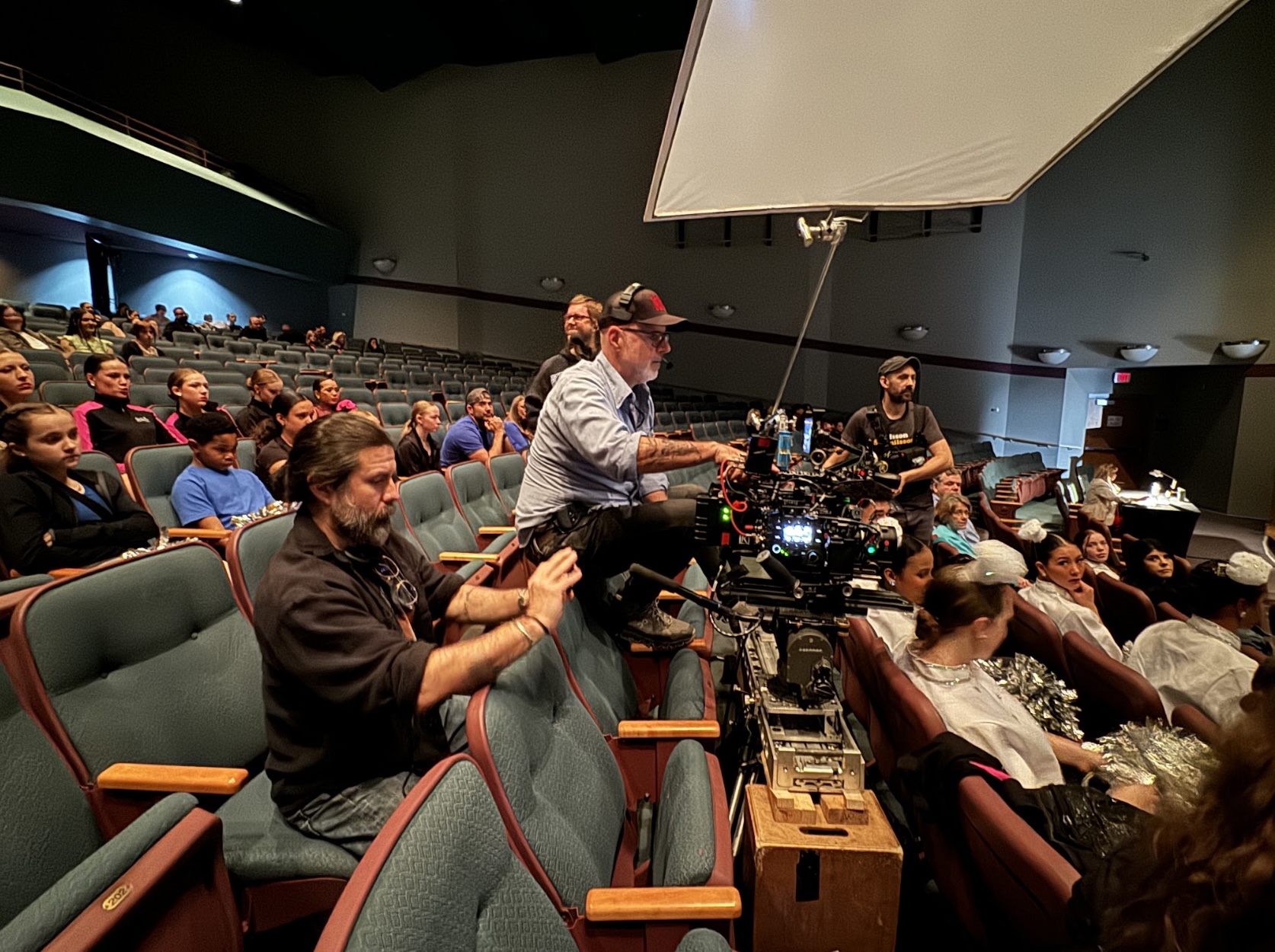
(L-R) Director Rick Gomez, DP David Morrison, and crew on the set of SHE DANCES. Image courtesy of Steve Zahn/Macaroni Art Productions.
The Venice's grain structure at high ISOs, he adds, is a significant part of its appeal. "The Venice 2 is even better. The grain structure at 3200 is amazing." This aesthetic quality — grain with integrity, rather than the electronic mush of a fast lens shot wide open — connects to Morrison's broader dissatisfaction with the prevailing look of contemporary production. "I was watching Tony Scott's Man on Fire recently and I missed HMIs coming through windows. I miss lighting. It's a craft we're losing because there's no time, no budget, and people think fast sensors mean you don't need to light. I understand that can service a story. But it can also just be lazy."
Composition and the Directors Who Teach It
Morrison's still-photography sensibility — he cites William Eggleston and Edward Hopper as persistent influences — surfaces throughout the film in frames-within-frames, spatial divisions, and the deliberate withholding of establishing shots. "I love separating people and their realities. Sometimes movies go too far and look like coffee table books. I like nods to it, but I don't want to live in that world — it can create too much distance from the characters."
Several of the film's most quietly powerful compositions were generated in collaboration with Gomez or emerged on the last day of production. The final shot of the second act — in which the lead character enters Ballroom C through a seamless split-screen divide — was conceived on the final setup of the final day, after the crew had already wrapped a different scene. "Rick started describing it," Morrison recalls. "'He's entering a portal. He's leaving behind the Jason who didn't deal with grief. He's going to enter this and exit a new person.' We all got out tape measures, scratching our heads. Usually people are moody as hell on the last shot of the last day and just want to get out of there. But everyone rallied."
Morrison traces the technical logic of the film's split-screen transitions to an earlier moment in his career — a music video he shot for Beck's "Girl," in which motion control moves folded the edges of the frame like the pages of Mad Magazine, revealing a new image. "I was obsessed with blending motion control with handheld seamlessly, so it didn't feel like the subject was stepping into a Stargate. When I read this script, I thought: we've got to go into these splits and somehow move back. It's all about the transitions." He showed Gomez the Beck video during prep. "He said, 'Oh yeah, that's exactly it. I remember that video.' It was really cool to use that past experience — not to copy the style, but the technique helped us find our approach."
The Camera Department
Morrison reserves particular praise for the collaborators who helped execute Gomez's vision on the ground. First AC Geoff Storz, a Kentucky-based focus puller, impressed Morrison not only technically but emotionally. “In the scene where Audrey is sitting on the bed with Steve, we were on a tight 65mm profile shot. Geoff suggested the rack focus from Steve to Audrey, and the timing of when it lands adds a layer of empathy to the moment. He was constantly aware of the emotional core of each scene and how we could shape it. He was a real scene partner.”
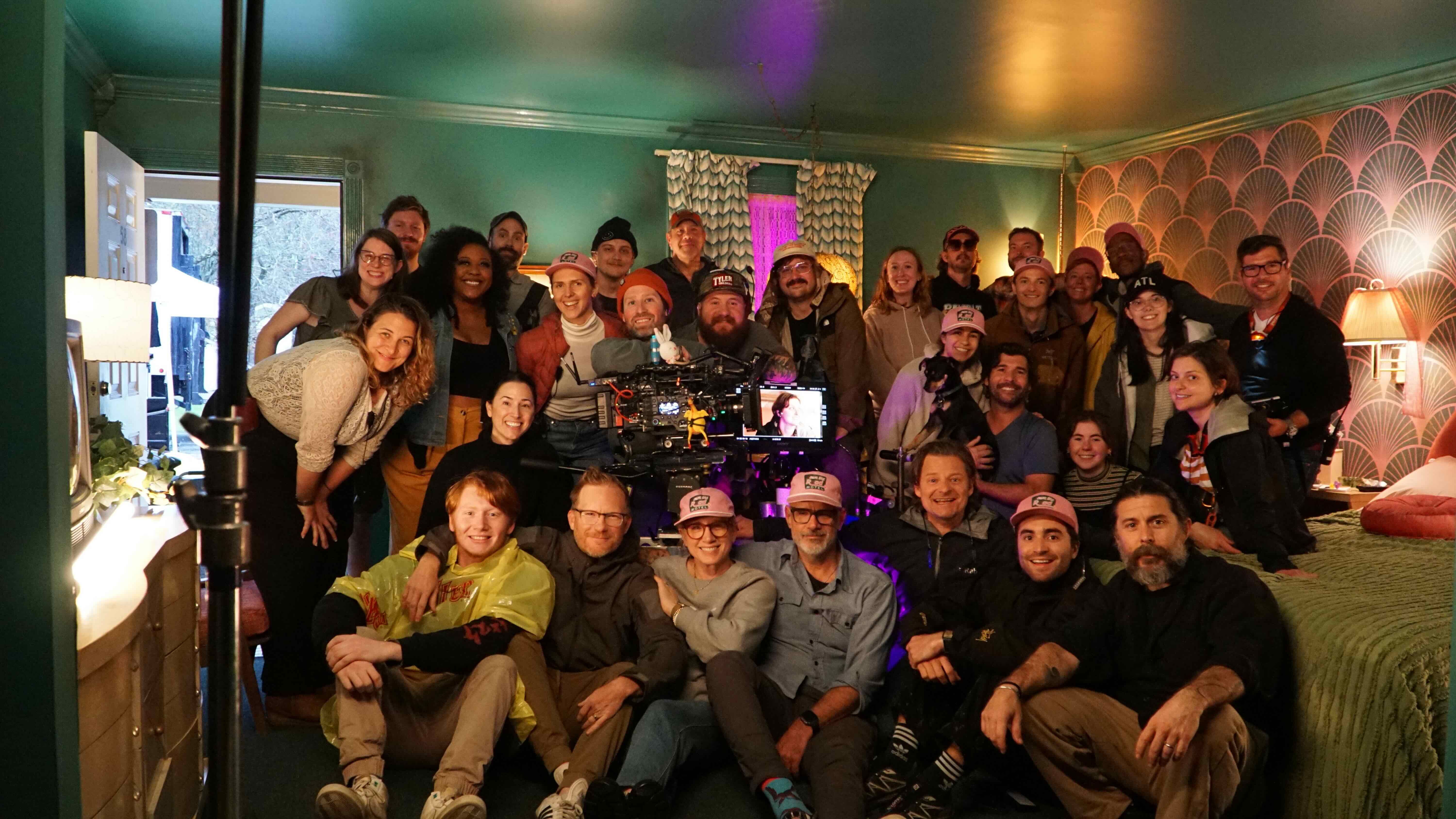
The cast and crew pose on the set of SHE DANCES. Image courtesy of Joe Matarrese/Macaroni Art Productions.
Key grip Joe Matarrese, himself a filmmaker and director, contributed one of Morrison's favorite moments of collaborative instinct on the project. During the climactic scene in Ballroom C, Morrison and the crew had no predetermined way out of the shot. “We just dove into it,” he says. “When we thought the scene was over, we were all a little lost in the performance. I was certainly overwhelmed.” Then he felt Joe’s hands tighten on the dolly. “I could feel his hands on the dolly and I knew he was about to move. He just started pulling the camera back.” Morrison’s tilt-up lands a beat later than planned, but the instinctive moment became the shot. “If you were rating the move, it wouldn’t be a 10, maybe a 9.7,” he laughs. “But Joe felt exactly when we needed to move. He made me better.”
B-camera operator Ashley Hughes, whose background as a dancer informed her instinct for movement and backlight, was essential to the texture of the dance sequences. The production operated non-union — a decision Morrison reflects on with some weight, given that the project was shot during the industry strike. "I had operator friends who really needed to work. But I had to operate this film because Rick's vision was so specific, and he talks to me in such a way that I didn't want another person in the middle having to translate."
For Morrison, operating again after years as a television DP — a role that had separated him from the eyepiece — was both challenging and revelatory. "I finally learned to drive the ship with my words. Then to get back on camera — I loved it. I thought, 'I never want to not operate again.'"
On Collaboration and the Long Game
Morrison's approach to the director relationship is built on questions rather than assertions. "I've never been a DP who comes in with 'a vision.' I have taste — things I like to see. But there are a million questions before I show anyone anything. How dark is dark? How bright is bright? What looks lit to you?" He describes building a LUT for a recent commercial directly from a director's mood boards, matching the magenta in the skin tones to what the boards suggested. "I go to the DNA."
From that foundation of listening, Morrison says, genuine collaboration becomes possible — including the capacity to challenge a director when necessary. "If something feels off-note for me, I first challenge my own lack of understanding by asking more questions. Then I'll say, 'Can I suggest something?' If you use a passive voice and show them an alternate way of looking at it, they trust you because you've already asked a million questions. By taking that listening approach first, I've never been separated from the heart of a director."
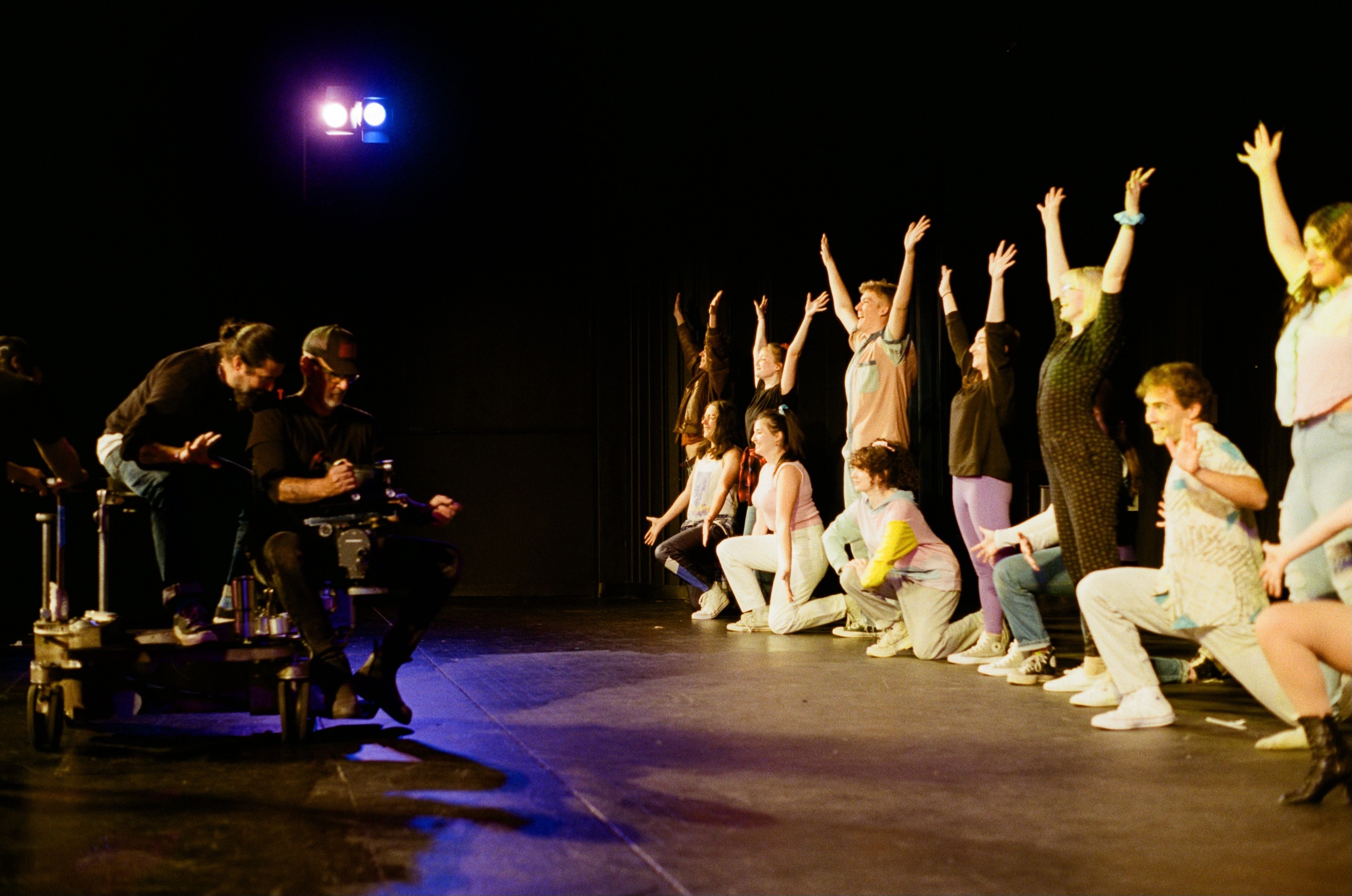
(L-R) Director Rick Gomez and DP David Morrison line up a shot on the set of SHE DANCES. Image courtesy of Geoff Storts/Macaroni Art Productions.
He has been working with commercial director Stacey Peralta for eighteen years — "two lifetimes in commercials" — and attributes that longevity to this philosophy. The same openness, he argues, should extend to the entire crew. "If there's a better solution from my first AC or my operators, I'm going to take it."
The hardest lessons, Morrison acknowledges, have been in leadership rather than craft. "Growing into a leader takes work. It's hard to be disliked in the moment. It's hard to fire your friends when it's best for the job." He has developed a personal standard for difficult personnel decisions: "Clean, compassionate, and fast." The alternative — the industry tendency to quietly drop someone from a call sheet without explanation — strikes him as both professionally and humanly corrosive. "You can't ghost people. It's a really hard business."
What he tells students at UCLA and SCAD carries a similar pragmatic honesty. "You'll be a great DP, you'll have people that love you, and you'll have gear. Working is the easy part. No one teaches you how to be unemployed. How do you stay positive when you haven't worked in two months? How do you interview without being desperate? That's the real challenge."
The Function of Art
When Morrison reflects on what the film meant to make — and what he hopes it means to watch — he moves beyond the technical. The Sasquatch that looms over the film's narrative, the TV-show-within-the-film whose voiceover was recorded by Rick Gomez's father, is understood by the entire production as a figure for avoidance, for the grief that grows in proportion to how completely it is suppressed. "When you ignore it, it just grows and grows. It works in the same way waves of grief do — you suppress something and it keeps coming back until you have to deal with it."
On the subject of Audrey Zahn's performance — at once the film's emotional center, and also a potential star-making turn — he speaks with something close to reverence. "My favorite acting is when people do nothing and know that's still interesting. Audrey just pulls that off. Her grief, her crying — the moment where she says, 'You wake up in the morning and everything's normal, and then it just comes crashing in' — that's great writing and she plays it perfectly."
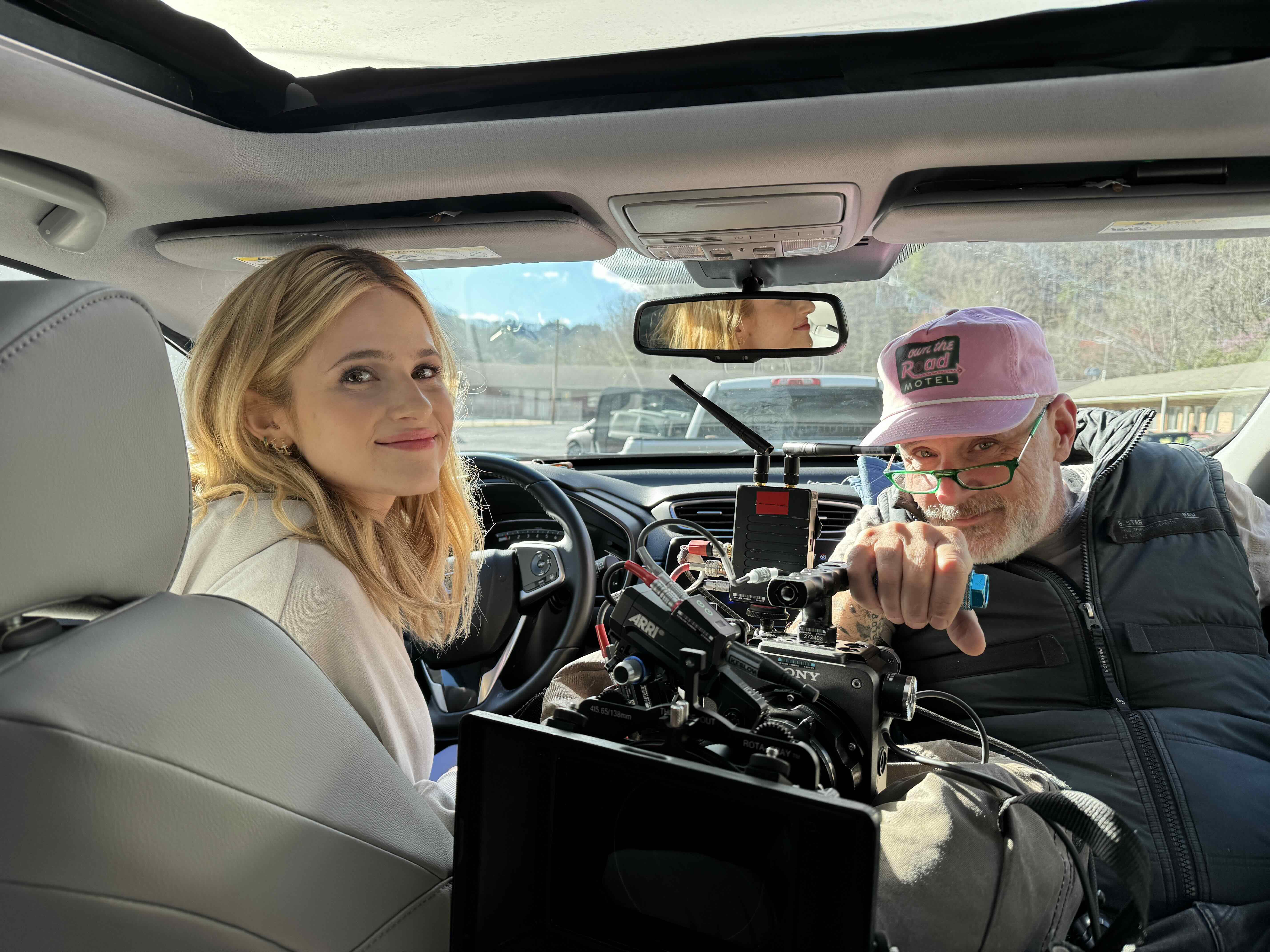
(L-R) Audrey Zahn and DP David Morrison on the set of SHE DANCES. Image courtesy of Steve Zahn/Macaroni Art Productions.
He returns, in the end, to the question of what cinema is actually for. "We can make transformative experiences as artists. We need characters to go through things that maybe we haven't had the courage or foresight to deal with in our own lives, and we take that into our lives and make them better. That's the role of good films." He pauses. "And Keslow helped me make something like that."
The film had its premiere at the Tribeca Film Festival, where Morrison was unable to attend due to a commercial commitment. His friends in the audience texted him afterward: "Oh my God, man. I had no idea." He is still waiting to experience that catharsis with an audience. By the sound of it, it's going to be worth the wait. [x]