
The Cinematography of "A Tribe Called Love" with DP Liam Higgins

DP Liam Higgins behind the scenes of "A TRIBE CALLED LOVE." Image courtesy of Mahaica Point Media.
"I'm not trying to convince you that this is a beautiful-looking film," says cinematographer Liam Higgins. "I'm trying to convince you that you're not even watching a film." Simple enough as an ambition. In practice it meant running against the grain on nearly every decision - format, focal length, aspect ratio, and the deliberate refusal of light.
A TRIBE CALLED LOVE, the feature debut of director Mohamed Ahmed, is a Romeo-and-Juliet story of unrequited love set within a Somali community in Toronto, told across two time periods: childhood in the early 2000s and adulthood in the present day. The visual grammar Higgins and Ahmed built for it - made possible in part through a long-standing partnership with Keslow Camera - starts from a counterintuitive premise: that format should track emotional truth rather than period convention, that stillness can be more radical than movement, and that the most effective lens set is sometimes the most constrained one.
Before he was a cinematographer, Higgins was a writer. He started in his early teens, wrote through high school, and eventually landed in the journalism program at St. Clair College. The program required him to photograph and film the stories he was writing for print. What started as a formal requirement became the thing that stuck: he became managing photo editor of the school paper, won photojournalism awards, and spent stretches on tour with musicians doing stills work.
The visual medium kept pulling him forward. From there, he studied film at York University, got represented as a cinematographer within a year of graduating, and built his career steadily through music videos, commercials, and narrative projects, before landing his first feature, Soft (directed by Joseph Amenta) in 2019. He read that script six or seven times before meeting Amenta. Not a performance of preparation - rather, Higgins was genuinely aligned with what the film was saying, and wanted to know it inside out before walking in the door. That project marked his arrival as a feature DP.
Wake, the short film he wrote and shot not long after, became the foundation of his partnership with Keslow Camera - one that has since run through nearly every project since that he talks about with pride.
The Five-Lens Discipline
On A Tribe Called Love, shooting with the ARRI ALEXA 35 came down to practicality. "I wanted something that was relatively a very condensed package just in terms of size so that it allowed us to be a little bit more nimble. I knew that my team was going to be quite small on this one." The in-camera textures were a bonus - a film-like quality Higgins reaches for on every project, budget permitting or not. "I always try to shoot a lot of projects on film, and when the budget doesn't really call for it, I try to create a filmic look as best as possible."
For glass, he went with a Canon K35 set, sourced by Stephanie Fagan (Vice President of Business Development, Keslow Camera Toronto.) The reasoning isn't what most cinematographers would give: he wanted fewer choices, not more. "The thing that I liked a lot about it is that you're constricted to only using five lenses, and that was something that I really wanted to focus on here." On a prior feature he'd had twelve focal lengths. The abundance bled energy - attention kept drifting toward lens decisions instead of staying in the story. Five lenses fixed that. "I could express more of a continuous thought pattern throughout the project."
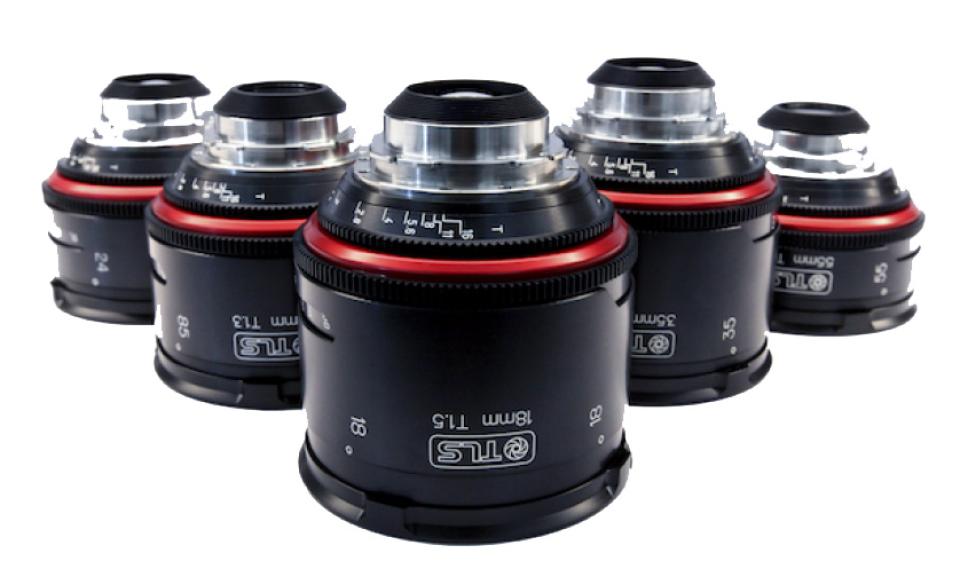
The K35s also happen to be excellent glass for this particular film. "I feel Canon K35s are particularly flattering on darker skin in the way that the highlight rolls off, and in the way that the actual lenses themselves fall off. It contributes to it feeling very painterly in close-up moments while not being too oversharpened for a digital sensor." Higgins is upfront that his recall has limits here - the film was shot more than two years before this conversation.
For the gunshot sequence in the second half, a close-up diopter on a wider lens pulled the moment into a different visual register - Higgins and Ahmed deliberately marking it as something apart from the film's standard dialogue coverage.
Keslow Camera and the Long Game
The Keslow Camera relationship goes back further than any single film. One of Higgins' earliest projects - a shoot that mattered to him personally, at a point in his career when the credits weren't there to make it an easy yes for a rental house - got turned down by most places he approached. "Keslow Camera said, 'We know you want to shoot film, we want to support you, we're here for you.'" Triton Hall (Former Lead Marketing Agent, Toronto), was on the other end of that conversation. They stayed in touch outside of work - not checking in about jobs, but just checking in. When Hall moved on, that continuity carried over to Fagan.
On A Tribe Called Love, Fagan showed up on set one day - not to troubleshoot anything, just to see how the shoot was going. "She was right outside there on set with us," Higgins says, "and it just felt as if she wanted to see what was going on and she wanted to be a part of understanding what we were doing." When he thanked her for the K35s, she was characteristically matter-of-fact - she'd found a gap in the schedule and wanted to make it work. It's the kind of thing that doesn't show up on an invoice, but makes a major impact nonetheless.
What Higgins keeps coming back to, is something bigger than gratitude. "The movies that always end up making the biggest impact in this world are never the movies that have millions and millions of dollars of budget and all of the resources in the world always." The films that end up mattering most rarely come with the resources to justify the investment upfront - which is exactly why these relationships do. "If I were to take stock of all the projects that I'm most proud of," he says, "it's always projects that Keslow Camera has supported me on."
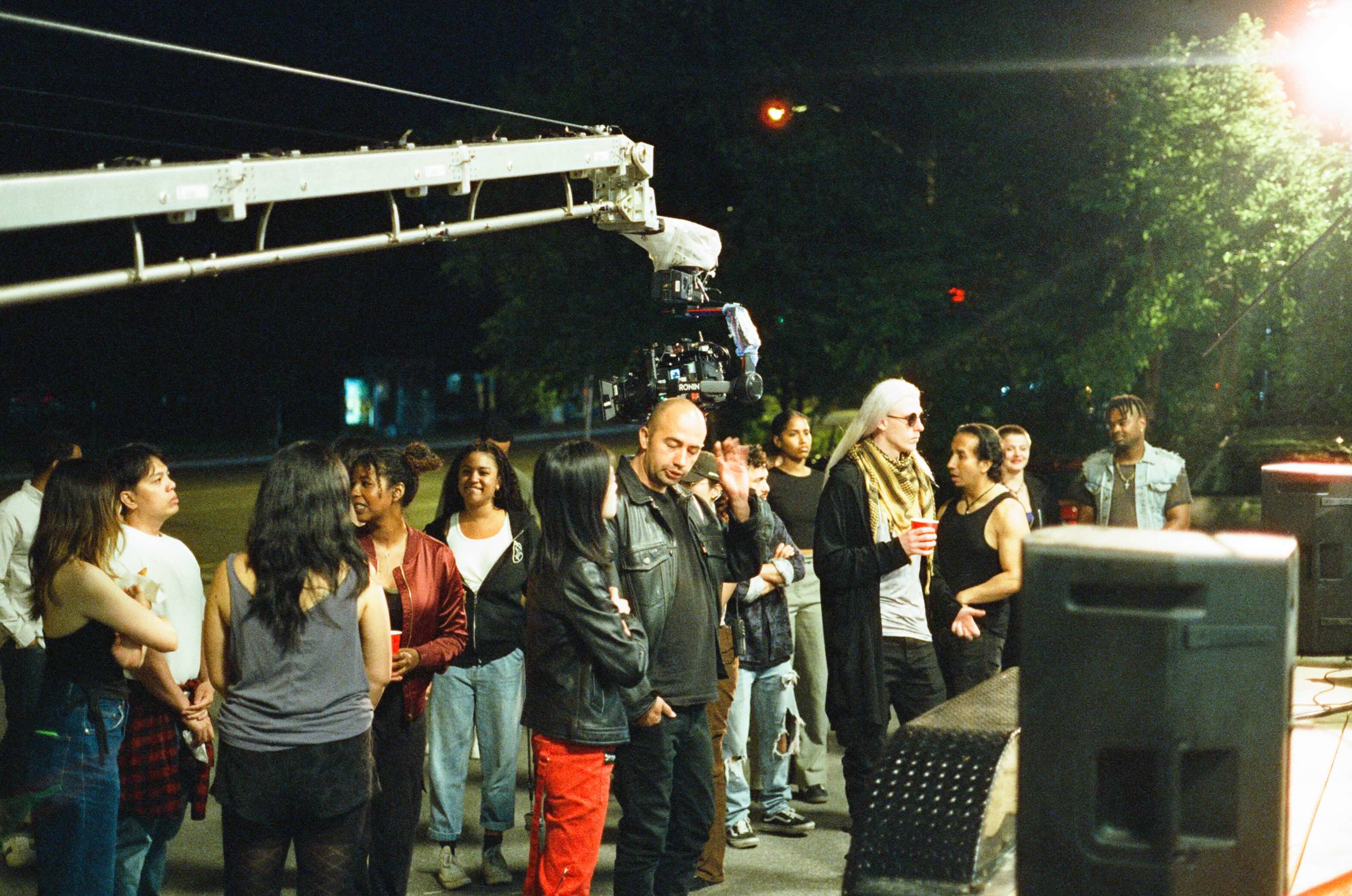
Behind the scenes of "A TRIBE CALLED LOVE." Image courtesy of Mahaica Point Media.
Against Convention: 16:9 in the Past, 4:3 in the Present
The most formally audacious decision in A Tribe Called Love is probably the one no viewer will consciously clock - which is the point. A film built across two time periods would conventionally put the boxy archival format in the past and the wider frame in the present. Higgins and Ahmed went the other way. The early 2000s sections run in 16:9. The present-day sections run in 4:3.
The historical argument comes first. "Something that was very popular in the 2000s was the 16:9 aspect ratio. It was really when the advent of digital truly started to take precedence in films." Shooting the childhood sections in 4:3 would have pushed the film toward DV camera territory - wrong for a period that ran on broadcast. "During the era of the broadcast camera, 16:9 was quite popular."
But the historical argument is only part of it. 4:3 in the adult sections does something the story needs - it makes you feel the world getting smaller around these characters, a community's sense of possibility closing in over time. "When we condensed down to 4:3, it almost felt that, although the image was taller and there was this more grandiose view, it also at the same time feels very constricting. This mirrors the view of all the people growing up in the film."
The transition lives in a single shot: a close-up of an eye in shattered glass - Higgins cites this directly as a reference to Gordon Parks, the photojournalist - from which the camera pulls back. "What you don't really notice is that the actual world is closing in on us as well because it's a square window. And as we pull back, it feels like 16:9, but it's also, in the same way, foreshadowing that format change in a way where his worldview is starting to shrink."
The Super 16mm Bolex material is a third register entirely - sequences with a music video and documentary grain that work as an emotional release valve. "It's a nice break in tension when we go to Super 16mm where it's wider screened because it gives us an opportunity to feel again what they were as children as they were falling in love. It almost feels as if they've sort of kept their youth where everyone else really hasn't."
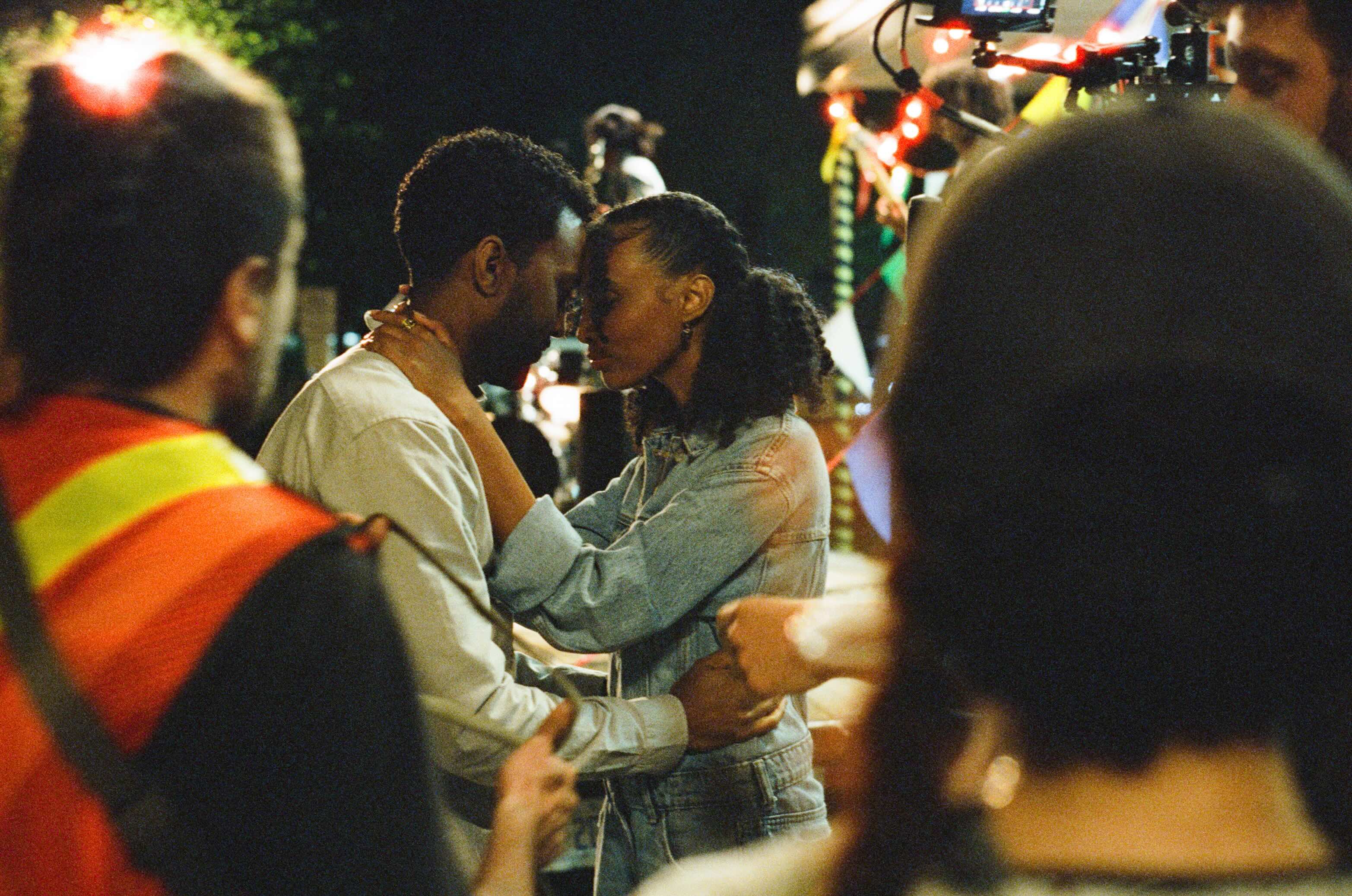
Behind the scenes of "A TRIBE CALLED LOVE." Image courtesy of Mahaica Point Media.
Romeo + Juliet, Do the Right Thing, and a Shared Visual Language
Two films kept coming up in early conversations between Higgins and Ahmed: Baz Luhrmann's Romeo + Juliet and Spike Lee's Do the Right Thing.
Romeo + Juliet maps structurally - a classic love story dropped into a specific, living cultural world. Do the Right Thing is a different kind of reference altogether. "I'm a big Spike Lee fan, specifically from the world of him coming from music videos and a variety of other projects, and then going into the narrative space to bring something particular and true to him as an artist." Lee's compositional instincts - layered frames, canted angles, the world visible in depth behind and around the central figures - kept surfacing as Higgins and Ahmed worked out the film's visual identity together. A sensibility to build toward rather than a set of shots to replicate.
What those conversations produced was a film with its people kept firmly in the frame's center. "There's something that I see with movies sometimes where it looks as if the director just let the DP do whatever they want, and it sort of takes away from the beauty of what the story is about, which is the characters and the world of the characters." "I looked at a lot of the coverage in this film; it is a portrait of these people's lives."
The community being portrayed shaped how every frame was built. This isn't a film with a setting that could be swapped out for another backdrop - Somali culture is the heart of the story, and the images had to be crafted accordingly. “The film is a romantic tragedy with touches of comedy, but underneath it is a retelling of time, and it's a retelling of culture and a very intimate cultural conversation specifically in Somalia that not a lot of people in Canada understand. I wanted to make sure these images accurately reflected the stories of those who've been impacted."
The Unrehearsed and the Unscripted
A Tribe Called Love was shot in a real Somali community in Toronto with a cast that mixed trained performers alongside people who'd never been in front of a camera before. Dalmar Abuzeid and Feaven Abera - trained actors, both community members - anchor the ensemble. Around them, first-time performers bring an unguarded quality to their roles that's specific to people who haven't yet learned to second-guess themselves on camera.
Higgins reaches for Richard Linklater to explain it - a filmmaker he's long admired for casting real people. Without formal training, people don't yet have a clear internal picture of what a mistake looks like on camera, so they don't perform around avoiding one. Simply being, rather than performing. "For a lot of these people coming onto the screen for the first time, they're just being themselves because they don't know what else to do."
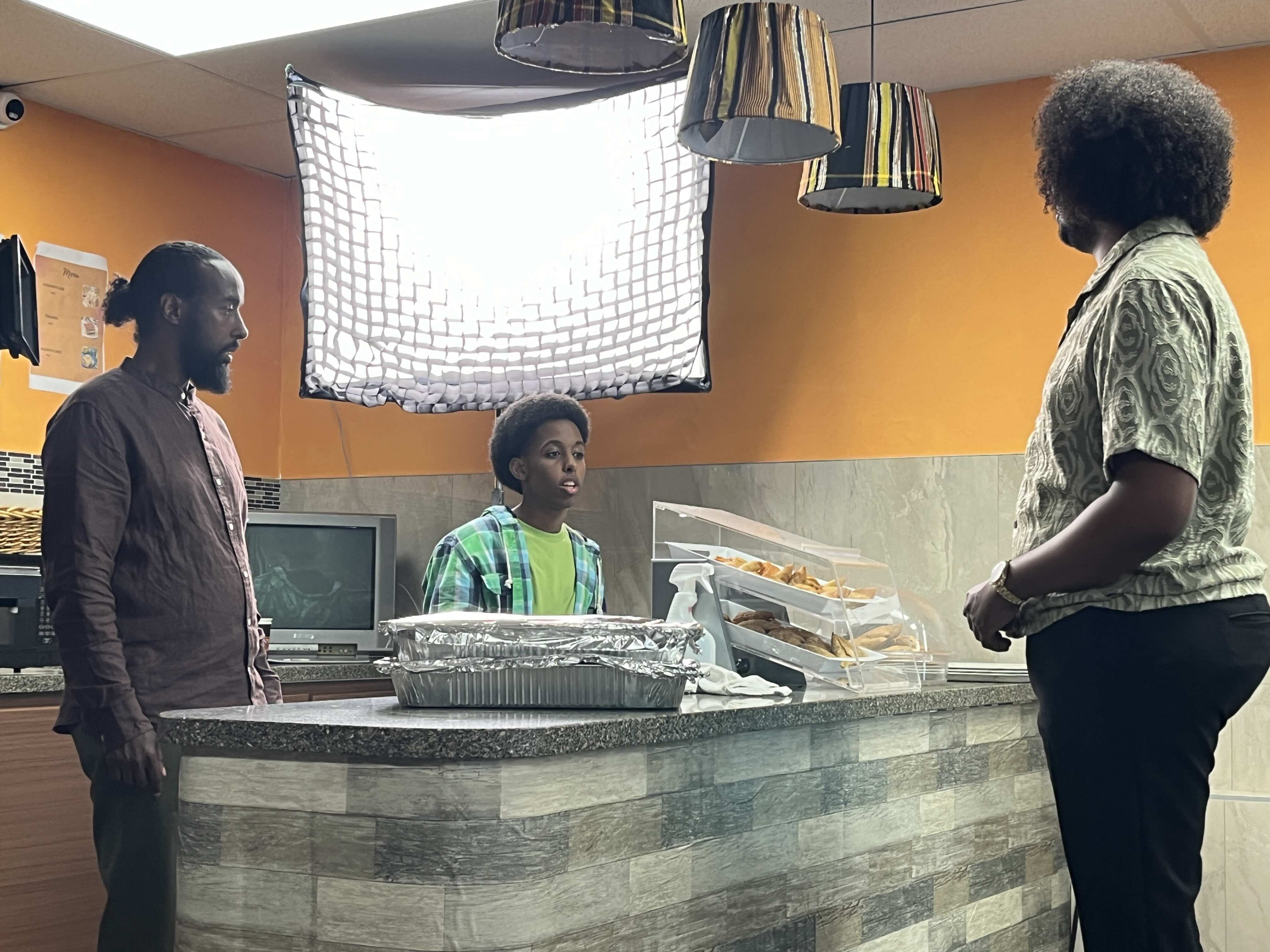
Behind the scenes of "A TRIBE CALLED LOVE." Image courtesy of Mahaica Point Media.
He sees it most in Ahmed Ibrahim, who plays young Farah. "Who you see him as in the film is exactly who he is as a person. He's lighthearted. He's fun. He's easy to talk to. His personality just thrives on screen because he's not told that he has to be a different way. He has no formal training. He's just himself." That quality surfaces in moments that clearly still delight Higgins in the telling. At the school dance, Higgins suggested an insult between takes, something from his own high school: "Yo, call him a bucket." The actor used it on the next take. "The director died of laughter, and we just kept it in the movie."
For Higgins, working with non-actors means throwing out a certain kind of preparation. "It makes me have to anticipate things rather than just thinking, 'Oh, they're going to hit their mark here and they're going to do this and deliver this line.' I get to see these idiosyncrasies of some of these characters that are new to acting that are just who they are. And that's so precious when you see the final cut."
What Lives Beneath the Script: Camera Movement and the Geometry of Tension
Every decision to move the camera in A Tribe Called Love - or to hold it still - answers a single question: what emotion does this serve, and what's lost without it?
"I love long takes. I love uncomfortably being with actors and having them move through a space to try to understand their marks; it doesn't have to be perfect." Dolly, handheld, Ronin - chosen for the scene, never deployed as a signature. Following action rather than intercutting is a conviction: trust the audience to sit inside the moment, and they will.
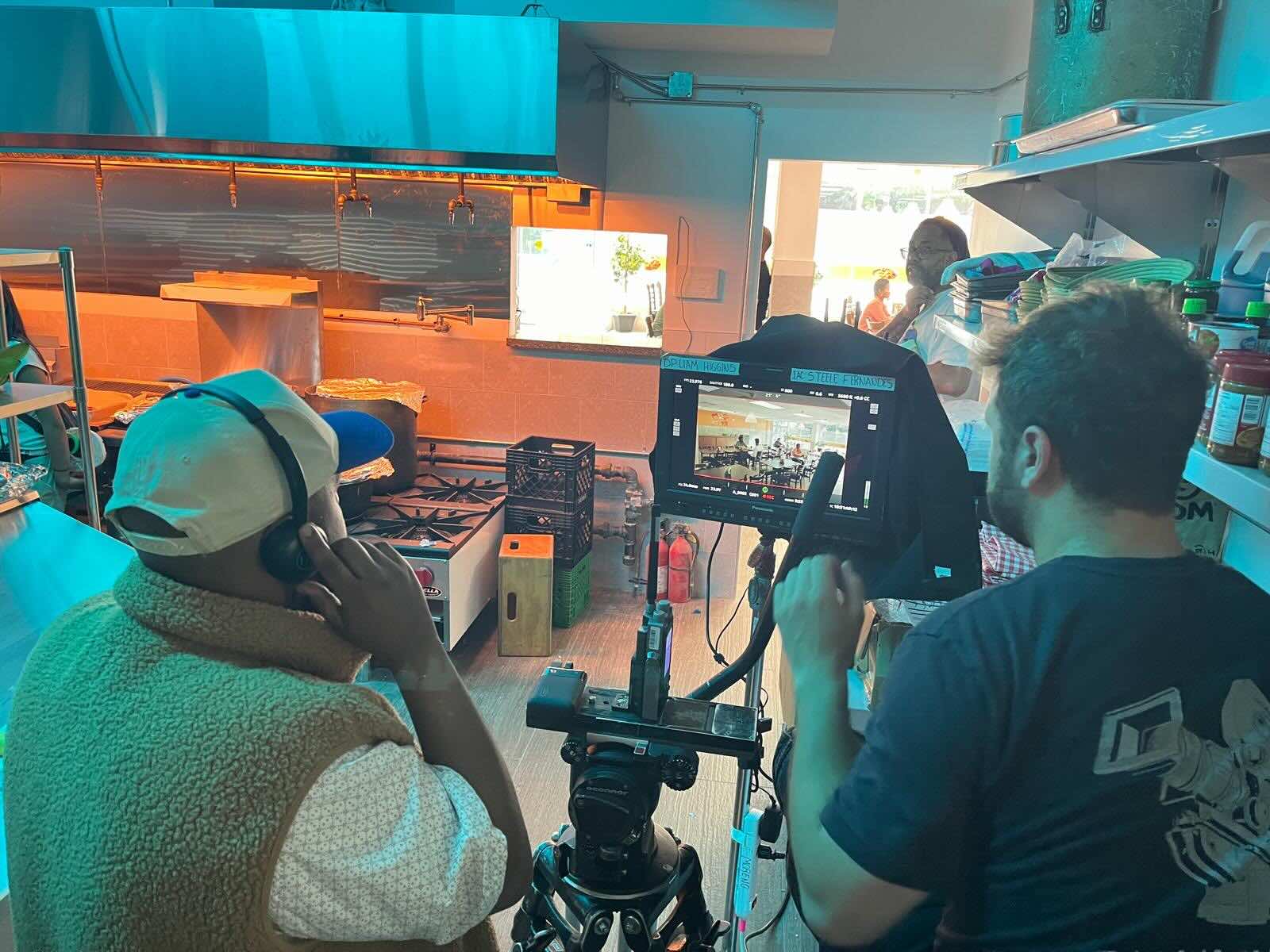
Behind the scenes of "A TRIBE CALLED LOVE." Image courtesy of Mahaica Point Media.
One particular sequence makes the approach concrete. The protagonist enters a restaurant, picks up a wooden spoon, trades it for a knife, goes downstairs, finds an old friend he wasn't expecting. Higgins followed him handheld, building tension in the close-up trailing behind him. As the character descends: flickering light, silhouette. Then in the basement, a dolly moving slowly back "to create this creeping sort of nature for that sequence." The camera finally swings to reveal the room - the anticipated threat collapses. "A bunch of people making music. It's almost an immediate relaxation that comes off of his back."
The Coen Brothers were Higgins' reference for the tonal range he was pursuing. "There are moments of drama, intensity, and comedy, and I wanted to make sure that this film was an exercise in showcasing all of the real human emotions and making sure that the camera sort of expressed that genuinely." Then the other end of it: the family at the table, the protagonist offering sambusas, everyone doing homework. "The camera is just still because it's just a quiet moment with the family." On this film, stillness is often the more deliberate choice.
Jordan Heguy and the Sodium Vapor Standard
The lighting on A Tribe Called Love grew from a collaboration Higgins and gaffer Jordan Heguy have been developing across narrative projects for several years - "crafting this lighting approach" together, in Higgins' phrase. Sergy, Heguy's second, is cited by Higgins with evident affection: steady, a settling presence on set.
Higgins traces his lighting philosophy back to a specific childhood memory - sitting in the back seat of a car, watching his mother drive, sodium vapor sweeping across her face in the rearview mirror. That image apparently never left. "You'll see sodium vapor brushing against the side of the car and brushing against the side of faces... That's what real life is. And for me, that's what I want to do with lighting." The prototypical car scene at night, perfectly lit with an eyelight conveniently tracking the driver through the glass, is his standing example of everything he's working against. "That's never the case."
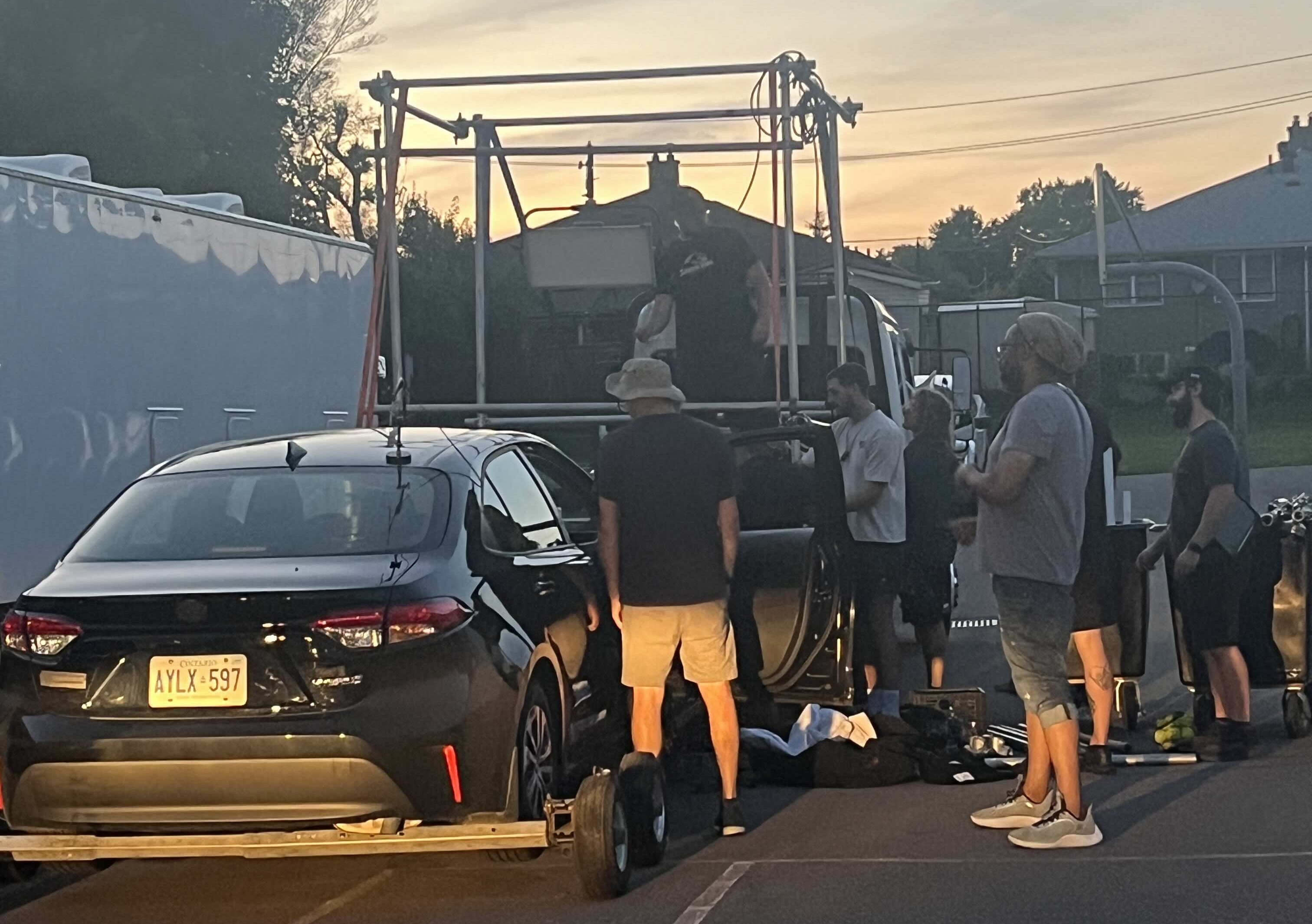
Behind the scenes of "A TRIBE CALLED LOVE." Image courtesy of Mahaica Point Media.
His feature debut as a DP, Soft, was a deliberate exercise in going dark - intentionally, sometimes uncomfortably so. "There are moments where the film is too dark, and I like it, and for me, that was what I intended to do." Same principle on A Tribe Called Love. "If a person walks into the darkness, they're meant to walk into the darkness."
What he's after is the moment the screen stops looking like a screen. "I'm not trying to convince you that this is a beautiful-looking film. I'm trying to convince you that you're not even watching a film... I'm trying to convince you that you're in a world, you're not in a movie." Perfect highlights and processed light do the opposite - they alert the trained eye that something is being constructed. "You immediately not only take the audience out of there, but the fellow filmmaker who's going to watch it."
Two Films Inside One: Animation, Parks, and a Bench in Winter
The rotoscoped animation in A Tribe Called Love developed in post-production, and when Higgins saw the first cut of it, something immediately clicked. “I finally understand exactly what it is you wanted to do."
The touchstone was Scott Pilgrim vs. The World - name-dropped by a character in the film's opening act - and specifically Edgar Wright's approach to comic book visual language. "A lot of the animation really did want to lean on that very Edgar Wright sort of animation of a comic book." In the first half it fits the world: youth, lightness, play. "I felt as if you were a kid reading a comic book. These are children we're talking about."
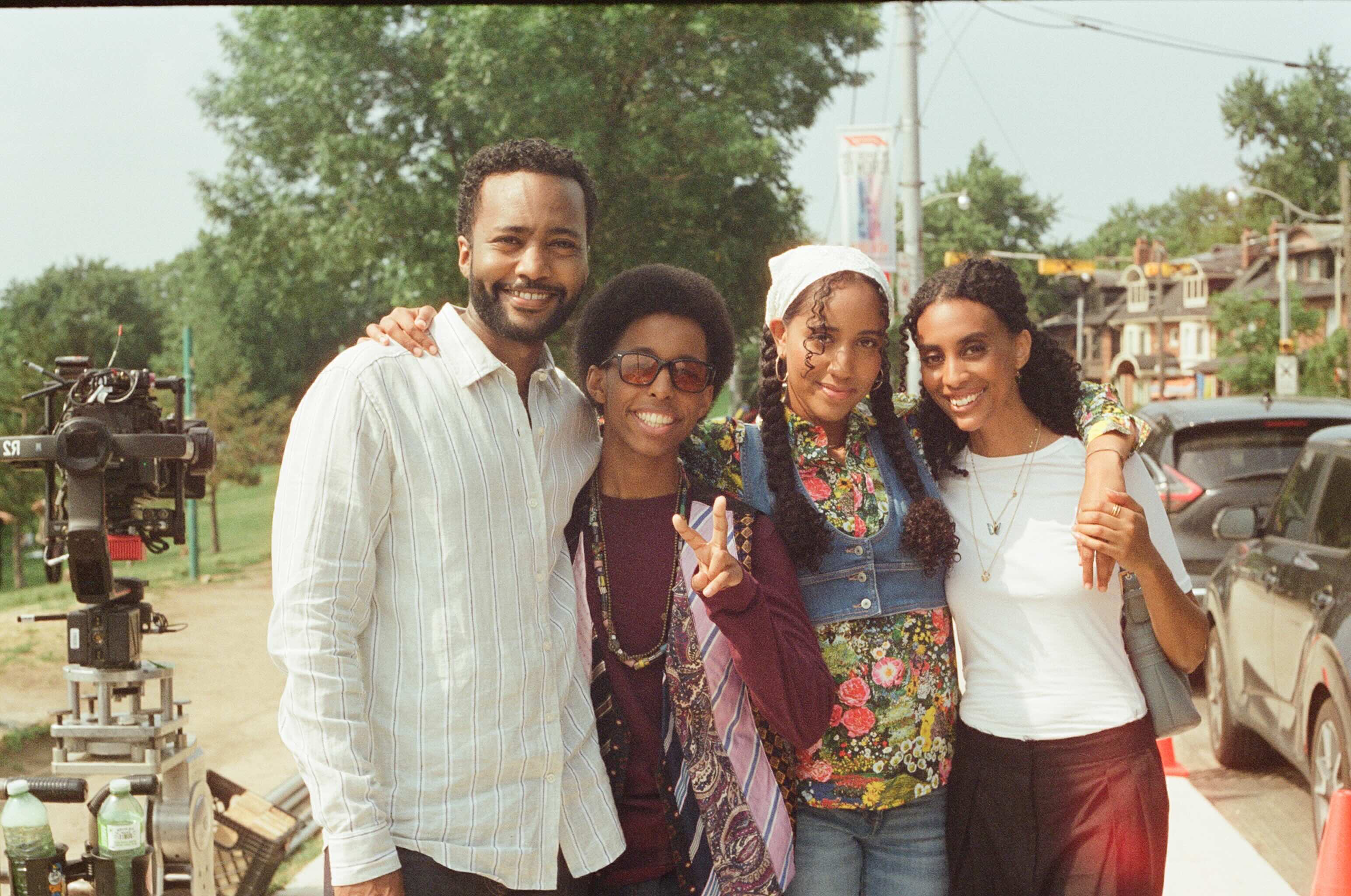
Behind the scenes of "A TRIBE CALLED LOVE." Image courtesy of Mahaica Point Media.
The contrast with the second half is built around one location, used twice. Young Halima and Farah in a park - she's painting the Toronto skyline, he's lying in the grass, warm, open, unhurried. Then near the end: adult Farah, played by Abuzeid, on the same bench, talking with Halima's father, The Sultan (played by John Phillips), about her death. "It's cold and it's blue, and it's these tight lenses that feel very intrusive. You see these scars on his face." Same bench. The world around it completely changed. "That's a huge part of understanding what the visual language of the film is - noticing how this world changes."
Against that cold, static register, the animation of the first half reads as a second film running alongside the one you think you're watching. "When you juxtapose that against this lighthearted animation world, you're creating two films almost in its own way."
The Tender Director and the Open Platform
A Tribe Called Love arrived in production carrying fourteen or fifteen years of Mohamed Ahmed's development behind it. What Higgins took from the collaboration, most of all, is a lesson about what trust between a director and a DP actually costs to build - and what it makes possible when you do.
"Alignment is so incredibly important when you're working with the director because this project taught me that alignment comes in so many different forms. It's not just about the creative alignment of the story. It's also alignment in communication." You show up. You pay attention. You don't assume you already know what someone needs from you. "I think the best work comes from being able to understand and empathize with the way other people see the world."
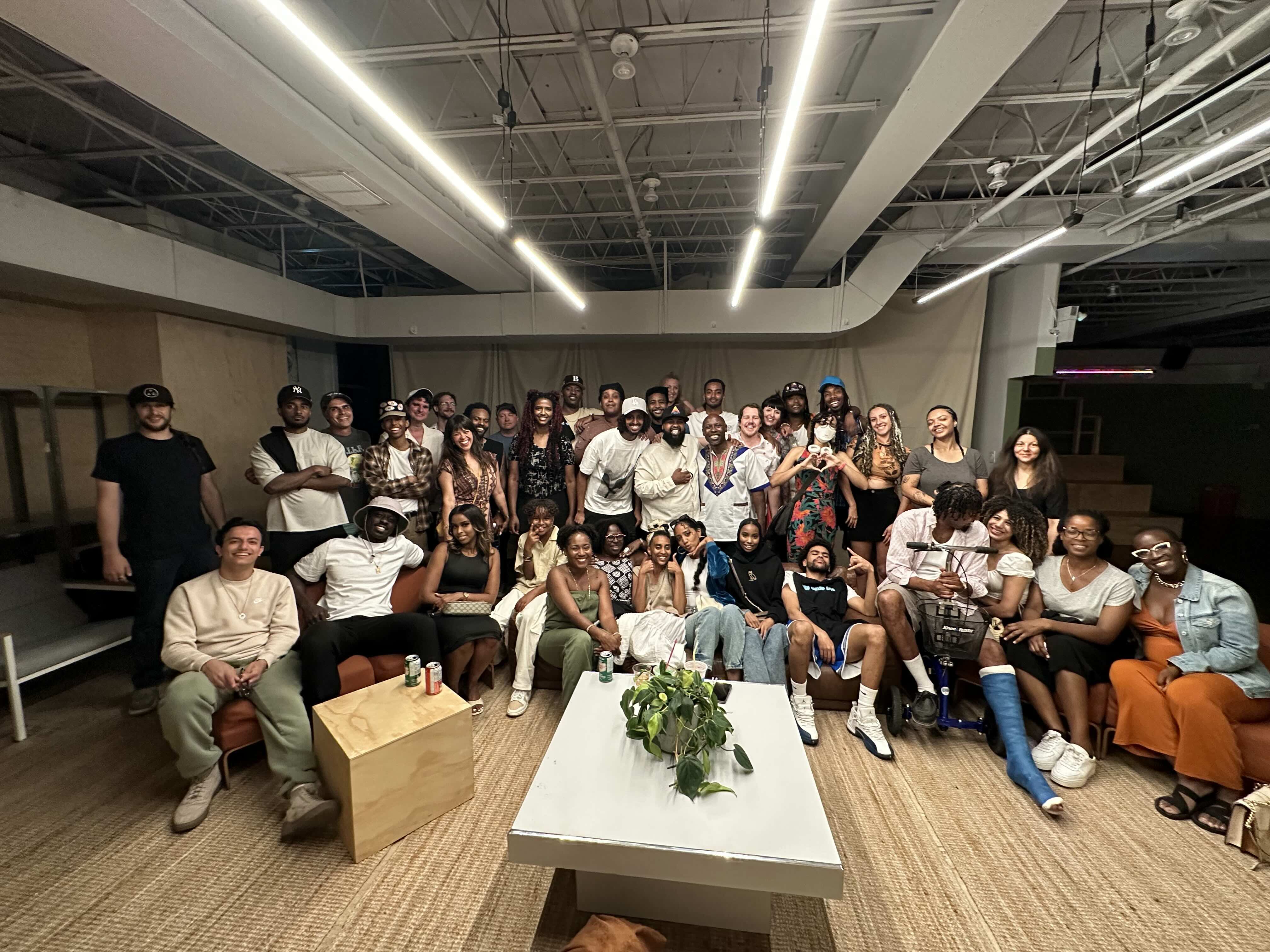
The cast and crew celebrate picture wrap, behind the scenes of "A TRIBE CALLED LOVE." Image courtesy of Mahaica Point Media.
Part of the job, in Higgins' view, is making sure the director doesn't have to carry it alone. "Directors are very lonely. They're on this island where they feel they have to guide this ship and remain stoic in the process of guiding this ship. As a DP, my goal is to always extend my heart open to them so that they can feel safe in this process of creation and not need to feel alone in that process."
The same thinking ran through his camera department, with less poetry and more pragmatics. First AC Steele Fernandes and second AC Ilse Moreno are both credited by name - Fernandes for his professionalism and ease, Moreno as "a force of support and comfort throughout the process of shooting." Higgins is deliberate about the atmosphere he keeps. "My goal when I'm working with my camera team all the time is to keep it light because sometimes I feel the camera team can be so militant." The operating principle behind it is direct: "You have to be able to give trust to receive trust. If I want to receive the trust of the people that I work with, I have to give them the trust." And when something goes wrong, which it will: "We talk about it, we learn about it, and we move on. And I still love you all the same."
Craft Over Polish: What the Image Is For
The list of influences tells you what Higgins is actually chasing. Richard Linklater. Harmony Korine. Sean Baker. Terrence Malick's Badlands and Days of Heaven. Abbas Kiarostami's Taste of Cherry. Satyajit Ray - Aparajito, Pather Panchali. Tarkovsky's Stalker. Cairo Station. Photographers: Jeff Wall, Alex Webb, Harry Gruyaert. The through line explains something real about what he's looking for when he picks up a camera.
The word he keeps landing on is craft - meaning something rooted in materiality and intention, not surface finish or spectacle. "I just think that there are a lot of these classic films for me that really showcase filmmaking at its core and its almost naturalistic view where it just feels so devoid of materialism... It just feels like craft."
Jeff Wall pulls him in for the theoretical grounding - art history training that moves freely across painting, film, and photography without ranking any of them above the others. "His work is so grounded in theory with his art history background... experimenting with different mediums. It has been a really inspiring place for me because it's a reminder that there's not one approach that fits all, but there is an approach that tells something properly."
The advice he gives aspiring DPs flows from the same place. Be present - not just logistically, but emotionally. "If you're going to do a feature film, throw yourself fully into it and only be present with that... I want to be there for every pre-production meeting. I want to be there for every location scout, regardless of whether it's a location we've decided on." The relationship between a cinematographer and a project changes when you give it that kind of attention. Something gets inside you that doesn't get there any other way. "If you're going to do it, do it the best you could ever do it."
Behind it is the same curiosity that made him a writer before he was a DP - and the same instinct that's kept Keslow Camera a fixture in the projects that matter most to him. "If you don't understand something, try your best to educate yourself on it because it'll usually surprise you... Any opportunity I have to learn somebody's story is an opportunity to understand the world better. That only enriches your art." The camera is just attention made visible - a way of looking that, when it works, pulls whoever's watching into looking too. [x]