

The Career of Dana Gonzales, ASC — From "Fargo" to "Alien: Earth"

Director, producer, and DP Dana Gonzales on the set of Alien: Earth season one. Photo courtesy of Dana Gonzales, ASC.
Emmy-award winning DP Dana Gonzales, ASC, has worked with Keslow Camera for over thirty years. On the eve of the premiere of his latest work, ALIEN: EARTH, proudly supported in Thailand by Keslow Camera, we connected with the illustrious DP, producer, and director, to discuss his history with Keslow Camera, charting a course from FARGO, to LEGION, all the way to the out-of-this-world ALIEN: EARTH.
[This interview contains minor spoilers for ALIEN: EARTH]
You've worked with Keslow for many years. There have been many of your projects we’ve supported, from bigger series to smaller features. How did that relationship begin, and how has it evolved over time?
It starts with my relationship with Robert Keslow (CEO & Founder, Keslow Camera). I met Robert before he had Keslow Camera. I knew Robert when he was a camera assistant. He had things to rent; he had a lot of rental gear. He had a matte box and zooms, and we used to sometimes sub-rent his stuff. I'd go on a job and we'd split it or whatever. And then he started Keslow Camera. Naturally, I started going over there, and I started doing all my work there from when they were on Playa in Culver City.
And this is in the film days. So there were just film cameras. In those days, not much changed with film cameras. You got a new film camera that had some sort of accessory or something, but the film still went through the gate. And during the digital revolution, I was there with Robert and Dennis McDonald (COO, Keslow Camera), literally tracking that digital revolution.
There was a question at the time, when people were still fighting digital. It was like, "No, it'll never last, I only shoot film," when they could actually talk about that. But now that's not even a question. People are shooting film again, but there was a point where it was going to go digital all the way, and it did. So I was there, and that was a very pivotal point.
I even had a discussion with Robert. We went to lunch one day and I told him that many jobs I was doing were going digital. And beyond that, I had seen the movie 28 Days Later. It was shot with a Canon XL1 with a prime lens adapter. And to me, I was like, "Okay, I see it. I see the writing on the wall. I want to shoot digitally." I had already shot digital. There had been a bunch of projects that I did with various tape-based digital cameras, and I'd have to always rent those somewhere else because Keslow hadn’t had those. They never had any tape-based cameras, but it was starting to happen a lot, and I told them.
This is right around the time the original RED hadn't even come out. They were shopping around their camera. They used to go to the shows and they just had the metal body, but it hadn't come out yet. But it definitely had this incredible price point, and they said it was going to do all these things. I believe the Arriflex D20 was out at the time, which I had done extensive testing with.

Dana Gonzales, ASC, in 1986 on the set of Kidnapped. (Image Credit: Bill Boatman.)
Because somebody commissioned me, I did this big test with the D20 with ARRI, Clairmont, and Panavision. It was for some big TV producing company and some producer commissioned me to do it. I did a big test side-by-side with film. It was to show the differences, so it was coming on strong. Keslow never bought D20s, and it was good that they didn't because they were short-lived and it wasn't really the way to go.
So Robert and I talked about these REDs, and he said, "I have three on deposit, but I don't know if I want to get them." The same day, he showed me an invoice because he really needed another film camera. He showed me an Arricam invoice, a basic Arricam. It was like $360,000, and he could have bought literally 15 REDs at that time. We also knew that he had all the accessories and stuff. This is before anybody thought about lenses. No one was thinking about digital cameras and lenses; no one was acquiring vintage lenses. So everybody just had the lenses they had.
We had this talk, and I'd like to think that I convinced him a bit. He ended up becoming the number one rental house with RED cameras besides RED themselves. I did one of the first projects, one of the first TV shows shot on RED, a show called Southland. The same producers as ER, and they actually did, I want to say, the last five episodes of ER on RED because they saw what we did on Southland.
From there on, Keslow became the digital leader, because all of a sudden, Panavision couldn't acquire those cameras. They weren't going to buy them, and by the time they realized it, it was too late. They started consigning digital cameras around the time they made the Genesis, which was a tape-based camera that was interesting in of itself, but it was short-lived and cost them a lot of money. So by the time all the other rental houses figured it out, Keslow Camera was already there. They already had these incredible relationships with RED. Then, when the Alexa came out, they knew that was the right move, and they went there.
And then they had their innovation. They have the people there, the Mike Kramer’s (R&D Manager, Keslow Camera), that are incredible people that will just build anything. It all fell in place perfectly. That was a very pivotal moment because if Robert didn't decide to go that direction, there may not be a Keslow Camera today. Or he would be behind.

(L-R) Keslow Camera CEO Robert Keslow, DP Dana Gonzales, ASC, guest speaker DP Paul Cameron, ASC, Keslow Camera COO Dennis McDonald, and DP Tobias Schliessler, ASC, at the ASC Clubhouse in 2013.
It was pivotal. To me, that made the next journey, the next 10, 15 years, very easy. All my projects... and then it was developing fast. The Canon 5D DSLRs started coming out, shooting digitally, accessorizing those. What lenses go on those? Now you had RED shows with a 5D B-cam.
There was a thing called an Indiecam, another little camera before these small cameras. I would literally tell them, "I need this camera," and they would buy it, even though it was kind of like, "How long is this going to last?" But they did. So today, all these other new rental houses, and ones in other states that basically have started in the last couple of years, make it look like this is business as usual. It was anything but business as usual in those days. I feel Keslow was at the tip of it.
I think that's when the Paul Cameron, ASC’s and Sal Totino, ASC, AIC’s and Claudio Miranda, ASC, ACC’s, and filmmakers like Soderbergh and Fincher, all these guys started gravitating towards Keslow Camera, because they were literally the only ones that were able to nuance the whole experience versus, say, a Panavision, which was a corporate company that had to go certain directions. You literally had two people, Robert and Dennis, who could basically champion the DPs and go in the directions that they felt they needed to go. And it's still happening. The strong relationship with Sony that you guys have, and being really at the forefront of that. So to me, if anything, it made my career more successful because I was able to be at the tip of the spear. Not only because of what I can think about and fantasize and do, but that they were able to support that.
I tell people that, and I don't know if they understand, but I'm like, because everybody's always interested in my career path or my success. I basically say, "Well, then you have to understand that Keslow was part of that." And when you have this relationship like I do and like many others have, they're going to make it happen.
Then there's this one thing that I'm very dear about, that I really want to make sure the world knows, is that they've supported me in every country that I've been in. The film business has changed globally. We wish it hadn’t gone as it did completely, but Keslow Camera has kept up. They now dominate Canada. They bought Clairmont Camera and now Sim. But they don't stop there, right? So I'm going to Thailand, I'm going to London, I'm going wherever, and they can support me there. That goes back to everything I just told you about, coming up with them and having that lunch with Robert and talking about digital and saying, "This is my experience and this is the direction I think you need to go."
We're still doing that, because I don't think any rental house—I can say this honestly—no rental house has ever supported a show the size of Alien: Earth in any country, from America. Especially a TV show. They just haven't. Producers aren't interested in it, no one's interested in it because they don't think it's going to work. But we did it 100% successfully. There's not one person in production, in camera, there's not one person that would say that was a dumb move. And I think the show visually will be one of the best of the year. That just goes to what I'm saying: the support that we needed to create that. I feel like if I went with the local options, there's no way they could have supported us the way Keslow did.
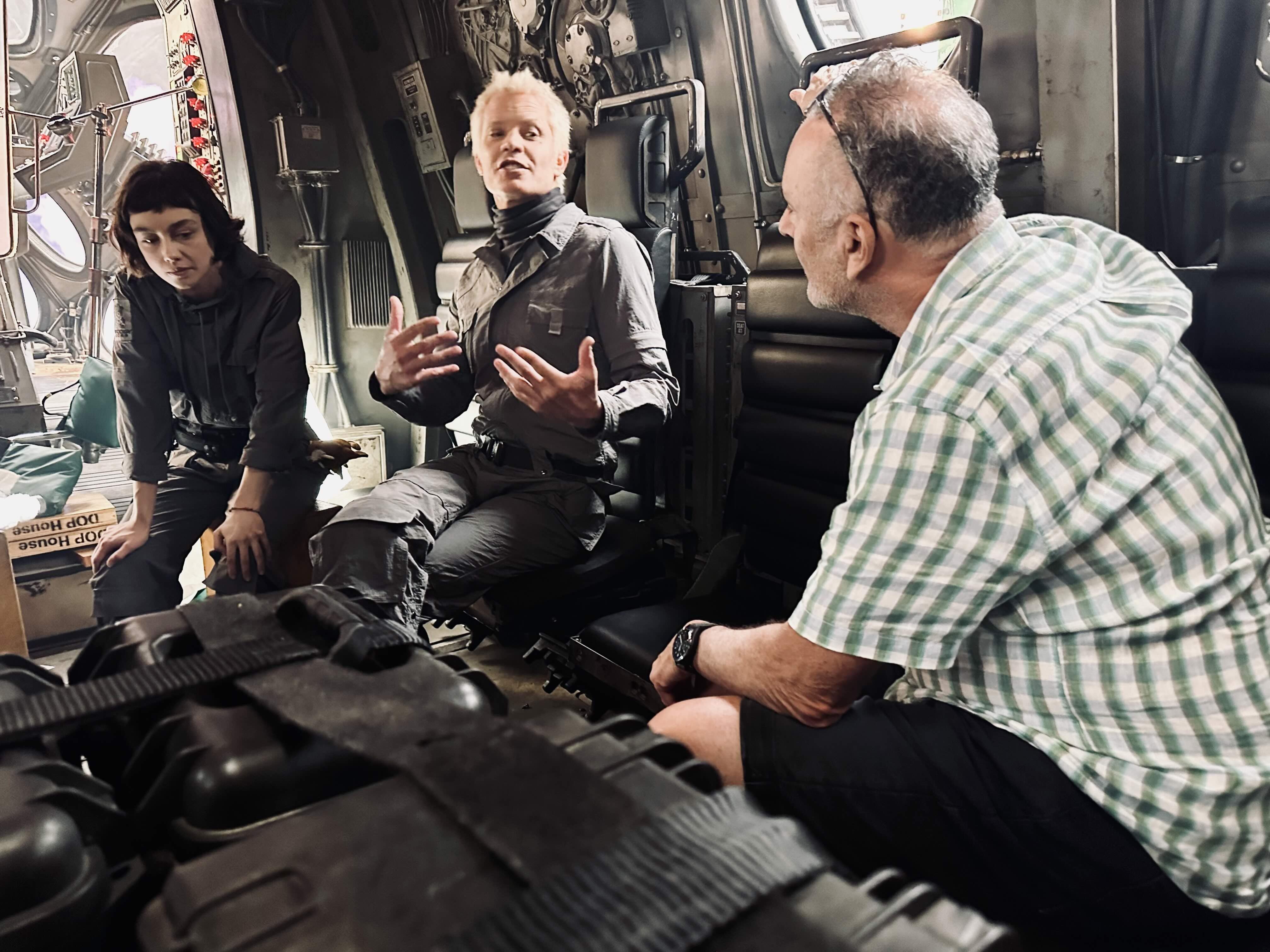
(L-R) Sydney Chandler and Timothy Olyphant discuss the next take with director Dana Gonzales, ASC, on the set of Alien: Earth episode 102. Photo courtesy of Dana Gonzales, ASC.
Charting your career and the path that you've been on, you don't often see DPs transition into directing as well. I'm curious about that shift for you, layering in that additional element of filmmaking and how being a DP contributed to your vision and skills as a director.
Normally, if you're on a television show and you have some interest in directing, if you've been there for a long enough time, multiple seasons, everybody knows you, especially in the days of 26 episodes. If everybody liked you and thought you could direct, you could probably get a directing job, an episode. But there's a big difference between making a career directing and being on a show for seven seasons and getting one episode, or one every year. There's a big difference between doing that and going out of that sphere and becoming a director.
I have worked outside the shows I shoot as a director. I've been asked to direct; I've been asked to direct before I've even been asked to shoot now. Even on the shows I do, my relationship with Noah Hawley in his camp is really good in a way that he normally directs the first episode, and I shoot it, and we build the world. Then I end up directing during the season and now producing. On Alien: Earth, I basically directed four out of eight and Noah did two out of eight, and then we had one other director.
I was the producing director as well, so I ended up doing directing something in every episode. On Fargo Season 5, I was the producing director as well, and I did the same thing, where I did the first two with Noah, and we built the world because that's a new world every year. I directed two, and shot two, and ended up directing many of the scenes in the episodes.
So, doing the projects I did as a DP, how it informed me as a director? I'm a very visual director, but I put a lot of emphasis also into character, directing actors. I didn't want to just be a visual director. I didn't want to be a guy who didn't want to talk to actors and just had visual strength; I wanted to have it all. And I've been very fortunate where I've worked with some really incredible cinematographers on the things I direct. Erik Messerschmidt, ASC, did like four episodes of television with me. Pete Konczal, ASC, David Franco... these are great cinematographers to begin with.
I'm able to still speak very strongly visually with them, but they're all different than me. They all light differently than I do; they're just different than me. So being a DP informed me, but I'm a well-rounded filmmaker because I do know about all the crafts. Some directors, especially newer directors coming in, they’ve never shot 150 episodes of television. They're never going to have that.
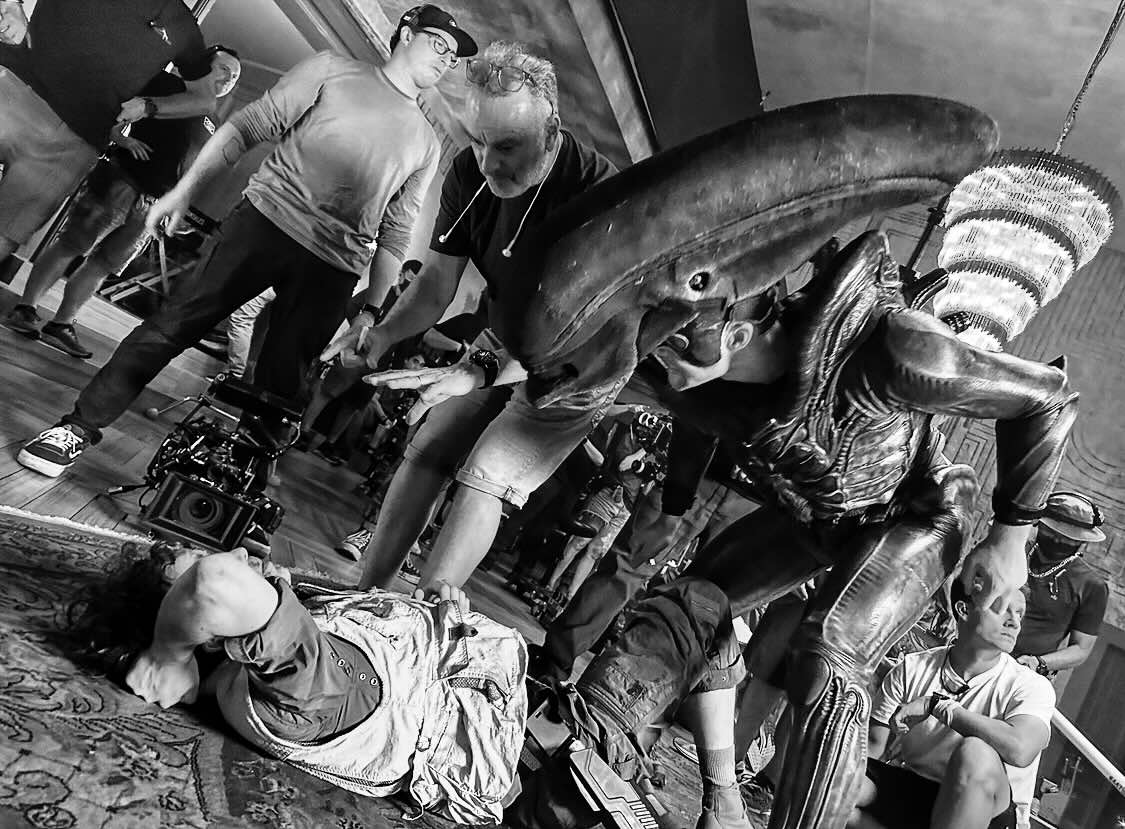
Director Dana Gonzales, ASC, lines up the frame for the next shot, on set of Alien: Earth episode 102. Photo courtesy of Dana Gonzales, ASC.
So I have a really strong sense of time and timing, and a production sense for handling production problems. Most cinematographers are going to have that, because that's what they do. DPs deal with time and production stuff more than any constant. But I know not every DP that directs an episode of television is going to become a director. Not everybody's cut out to be a director. But it's definitely informed me 100%.
I think if you talk to anybody, they're going to tell you that I'm not known as just a guy who only knows where to put the camera. I really enjoy the storytelling; I put a lot of emphasis into that. Yes, I have to put less emphasis into the visuals because I'm working with a strong DP always, but I know it's ingrained in me.
I think a big aspect of it too, is having those leadership abilities because it's something that you can't really teach. You can teach someone, but it's something you have to learn through experience and really doing it.
Yeah. And you learn by making mistakes, and believe me, I made every mistake you can make. I mean, coming up as an assistant cameraman, a DP, I'm a director, and a producer, and I've literally done it all. I was a PA on my first job. I wasn't a PA for a long time, so I can't claim that I was a PA too long and learned that, I never really was in production. But yeah, that definitely is something that I bring a lot to the picture. Obviously, you don't need that to become a great filmmaker, but it's definitely a strength.
On the experience of making Fargo specifically, what was it like embarking on this collaboration with Noah Hawley for the first time? Fargo is an interesting parallel to Alien because it’s also a reinvention of a classic film. Was there anything similar about that process?
When we made Fargo season one, it was very close to Alien in that everybody's like, "Don't do it." They're like, “It’s the holy grail of Coen brothers’ films.” And with Alien, it was the same. I think there are fewer people who saw the original Fargo film than had seen Alien, ultimately. It was a very select audience, in comparison.
The Coen’s films aren't for everybody, but it was still considered a seminal Coen brothers' film, and when we made it, there were a lot of naysayers. Making that first season was amazing to me because I love the unknown. I love not knowing. I love that no one knows because that means you have to work harder. You have nothing to fall back on.
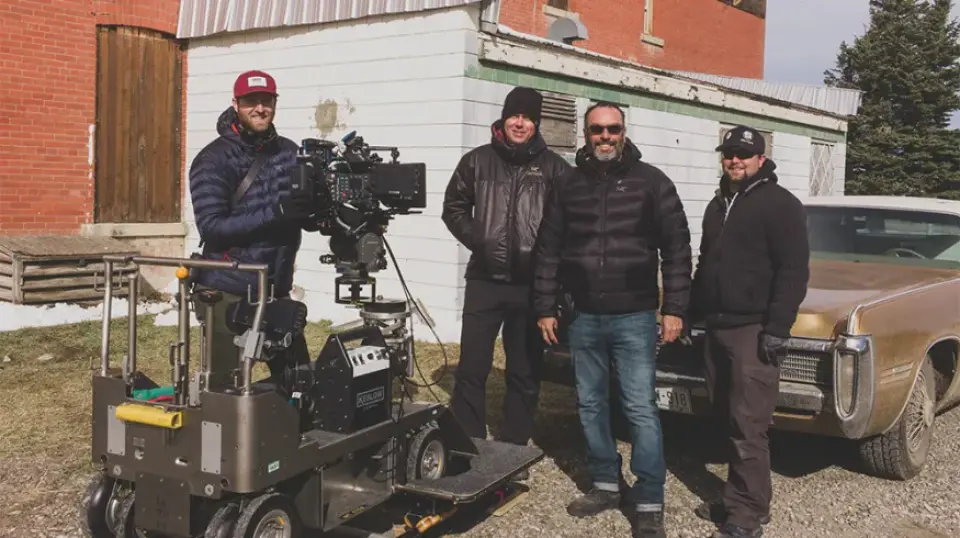
DP Dana Gonzales, ASC, and crew on the set of Fargo season two.
You have zero understanding of what works, if the actors work, the characters work, if this type of storytelling works, if some of the storytelling vehicles work. You have zero idea, and I really like that. And then Alien comes along and it's the same thing. The number one thing I've seen, not so much right now, but in the comments of earlier stuff when they announced it, is like, "Oh, they're going to f*** it up, don't f*** it up."
It was the same with Fargo. The Coen’s and Roger Deakins, ASC, BSC, had a very distinct style with that, and several films around that film, with the lensing of it. They only used certain lenses; they didn't use long lenses. They probably made it with four different lenses to tell you the truth. It was a very controlled palette in the way that they told the film. So we adhered to that pretty strongly on season one of Fargo. Because we felt that again, it was never like, "Let's just do something different and not care about what happened before us."
Because definitely for the regular audiences, yeah, they probably wouldn't have cared how we shot it. It probably still would have worked because I think it was such strong writing, and strong characters, and acting in the first season. It still would have worked. But not only did it work on that level, but all the Coen people, all the Coen fans loved it. And there are homages in Fargo, we do homages to not just Fargo, but several Coen brothers’ films.
And then with Alien, the difference is we studied the filmmaking of Alien, and we just wanted to stay true to it. But even with that, the funny thing is Ridley Scott told Noah that he had shot Alien primarily handheld, and he didn't. There's handheld, but I think the handheld was more about time and space, sometimes getting the camera into a little part of the ship. It was probably easier handheld and then maybe even like, "Oh, just put the camera here, handheld, and get the shot." I never thought about it as a handheld film, and I still don't think about it as a handheld film. So the lensing of it, yeah, I definitely looked at that a lot. And even other iconic films of the 70s.
Maybe because Fargo was the first of those projects we did like that, we definitely had to tap into the Coen brothers’ universe pretty sharply. And then through the seasons, we loosened up a bit. That was also my first project with Noah. So as time has gone on, we've started developing our own style and aesthetic. But we liked the Coen brothers' aesthetic, so it never was like that was a s***** aesthetic; we liked it. But we just kind of evolved it for our needs, for the storytelling we had to tell, especially again in a TV show versus a movie.

Dana Gonzales, ASC, with a director's viewfinder on the set of Fargo season five.
It doesn't feel like an imitation at all. It's definitely kind of just speaking in that same cinematic language and expanding on it, which is very organic in that sense.
We had done Legion between seasons 2 and 3 of Fargo. We did it back-to-back. We finished the first season of Legion and I literally flew to Calgary right from there. We went right into Fargo season 3.
And so in season 3 you started seeing a bit more storytelling with the camera. That was a little looser, and we used a broader sense of tools. But I can also tell you, our producer, one of our producers who did most of the Fargo with us, he did the original film, he was the first AD or the production manager on the original Fargo. And they didn't have a lot of money. So it looked like that because of practical reasons too.
So if Fargo was $80 million at the time or something, they might have had a bunch of crane shots, and they might have done a bunch of stuff. Who knows what they would have done, but they didn't have a lot of money, and they were chasing the snow. So on our end, by season 3, you start seeing more tech, more equipment, more lensing used. It just changed.
Then we do season 4. Season 4, I don't think we even talked about the Coen brothers’ films, because we've done it and we still have that aesthetic. That season has a little longer lensing. It's large format, it was the first large format season we did. So it naturally has a different feel, right? Literally, we shot those with ALEXA Mini LFs.
And so that changed the whole thing. Then season five comes around, and if anything, season five went back to basics a little bit. It still was large format, so it still had that going for it. But as hopefully your audience will know, every season of Fargo is a different story. It's a different look, different characters.
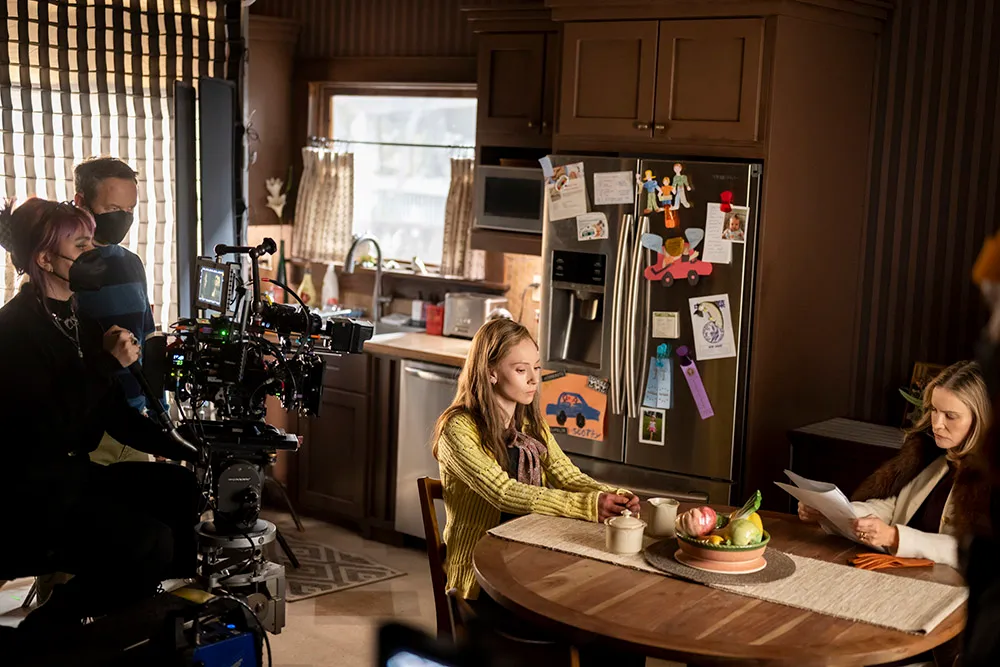
Creator Noah Hawley on set with Fargo stars Juno Temple (center) and Jennifer Jason Leigh. (Image Credit: Michelle Faye/FX)
They all look different. Noah loves that. If you show any one frame of a season of Fargo, you'll know right away what season it’s from based on its look. You don't even have to have a character in there. If you just had a wide establishing shot, you would know, "Oh, that's season two or three or four" because they all look different.
There's so many iconic settings and characters that are individual just to each season. That said, there's a little bit of connective tissue throughout, where you’ve got some characters that return as well.
Well, yes. In season two, you have a younger version of the season one character. You have Molly; she's a kid. So you have the same characters that are played by different actors. And then there's some crossover in four with Milligan from season 2.
There's a tie-in from all of them, because they're all on the same planet, and they're all in the same part of the world. And even though they look different, they're all tied in. So there's Easter eggs in all of them that tie them in to let you know that, because even if season 4 is 1950, they're all there. There's a character in season five that's from season two, where you see an expansion of that character who's younger. So they're all tied together in that way.
Some of that is really for the die-hard who remembers the name. So season four, a young Joe Bulo, who's played by Brad Garrett in season two. You see the young Joe Bulo because it's 1950, and then season two is 1970. So it's the same character, different actor.
On Legion, I remember watching the pilot when it came out, I was in film school and remember just being blown away. I'd never seen a show that looked like that. Especially for something in the Marvel world, it wasn't afraid to craft its own look. The aspect ratio changes, and there's so much that's almost Bollywood-inspired with the 60s saturated colors. What was that process like, especially going back and forth between Fargo and Legion? Because they’re almost polar opposite ends of a visual spectrum.
It absolutely was. Up until that moment, I had only done Fargo with Noah, because that's how we went from one to two. On Fargo, we didn't even do steadicam, or we barely did steadicam. So on Legion, we were like, we had to have a steadicam, we had to have long lenses, we had zooms.

The camera team of Legion season one poses for a photo. (L-R) (back) Tim Milligan, Donovan Fraser, Dana Gonzales, ASC, Daryl Hartwell, Ryan McGregor & George Collins. (middle) Michael Dymock, Ivona Mikulic & Luke Towers. (front) Riley Bell.
On that show, there were no rules. We could use any piece of equipment to tell these bombastic stories. And if anything, as the seasons progressed, it got even harder because the scenes just became trickier and trickier to bring to life. But again, our aesthetic, which became very honed after season two of Fargo, was there.
We knew what we liked and what we didn't like. We knew what we gravitated towards. I already had my strong views about lensing. I liked a 32mm or 40mm close-up. I don't like a 150mm close-up, I don't like a long lens close-up. I think that robs the audience of everything. I like the lens pretty close and experiential. So those things came through.
A lot of the stuff we do is more singular camera. We may have two cameras, but a lot of it is really a singular camera show in terms of our style and approach. The second camera gets some supporting shots, it doesn't get the close-up. We don't do two cameras next to each other doing coverage; we never do that. And Legion, the thing is that I have to admit, and I will say it to anybody: I'm not really a Marvel person. I don't watch those kinds of films. I like foreign films the best. I actually love very character-driven films. I always like these films when I see them, like The Suicide Squad, and I watch them more now than I did. So I didn't go into it with any of that, like what everybody else did or how they did it. I didn't go into it like it needs to look a certain way.
So for Legion, my only barometer at the moment really was a comic book because it was a comic book character, but I still didn't think about it in those terms. I didn't want to make it look like a traditional comic book movie. Defining the look of it was really talking to Noah, and then when you start building all those design elements—the way the sets look and the wardrobe look and telling a story from an unreliable narrator's point of view—and then you throw in a Bollywood dance.
So to me, you're servicing all those things for how they need to be serviced. And the aspect ratio was another one where it’s like memories within memories. How do you do that? For me, any type of flashback or anything like that, I want the audience to quickly know it's in a different place. I don't want them to be 20 seconds into it and go, "Oh, wait. Are they…?" And that show was a mindf***, right? So it's very important to me that whatever that is, we telegraph it correctly and we use some convention so the audience quickly knows, even if they maybe don't know what that is, that they're in a different time and space or whatever, and make it organic.

The camera crew preparing for the next shot on the set of Legion season one.
On that show, I want to say we used over 50 different lenses or something like that. We used everything you could imagine. And that's a thing where I'm calling out every season. I remember I had a meeting going into the pilot of Legion. I got together in Dennis' office with everybody, and I said, "I don't know if anybody's ever done this, but could I have a meeting with everybody at Keslow? I just want to tell them what I'm making and I want to hear whatever they have to say.” That's how I went into it because I'm just like, "Here's what I'm doing. Here's what I'm going to try. I don't particularly know. I have to do these things, and you don't have to tell me now, but think about it and let's work together to build the world."
And that's what they did. They thought about it, and they came back and were like, "Well, what about this and what about that? What about this?" Because again, I don't know everything that's there, or possibilities. And that is what is key about my relationship with Keslow. I don't think I could have that relationship with any other place. I like Panavision; I know everybody at Panavision. I know all these people who have worked there forever; I used to do a lot of work there. But it's a segmented, very segmented company, right? It's this big corporation. You're just not going to have that accessibility and freedom.
I literally had them in the office, just like, "Bring it to me." They'll tell you if you ask them. And so that shaped that show, and we made three seasons of the show. I think that was enough in a way, because it was so difficult in the storytelling. We used so many different tools, and then the technology changed. So from season one to three, I shot season three on large format and it was the original ALEXA LF studio because they didn't even have Mini LFs at the time. So I literally forced that thing into the show. That season has a whole different feeling because of that.
Legion is like Fargo in the sense that every season is the same story, same characters, but it was set in a different world. We shot in Vancouver on season one. We shot season 2 at the Sunset Las Palmas Studio lot in L.A. And then we shot at Paramount for season 3. And all those three seasons had different sets; there was no standing set. We never went back to a set. I think I did different lenses in season two. I think in season one, I used ARRI Master Primes for the main set. Season 3 was Supremes and large format.
It was all this evolving thing. And again, as this new equipment would come out to Keslow, and a lot of times the "new" was vintage equipment that was being rehoused and whatever it was, I’d get my hands on it and try it out. Keslow has been the key to all of this; I don't even know how we'd make those shows without our collaboration. I really don't.
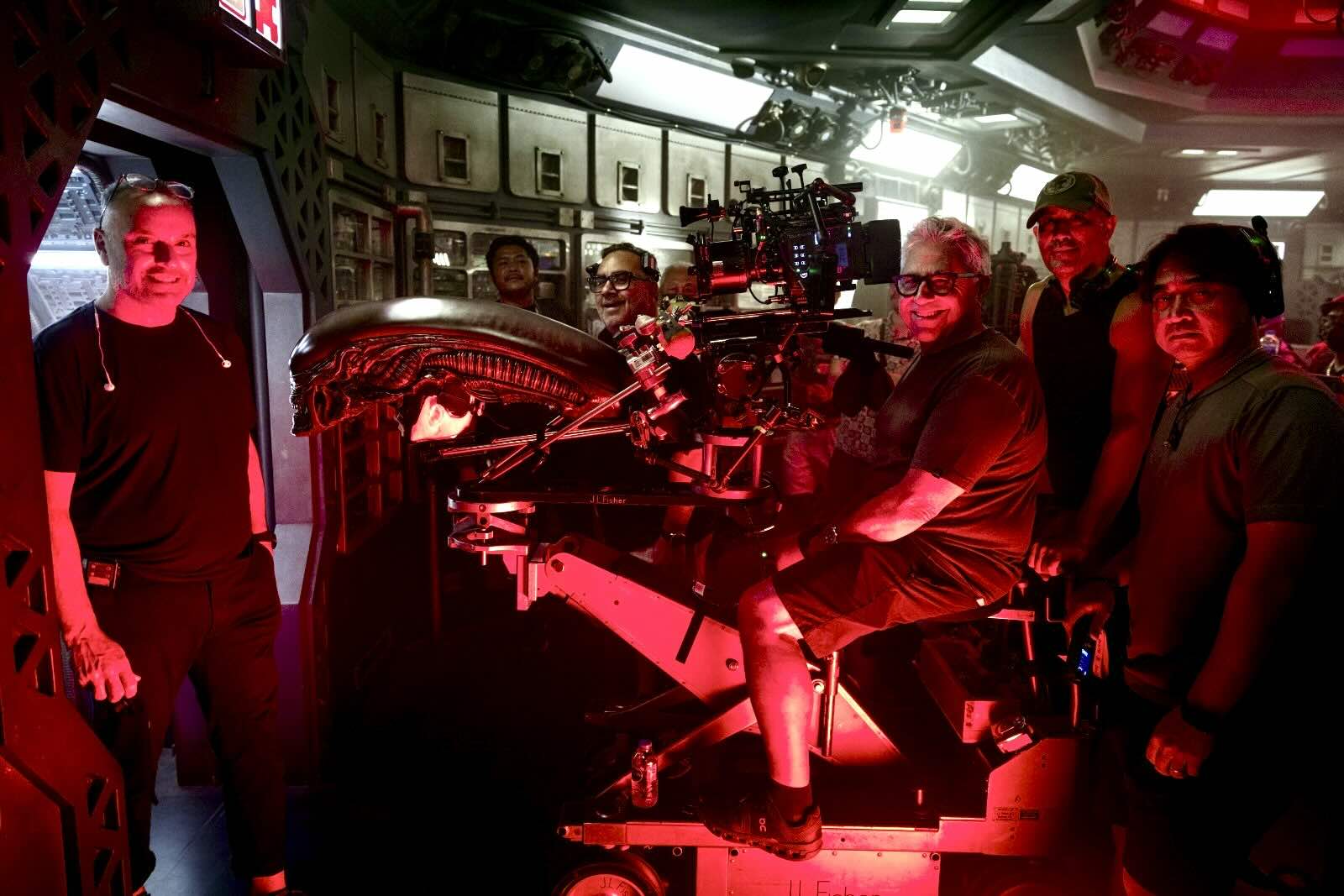
Dana Gonzales, ASC (Left) poses with the Xenomorph and camera team on the set of Alien: Earth. Photo courtesy of Dana Gonzales, ASC.
Alien: Earth is making huge waves and is shaping up to be a major hit. The series is absolutely gorgeous. Playing more directly in an existing universe has some similarities and some huge differences between your previous collaborations with Noah. How do you balance the expectations from existing fans of the franchise and those experiencing this world for the first time?
This show, I think, you have a huge new audience, to tell you the truth. I think there's some people who saw Alien: Romulus, and maybe that was their first experience with Alien. I think there's a lot that didn't even see Romulus, and so Earth may be their first foray into this universe.
So I feel today a lot of the younger generation are going to be entering something they don't know, with the Alien universe. The form of a limited series or TV show is more accessible. So I think this will be their first experience with the show and the franchise. That makes it tricky, too, because you're making a show that you want to honor the franchise and for those fans, because believe me, there's some rabid Alien fans down to the lore and the lineage of it. And there's been seven different movies.
And they certainly aren't all perfectly linear in their way. So here we are with this prequel. You have a lot more character work. These characters have to hold your interest for multiple seasons. And then you have the obvious monsters.
Noah always talks about, when you see the alien the first time, the Xenomorph is scary, right? And that's the big thing about that original film. For the most part, they've been using that same scare for all these other movies. How do you keep it exciting again, especially over eight hours or 10 hours or 50 hours or whatever it's going to be?
So we introduced five new creatures. Well, that's how you do it, right? There are now five new creatures. How deadly are they? What do they do exactly? What do they eat? How do they fit into the ecosystem? You're trying to honor the rabid fans, and then obviously make an original story, because you don't want to start it after the seventh movie and then have a whole audience that doesn't have any tangible understanding of the original fear. Maybe not all the backstory, but the original fear.
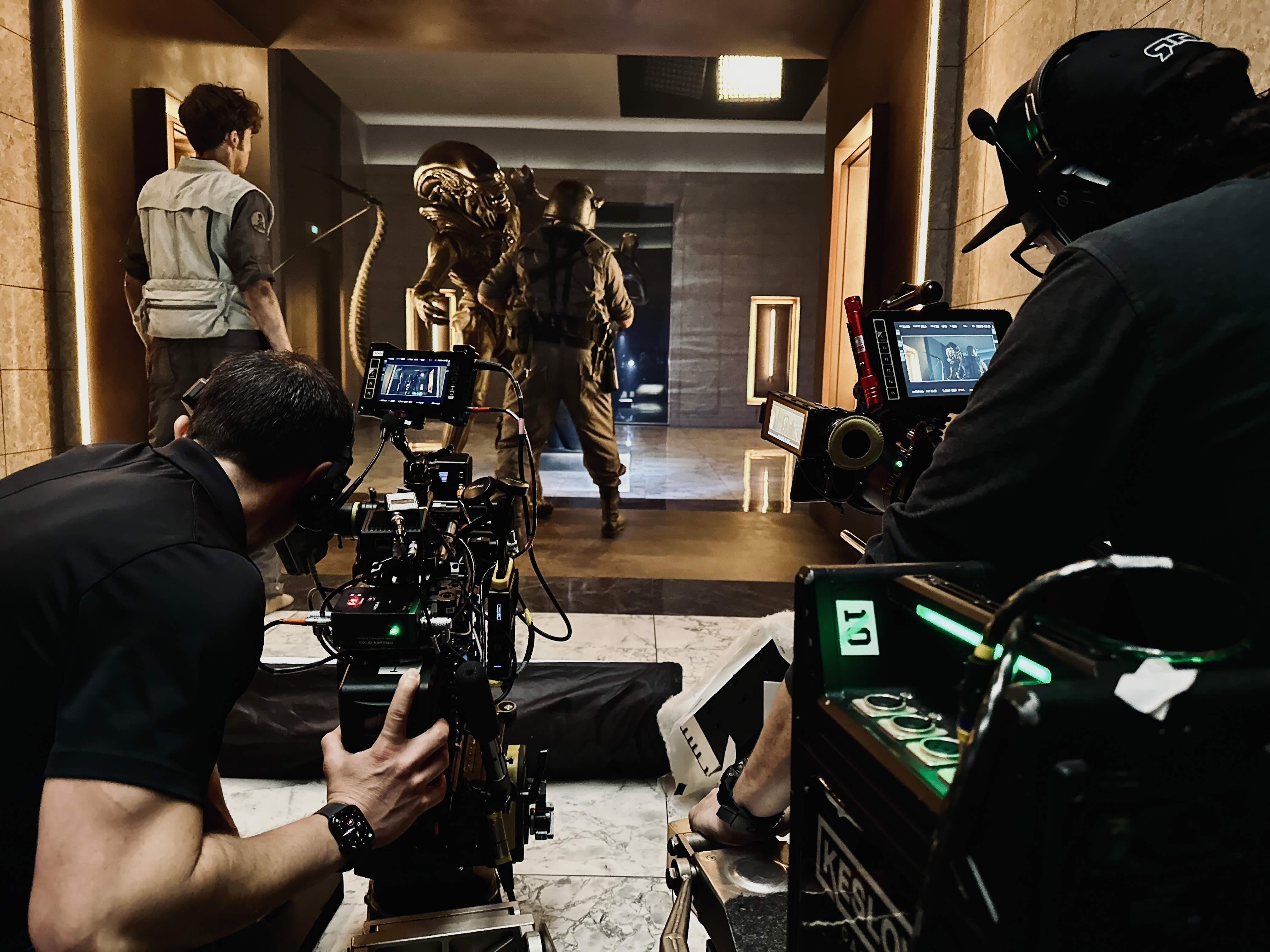
A behind the scenes moment before carnage unfolds on the set of Alien: Earth episode 102. Photo courtesy of Dana Gonzales, ASC.
So you have to introduce some original fear back into it. And again, make sure that the old audience doesn't say, "Well, we've seen that before." And they do. I think we've done it successfully. I don't know if you've read any of the reviews; the reviews are crazy good. I read two bad reviews on Rotten Tomatoes, and the rest of them were great. And the bad reviews were literally the super fans that didn't get what they wanted out of it or whatever it might be.
That's the challenge with any big franchise: there's going to be fans that come in with a lot of baggage. And these days, especially, even if you're subverting expectations deliberately, there's people that just don't like that. They want something that's going to check the boxes for them. But challenging art is always the most engaging.
Even coming down to the look of it, all the films have looked different, right? Aliens looked different than Alien; it just did. Different cameramen, different DPs; they just looked different. The worlds they were in were different.
Then you have Alien 3, which is set in a remote prison planet. And then you have Resurrection, and all the other ones, Prometheus and Covenant that are ships and planets and stuff. So which one do you attach yourself to? Most people come into some of these things, and they want to make it original. I get it; they want to forget about what anybody else has done and make it their own. And I get that. But I think ultimately when we're remaking something, whatever it is, there was an original reason that it worked, right? It's not one thing normally.
To me, any remake maybe had strong actors, it obviously had a strong story, and there was even the tonality of it, right? Maybe it's subtle, and maybe the visuals are not the strongest thing that you think about, but it’s important. Blade Runner is a good example. Blade Runner is an iconic visual story, movie, and ahead of its time. So when they made the second one, obviously the visuals had to be strong, right? They had to be super strong, and they won an Academy Award. But not all remakes, or reboots have that.
It wasn't like they made Alien, and they didn't make anything else in the franchise for the next 30 years. They literally did make more things with different feelings and different looks. So we went back to Alien. There are elements from Alien 3 and from Alien: Resurrection. But that's pretty much where I stopped. There are definitely little Easter eggs and things like that in there. But the ship in Earth, the look of the USCSS Maginot, which is a direct copy of the USCSS Nostromo from the original movie, and just the retro-futuristic, cyberpunk feel, the retro-ness of the original, is all iconic.
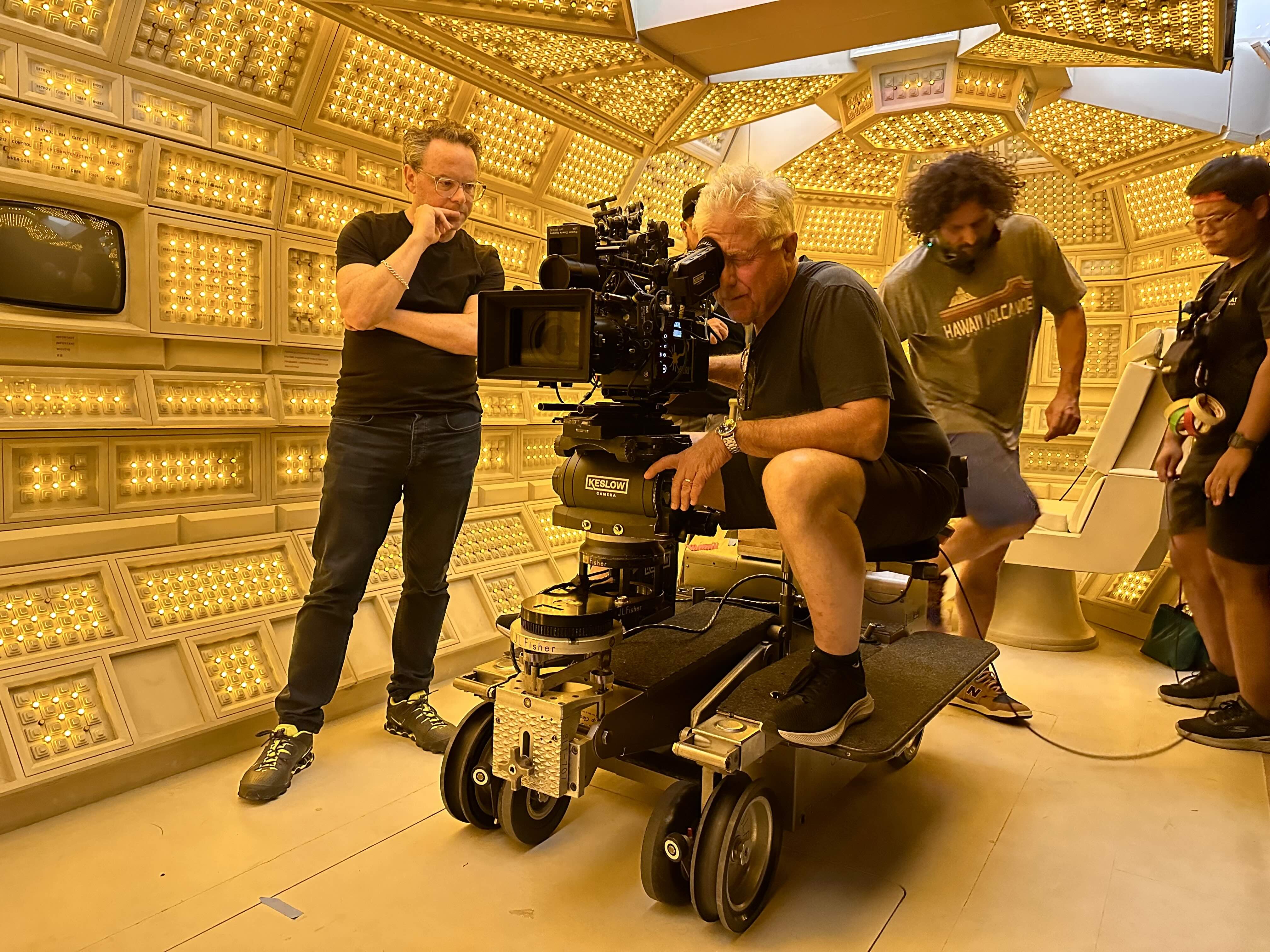
Creator Noah Hawley (Left) and crew on the set of the MOTHER control room for Alien: Earth episode 101. Photo courtesy of Dana Gonzales, ASC.
I think some of the original production design came about because they didn't have certain resources. Some of that, if you were to see how they built the sets, we used some of the same type of materials. They're crates that held some sort of soft drinks or whatever it was there. I think there was some economy to it. And then Ridley probably just said, "Look, let's just go for it and show it and not try to hide it." And that made it classic. And then we have this new Neverland, which is not a Weyland-Yutani architecture or design. But you're still in Alien, you're still in that world.
So it was finding that world, but the look of it to me very much started with Alien and that filmic look. Even today, if I was to shoot on film, I couldn't have really shot it the way they did it, because they shot on 100 ASA film. I'm not sure even how they did that with all the console lights and stuff in the ship. That stuff's complicated at 100 ASA.
And it doesn't look like it. When you look at the film, it doesn't look like 100 ASA, particularly. There must have been a shitload of light. The blacks are really crisp. To me, the thing that comes with film from that era is that most film, not all film, but most film is 3200-Kelvin based, so it's tungsten-based film. And especially for the interior, you're not going to add a color filter or anything.
You're going to shoot at 3200K and do it with the lights or whatever. So for me, that was my playbook where that was the baseline. That's how I shot as close to the movie as I could with digital cameras. So being disciplined creatively is important. My work is always very disciplined.
I put these disciplines on myself like I'm only going to do this, I'm not going to do this, I'm only going to use this equipment or whatever. I'm very disciplined about everything I do. The discipline is about maintaining a look. It's not about my personal aesthetic or "I need discipline in my life" or anything like that. And I approach every project that way.
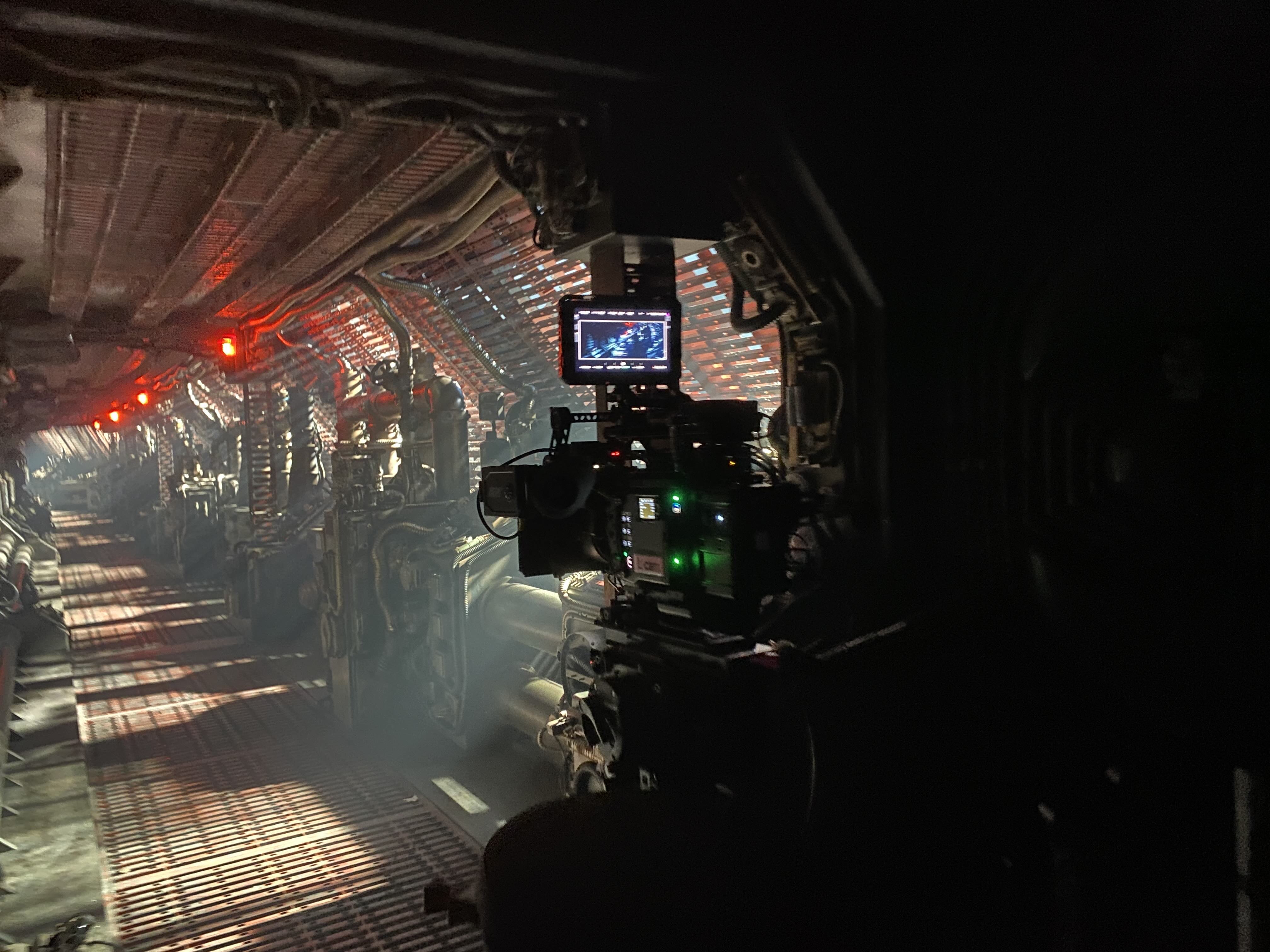
A hallway on the USCSS Maginot set for Alien: Earth season one. Photo courtesy of 2nd Unit DP Rapatchanun Cochaputsup.
I assume some of the people I work with at Keslow Camera on the floor, Freddy Saladin (Senior Lens Tech, Keslow Camera) or anybody like that that works with me on builds, knows I'm always coming in there and saying, "I had these ideas about this or whatever." And then I ask, "Do you have any lenses or do you have any tools that this may work with?" And Chad Martin (Camera Service Manager) will bring stuff out.
And something that no one's talked about in a long time, the cool thing is when Keslow acquired Clairmont, I grew up at Clairmont, so I knew all that stuff that Clairmont had. I knew a lot of it that just disappeared, especially when digital came. I think a lot of that stuff, the squishy lens and those things… I mean, if the one thing Keslow acquired from Clairmont, was the Image Shaker, I would have been happy. I used the shaker on Alien. I've used that thing on so many of my projects just because it's just right. It's one of those things that's organically just right.
Have you been able to play around with the upgraded version of the Image Shaker that we have in the pipeline right now? We’re innovating a bit on the classic tech to allow for more granularity of control.
That’s very exciting. With a tool like that, I think it's about finding the right tone of it. You have to do it by feel. It's like you're playing an instrument, and I think replicating it isn't so numerical. I don't think you're just moving the style this way or whatever. And I think it's daunting. It's amazing how many people I work with that have never worked with it or never seen it, or even heard of it. And it's been around now for 40 years or something. It's been around a long time, and it still works great.
I think the thing that is cool about it, is that it's a very organic effect. So, again, for me, tapping into even that tech, 30-year-old, 40-year-old tech, for doing a show like Alien makes perfect sense. I find I gravitate towards the older things versus always going after the new tech. Now, if I was to do something like some of the projects Claudio Miranda, ASC, ACC, has done, some of those futuristic projects that he's done, especially with him and Joseph Kosinski, their style tends to be this very clean style. Then I would lean into the newer stuff more, but I tend not to start there.
Even with lensing, when I go there and test lenses, my benchmark is an ARRI Master Prime. If I test a lens, that'll be my benchmark because I know it's perfection in color and everything. And then I'll do all these tests of older lenses. I've shot several features with those lenses on digital cameras and film cameras, so I know what those look like. And then even if I know I'm not going to use that lens for most of the time, I'm able to have a benchmark for the other five I test. And I test vintage lenses and things. The original Alien was shot with C series Panavision lenses, anamorphics. So I wanted to find something that worked.
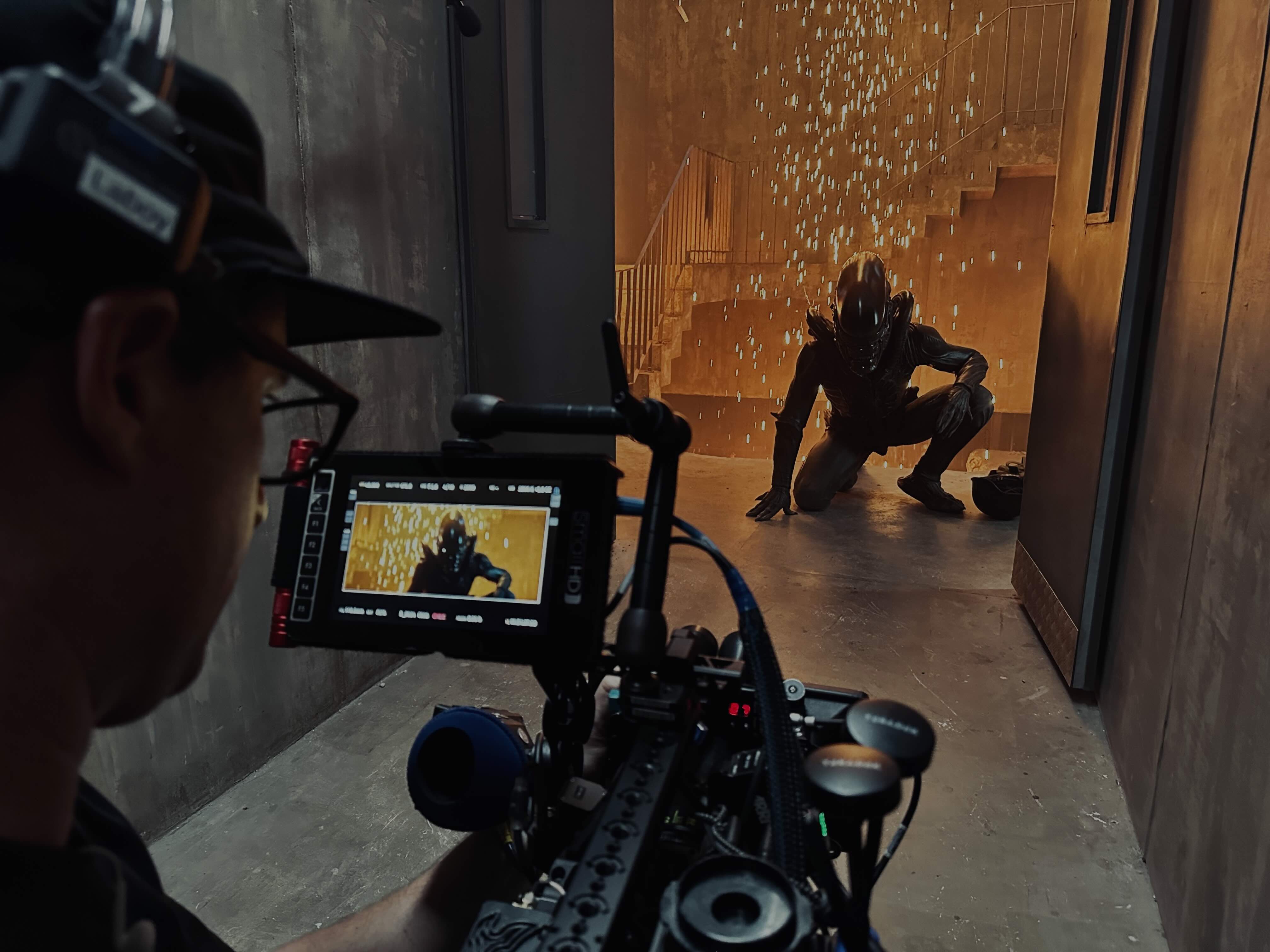
A Xenomorph ready to leap into action on the set of Alien: Earth episode 102. Photo courtesy of Dana Gonzales, ASC.
I love that look and I wanted to find something that looked like it and had that quality to it. So then you're starting to look at vintage anamorphic lenses. Obviously, Keslow has many different types, but then you start putting sets together. I ended up using Hawks, from a few different series. I used V-Lites and Hawk V-Series. I probably had 25 lenses on Alien: Earth.
I also had the V-Plus zooms, which were incredible. Some of those zooms are the best anamorphic zooms out there as far as I'm concerned, of any lens. And then there was a 50mm Hawk V-Series anamorphic; it's a bigger one, so it doesn't work as well on a Ronin or something. But I just loved this 50mm for the close-ups. There were also the V-Plus Anamorphic primes, the 120mm macro, and the 65mm macro. We used a lot of Ronin work, so the V-Lites definitely helped with that. But you start shooting, and you start seeing the character of these lenses and you start gravitating towards things. This 50mm, I was just really addicted to it. I got to a point where by the end of the last block of the show, everything was on that lens.
In terms of those optical qualities, because obviously you're comparing to the Panavision C series from the original, was there anything in terms of the character from the original that you were looking at and trying to replicate in your lens choices?
Sharpness is not something I don't like, but there's just something about a film from the ‘70s or ‘80s that feels almost like there's a bit of resolution loss. It still looks incredible, even on a big screen, but it doesn't have that digital sharpness. I always use diffusion, so I do knock that down. But then there's this thing in digital versus film that is always just hard to replicate.
And because I like atmosphere, and I don't mean just smoke and haze. I do use that quite a bit, but that's not even enough for me. Diffusion and atmosphere are not enough. I've even toyed around with putting some kind of plastic in front of the lens to take it down. But I would never be able to find the right vibe because what I'm thinking about is, even though film is high resolution, the way it's printed and the way it's processed and telecined, there's a photochemical thing that's happening that gives it that character.
I think when you talk about lenses of the ‘70s era, some of them were struggling with resolution. Film stocks were getting sharper, but not always as sharp as they are now. And then you have lenses that were meant to resolve, maybe they were highly resolving in 1970, but by the 90s they were suffering a little bit. Then you have the modern lenses that went towards resolution and contrast, and they MTFed them with a certain type of contrast. Because film and the processing, when those lenses got sharper, it wasn't like they lost that quality.
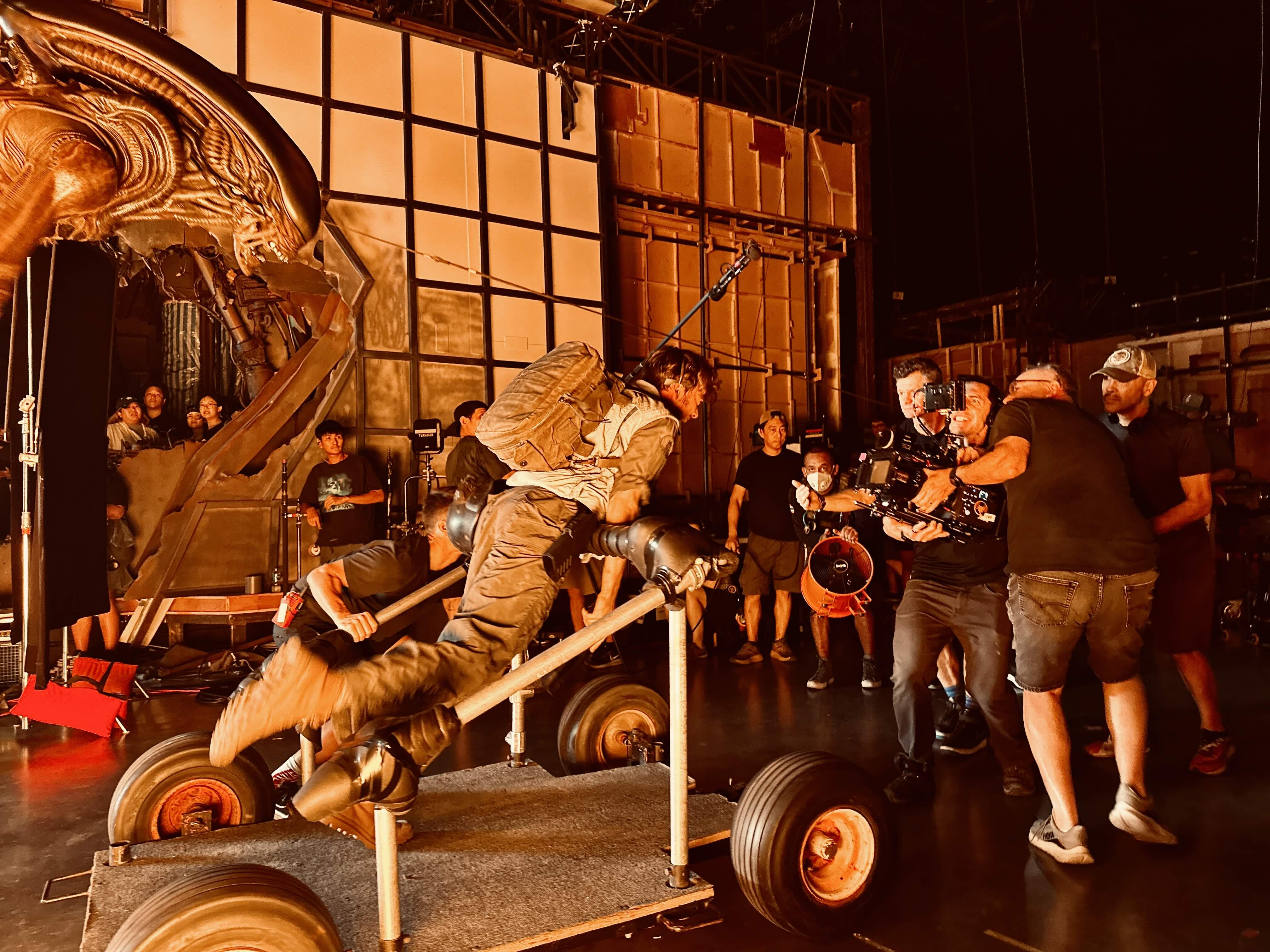
A behind the scenes moment on the set of Alien: Earth episode 102. Photo courtesy of Dana Gonzales, ASC.
And then digital comes on and is obviously just a sharper medium. So finding a lens that has that, because even if I found this lens that had this optical inferiority or whatever I want to call it, it may not have the complete set I need. It may not have an additional zoom; I needed zooms. I knew we were doing some zooms.
So then you have to break it down to which sets of lenses have a zoom, or what zooms will color-wise match the primes, and what do they have? Are there macro lenses? What are their long lenses? Are the sets complete? It's a large number of questions that focus me. I'm rarely in a place where I'm like, "Oh, I don't know, should I go with this set or this set?"
I'm rarely in that place with anything I do. For another project, I don't need zooms. I know I can shoot with five lenses, maybe that's all I need. Versus this one, where I knew I needed all these different layers. So even if I went to Panavision and got the C series, the minute I put zooms into the mix… I know they've gotten better, but my experience is that some of the Panavision zooms do not match as well.
We even had this Cooke Cinetal Zoom, which was anamorphic-ized. So that's a rear anamorphic. That lens is, for a 10-to-1, unbelievably great. To me, it just had that thing. It was still sharp. Sometimes there are lenses used on certain shows that are radical, and you see it. You may get used to it, but you're like, "Oh, you can see the fall-off of the focus or whatever it is."
I feel like none of that's in the show, but yet, it does have a patina. It's as close as I can get to that patina that I'm talking about. And again, it's diffusion, the lenses, but then you have to know mechanically you're going to be able to do everything, especially now with remote focuses, Ronins, drone work, whatever. It has to be able to withstand being in Thailand. You can't just have this lens that's going to break. You guys have those types of lenses. I mean, Lomos are beautiful; you get the right set of Lomos, they're incredible, but they're mechanically terrible. They're like glued together. Any of the lens techs will tell you they're just unbearable. So then all of a sudden, you need to go with nine sets of lenses so you can get through a season of television.
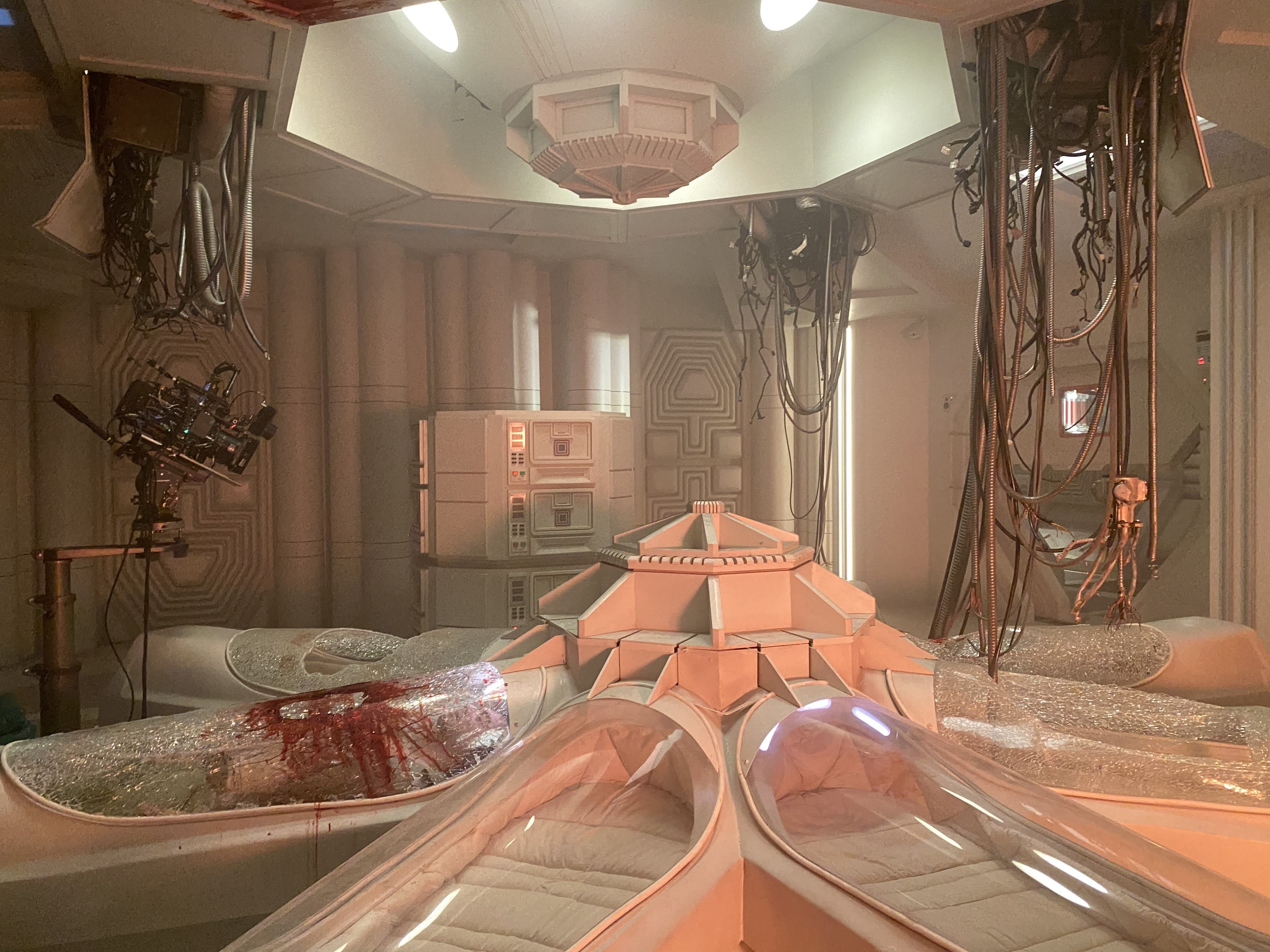
The destroyed cryo-chamber of the USCSS Maginot, on the set of Alien: Earth season one. Photo courtesy of 2nd Unit DP Rapatchanun Cochaputsup.
So it’s about splitting the difference between the quality and the character and also the reliability and function.
Yes, but really, to put the Keslow component into that, again, if you talk to Brett Reed (Senior Lens Tech, Keslow Camera), Chad, or Freddy, or any of these guys about it, because they're always there with me, scratching our heads. I come in with these parameters, right? And I'm throwing them out there, and it really is whittling down options. So sometimes the floor will have 10 sets of lenses or whatever. And then again, with Freddy, I'll say something and he'll be like, "Well, I have this thing."
Or sometimes I'll be like, "I know there's something back there that I don't know about." Especially when the Clairmont stuff came through and there was still stuff in boxes that hadn't even been cataloged. When I did Legion, for instance, I was just like, "I don't know, man. I'm just looking for something I haven't found yet.” And then he brings me this lens, this 15mm.
And we put it up and we start looking at it and I'm like, "Oh my god, this thing's incredible." And it was a very specific thing. It didn't define the show, but it was something I used for certain moments that to me really stand out. And I got to say that beyond just even the equipment stuff, I've known these guys, I've known Freddy and Brett and Chad for 30-plus years, a long time. They worked at Clairmont and I've known them forever. So it's like I have them, I have everything that was at Clairmont, and I know I'm going to be able to find this look.
I feel like other rental houses, some of them, I don't think they're going to be able to do that exactly for me. I mean, because some of them just aren't going to have that depth of varied equipment. They're not going to have some of that lived experience. I guarantee you that.
We're grateful to have played a part, no question about that.
Yeah. It's so important to me. The thing that makes me the happiest is as new people come into my camp and they experience Keslow, they're sold. Again, this is not a slight on any other rental house. It's just they see how Keslow works with me, how they work, how Keslow support them, what they have, how they're willing to bend backwards.
But I also see they see how important it is, how they rise to the occasion of the projects we're doing, whatever that means. And then they're sold. They're there for life. So that's the proof of it.

Dana Gonzales, ASC, on the set of Fargo (Image Credit: Michelle Faye/FX)
I think all those notable DPs that work with Keslow all know the secret. When I'm at these awards shows with Robert and Dennis, and then there's a younger cameraperson or DP that comes up and talks to me, I always introduce them like, "Do you know Robert? Do you know Dennis?"
And I look at these guys and I'm like, "You need to go over there and you need to talk to them." I'm telling you, because they're literally wanting my advice like, "How do you do it? Why does it work for you?" And it's like, “This is why it works for me. This is a big reason why it works for me.”
I see a lot of younger filmmakers who just don't understand even going to a rental house, period. They'll go online, and they'll want to rent from someone they’ve never met. It kind of reflects this digital culture that we have nowadays, where it's borderline antisocial. But I think that it's to everyone's benefit to go out and build these relationships. And that's really where you're going to get your foot up.
When they become successful, if they do, that's when they're going to need the relationships. They're not going to need them so much, maybe, or they could when they're starting out. They absolutely should, but my daughter's a good example. My daughter Bella, when she was going to AFI and she needed cameras to do their projects, Keslow helped her.
And I told her, I said, "Look, the way you pay them back"—because she was always worried about how much she rented—I said, "The way you pay them back is as you make it, you use them. And even if it's a job that pays $1,000, you give them that $1,000 because they're investing in you. And then when you're mainstream, you stay with them and you bring them the big jobs and you're creating a personal relationship. They know you, they know how to service you, and you're repaying them and you're one of them and you're with them." And she's got that.

(L-R) DP Bella Gonzales and Dana Gonzales, ASC, on set of the MOTHER control room for Alien: Earth episode 101. Photo courtesy of Dana Gonzales, ASC.
She's been solid in paying it back to Keslow. She just did Ted Lasso with you guys. She did two movies right before with Keslow. She's literally done that all day long. I know on Instagram some people are like, "Here's these fancy lenses, or here's this cool Panavision lens," and they fantasize about that, but the reality is the business is so much bigger than that.
It’s about how you will make deals, how you will be serviced. Because then you get into even a mid-range career, and you're literally struggling to make these deals. Isn't it incredible if you could literally have the same type of service on your big show as you have on the medium show as your smaller show? If I do a $500,000 movie, yeah, I'm not going to have the same sh*t I had on Alien, but I'm going to be serviced. I know that.
Not just me, and yes, I have a relationship with Keslow, but I have a proven relationship with you all on all these different projects, and I've been there with Dennis making deals on every show, whatever that is. That's the thing that these new DPs need to understand. And I do see some young people come in there and figure that out. It will only help them. Because they hope they get in that situation where they're in constant dealing mode and trying to make these deals work and trying to get the equipment they need.
You’ve got to start somewhere, and you have to build a foundation to even get to that level.
Yeah. Even to have someone like Robert walk the floor and go talk to you and shake his hand. Such a big thing. I guess you could wait until you get to that moment where you're a Hoyte van Hoytema, ASC, or something. I don't know, but there's a long way before you get there. I know Robert goes out on the floor and talks to whoever it is and introduces himself. And that's the relationship.
It's very important to me that the world knows that Keslow Camera serviced Alien: Earth, in Thailand, of all places. If anything, this discussion was about the relationship. Because this is where this world's going. Colin Watkinson, ASC, BSC, did it on this next show, The Twisted Tale of Amanda Knox, because of what we did. That's how it works because then he's like, "Well, they're going to do it, I'm going to bring them to Budapest." There are plenty of rental houses in Budapest, but he was able to do it.
So to me, that's the thing, man. Because I care ultimately about the company, and I want people to know that it is crucial to the success of what I do and crucial to the way Alien: Earth looks. Fargo, Legion - crucial to the way those shows look.
I can't even put it into words. When people are always asking me the secret, they don't always want to do the secret. I'll tell them, "Okay, here's the secret, but it means this, this, and this." It means having a relationship with maybe one rental house for 30 years. So if you can do that, then maybe you can do what I do. [x]
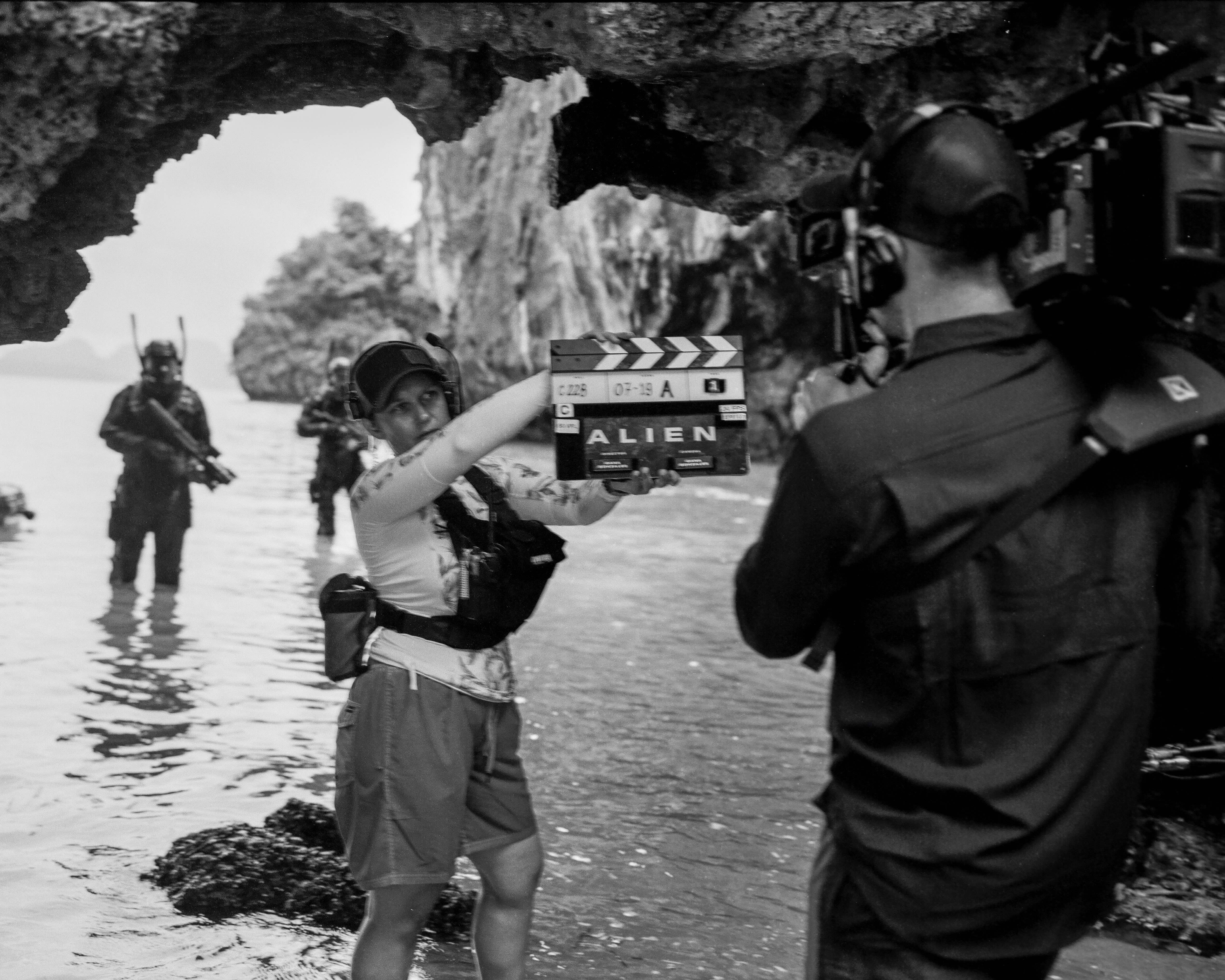
The crew readies for a take on location for Alien: Earth season one. Photo courtesy of Dana Gonzales, ASC.